

KuCoin Ventures Weekly Report: Crypto Security Faces New Tests, High Rates and Capital Outflows Weigh on Markets
1. Weekly Market Highlights
Ledger Supply Chain Incident and Growing AI and Quantum Concerns Raise the Bar for Crypto Security Infrastructure
Last week, losses suffered by Ledger users, the AI-assisted discovery of a longstanding XRP Ledger vulnerability, and discussions around Starknet’s shift toward quantum resistance brought crypto security back into the spotlight. These developments span hardware, code, and cryptography, but point to a common challenge: security must keep pace with evolving attack tools, and even defenses that have worked in the past need to be continually tested.
The Ledger incident exposed risks in the hardware wallet supply chain. On October 9, multiple Ledger users reported that assets had been transferred out of their wallets without their authorization, with losses totaling approximately $93.2 million. Reports were concentrated among users who had purchased devices through Southeast Asian reseller CryptoBilis, raising concerns about tampering during distribution. Ledger subsequently launched an investigation and confirmed an unauthorized hardware implant in one affected device. CryptoBilis has suspended all hardware wallet sales, while the full scope of the incident remains under investigation. The discovery shifted attention to the supply chain: had devices been tampered with before reaching their users?
The incident brings the trustworthiness of the device itself into sharper focus. Hardware wallets can isolate private keys from everyday internet-connected environments, but users still depend on the integrity of the entire chain—from manufacturing and shipping to distribution and initialization. If a device is compromised before delivery, using it offline afterward cannot undo that compromise. For wallet manufacturers and institutional buyers, tamper resistance, distribution controls, and delivery traceability are all part of asset security.
AI, meanwhile, is changing how efficiently vulnerabilities can be discovered. On October 9, XRP Ledger, the blockchain associated with Ripple, disclosed a payment-engine vulnerability that had remained undetected for roughly a decade, identified with assistance from Veria Labs’ AI tools. A specially crafted transaction could trigger an integer overflow, theoretically creating approximately 18.45 trillion spendable XRP in a single instance. An emergency fix was deployed on September 25, and the team reported no evidence of exploitation on public networks.
Quantum computing is extending the security debate to the underlying cryptography. On October 7, Europol published a report identifying wallet keys as a primary point of exposure and recommending early planning for migration to post-quantum cryptography. The arrival of sufficiently capable attacks remains uncertain, but upgrading systems and coordinating networks will itself require years of preparation. That same week, Justin Drake’s “bunker mode” discussion emphasized reducing public-key exposure and preparing defenses in advance, while cautioning against rushed migrations. AI-assisted vulnerability discovery already has concrete examples; the potential for AI to accelerate mathematical breakthroughs is now another variable drawing researchers’ attention.
Starknet has also brought quantum resistance into the competition among blockchain networks. On October 8, the project said it was considering becoming an independent Layer 1, with a goal of achieving full quantum resistance by 2027. Yet for a heavily funded flagship project that once carried high expectations for ZK scaling, adoption remains well behind leading Layer 2 networks. As of October 12, Starknet recorded approximately 4,100 active addresses over 24 hours, compared with around 300,000 on Base and 110,000 on Arbitrum—a gap of tens of times. Its financial backing and technical reputation have yet to translate into comparable usage. Against this backdrop, quantum resistance also offers a potential path to renewed growth: as differentiation in scaling becomes harder, security could provide a new basis for competition. Whether Starknet can turn its cryptographic advantages into a reason for users to keep returning remains an open question.
Last week’s developments stretched from hardware wallet supply chains to software vulnerabilities and foundational cryptography, bringing greater attention and scrutiny to security across the industry. As attack tools evolve, the speed at which projects discover vulnerabilities, deploy fixes, and upgrade protocols will become part of their competitive strength. Quantum resistance has gained traction as a market narrative. The next test is who can turn it into practical security capabilities with real commercial adoption.
2. Weekly Selected Market Signals
Fed Signals a Pause, Easing Near-Term Rate-Hike Expectations, While Elevated Long-Term Yields and Middle East Risks Continue to Weigh on Risk Appetite; Crypto ETF Outflows Accelerate
Fed policy expectations shifted further last week toward “a near-term pause while keeping room for additional tightening later this year.” Minutes from the September FOMC meeting showed clear internal disagreement over the pace of further tightening after the Fed raised rates to 3.75%–4.00%. Waller subsequently said that inflation may still require additional policy tightening, but rate hikes do not need to occur consecutively, providing clearer room for the Fed to pause in October.
The CME FedWatch Tool showed that markets were pricing in only around a 17% probability of another 25-basis-point hike in October, while the probability of at least one more hike by year-end remained at approximately 86%. In other words, the market focus has shifted from “whether the Fed will hike consecutively” to “how long the next hike will be delayed.” The current path increasingly points to the Fed using October to assess incoming data while preserving room to act again in December.
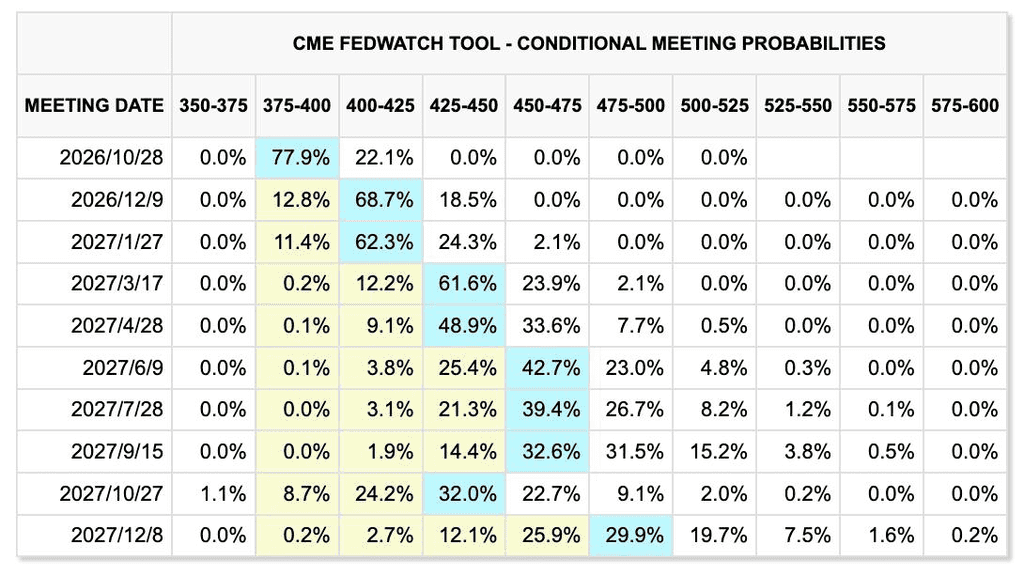
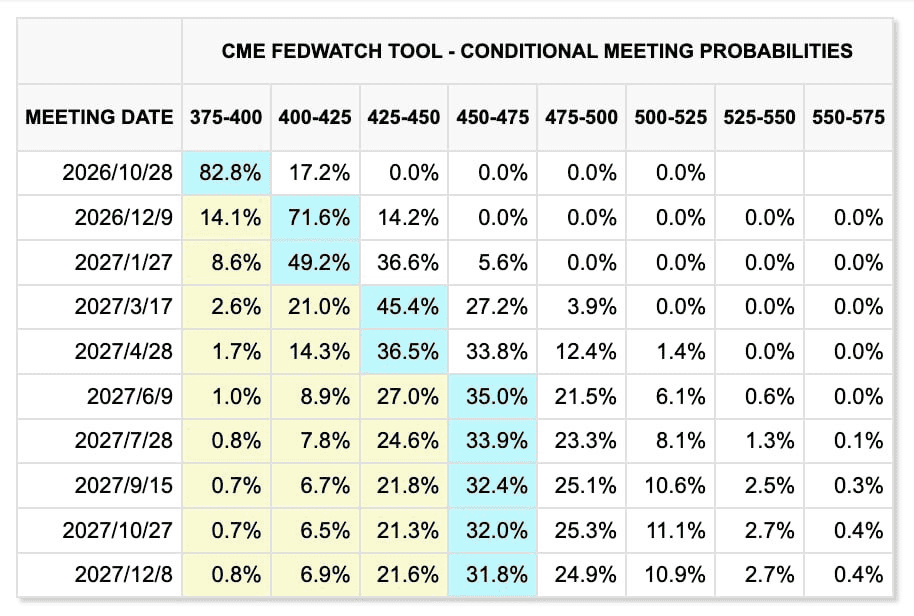
Changes in market pricing over the past two weeks (previous week shown first, current week second)
Source: CME FedWatchTool
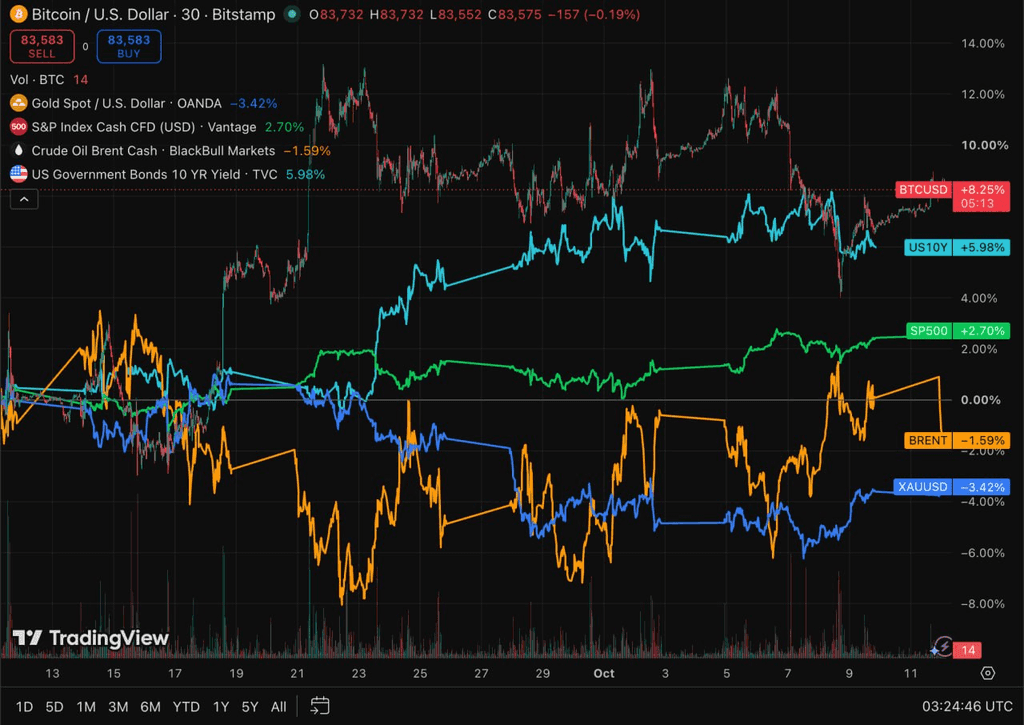
Easing expectations for short-term policy tightening have not materially reduced long-term financing pressure. The U.S. 10-year Treasury yield rose to around a 24-year high during the week before retreating to approximately 5.26%, still an historically elevated level. High government debt, corporate financing demand, and sustained capital expenditure associated with AI data-center expansion are jointly pushing up long-term funding costs. Even if the Fed pauses rate hikes, this does not necessarily mean that financial conditions have meaningfully loosened.
U.S. equities remained relatively resilient despite the high-rate environment. The S&P 500 and Nasdaq both gained approximately 0.6% over the week and reached new highs early in the period, although volatility within the technology sector increased materially. On Thursday, concerns over AI profitability intensified, sending semiconductor stocks down roughly 4% in a single session, with Nvidia, Intel, Oracle, and others coming under pressure. One catalyst was renewed scrutiny of OpenAI’s revenue outlook, debt financing, and returns on AI infrastructure investment. This reflects a broader shift in the AI trade from asking whether demand exists toward assessing whether revenue and cash flow can ultimately justify massive capital investment.
Middle East risks escalated sharply over the weekend. Riyadh International Airport was attacked repeatedly within a single week. The October 10 attack killed at least 12 people and injured more than 300, making it one of the most severe such attacks in Saudi Arabia in more than a decade. Trump also said the U.S. could participate in Saudi military action against the Houthis, raising the risk that the Yemen conflict could spill further into Saudi territory and regional aviation security.
Brent crude rose approximately 2.4% last week to $104.7 per barrel, while WTI gained around 0.8% to $91.9. Progress in U.S.-Iran talks and increased Russian diesel supply temporarily eased the geopolitical risk premium during the week, but the attack on Riyadh airport renewed concerns over supply and transportation disruptions. Oil prices are therefore likely to remain volatile in the near term and continue to influence inflation expectations and Fed policy pricing.
Gold, meanwhile, ended a two-week losing streak, with spot prices gaining approximately 1.3% over the week to $4,194 per ounce. Gold fell to a two-month low midweek as the dollar and Treasury yields rose, before rebounding as long-term yields eased and dip-buying returned. Fiscal and geopolitical risks continue to support gold, but Treasury yields around 5% remain a meaningful constraint on further upside.
Source: TradingView
Crypto Assets and ETFs: BTC and ETH ETFs See Simultaneous Heavy Outflows as Institutional Flows Shift from Rotation to Broader Risk Reduction
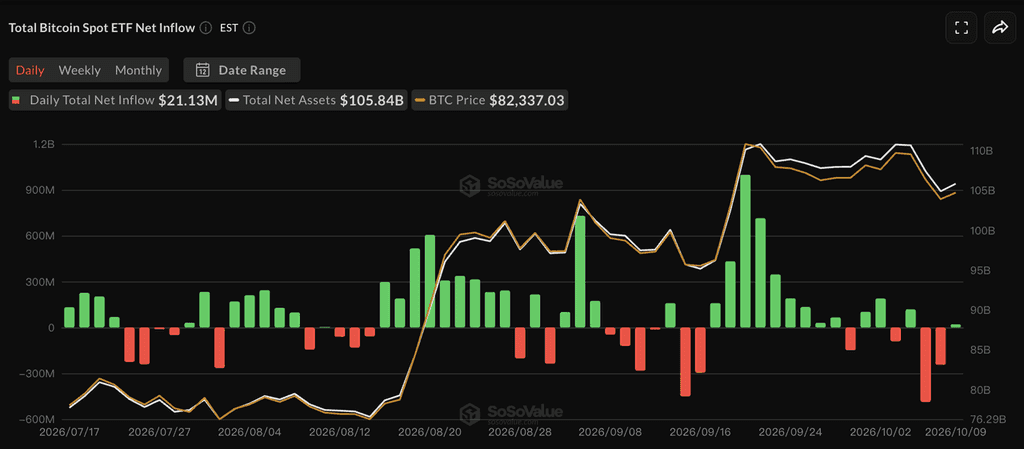
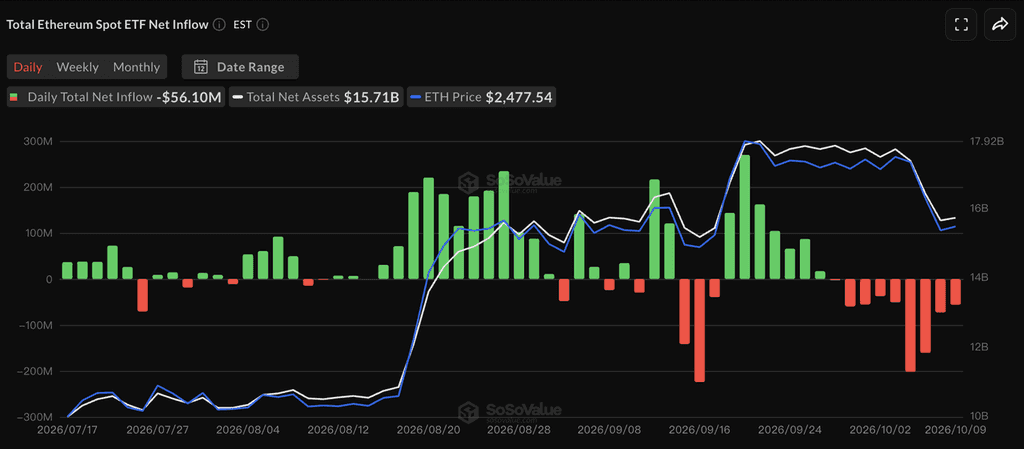
The crypto market significantly underperformed U.S. equities last week. BTC declined from around $86,000 at the beginning of the week to approximately $82,000–$83,000, while ETH fell from around $2,700 to roughly $2,500, posting a noticeably larger decline than BTC. Elevated long-term Treasury yields, a relatively strong U.S. dollar, and recurring Middle East geopolitical risks jointly weighed on valuations across high-volatility assets.
Source: SoSoValue
According to SoSoValue, U.S. spot BTC ETFs recorded approximately $681.1 million in net outflows between October 5 and October 9, ending a three-week streak of net inflows. On October 7 alone, outflows reached approximately $487 million. Fidelity’s FBTC and ARKB were the main sources of redemptions.
ETH ETFs recorded approximately $542.1 million in net outflows over the same period, marking their worst weekly performance since January and extending the outflow streak to nine consecutive trading days. BlackRock’s ETHA accounted for roughly $477 million of weekly redemptions. Combined BTC and ETH ETF outflows exceeded $1.2 billion.
Unlike previous weeks, when capital was largely rotating between BTC and ETH, both major ETF categories experienced heavy redemptions simultaneously. This suggests that institutional positioning has shifted from asset-level reallocation toward broader risk reduction. BTC remains relatively elevated compared with earlier in the rebound, but unless ETF demand turns positive again, short-term upside may remain constrained.
Stablecoins: Total Market Capitalization Contracts Slightly Again as ETF Outflows Fail to Translate into Meaningful On-Chain Dollar Reaccumulation
Source: DeFiLlama
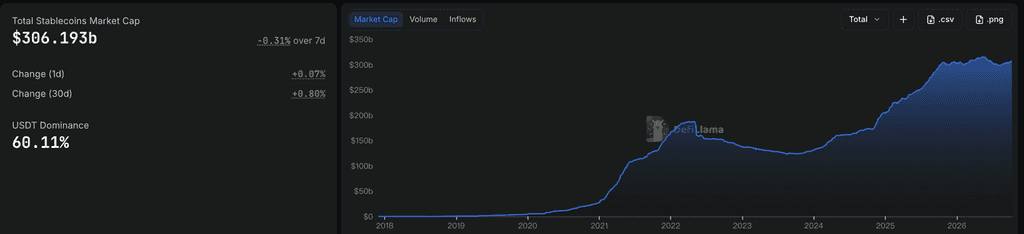
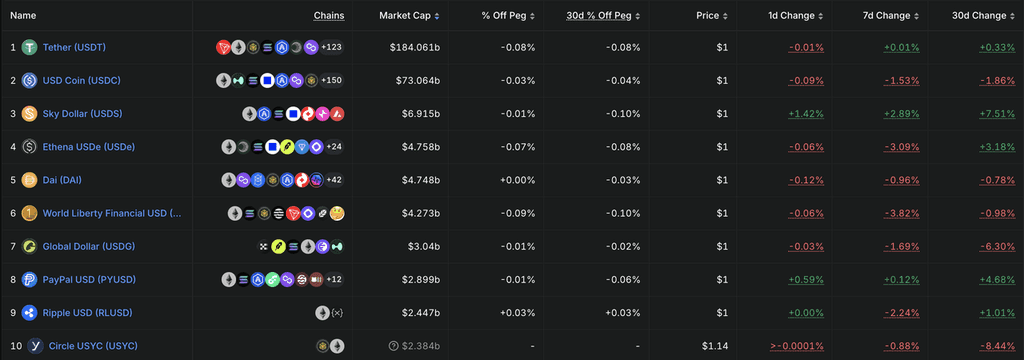
DeFiLlama data showed total stablecoin market capitalization at approximately $306.2 billion, down around 0.31% over the previous seven days, while still up roughly 0.8% over the previous 30 days. USDT’s market share stood at approximately 60.11%. The recent period of modest stablecoin supply expansion has therefore slowed again, broadly consistent with the significant ETF outflows seen during the week.
Among the top 10 stablecoins, USDT supply was broadly unchanged, while USDC declined approximately 1.5% over the week. USDe and USD1 fell by around 2.9% and 3.8%, respectively. USDS increased approximately 1.6%, while PYUSD rose modestly by around 1.1%. The overall changes continue to reflect rotation between individual products, but the simultaneous contraction of major USDC supply and several ecosystem-linked stablecoins suggests that incremental on-chain dollar demand remains relatively weak.
Combined with simultaneous outflows from BTC and ETH ETFs, overall funding conditions weakened noticeably compared with previous weeks. Stablecoin supply has not experienced a large-scale withdrawal, but neither has it generated enough new liquidity to offset institutional redemptions.
Key Events to Watch This Week
Markets will focus on U.S. September CPI, subsequent Fed policy communication, developments in the Middle East, and ASML/TSMC earnings as a test of AI capital-expenditure momentum. With markets largely pricing out another consecutive rate hike in October, inflation data will be critical in determining whether expectations for a December hike remain elevated.
-
October 13: The IMF releases its World Economic Outlook and Global Financial Stability Report, with particular attention to energy shocks, high interest rates, and global debt risks.
-
October 14: The U.S. releases September CPI, a key input for October pause expectations and December rate-hike pricing. ASML also reports third-quarter earnings, providing another read on AI semiconductor equipment demand and advanced-process capital expenditure. China releases CPI, PPI, and trade data on the same day.
-
October 15: TSMC reports third-quarter earnings. Markets will focus on AI-chip demand, advanced packaging, and future capital-expenditure guidance as indicators of whether the AI infrastructure cycle can continue.
-
October 16: Warsh participates in a discussion with Georgieva during the IMF/World Bank Annual Meetings. Markets will focus on his views on inflation, long-term Treasury yields, and the timing of the next potential rate hike.
On the geopolitical front, following repeated attacks on Riyadh airport, whether the U.S. directly participates in military action against the Houthis—and whether U.S.-Iran negotiations can continue—will directly influence the oil risk premium. If energy prices rise sharply again, expectations for renewed tightening in December could strengthen even if the probability of an October hike remains low.
Primary Market Funding Review: Large AI and Tokenization Rounds Highlight Continued Capital Preference for Infrastructure with Commercial Validation
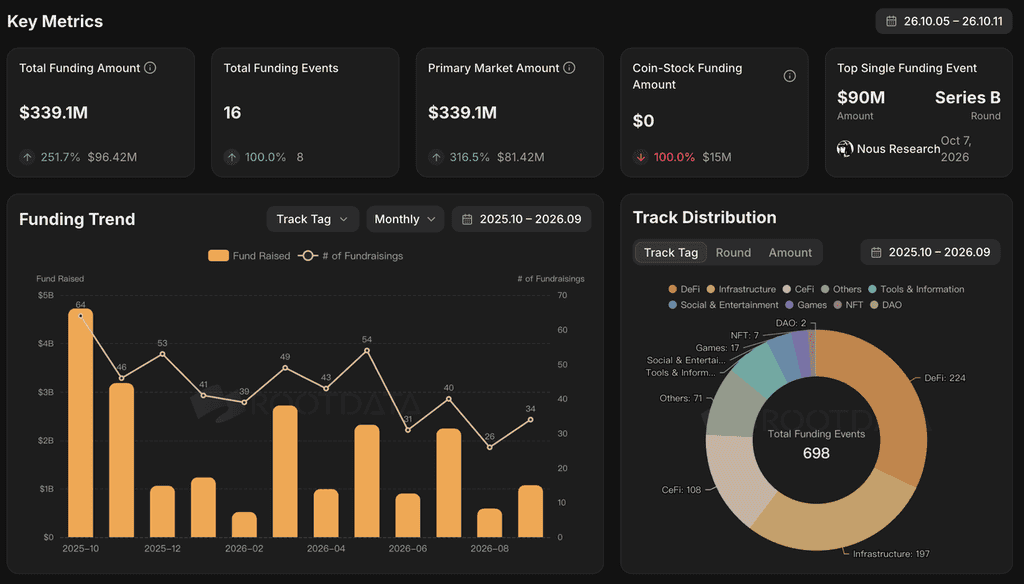
Source: RootData
According to RootData and other broad funding datasets, several large private-market transactions were announced last week, with Nous Research and Spiko each raising $90 million. Capital remained concentrated in AI infrastructure, tokenization, and regulated financial products, with relatively stronger investor willingness to pay for projects that already demonstrate users, revenue, or meaningful asset scale.
In AI, Nous Research raised a $90 million Series B at an approximately $1.5 billion valuation, led by Robot Ventures with participation from NVIDIA, Microsoft M12, Samsung, USV, and others. Its flagship product, Hermes, is an open-source AI Agent designed for both individuals and enterprises, with an emphasis on model customization, data sovereignty, and an open ecosystem. Compared with generalized AI+Crypto narratives, the more notable aspect of this round is that Nous Research has already demonstrated meaningful product adoption and commercial traction, while attracting participation from both traditional AI industry investors and Crypto VCs. This suggests that capital remains willing to pay a premium for open AI infrastructure with real users and revenue growth.
In tokenization, Spiko raised a $90 million Series B, led by NEA. The platform currently manages approximately $2.7 billion in assets. Its core products tokenize cash-management instruments such as money-market funds and short-term government bonds. The investment thesis has therefore moved beyond simple RWA issuance capabilities toward real AUM, institutional distribution, and management-fee revenue, suggesting that tokenization is entering a more scaled asset-management phase.
In addition, Meanwhile raised $37.5 million, continuing to expand BTC-denominated insurance and long-term wealth-management products. Overall, the week’s larger financings were not concentrated in new on-chain narratives. Instead, they further reflected investor preference for commercially validated AI infrastructure, tokenized cash/RWA asset-management platforms, and regulated Crypto financial products. General-purpose protocols without meaningful users, revenue, or clear distribution channels continue to face a more selective funding environment.
About KuCoin Ventures
KuCoin Ventures, is the leading investment arm of KuCoin Exchange, which is a leading global crypto platform built on trust, serving over 40 million users across 200+ countries and regions. Aiming to invest in the most disruptive crypto and blockchain projects of the Web 3.0 era, KuCoin Ventures supports crypto and Web 3.0 builders both financially and strategically with deep insights and global resources.
As a community-friendly and research-driven investor, KuCoin Ventures works closely with portfolio projects throughout the entire life cycle, with a focus on Web3.0 infrastructures, AI, Consumer App, DeFi and PayFi.
Disclaimer This general market information, possibly from third-party, commercial, or sponsored sources, is not legal, compliance, financial, or investment advice, an offer, solicitation, or guarantee. We make no express or implied representations or warranties regarding its accuracy, completeness, or reliability, and disclaim liability for any resulting losses. Investments/trading are risky; past performance doesn't guarantee future results. Users should research, judge prudently, and take full responsibility. Please consult professional legal, tax, or financial advisors if necessary.