

Is BMNR Stock Undervalued? Bitmine's Ethereum Holdings, NAV Premium, and AI Investment Strategy Explained
Is BMNR stock undervalued, or is the market already pricing in years of future Ethereum growth? Bitmine Immersion Technologies (NYSE: BMNR) has become a major publicly traded vehicle for investors seeking exposure to Ethereum (ETH), combining a large cryptocurrency treasury with staking operations and investments in emerging technology businesses. However, the value of its ETH holdings does not automatically determine the fair value of its common stock.
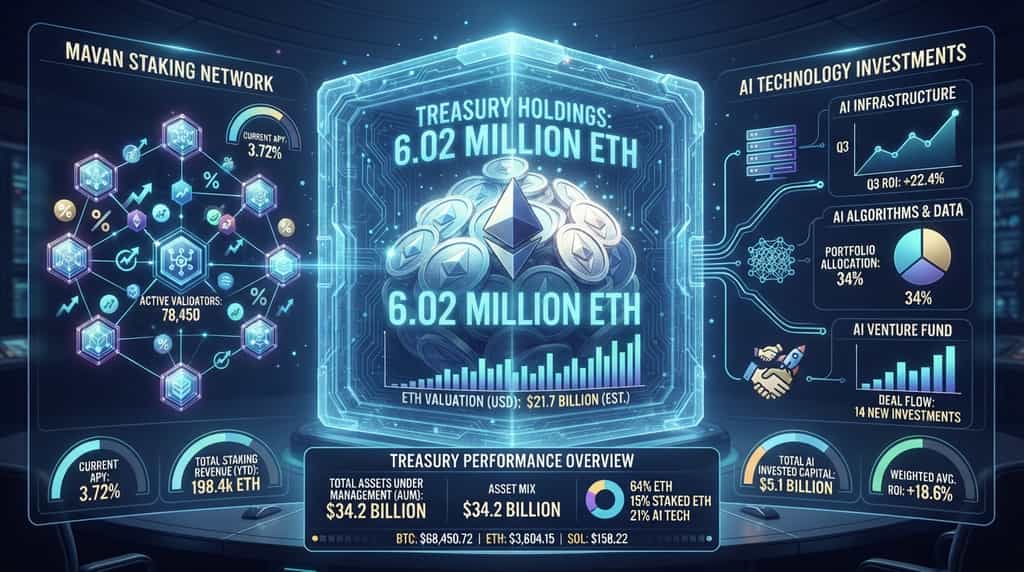
According to Bitmine's October 5, 2026, announcement filed with the U.S. Securities and Exchange Commission (SEC), the company held approximately 6.02 million ETH, representing 4.9% of Ethereum's total supply, alongside $643 million in cash and marketable securities and investments in other businesses. Its reported crypto, cash, and other investment holdings totaled approximately $17.4 billion.
To determine whether BMNR stock is undervalued, investors must compare its market capitalization with its net asset value (NAV), account for staking income and financing costs, evaluate dilution, and distinguish its Ethereum treasury from its emerging AI-related investment strategy.
Bitmine is a publicly traded digital asset treasury company whose primary investment thesis centers on accumulating Ethereum, earning staking rewards, and building services around the Ethereum ecosystem. Investors buying BMNR are purchasing equity in a company that holds and manages digital assets, not ETH itself.
The distinction matters because BMNR's share price reflects more than the value of its cryptocurrency reserves. Its valuation can incorporate expectations for future staking income, operating capabilities, capital allocation, and management's ability to create value for shareholders. It can also reflect a premium or discount to the underlying assets.
According to Bitmine's October 5, 2026, SEC-filed announcement, the company had accumulated 6,016,414 ETH as of October 4, alongside 214 BTC, $643 million in cash and marketable securities, a $180 million investment in Beast Industries, and a $117 million investment in Eightco Holdings (NASDAQ: ORBS). Bitmine reported total crypto, cash, and other investment holdings of approximately $17.4 billion. These are company-reported figures, not an independent assessment of fair value. Source: SEC-filed company announcement.
Bitmine's strategy also includes its Made in America VAlidator Network (MAVAN), which provides Ethereum staking and validation infrastructure. This creates a potential income stream alongside asset appreciation, although operating costs, staking risks, and capital requirements affect the economic benefit to shareholders.
Bitmine's approximately 6.02 million ETH treasury is the central driver of its investment case because it gives shareholders substantial indirect exposure to Ethereum's market price. The company reported that its holdings represented approximately 4.9% of the total ETH supply as of October 4, 2026.
According to the same announcement, Bitmine valued its ETH holdings at approximately $16.4 billion, based on an ETH price of $2,726. The company also reported 5,067,309 ETH staked, worth approximately $13.8 billion at that price. These figures illustrate both the scale of its treasury and the importance of staking to its operating strategy. Source: Bitmine's October 2026 announcement.
How Does Ethereum Price Affect BMNR Stock?
Ethereum price movements can materially change Bitmine's reported asset value. When ETH appreciates, the dollar value of its treasury rises, potentially improving NAV per share. When ETH declines, the reverse occurs, even if Bitmine continues to hold the same number of tokens.
For illustration, using the reported 6,016,414 ETH balance, a $500 increase in ETH's price would add approximately $3.01 billion to the gross market value of that ETH position, before considering changes in other assets, liabilities, shares outstanding, and market pricing. A $500 decline would have the opposite effect.
This sensitivity is not a forecast. It demonstrates why BMNR investors must assess both Ethereum's outlook and the premium or discount at which the stock trades relative to its underlying assets.
BMNR may also move differently from ETH over shorter periods. Equity investors respond to financing announcements, stock issuance, buybacks, management decisions, liquidity conditions, and expectations for future growth. Consequently, a positive outlook for Ethereum does not guarantee an equivalent return for BMNR shareholders.
Why Does Bitmine's 5% Ethereum Target Matter?
Bitmine's stated "Alchemy of 5%" initiative aims to accumulate 5% of Ethereum's total supply. Its October 2026 announcement put its holdings at approximately 4.9%, meaning it was approaching that target.
The strategy could strengthen Bitmine's position as a major institutional participant in Ethereum, support its staking operations, and potentially attract investors who want public-market exposure to ETH. However, the 5% target is a company objective, not a guarantee of superior shareholder returns.
Investors should also distinguish between accumulating ETH and creating value per share. If new shares are issued to fund additional purchases, the company's total assets can grow without a proportionate increase in each existing shareholder's economic interest. The relevant question is whether treasury growth, staking income, and other benefits outweigh the cost of the capital used to achieve them.
BMNR is undervalued only if its market price is below a reasonable estimate of its intrinsic equity value, after accounting for liabilities, financing costs, dilution, and the risk of its business strategy. Comparing the stock's market capitalization with its reported holdings is a useful starting point, but it does not establish fair value on its own.
Investors can use net asset value (NAV) to estimate what remains for common shareholders after subtracting liabilities from the fair value of the company's assets. For a digital asset treasury company, the analysis should also distinguish liquid cryptocurrency and cash from less liquid strategic investments and operating businesses.
How Do You Calculate BMNR's Net Asset Value?
A simplified NAV calculation starts with the market value of the company's holdings and subtracts liabilities:
NAV = Fair Value of Assets - Total Liabilities
For BMNR, the asset side includes ETH, BTC, cash and marketable securities, and other investments. A complete valuation should use consistent valuation dates and current market prices, rather than combining figures taken from different reporting periods. The following framework illustrates how investors can assess the company's asset base.
| Valuation component | What investors should examine |
| Ethereum treasury | ETH holdings multiplied by the prevailing ETH price |
| Bitcoin treasury | BTC holdings multiplied by the prevailing BTC price |
| Cash and marketable securities | Reported balances, liquidity, and any restrictions |
| Strategic investments | Realizable value of investments in businesses such as Beast Industries and Eightco |
| Liabilities and financing | Debt, preferred stock obligations, accrued expenses, and other claims |
| Common equity NAV | Fair value of assets minus liabilities and other senior claims, where applicable |
Bitmine's October 5 announcement reported $17.4 billion in combined crypto, cash, marketable securities, and other investment holdings. This headline figure should not automatically be treated as NAV because it is not, by itself, a complete common-equity balance-sheet calculation. Source: SEC-filed announcement.
A rigorous analysis should use the latest available SEC financial statements to verify liabilities, outstanding shares, preferred securities, and any material changes after the balance-sheet date.
What Is BMNR's NAV Premium or Discount?
The NAV premium measures how much investors pay above a company's underlying net asset value. A discount means the stock trades below that estimated value.
The standard calculation is:
NAV Premium or Discount = (Market Capitalization / Common Equity NAV) - 1
For example, if a company's common equity NAV were $15 billion and its market capitalization were $18 billion, its stock would trade at a 20% premium to NAV. If its market capitalization were $12 billion, it would trade at a 20% discount. These figures are hypothetical examples, not current BMNR valuation estimates.
A premium can be justified when investors expect the company to increase ETH per share, generate attractive staking income, operate valuable infrastructure, or benefit from strong capital-market access. A discount can reflect concerns about management execution, operating costs, dilution, asset volatility, or the possibility that the stock will not capture the full value of its treasury.
The critical question is whether any premium is supported by measurable economic benefits. A premium based primarily on optimism can contract even when ETH prices remain stable or increase.
Does a Large Ethereum Treasury Make BMNR Cheap?
No. A large treasury establishes the scale of the company's assets, but it does not establish that its stock is undervalued. Investors must compare the market value of common equity with the net economic value attributable to common shareholders.
Two companies holding similar quantities of ETH can trade at different valuations because of differences in share counts, financing structures, operating expenses, staking capabilities, and investor expectations. A company with a smaller treasury could even deliver stronger per-share returns if it acquires assets more efficiently or avoids excessive dilution.
BMNR's valuation therefore requires both an asset-based analysis and an assessment of the company's ability to increase value per share over time.
Bitmine's staking strategy is designed to turn part of its ETH treasury into an income-generating asset rather than relying exclusively on Ethereum price appreciation. Staking involves participating in Ethereum's proof-of-stake consensus mechanism, directly or through staking providers, to help validate transactions and secure the network in exchange for rewards.
According to Bitmine's October 5, 2026, announcement, the company had staked approximately 5.07 million ETH, or about 84% of its reported 6.02 million ETH treasury. Management cited a seven-day annualized staking yield of 2.63% and projected annualized staking revenue of approximately $363 million. At full scale, management projected potential annualized rewards of $431 million, subject to the assumptions stated in its announcement. These are company projections, not guaranteed returns. Source: Bitmine's SEC-filed announcement.
What Is MAVAN, and Why Is It Important?
MAVAN, or the Made in America VAlidator Network, is Bitmine's staking and validation platform. The company developed it to support its own Ethereum treasury and has expanded the platform to serve institutional investors, custodians, and ecosystem partners.
The platform could create value in two ways. First, it supports staking operations for Bitmine's own ETH holdings. Second, providing infrastructure to external clients could generate service revenue and establish a business beyond holding digital assets.
However, investors should not treat gross staking rewards as net profit. The economic contribution depends on validator operating costs, infrastructure investment, service-provider fees, the amount of ETH actually earning rewards, and the company's share of revenue from third-party assets.
Staking also introduces risks, including slashing penalties for certain validator failures or misconduct, technical outages, cybersecurity incidents, and changes in network rewards. The ability to earn rewards does not eliminate the market risk associated with holding ETH.
Can Staking Make BMNR Less Dependent on ETH Price Appreciation?
Staking can diversify Bitmine's sources of economic value, but it does not remove its underlying exposure to Ethereum. Rewards are generally denominated in ETH, so their dollar value also fluctuates with ETH's market price.
For example, a treasury that earns 2.63% annually in ETH would accumulate additional tokens if that yield were sustained and rewards were retained. Yet a sufficiently large ETH price decline could outweigh the dollar value of those additional tokens. Actual results will also differ if yields change, rewards are distributed, or operating costs rise.
For valuation purposes, investors should assess the value of staking rewards after expenses and consider whether those rewards increase NAV per share. This is more informative than simply multiplying the company's total ETH holdings by an advertised annualized yield.
Bitmine's AI-related investment thesis is primarily an indirect exposure strategy, rather than evidence that its core Ethereum treasury business has become a conventional AI infrastructure company. Investors should separate the potential benefits of AI adoption across digital assets from the financial performance of Bitmine's individual investments.
In its October 5, 2026, announcement, Bitmine reported a $117 million investment in Eightco Holdings (NASDAQ: ORBS), which it described as providing indirect exposure to OpenAI, and a $180 million investment in Beast Industries. The company classifies these positions as "moonshot" investments alongside its crypto and cash holdings. Source: SEC-filed announcement.
How Could AI Adoption Benefit Ethereum?
AI agents could increase demand for digital wallets, automated payments, blockchain-based settlement, and programmable financial services. If these applications develop at scale, Ethereum and compatible networks could benefit from additional on-chain activity.
Bitmine's management has presented AI agents and tokenization as potential long-term drivers of cryptocurrency adoption. This is a strategic thesis, however, rather than proof that AI-related activity will translate into higher ETH prices or greater BMNR earnings.
Several steps must occur for the thesis to benefit shareholders: AI applications must generate meaningful demand for blockchain services, Ethereum must capture a competitive share of that activity, and the resulting economic value must reach ETH holders or Bitmine through appreciation, staking, or service revenue.
AI growth alone is not sufficient. Applications may use other blockchains or traditional payment systems, and increased blockchain usage does not necessarily translate into proportionate gains for ETH holders.
Do Bitmine's AI-Related Investments Justify a Higher Valuation?
Potentially, but only if these investments generate sustainable economic value that is not already reflected in their purchase prices. Investors should examine each position separately, including its ownership structure, liquidity, financial disclosures, and realistic exit value.
Eightco's reported connection to OpenAI should not be interpreted as direct ownership of OpenAI shares by BMNR shareholders. Bitmine holds an investment in Eightco, and any economic exposure to OpenAI depends on Eightco's actual assets and the terms of its investment. Likewise, the investment in Beast Industries is a separate strategic position whose value depends on that business's prospects.
These investments may offer diversification and upside, but they also introduce valuation uncertainty. Private-company investments can be difficult to price because observable market transactions may be limited, and their stated values may not equal the cash that could be realized in a sale.
For a conservative BMNR valuation, investors can assign a discount to less liquid strategic investments rather than assuming they can be sold immediately at their reported values. Any premium attributed to AI-related opportunities should be supported by evidence of value creation, not simply by the popularity of AI as an investment theme.
Market news moves fast — but where you act on it matters just as much. This October, KuCoin launches KuCoin 5.0, transforming KuCoin into a rebuilt platform. Here's what actually changes for you:
-
One account for everything. Older platforms split your money across separate "spot," "margin," and "futures" accounts and expected you to understand why. KuCoin 5.0's unified account removes that entirely — deposit once, and everything is simply there (only available to VIPs for now).
-
Stocks, indices, and commodities. KuCoin 5.0 expands beyond crypto into global markets. When crypto chops sideways and equities rally (or the reverse), you rotate in minutes instead of opening a brokerage account and waiting days for fiat rails.
-
Real-world assets (RWA). Tokenized exposure to traditional assets like commodities, right inside your crypto account. One of the fastest-growing segments in global finance is no longer reserved for institutions — you access it from the same balance you trade with.
-
Earn while you learn. Not ready to trade? KCUSD lets your stablecoins earn daily, auto-compounding interest. The lowest-stress way to put your idle deposit to work for 4% yield.
-
An AI assistant in plain language. Ask questions, get market context, understand what you're looking at — built into the platform, no jargon required.
-
An app that doesn't overwhelm. Faster, cleaner, and consistent — intuitive from the first tap, not after a tutorial.
-
Safety you can check, not just trust. A MiCAR-licensed EU entity, Proof of Reserves you can verify yourself, and internationally certified security (SOC 2 Type II, ISO 27001:2022).
Create your account in minutes — and start on the platform built for where crypto is going, not where it's been.
Is BMNR stock undervalued? The answer depends on its current market capitalization relative to the fair value of its assets, the economic benefits of its staking operations, and the risks embedded in its financing structure. Bitmine's reported 6.02 million ETH holdings as of October 4, 2026, make Ethereum the central driver of its investment thesis. Its MAVAN staking platform offers a potential source of recurring rewards, while its investments in Eightco and Beast Industries provide additional exposure to emerging technology and consumer businesses.
However, a large cryptocurrency treasury does not automatically make a stock cheap. Investors must calculate common equity NAV, account for liabilities and preferred securities, assess dilution, and determine whether any premium to NAV is supported by sustainable value creation. They should also distinguish management's forward-looking projections from realized financial results.
The strongest BMNR valuation case would combine favorable Ethereum fundamentals with attractive per-share asset growth, sustainable staking economics, disciplined capital allocation, and credible execution. The bearish case would involve falling ETH prices, excessive dilution, weak returns on strategic investments, or a persistent premium unsupported by fundamentals.
Ultimately, BMNR should be evaluated as both an Ethereum treasury and a corporate equity investment. Investors who understand that distinction will be better positioned to assess whether its market price offers an attractive risk-adjusted opportunity.
1. Does BMNR stock pay a dividend?
BMNR common stock should not be assumed to provide regular dividend income. Investors should check the company's latest disclosures for any declared common-stock dividends. Bitmine also has a separate Series A perpetual preferred stock, BMNP, whose dividend terms differ from those of its common stock.
2. Is BMNR stock the same as owning Ethereum?
No. BMNR is common stock in a company that holds ETH and operates related businesses. Its share price can diverge from ETH because of NAV premiums or discounts, financing decisions, dilution, and business performance. Holding ETH directly does not confer ownership of Bitmine's corporate assets.
3. What is the difference between BMNR and an Ethereum ETF?
BMNR is an operating company with an Ethereum-focused treasury, staking operations, and strategic investments. An Ethereum exchange-traded fund generally seeks to provide exposure to ETH through a regulated investment product, subject to its structure and fees. The two can have different tracking characteristics, costs, and risks.
4. Can BMNR stock fall when Ethereum rises?
Yes. BMNR can decline even when ETH appreciates if its NAV premium contracts, investors react negatively to financing or dilution, or company-specific developments weaken market confidence. The relationship between ETH and BMNR is important, but it is not a guarantee of matching returns.
5. What financial metrics should investors monitor for BMNR?
Investors should monitor ETH holdings, NAV per share, the premium or discount to NAV, staking yields and net income, diluted shares outstanding, cash reserves, liabilities, preferred-stock obligations, and the performance of strategic investments. These measures provide a more complete picture than treasury size or stock-price momentum alone.
Disclaimer: This article is for informational purposes only and does not constitute financial, legal, or investment advice. Always conduct your own research before interacting with digital assets.