

Fed September Rate Hike Odds Fall Back to 50% Coin Flip, CME FedWatch Shows
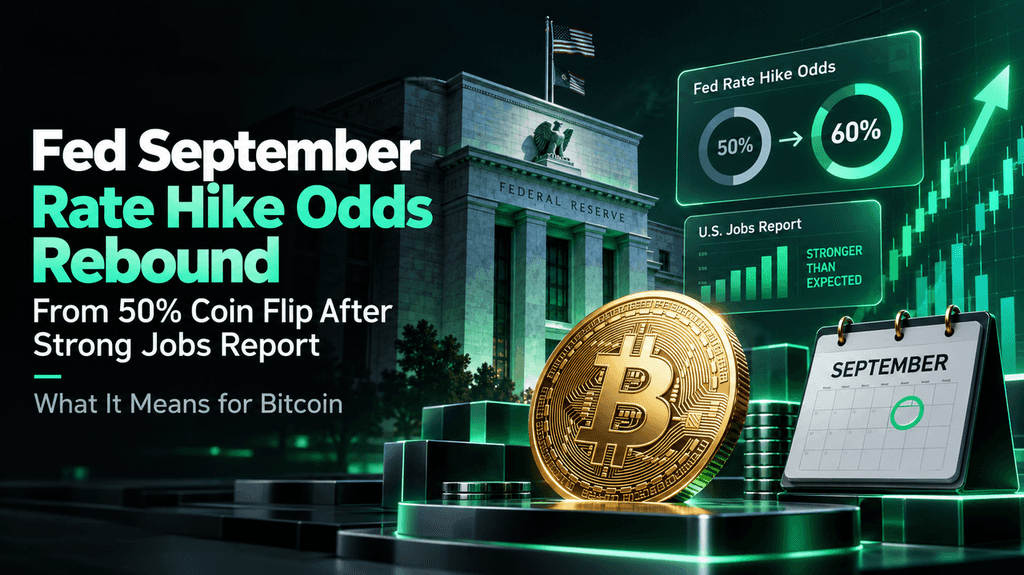
Expectations for a September Federal Reserve rate hike have swung sharply as investors respond to conflicting signals from Fed officials and the latest U.S. economic data. Fed Governor Christopher Waller’s more cautious comments initially pushed the probability of a September increase down from 63.2% to roughly 50.4%, effectively turning the decision into a coin flip. Just one day later, a much stronger-than-expected U.S. jobs report drove rate-hike expectations back above 60% during trading before they eased into the high-50% range later in the session. Bitcoin reacted quickly to the changing macro outlook, retreating from above $81,000 as Treasury yields climbed and expectations for tighter monetary policy returned. With the September FOMC meeting approaching, investors are now focused on inflation data, FedWatch pricing and the Fed’s forward guidance to assess what the next interest-rate decision could mean for Bitcoin and the broader crypto market.
Why Fed September Rate Hike Odds Jumped Above 60% After the Strong U.S. Jobs Report
Expectations for a Federal Reserve rate hike in September 2026 strengthened sharply after the latest U.S. employment report showed that the labor market remained considerably more resilient than economists had anticipated. Market pricing moved the probability of a 25-basis-point September increase above 60% immediately after the report, reversing much of the dovish repricing triggered by Waller’s comments. Reuters reported probabilities reaching around 62% in the initial response, with some futures pricing briefly moving even higher before settling back toward the high-50% range later Friday. The rapid shift highlights why CME FedWatch probabilities should be treated as continuously changing market estimates rather than fixed forecasts of what the Federal Reserve will ultimately decide.
Strong August Jobs Data Strengthened the Case for a September Fed Hike
The U.S. economy added 162,000 nonfarm payroll jobs in August, far above the roughly 56,000 expected in a Reuters survey, while the unemployment rate remained unchanged at 4.1%. Labor-force participation increased to 61.6%, indicating that employment growth occurred even as more people entered the workforce. Average hourly earnings rose 0.3% from the previous month and 3.1% year over year, suggesting wage growth remained positive without accelerating sharply. The employment gain was also well above the average monthly increase of 31,000 recorded over the prior 12 months, reinforcing evidence that labor-market momentum improved significantly in August.
Previous employment estimates were also revised higher. The Bureau of Labor Statistics increased June payroll growth from 20,000 to 31,000 and revised July from a previously reported 23,000 decline to a 21,000 increase. Together, the revisions added another 55,000 jobs to the previous two months. A more resilient labor market does not automatically require another rate increase, but it can give policymakers greater flexibility to maintain restrictive monetary policy while they focus on inflation. With employment conditions showing fewer signs of immediate weakness, the debate around the September Fed rate hike is increasingly likely to depend on whether inflation is cooling quickly enough to justify keeping rates unchanged.
CME FedWatch Odds Reversed as Markets Repriced the Fed Outlook
The jobs report produced a particularly sharp market reaction because it arrived only a day after Fed Governor Christopher Waller had reduced expectations for an immediate hike. Waller indicated that he could support leaving rates unchanged if incoming inflation data confirmed that price pressures were continuing to ease. His remarks caused market-implied September hike odds to fall from 63.2% to approximately 50.4%, creating the 50/50 “coin flip” that initially defined the story. The employment surprise then shifted the balance back toward a hike, although the probability later moderated as investors assessed wage growth and waited for the upcoming inflation reports.
Key developments influencing September Fed rate hike odds include:
-
August payrolls increased by 162,000, substantially exceeding consensus expectations.
-
The unemployment rate remained at 4.1%, limiting evidence of a rapid labor-market slowdown.
-
June and July payroll estimates were revised higher by a combined 55,000 jobs.
-
Wage growth reached 3.1% year over year, remaining an important input for the inflation outlook.
-
September hike probabilities moved from around 50% to above 60% immediately after the jobs report.
-
Futures pricing later eased toward roughly 57%–59%, showing that the decision remains closely contested.
The stronger employment report therefore shifted the September policy debate without settling it. Investors still have important inflation data to digest before the September 15–16 FOMC meeting, and even modest surprises could materially alter market pricing. A softer inflation report could strengthen the case for another pause, while persistent price pressures could push expectations back toward a more decisive probability of a rate increase.
How Rising Fed Rate Hike Bets Are Affecting Bitcoin and Crypto Markets
Changing Fed rate hike expectations have already produced noticeable volatility in Bitcoin and other cryptocurrencies. Bitcoin climbed to approximately $81,200 as rate expectations eased following Waller’s remarks, reaching its highest level since mid-May. The move reversed after the strong employment data forced traders to reassess the likelihood of tighter monetary policy. Bitcoin dropped more than 2% toward $79,000 after the report and later stabilised around $79,500, illustrating how quickly macroeconomic surprises can affect digital-asset prices. Investors following those moves can compare changes through the Bitcoin live price and market overview as monetary-policy expectations continue to evolve.
Bitcoin’s reaction also reflects its increasingly important relationship with global financial conditions. Crypto traders now monitor interest rates, Treasury yields, inflation expectations and dollar movements alongside blockchain-specific developments and market positioning. When investors expect monetary policy to become more restrictive, demand for highly volatile assets can weaken as capital shifts toward instruments offering attractive yields with lower risk. Conversely, expectations for easier financial conditions can improve risk appetite. Comparing real-time crypto market data can help show whether such macro-driven moves are concentrated in Bitcoin or spreading across Ether and other major digital assets.
Higher Treasury Yields Are Creating a Tougher Backdrop for Bitcoin
Treasury yields rose immediately after the jobs report as bond markets priced a greater chance of another Fed increase. The benchmark 10-year Treasury yield reached roughly 4.78%, while the two-year yield moved to around 4.37%–4.38%. Shorter-term yields are especially sensitive to expectations for Federal Reserve policy, making the two-year move another indication that traders had become more hawkish after the employment figures. Higher yields can increase the relative attractiveness of government debt while simultaneously raising financing costs throughout the financial system, creating a more challenging environment for speculative assets.
For Bitcoin, the relationship is important because investors increasingly compare potential crypto returns with yields available from traditional assets. Elevated real interest rates can raise the opportunity cost of holding assets that do not generate cash flows, while a stronger dollar can tighten financial conditions internationally. Bitcoin’s performance is nevertheless determined by more than interest rates alone. Institutional demand, market positioning, ETF flows, regulatory developments and crypto-specific liquidity can all moderate or amplify the effect of a hawkish Fed.
Crypto Markets Remain Sensitive to Shifts in Risk Appetite
The wider crypto market can be even more sensitive to changes in monetary-policy expectations because many altcoins have lower liquidity and greater volatility than Bitcoin. When global risk appetite improves, investors may be more willing to move further along the risk spectrum into smaller digital assets. When financial conditions tighten, that process can reverse as traders reduce leverage and shift toward more liquid assets or cash. This helps explain why macroeconomic events such as employment reports, CPI releases and FOMC announcements can influence not only Bitcoin but the broader cryptocurrency market.
Several additional factors can shape the crypto market response to Fed policy:
-
Persistent high yields can influence institutional asset-allocation decisions between bonds and digital assets.
-
Dollar strength can tighten global liquidity even when crypto-specific fundamentals remain unchanged.
-
Large Bitcoin ETF inflows could potentially offset part of a macro-driven decline in risk appetite.
-
Altcoins with thinner market depth may experience larger percentage moves during periods of rapid repricing.
-
Changes in derivatives positioning can amplify short-term volatility around major economic releases.
Derivatives can also magnify market reactions when traders build highly leveraged positions ahead of major economic events. Rising Fed hike expectations therefore do not guarantee a prolonged crypto decline. If markets fully price a September hike in advance, the eventual decision could have less impact than unexpected guidance about what comes next. Bitcoin’s direction will also depend on whether institutional demand and crypto-specific capital flows are strong enough to counter tighter macroeconomic conditions.
Will the Fed Raise Rates in September? CPI, FedWatch and the Next Bitcoin Catalysts
Whether the Federal Reserve raises interest rates in September 2026 is still unresolved. Although the jobs report temporarily pushed market-implied hike probabilities above 60%, Reuters reported futures pricing later easing to approximately 57%, while another post-report snapshot put the probability around 59%. The most accurate way to describe the current setup is therefore that markets are pricing a modestly greater chance of a hike than a hold, rather than treating either outcome as certain. The September decision is likely to remain highly sensitive to inflation data because labor-market strength has reduced one potential argument against further tightening.
-
August CPI Could Be the Deciding Data for a September Fed Rate Hike
The August U.S. CPI report on September 11 could become the most important economic release remaining before the FOMC decision. July headline CPI increased 0.1% month over month and 3.4% year over year, while core CPI increased 0.2% monthly and 2.5% annually. For August, economists expect headline CPI to increase roughly 0.4% from the previous month and core CPI to rise about 0.2%. The August Producer Price Index will arrive on September 10, providing an earlier indication of inflation pressures within the supply chain. A hotter-than-expected CPI result could strengthen support for another 25-basis-point increase, while softer underlying inflation could reinforce the argument for patience.
-
FedWatch Shows the September Rate Decision Is Still Close
The recent movement in CME FedWatch probabilities illustrates why investors should avoid treating one percentage as a permanent forecast. Rate-hike expectations were above 60% before Waller’s remarks, fell to about 50% after his comments, climbed above 60% again following the employment report and subsequently eased back toward the high-50% range. That sequence reflects the market’s attempt to continuously incorporate new information rather than contradictory estimates from different sources. With the probability of a hike still relatively close to the probability of a hold, CPI and PPI surprises could generate another significant repricing before the Fed meeting.
-
Bitcoin Faces Key Catalysts Around the September FOMC Meeting
The Federal Reserve’s September meeting is scheduled for September 15–16, with the policy decision due at 2:00 p.m. ET on September 16 and the press conference scheduled for 2:30 p.m. ET. The meeting is also associated with a new Summary of Economic Projections, meaning investors will receive updated policymaker forecasts for inflation, economic growth, unemployment and the expected path of interest rates. These projections could matter substantially for Bitcoin because markets generally price the future direction of monetary policy rather than focusing only on the immediate 25-basis-point decision.
A hike accompanied by indications that policymakers expect rates to remain elevated or increase again could create a more restrictive backdrop for liquidity-sensitive assets. Conversely, even if the Fed raises rates, guidance suggesting that additional tightening is unlikely could produce a less negative reaction than the headline decision alone might imply. Bitcoin investors will therefore be watching Treasury yields, dollar strength, inflation expectations, ETF flows and Fed projections together rather than relying exclusively on the rate announcement. Macro policy will remain important, but it will interact with institutional demand, derivatives positioning and broader crypto-market sentiment in determining the eventual BTC response.
Conclusion
The September Fed rate hike outlook has shifted from a near coin flip to a modest market preference for another increase after the stronger August employment report. The move does not mean a hike is assured. Instead, it shows how quickly investors are repricing monetary policy as new information arrives. With payrolls rising by 162,000 and unemployment holding at 4.1%, the labor market has given policymakers greater room to focus on persistent inflation. The August CPI and PPI reports now represent the final major inflation tests before the September 15–16 meeting and could determine whether the recent increase in rate-hike expectations is sustained.
For Bitcoin and the broader crypto market, the significance extends beyond a single quarter-point rate decision. Treasury yields, the U.S. dollar, liquidity expectations and Fed forward guidance may ultimately matter more than whether the September vote produces a hike or a hold. Bitcoin’s fall from above $81,000 following the jobs report demonstrated its sensitivity to rapidly changing macro expectations, but monetary policy is only one part of the market outlook. ETF flows, institutional positioning, derivatives activity and crypto-specific demand could offset or amplify the effect of tighter financial conditions. Investors should therefore view the September FOMC meeting as an important catalyst rather than a guaranteed determinant of Bitcoin’s longer-term direction.
KuCoin Offers A More Stable Option in A Volatile Market
If you worry about the frequent ups and downs in the market, and pursue a more stable option to earn money passively, KuCoin is the right place to come:
Simple Earn: Deposit and withdraw tokens anytime, earning stable returns.
Kucoin Earn: Earn stable profits with professional asset management.
Hold to Earn: Earn rewards by holding assets in Funding, Trading, Margin, Futures, Mining, and Unified Accounts.
Staking: Unlock the earning potential of on-chain assets.
Advanced Investments: Advanced Investments offer a variety of structured products to help your money grow in any market.
Shark Fin: Principal Protection and Guaranteed Gains
Dual Investment: Buy low and sell high with transparent return calculations.
Snowball: High yields, with price protection.
Discount Buy: Buy crypto at discount prices.
KCS Loyalty: Level up to enjoy exclusive perks by staking ≥ 1 KCS.
KuCoin Wealth: Discover future value and begin your smart investing journey.
KCS Benefits: Hold and stake KCS to access benefits across the platform.
KCS Staking 2.0: Participate in KCS on-chain governance to earn yield.

FAQs
What does a Fed rate hike mean for Bitcoin investors?
A Fed rate hike generally raises borrowing costs and can increase returns available from lower-risk assets such as U.S. government bonds. For Bitcoin investors, the impact depends on whether the move was already expected, how Treasury yields and the dollar respond and what the Fed signals about future policy. A fully anticipated hike may produce a smaller market reaction than an unexpected decision.
Can Fed guidance matter more for Bitcoin than the actual rate decision?
Yes. Investors generally focus on the expected future path of monetary policy rather than only the current rate. A hike combined with cautious guidance about additional tightening could be interpreted differently from the same hike accompanied by expectations for several more increases.
Are altcoins more sensitive to Fed policy than Bitcoin?
Many altcoins can experience larger swings because they generally have lower liquidity, smaller market capitalisations and greater volatility than Bitcoin. During periods of declining risk appetite, investors may reduce exposure to more speculative digital assets first.
What economic data matter most before the September Fed meeting?
The August PPI on September 10 and August CPI on September 11 are among the most important remaining releases. Investors will focus particularly on underlying inflation because stronger employment has reduced concerns about an immediate labor-market deterioration.
What should Bitcoin investors watch after the September Fed decision?
After the meeting, investors can monitor the Fed’s projected rate path, Treasury yields, the U.S. dollar, inflation expectations, Bitcoin ETF flows and broader institutional positioning. Those indicators can provide more information about future financial conditions than the September rate decision alone.
Disclaimer
The information provided on this page may originate from third-party sources and does not necessarily represent the views or opinions of KuCoin. This content is intended solely for general informational purposes and should not be considered financial, investment, or professional advice. KuCoin does not guarantee the accuracy, completeness, or reliability of the information, and is not responsible for any errors, omissions, or outcomes resulting from its use. Investing in digital assets carries inherent risks. Please carefully evaluate your risk tolerance and financial situation before making any investment decisions. For further details, please consult KuCoin’s Terms of Use and Risk Disclosure.