

Can the CLARITY Act Save the US Treasury Market? Stablecoin Demand, Crypto Clarity, and Debt Realities
2026/08/24 15:19:00
Introduction
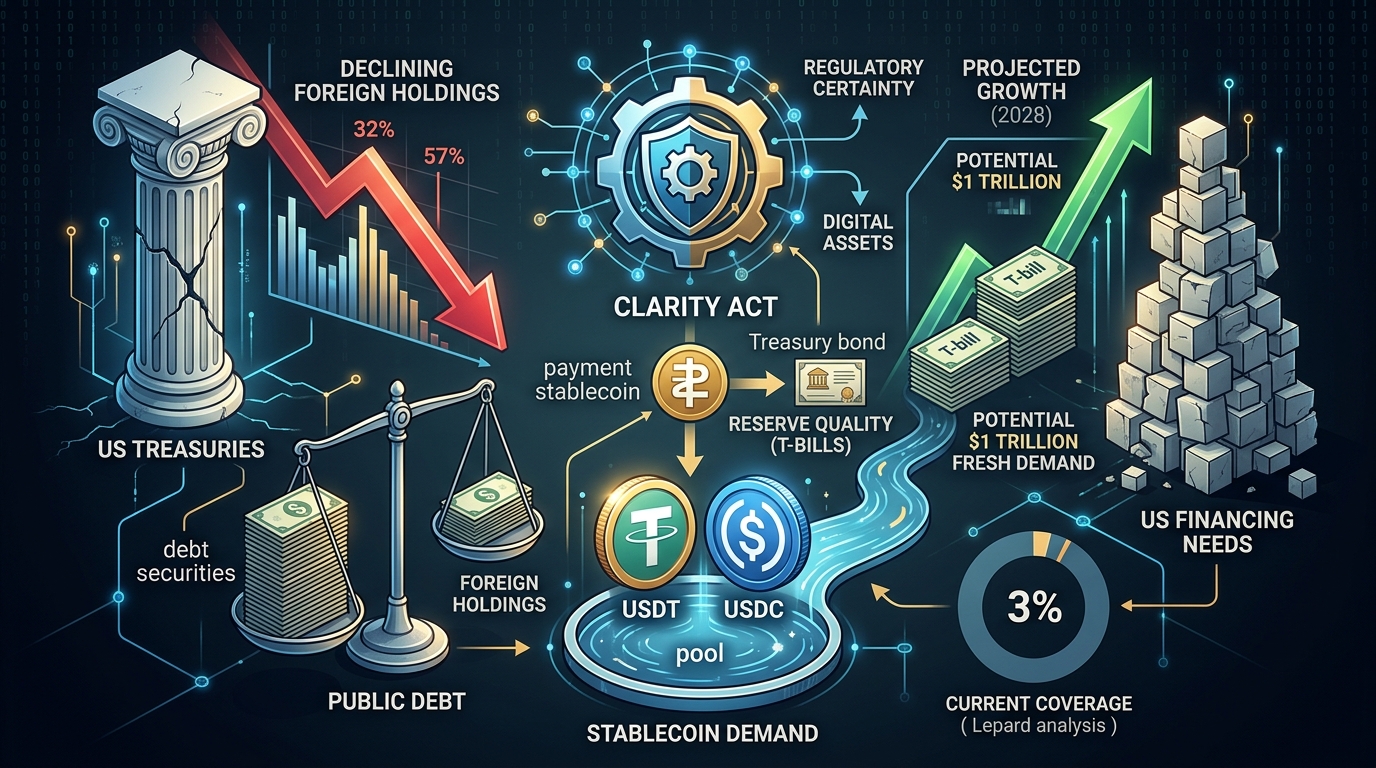
Did you know that even as the US gross national debt surpassed $40 trillion in August 2026, foreign holdings of Treasury securities hovered near just 32% of debt held by the public—far below post-financial-crisis peaks near 57%? Investment managers and policymakers increasingly point to dollar stablecoins as a potential new buyer for short-term US Treasuries. Yet the Digital Asset Market Clarity Act alone cannot close the gap. According to recent commentary from investment manager Lawrence Lepard, author of The Big Print, current stablecoin market capitalization covers only about 3% of the more than $8 trillion in annual US debt rollover needs.
The CLARITY Act aims to deliver long-awaited regulatory certainty for digital assets, including clearer rules for stablecoins and market structure. Proponents argue this clarity could accelerate stablecoin adoption and channel overseas demand for digital dollars into Treasury purchases. Reality checks from market data and expert analysis show the scale remains limited relative to US financing requirements. This article examines the Act’s provisions, the size of stablecoin Treasury holdings, foreign demand trends, growth projections, and practical implications for investors.
What Is the CLARITY Act and How Does It Relate to Stablecoins?
The Digital Asset Market Clarity Act establishes a federal market structure framework for digital assets by clarifying jurisdiction between the Securities and Exchange Commission (SEC) and the Commodity Futures Trading Commission (CFTC). It defines digital commodities, sets registration requirements for intermediaries such as digital commodity brokers, dealers, and exchanges, and addresses treatment of payment stablecoins within the broader ecosystem.
House passage occurred in July 2025 with strong bipartisan support. Senate versions advanced through Banking and Agriculture Committees in 2026, with updated consolidated text released in July 2026 that included software developer protections and ethics provisions with a 2029 sunset. As of late August 2026, the bill had not cleared a full Senate vote, with negotiations continuing after the August recess and parallel SEC proposals for crypto asset offerings moving forward.
Stablecoins sit at the intersection because the earlier GENIUS Act already established federal rules for payment stablecoins, requiring high-quality liquid reserves such as short-term Treasuries or Treasury-backed repos. CLARITY builds on this by providing clearer rules for the exchanges, brokers, and networks that support stablecoin activity. Coinbase Chief Policy Officer Faryar Shirzad has noted that dollar stablecoins can convert overseas demand for digital dollars into demand for US Treasuries.
Clearer rules reduce regulatory uncertainty that previously pushed activity offshore. This environment can support broader institutional and retail adoption of stablecoins, potentially increasing the pool of capital backing those tokens with Treasuries. The Act does not mandate Treasury purchases or create new demand mechanisms by itself; it primarily removes friction for existing and future market participants.
How Large Is Current Stablecoin Demand for US Treasuries?
Stablecoin issuers already rank among notable holders of short-term US Treasuries, but their absolute size remains modest compared with total debt needs. As of late August 2026, the total stablecoin market capitalization stood near $290–310 billion according to multiple trackers, with USDT and USDC dominating.
Tether reported substantial direct holdings of Treasury bills—around $115 billion in one recent attestation—plus additional repo exposure. Circle’s USDC reserves are heavily concentrated in cash and short-term government securities. Combined Treasury-linked exposure from major issuers runs into the low hundreds of billions.
Lawrence Lepard highlighted that the stablecoin market stood near $255 billion at the time of his comments (down from $263 billion earlier in the year), primarily backed by Treasuries purchased by Circle and Tether. With annual Treasury rollovers exceeding $8 trillion, this equates to roughly 3% coverage. Even updated market-cap figures near $300 billion do not materially change the percentage relative to the scale of maturing debt.
Stablecoin demand is price-insensitive and concentrated at the front end of the curve. Issuers must maintain 1:1 liquid reserves regardless of yield levels. This creates steady, structural buying of T-bills. It does not, however, offset the much larger volumes required to roll existing debt or finance new deficits.
Why Are Foreign Holdings of US Treasuries Declining?
Foreign ownership of US Treasury securities has trended lower as a share of debt held by the public. Recent data place the figure near 31–32%, down from levels around 57% in the years after the global financial crisis. As of June 2026, major foreign holders totaled approximately $9.3 trillion.
Japan, the United Kingdom, and China remain the largest country holders, yet absolute and relative positions have shifted. In June 2026, foreign investors sold roughly $29 billion of short-term Treasury bills while directing more capital into equities. Two consecutive months of bill reductions totaled about $72.5 billion.
Multiple factors drive the shift: higher domestic yields in some countries, diversification strategies by official institutions, and fiscal concerns surrounding the US debt trajectory. The Federal Reserve’s own holdings and domestic private demand have absorbed more of the supply in recent years. Declining foreign participation increases the importance of alternative buyers, which is why policymakers and industry figures highlight stablecoins.
Stablecoins offer a potential partial offset by converting global demand for dollar-denominated digital assets into Treasury reserves. Growth concentrated among non-US users—particularly in emerging markets seeking dollar access—generates more incremental demand than domestic substitution from bank deposits or money-market funds.
Can Projected Stablecoin Growth Meaningfully Support the Treasury Market?
Optimistic forecasts suggest stablecoin expansion could add substantial T-bill demand over multi-year horizons, yet near-term impact stays limited. Standard Chartered analysts project the stablecoin market could reach $2 trillion by the end of 2028, generating roughly $0.8–1 trillion in fresh demand for Treasury bills as issuers accumulate short-term government debt.
Combined with expected Federal Reserve activity, total new bill demand could approach $2.2 trillion through 2028 against projected net supply nearer $1.3 trillion under constant bill-share assumptions. This scenario would create excess demand and give the Treasury flexibility to adjust issuance maturity.
Such projections depend on continued regulatory progress, including CLARITY Act passage or equivalent clarity, sustained crypto-market growth, and high reserve allocation to Treasuries under frameworks like GENIUS. Even under bullish assumptions, the contribution remains a fraction of annual rollover volumes exceeding $8 trillion and the overall debt stock now above $40 trillion.
Lepard’s analysis underscores the gap: meaningful relief requires both legislative clarity and substantial market-cap expansion. CLARITY can accelerate the former; the latter depends on broader adoption, network effects, and macroeconomic conditions. Risks include redemption waves that could force issuers to sell Treasuries during stress periods, potentially amplifying volatility rather than stabilizing the market.
KuCoin Offers A More Stable Option in A Volatile Market
If you worry about the frequent ups and downs in the market, and pursue a more stable option to earn money passively, KuCoin is the right place to come:
-
Simple Earn: Deposit and withdraw tokens anytime, earning stable returns.
-
Kucoin Earn: Earn stable profits with professional asset management.
-
Hold to Earn: Earn rewards by holding assets in Funding, Trading, Margin, Futures, Mining, and Unified Accounts.
-
Staking: Unlock the earning potential of on-chain assets.
-
Advanced Investments: Advanced Investments offer a variety of structured products to help your money grow in any market.
-
Shark Fin: Principal Protection and Guaranteed Gains
-
Dual Investment: Buy low and sell high with transparent return calculations.
-
Snowball: High yields, with price protection.
-
Discount Buy: Buy crypto at discount prices.
-
KCS Loyalty: Level up to enjoy exclusive perks by staking ≥ 1 KCS.
-
KuCoin Wealth: Discover future value and begin your smart investing journey.
-
KCS Benefits: Hold and stake KCS to access benefits across the platform.
-
KCS Staking 2.0: Participate in KCS on-chain governance to earn yield.

Conclusion
The CLARITY Act can support greater regulatory certainty for digital assets and, by extension, help expand the stablecoin market that already channels capital into short-term US Treasuries. Current holdings by major issuers represent meaningful but still limited demand—on the order of a few percent of annual debt rollover volumes exceeding $8 trillion. Foreign ownership shares have declined toward 32%, increasing interest in alternative buyers. Multi-year projections of $0.8–1 trillion in additional T-bill demand from stablecoin growth illustrate longer-term potential, yet near-term coverage remains modest.
Risks around concentration, maturity structure, and redemption dynamics require careful monitoring. Clearer rules improve the environment for responsible growth; they do not independently solve the scale of US financing needs. Investors and market participants should track legislative progress, reserve data, and Treasury issuance patterns while focusing on diversified risk management.
FAQs
What is the primary goal of the CLARITY Act?
The primary goal is to create a clear federal regulatory framework for digital asset markets by defining asset categories and allocating oversight between the SEC and CFTC.
How much of the US Treasury market do stablecoins currently support?
Major stablecoin issuers hold low-hundreds-of-billions in Treasury-linked assets, equating to roughly 3% of annual debt rollover needs exceeding $8 trillion based on recent analyses.
Has the CLARITY Act become law?
As of August 2026 the Act had passed the House and advanced through Senate committees but had not yet received a full Senate vote or final enactment.
Do stablecoins only buy short-term Treasuries?
Under frameworks such as the GENIUS Act, payment stablecoin reserves prioritize short-term Treasuries (typically 93 days or less remaining maturity) and related highly liquid assets.