

Can AI Cure Cancer? Palantir CTO’s Remarks Spark Debate Over AI Hype
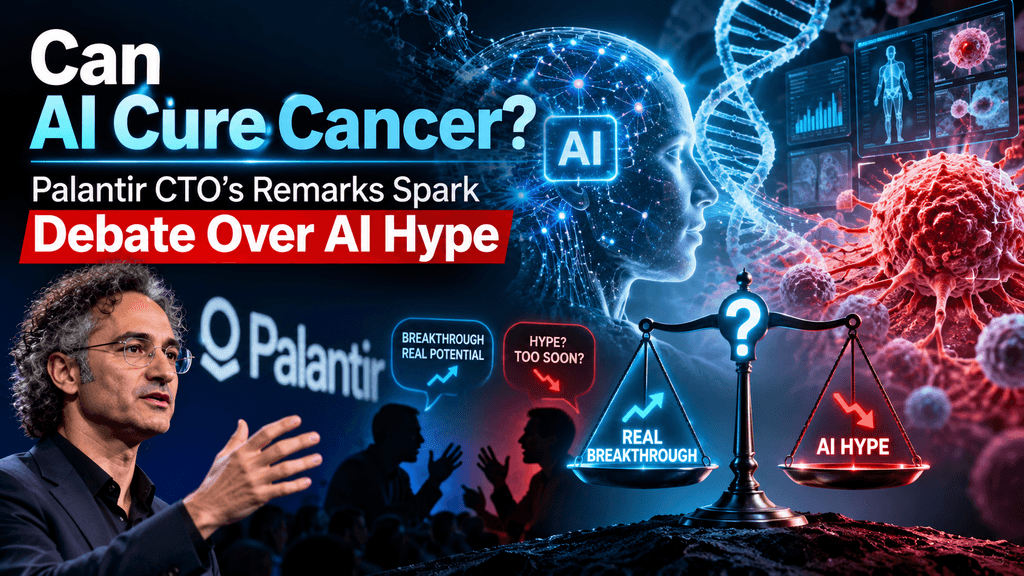
Could artificial intelligence become so advanced that it cures humanity’s most devastating diseases? According to some technologists in Silicon Valley, the answer is a resounding "yes." This conviction has reached such an extreme level that, reportedly, some AI researchers have begun taking up cigarette smoking. Their logic? They are so confident that AI will soon cure cancer that they are willing to risk their health today to signal their unwavering faith in the technology. This bizarre trend was recently highlighted by Shyam Sankar, the Chief Technology Officer (CTO) of data analytics giant Palantir, during a Sunday morning news interview. Sankar’s comments have ignited a fierce debate about whether the tech industry’s belief in AI has crossed the line from visionary optimism into "mass psychosis" and "social delusion".
As the cryptocurrency market increasingly intersects with AI narratives—particularly through Decentralized Science (DeSci) and AI-focused tokens—this controversy has prompted investors and developers to re-evaluate the distinction between verifiable technological progress and dangerous hype.
Key Takeaways
-
Extreme AI Belief: Palantir CTO Shyam Sankar revealed that some AI researchers are smoking cigarettes to demonstrate their belief that AI will inevitably cure cancer.
-
"Mass Psychosis": Sankar criticized this behavior as a form of "mass psychosis" and "social delusion," suggesting that Silicon Valley’s faith in AI resembles a religious cult rather than scientific engineering.
-
The Reality of Cancer: Medical experts emphasize that cancer is not a single disease with a single cure. Furthermore, smoking causes numerous other fatal conditions—such as heart disease and COPD—that an AI "cancer cure" would not address.
-
Impact on Crypto Markets: The debate highlights the speculative nature of AI-related cryptocurrency tokens, urging investors to differentiate between protocols providing genuine computational utility and those driven purely by narrative hype.
-
The Need for Grounded Development: The controversy underscores the necessity for AI and DeSci projects to focus on rigorous scientific validation rather than utopian promises.
The Spark: Sankar’s Interview on "Face the Nation"
The debate originated from an October 11, 2026, interview on CBS News’ "Face the Nation," where Palantir CTO Shyam Sankar discussed the current state and future implications of artificial intelligence. While discussing the extreme narratives surrounding AI—ranging from doomsday scenarios of human extinction to utopian visions of perfect prosperity—Sankar offered a startling anecdote.
"My Chips Are All In"
Sankar told host Margaret Brennan, "So many AI researchers have started smoking as a way of signaling to other researchers how much they believe in AI". When Brennan expressed disbelief, noting that the behavior "makes no sense," Sankar elaborated on the researchers' mindset: "I believe so much in AI that it's going to cure cancer. So I will—I'm showing you my chips are all in".
Sankar did not endorse this behavior; rather, he used it to highlight a dangerous psychological trend within the tech industry. He described this extreme faith as a "mass psychosis" and a "social delusion". In his view, this almost religious devotion to the idea of Artificial General Intelligence (AGI) distracts from the practical, immediate applications of AI and the necessary hard work of responsible engineering.
Echoes in Silicon Valley
Sankar’s claims are not entirely isolated. Vlad Tenev, the CEO of the financial technology company Robinhood, recently posted on the social media platform X (formerly Twitter): "Hearing more and more AI researchers are taking up smoking … superintelligence is near". This suggests that the trend, or at least the narrative surrounding it, is gaining traction among tech executives.
The Medical Reality: AI is Not a Magic Wand
The assertion that one can safely smoke because AI will eventually "cure cancer" demonstrates a profound misunderstanding of both oncology and the capabilities of artificial intelligence. Medical professionals and science communicators were quick to point out the dangerous flaws in this logic.
Cancer is Not a Single Disease
The fundamental flaw in the "AI will cure cancer" narrative is the misconception that cancer is a monolithic entity. In reality, cancer refers to a group of more than 200 distinct diseases characterized by the uncontrolled growth and spread of abnormal cells. Each type of cancer has its own unique genetic drivers, mutational pathways, and resistance mechanisms. While AI is proving incredibly useful in analyzing complex multi-omic data to identify potential drug targets and personalize treatment plans, it cannot provide a single, universal "cure."
The Clinical Trial Bottleneck
Even if an AI algorithm successfully designs a novel molecule that perfectly targets a specific cancer mutation in silico (in a computer simulation), that molecule must still undergo rigorous, multi-year clinical trials. AI cannot bypass the biological necessity of testing a drug in human patients to ensure its safety and efficacy. The physical realities of human biology—toxicity, bioavailability, and immune response—cannot be entirely simulated or accelerated by computing power.
Smoking Causes More Than Just Cancer
Perhaps the most glaring hole in the researchers’ logic is that smoking is linked to a multitude of severe health conditions beyond lung cancer. Cigarette smoke contains thousands of toxic chemicals that damage the cardiovascular and respiratory systems. Smoking is a leading cause of heart disease, stroke, chronic obstructive pulmonary disease (COPD), and emphysema. Even if an AI miraculously cured all forms of cancer tomorrow, it would not undo the widespread cardiovascular damage caused by years of inhaling toxins.
The Ripple Effect: AI Hype and the Crypto Market
The controversy surrounding Sankar's remarks extends beyond Silicon Valley laboratories; it has significant implications for the cryptocurrency market, particularly for sectors intersecting with artificial intelligence and biotechnology.
DeSci and AI Tokens: Navigating the Hype
The cryptocurrency ecosystem is highly sensitive to technological narratives. Decentralized Science (DeSci) projects, which aim to use blockchain technology to fund, organize, and accelerate scientific research, often leverage AI as a core component of their value proposition. Similarly, AI-focused crypto tokens frequently experience massive price surges based on broad optimism about machine learning capabilities.
However, the "smoking researcher" anecdote serves as a stark warning about the dangers of speculative hype. When the market prices tokens based on utopian visions rather than verifiable utility, it creates a fragile ecosystem vulnerable to severe corrections. If investors realize that AI is an accelerator rather than a magic wand, tokens built purely on narrative momentum may face significant downward pressure.
| Crypto Sector | Core Focus | Vulnerability to Hype |
| Decentralized Compute (DePIN) | Providing verifiable GPU/TPU resources for AI training. | Moderate: Value is tied to tangible hardware utility and network demand. |
| DeSci (Biotech) | Tokenizing intellectual property and funding clinical trials. | Moderate: Depends on actual scientific milestones and wet-lab results. |
| AI Narrative Tokens | General AI promotion, speculative governance, and access. | High: Extremely vulnerable to shifts in sentiment and the deflation of utopian promises. |
The Importance of Verifiable Utility
For the intersection of crypto and AI to mature, the focus must shift from speculative promises to verifiable, on-chain utility. DePIN (Decentralized Physical Infrastructure Networks) projects that provide tangible computational resources for training models are generally more resilient to hype cycles than tokens whose value relies solely on the promise of future AGI. The market will increasingly demand proof of work—not just cryptographic proof, but actual scientific and computational output.
The Danger of Technological Utopianism
The underlying issue highlighted by the Palantir CTO is the danger of abdicating human agency to technological determinism. If technologists believe that a "machine god" will inevitably solve all human problems, they may neglect the rigorous, responsible engineering required to build safe and effective systems today.
The Abdication of Responsibility
Sankar noted that both the extreme "doomsday" narratives (AI will destroy humanity) and the utopian narratives (AI will cure all diseases) share a common thread: the belief that humans are no longer in control. He argued against this, stating, "You cannot abdicate this idea that designing safe products is your job. You can't hand wave around it". The belief that an inevitable AGI will retroactively fix the health consequences of smoking is the ultimate abdication of personal and professional responsibility.
Conclusion
The revelation that some AI researchers are smoking cigarettes as a testament to their faith in artificial intelligence is a profound illustration of the hype currently gripping the tech industry. Palantir CTO Shyam Sankar’s characterization of this behavior as "mass psychosis" serves as a necessary reality check. While AI is undeniably a powerful tool that is revolutionizing fields like oncology and computational biology, it is not a miraculous panacea capable of overriding the laws of human biology and the rigorous demands of clinical testing. For the cryptocurrency market, this controversy is a stark reminder to separate verifiable utility from speculative narratives. Projects operating in the DeSci and AI token space must demonstrate tangible progress rather than relying on utopian promises. Ultimately, the future of both medicine and technology relies on grounded, responsible engineering, not blind faith in an omnipotent algorithmic savior.
🔥 Beyond the Headlines: What KuCoin 5.0 Means for You
Market news moves fast — but where you act on it matters just as much. This October, KuCoin launches KuCoin 5.0, transforming KuCoin into a rebuilt platform. Here's what actually changes for you:
-
One account for everything. Older platforms split your money across separate "spot," "margin," and "futures" accounts and expected you to understand why. KuCoin 5.0's unified account removes that entirely — deposit once, and everything is simply there (only available to VIPs for now).
-
Stocks, indices, and commodities. KuCoin 5.0 expands beyond crypto into global markets. When crypto chops sideways and equities rally (or the reverse), you rotate in minutes instead of opening a brokerage account and waiting days for fiat rails.
-
Real-world assets (RWA). Tokenized exposure to traditional assets like commodities, right inside your crypto account. One of the fastest-growing segments in global finance is no longer reserved for institutions — you access it from the same balance you trade with.
-
Earn while you learn. Not ready to trade? KCUSD lets your stablecoins earn daily, auto-compounding interest. The lowest-stress way to put your idle deposit to work for 4% yield.
-
An AI assistant in plain language. Ask questions, get market context, understand what you're looking at — built into the platform, no jargon required.
-
An app that doesn't overwhelm. Faster, cleaner, and consistent — intuitive from the first tap, not after a tutorial.
-
Safety you can check, not just trust. A MiCAR-licensed EU entity, Proof of Reserves you can verify yourself, and internationally certified security (SOC 2 Type II, ISO 27001:2022).
Create your account in minutes — and start on the platform built for where crypto is going, not where it's been.
FAQs
What is DeSci?
Decentralized Science (DeSci) is a movement within the Web3 ecosystem that uses blockchain technology to improve how scientific research is funded, shared, and monetized. It aims to create a more open, transparent, and collaborative scientific process by removing traditional institutional gatekeepers.
How is AI currently being used in cancer research?
AI is primarily used in oncology to analyze massive datasets, such as genomic sequences and medical images, to identify patterns that humans might miss. It helps in discovering new biomarkers, predicting how specific tumors might respond to different treatments, and accelerating the early stages of drug discovery.
What are DePINs and how do they relate to AI?
Decentralized Physical Infrastructure Networks (DePINs) use blockchain protocols to coordinate and incentivize the provision of physical hardware, such as GPUs. In the context of AI, DePINs can provide the massive, distributed computational power necessary for training complex machine learning models, offering an alternative to centralized cloud providers.
Why did Palantir's CTO call the researchers' behavior a "social delusion"?
Shyam Sankar used the term "social delusion" to describe the irrational belief that AI will inevitably and effortlessly solve complex biological problems like cancer. He argued that this extreme faith leads people to make dangerous personal choices (like smoking) and distracts the industry from the hard work of responsible engineering.
Can a smart contract manage a clinical trial?
While smart contracts can automate certain administrative aspects of a clinical trial, such as milestone-based payments or transparent data logging, they cannot manage the trial itself. Clinical trials require rigorous medical oversight, patient care, and adherence to complex, jurisdiction-specific health regulations that require human medical professionals.
Disclaimer: This article is for informational purposes only and does not constitute financial or investment advice. Cryptocurrency investments carry significant risk. Always conduct your own research before trading.