

Robinhood Chain Tops Uniswap V4 After pools.trade Launch: Is a New Token Boom Beginning?
2026/08/09 14:00:00
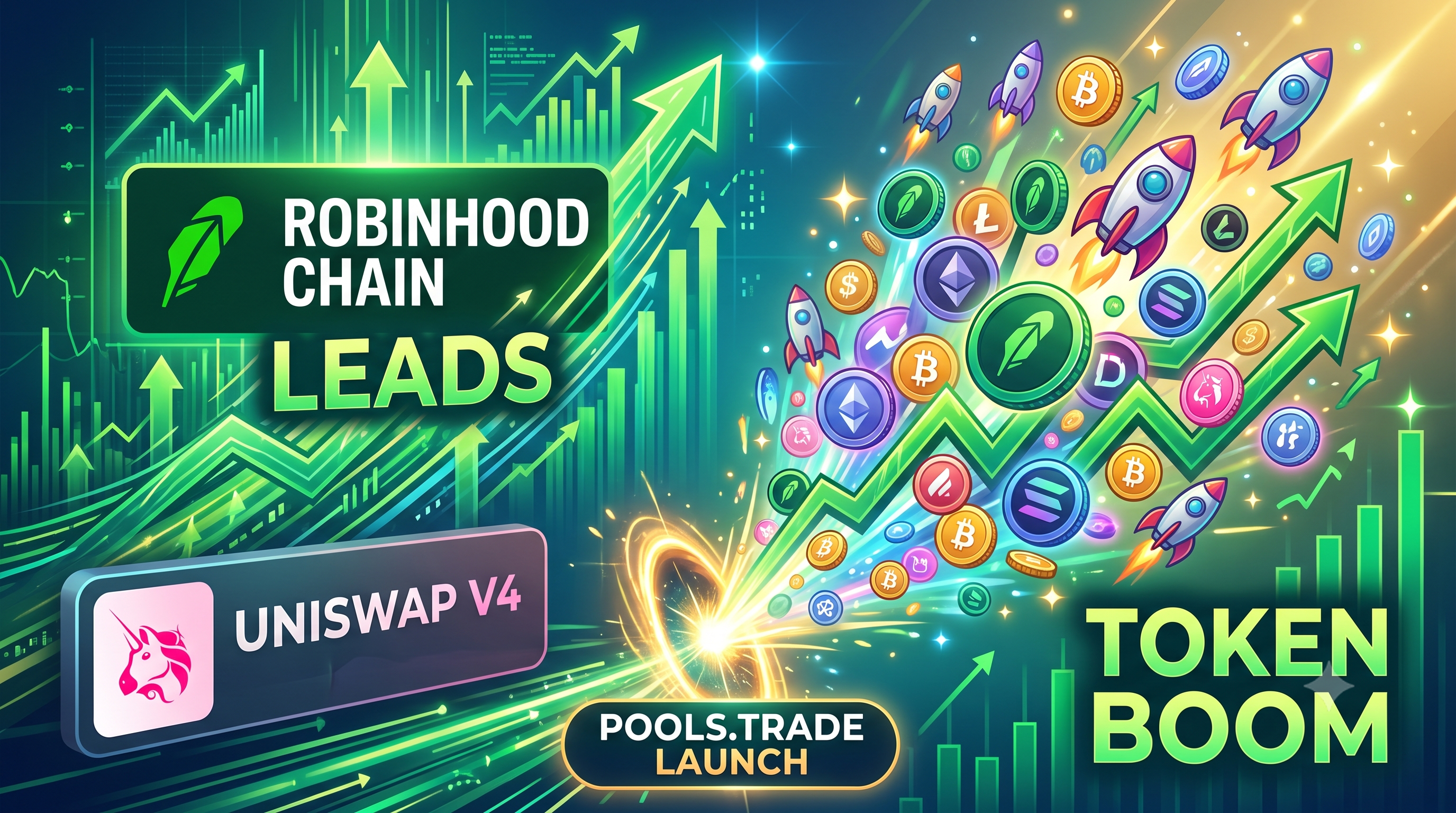
How Zero-Fee Token Launches Are Accelerating Growth on Robinhood Chain
Robinhood Chain, the Arbitrum-based Layer 2 launched by Robinhood Crypto on July 1, 2026, was designed primarily for tokenized real-world assets, including Stock Tokens. Within weeks, memecoin and speculative token trading dominated activity. Uniswap served as the primary public automated market maker from day one, with full support for v2, v3, v4, and UniswapX across its web app, wallet, and API. On August 5, 2026, Uniswap Labs introduced pools.trade, a native launchpad that routes every completed token into permanently locked Uniswap v4 pools with autocompounding fees and zero platform launch fees. Early data showed Uniswap v4 volume on the Robinhood Chain exceeding Ethereum mainnet figures on the first full day of activity, while thousands of tokens were created.
This development raises a concrete question about whether the combination of low-friction launches, distribution through existing Uniswap surfaces, and locked liquidity is seeding a sustained period of new token formation and trading on the chain. The pools.trade launch has vertically integrated token creation with Uniswap’s dominant liquidity layer on Robinhood Chain, producing measurable volume leadership in v4 trading and high launch throughput that could support a broader wave of speculative and community-driven tokens if sustained activity and liquidity depth continue.
How Robinhood Chain Positioned Uniswap as Primary Liquidity from Launch Day
Robinhood Chain went live on the public mainnet on July 1, 2026, as a permissionless Ethereum-compatible Layer 2 built on Arbitrum technology with approximately 100-millisecond block times and ETH as the gas token. The network was positioned for tokenized equities and other real-world assets, with Stock Tokens available for 24/7 trading and integration into DeFi primitives. Uniswap deployed as the designated primary public AMM immediately, enabling swaps, liquidity provision, and access through the Uniswap web application, wallet, and API. Support extended across protocol versions and UniswapX for intent-based execution. Early metrics illustrated rapid adoption: cumulative Uniswap volume crossed $1 billion within nine days, with single-day spikes approaching $500 million driven by both Stock Tokens and emerging memecoins.
Chain-level DEX volume frequently ranked among the higher activity networks in subsequent weeks, while stablecoin capitalization and total value locked expanded. The presence of complementary venues such as proprietary AMMs and perpetuals platforms created a broader trading environment, yet Uniswap captured the majority of public liquidity routing. This foundational role meant that any subsequent launchpad activity would naturally settle into Uniswap pools, concentrating volume and fee generation within the same protocol that already commanded the chain’s primary trading surface. The design choice reduced friction for users already familiar with Uniswap interfaces and prepared the ground for a native creation tool that could capture value earlier in the token lifecycle.
How Launchpads Leverage Existing Blockchain Ecosystems to Scale Faster
The chain’s permissionless nature allowed rapid deployment of contracts without gatekeeping, which accelerated experimental token activity alongside the intended RWA focus. Data trackers recorded daily transaction counts in the millions and active address peaks exceeding 300,000 in the first two weeks. Memecoins accounted for a substantial share of early volume, demonstrating that retail speculative interest adapted quickly to the new environment even as Stock Token volume reached milestones such as $250 million processed through Uniswap.
Infrastructure partners, including oracles, bridges, and analytics providers, supported the ecosystem, while the Uniswap integration ensured that liquidity for both regulated-style assets and open tokens resided in the same protocol. This dual-use capacity became relevant once pools.trade arrived, because the launchpad could inherit the existing user base, routing, and distribution channels without requiring separate infrastructure. The result was a ready-made environment in which new tokens could achieve immediate tradability and visibility rather than needing to bootstrap liquidity from zero on a less established venue.
pools.trade Introduces Dual Launch Paths Ending in Locked Uniswap v4 Pools
Uniswap Labs released pools.trade on August 5, 2026, as a dedicated launchpad built specifically for Robinhood Chain. Every token begins with a fixed supply of one billion and concludes in a standard Uniswap v4 pool. The platform offers two formats. Crowd Launch runs a four-hour window in which participants submit budgets that fill gradually according to a time-weighted average price mechanism. This design aims to reduce bundling and front-running by spreading allocation over time; the token becomes freely tradable only if the process reaches a $10,000 fully diluted valuation threshold; otherwise, bids are refunded. Instant Launch activates trading immediately via a classic bonding-curve model with no minimum graduation requirement. In both cases, liquidity moves into a protocol-held position that cannot be removed by the creator, establishing permanent locked liquidity from the outset. The standard 0.25 percent liquidity-provider fee applies, with an optional creator allocation of 0.05 percent; the remainder autocompounds back into the locked position through search engine incentives. No separate launchpad fee is charged, positioning the structure as lower-cost relative to platforms that typically levy around 1 percent.
Distribution is native and immediate. Tokens appear in the Uniswap web app and wallet, the Launches aggregator tab, the trading API, and third-party integrators, including selected wallets and aggregators. This vertical integration means a newly launched token inherits Uniswap’s existing user reach rather than relying solely on the launchpad interface. Official documentation emphasizes that the product is intended for memecoins, speculative assets whose value derives from market demand and cultural interest, and carries standard disclaimers regarding volatility and lack of endorsement. Early contracts saw substantial activity before the full user interface was live, with founder comments noting more than $150 million in trading volume processed through preliminary versions. The combination of locked liquidity, autocompounding, and dual mechanisms differentiates the platform from pure bonding-curve launchpads while remaining fully compatible with Uniswap v4 hooks and routing.
Day-One Metrics Show Robinhood Chain Uniswap V4 Volume Exceeding Ethereum Mainnet
On the first day of pools.trade activity, provisional data indicated Uniswap v4 trading volume on Robinhood Chain at approximately $73.6 million, surpassing the concurrent Ethereum mainnet figure of roughly $47.2 million and establishing the chain as the highest-activity network for that protocol version during the measured window. Cumulative volume linked to the launchpad exceeded $150 million once early contract activity was included, according to statements from Uniswap leadership. Independent trackers recorded thousands of new tokens minted; reports cited around 6,000 on day one, exceeding daily issuance figures from several existing launchpads operating on the same chain. Specific early tokens attracted notable attention, with one frequently referenced asset reaching multi-million-dollar market capitalization and tens of millions in 24-hour volume while accumulating thousands of holders. These figures arrived against a backdrop of already elevated chain-level DEX activity that had previously produced multi-hundred-million-dollar daily volumes in peak periods following the July mainnet launch.
The volume concentration on Uniswap v4 pools reflects the design of pools.trade, which routes all graduated or instant launches directly into those pools. Because Uniswap already held the primary public liquidity position on the chain, the incremental launch activity amplified existing routing rather than fragmenting it across competing venues. Fee generation and autocompounding further concentrated capital inside the locked positions, potentially supporting tighter spreads over time if sustained. While single-day rankings can shift rapidly in crypto markets, the simultaneous leadership in both launch throughput and protocol-version volume provided a measurable signal that the new tool had captured a significant share of speculative attention on Robinhood Chain. Subsequent days continued to show elevated activity relative to many other networks, consistent with the broader pattern of retail-driven token cycles migrating toward environments that combine low barriers, permanent liquidity commitments, and established distribution surfaces.
Permanent Locked Liquidity and Autocompounding Alter Post-Launch Dynamics
A core technical feature of pools.trade is the permanent lock of liquidity inside protocol-held Uniswap v4 positions. Creators cannot withdraw the initial liquidity after launch, removing a common vector for rug-pull behavior associated with removable liquidity. The 0.25 percent fee structure directs the majority of collected fees back into the same locked position via autocompounding, executed through searchers who have economic incentive to reinvest withdrawn fees. Creators may optionally claim 0.05 percent, creating a limited ongoing revenue share without granting control over the pool itself. This arrangement produces a structural difference from launchpads that allow liquidity removal or that extract higher platform fees before liquidity settles. Over successive trades, the locked position can deepen, which in principle reduces price impact for subsequent participants and supports more continuous trading rather than rapid exhaustion of shallow pools.
The mechanism also interacts with Uniswap v4’s hook architecture, allowing the launch pools to inherit protocol-level efficiencies while remaining standard pools for routing purposes. Early observations of high transaction counts and volume on newly created pairs suggest that the combination of immediate tradability and locked depth attracted both organic buyers and automated strategies. Because the same liquidity surface serves Stock Tokens and speculative tokens, capital can move between asset classes within a single protocol environment. Whether the autocompounding produces durable depth depends on sustained trading interest; however, the design removes the most immediate exit risk for creators and aligns fee flow with pool growth rather than platform extraction. This alignment is visible in the day-one volume concentration and the rapid appearance of tokens with multi-million-dollar capitalizations and substantial holder bases.
Crowd Launch Mechanism Targets Fairer Allocation Through Time-Weighted Bidding
The Crowd Launch format addresses a persistent issue in token launches: concentrated early purchases by sophisticated actors using bundled transactions. Participants submit a budget rather than a fixed quantity; fills occur gradually across the four-hour window according to a time-weighted process. Earlier bids receive relatively better average prices as demand influences the clearing trajectory, yet every budget is intended to fill by the end of the window. Graduation requires the process to reach a $10,000 fully diluted valuation; failure results in full refunds. This structure draws conceptual inspiration from continuous clearing approaches previously deployed by Uniswap for liquidity bootstrapping, adapted into a simpler interface for rapid token creation. The four-hour duration balances the desire for broad participation against the need to conclude and migrate liquidity into the permanent v4 pool within a predictable timeframe.
By spreading allocation, the mechanism raises the cost and complexity of dominating the initial float, which can improve the distribution of tokens among a wider set of addresses. Data from the first days showed substantial participation volumes consistent with retail interest, alongside the emergence of tokens that achieved meaningful market capitalizations shortly after graduation. The refund provision reduces downside for unsuccessful launches, potentially encouraging more experimental creations. When combined with the permanent lock, successful Crowd Launches enter secondary trading with both broader initial ownership and non-removable liquidity, two factors that historically correlate with longer trading lifespans in speculative token markets. Instant Launch remains available for creators prioritizing speed over the graduated process, ensuring the platform accommodates different risk and speed preferences without forcing a single path.
Immediate Distribution Across Uniswap Surfaces Accelerates Discovery
Tokens created on pools.trade become visible and tradable across the full set of Uniswap interfaces and connected integrations from the moment liquidity settles. The Uniswap web application and wallet surface them for discovery and swapping. The Launches tab aggregates activity alongside other launchpads operating on Uniswap infrastructure. The trading API routes them into aggregators and third-party wallets, extending reach beyond the native pools.trade feed. This multi-surface availability contrasts with launchpads that require users to remain inside a single interface or to bridge liquidity manually. Because millions of users already interact with Uniswap products, new tokens inherit an existing attention channel rather than competing for discovery from a cold start.
The practical effect appears in the rapid accumulation of holders and volume for early standout tokens. Market participants can move from discovery inside the Uniswap app directly into a swap without additional onboarding steps. Aggregator support further multiplies the possible entry points. In an environment where attention cycles move quickly, the reduction in discovery friction can compress the time between launch and peak trading activity. The same distribution layer that previously supported organic memecoin activity on Robinhood Chain now receives a steady supply of newly locked pools, creating a feedback loop between creation volume and secondary trading. Whether this loop sustains depends on continued user engagement, yet the architectural choice removes a common bottleneck that has limited many prior launchpad efforts.
Early Token Examples Illustrate Speculative Momentum and Holder Growth
Within hours of the pools.trade interface becoming fully available, several tokens attracted concentrated trading interest. One frequently cited asset reached a market capitalization in the multi-million-dollar range with 24-hour volumes exceeding $30 million and holder counts above 10,000, according to contemporaneous trackers. Another token associated with the launchpad branding itself recorded volumes in the mid-teens of millions and several thousand holders. These outcomes occurred against the backdrop of the broader chain already hosting high daily DEX volumes and active address counts. The tokens exhibited the classic characteristics of memecoin cycles, fast price discovery, social amplification, and high turnover, while benefiting from the permanent liquidity lock that prevented immediate creator withdrawal.
Holder distribution and volume concentration provide early indicators of whether activity is broadly participatory or dominated by a small set of addresses. Public data at the time showed thousands of unique wallets interacting with the leading pairs, consistent with retail participation layers. Because liquidity remains locked, subsequent price movements reflect ongoing supply and demand rather than sudden liquidity removal events. The speed at which these tokens achieved visibility inside Uniswap interfaces accelerated the feedback between social attention and on-chain volume. While individual token outcomes remain highly variable and subject to rapid reversal, the collective appearance of multiple assets with substantial early metrics demonstrates that the launchpad successfully channeled speculative interest into measurable trading activity on the chain’s primary liquidity protocol.
Comparison of Fee Structures and Liquidity Commitments Relative to Existing Launchpads
pools.trade charges no platform launch fee and applies only the standard Uniswap v4 0.25 percent liquidity-provider fee, of which creators may optionally take 0.05 percent. The balance autocompounds into permanent liquidity. Many competing launchpads operating on the same or similar chains have historically levied higher effective fees, often near 1 percent, before liquidity settles, and have permitted creators greater control over initial liquidity. The lower extraction rate and permanent lock therefore alter the economic incentives for both creators and traders. Creators retain a modest ongoing share if they elect the optional fee, while traders benefit from the absence of an additional platform cut and from the structural commitment that liquidity will remain. Autocompounding further aligns fee flow with pool depth rather than external extraction.
This structure is feasible in part because Uniswap already captures value through its broader protocol activity on the chain and can treat the launchpad as an extension of existing infrastructure rather than a standalone profit center. The resulting competitive positioning appears in the day-one issuance and volume figures that exceeded those of several established alternatives on Robinhood Chain. Over longer periods, the durability of the advantage will depend on whether the locked and compounding liquidity produces measurably better trading conditions, tighter spreads, higher sustained volume, and lower incidence of post-launch liquidity events, relative to platforms with removable liquidity or higher fees. Early data is consistent with rapid capture of launch market share, yet sustained differentiation requires continued observation of depth and retention metrics beyond the initial surge.
Effects for Uniswap Protocol Economics and UNI Token Dynamics
Elevated volume on Uniswap v4 pools generates fee activity that, under current protocol settings, can contribute to broader economic flows, including any activated fee-switch mechanisms. On Robinhood Chain, the concentration of launch and secondary trading inside Uniswap surfaces amplifies this effect relative to more fragmented ecosystems. Prior periods of high chain activity had already produced measurable increases in protocol revenue and correlated movements in UNI price and exchange supply metrics. The addition of a high-throughput native launchpad extends the period of elevated utilization and may deepen the relationship between on-chain activity and protocol-level value accrual. Because liquidity is permanently locked and fees largely reinvested, a larger share of economic activity remains inside the protocol rather than leaking to external platforms.
Market observers noted concurrent declines in UNI exchange supply alongside price appreciation in the weeks surrounding both the chain launch and the pools.trade release. While correlation does not establish causation, the timing aligns with periods of rising volume and fee generation on the network where Uniswap holds primary liquidity share. The launchpad’s design further positions Uniswap earlier in the token value chain, capturing creation, distribution, and secondary trading, rather than solely post-launch routing. This vertical expansion can increase the protocol’s share of overall economic activity on the chain if launch throughput and secondary volume remain elevated. Longer-term effects on UNI will depend on governance decisions regarding fee distribution, the sustainability of the current activity levels, and competitive responses from other venues.
Market Context of Layer-2 Token Cycles and Retail Participation
Robinhood Chain’s early trajectory mirrors patterns observed on other high-throughput Layer 2s and specialized environments where low fees and fast finality attract speculative token activity. Previous cycles on networks optimized for retail trading produced rapid volume spikes, large numbers of short-lived tokens, and occasional migration of attention toward more durable projects or back to higher-security layers. The presence of Stock Tokens and RWA infrastructure on the same chain introduces a dual narrative: institutional-style assets coexist with open memecoin markets. pools.trade accelerates the speculative side by lowering creation barriers and guaranteeing locked liquidity, potentially lengthening the window of high activity relative to pure bonding-curve platforms that often experience steeper post-launch declines.
Retail accessibility remains a defining feature. Users already onboarded to Robinhood products or Uniswap interfaces can participate without additional complex bridging or interface learning. This accessibility, combined with permanent liquidity commitments, may support higher retention of trading activity than environments where liquidity can be withdrawn abruptly. Historical data from similar cycles shows that volume leadership is often temporary and sensitive to broader market sentiment, social narratives, and the emergence of competing venues. The current combination of measurable volume outperformance, high launch counts, and structural liquidity locks provides a clearer empirical base for evaluating whether the present phase represents a short-lived surge or the beginning of a more extended token formation cycle on the chain.
Risk Factors and Structural Constraints on Sustained Token Activity
Memecoin and launchpad-driven markets carry inherent volatility. Tokens can experience extreme price swings and may decline to negligible value regardless of initial volume or holder counts. The permanent lock mitigates one specific risk, creator liquidity removal, but does not eliminate market, smart-contract, or sentiment risks. Early contracts and high throughput increase the surface for potential technical issues, although Uniswap’s established security practices and the use of standard v4 pools provide a baseline of protocol-level protections. Regulatory attention to tokenized assets and speculative instruments remains a background consideration, particularly given the chain’s association with a regulated brokerage, even though the launchpad itself operates in a permissionless environment intended for entertainment-oriented assets.
Activity levels can also prove sensitive to attention cycles. Single-day volume leadership and thousands of new tokens do not guarantee multi-week or multi-month persistence. Competing launchpads may adjust fee structures or features in response, and capital can rotate rapidly among chains. Data from the first weeks of Robinhood Chain already showed fluctuations in daily volume after initial peaks. The autocompounding mechanism improves the theoretical depth trajectory, yet depth only materializes if trading continues. Participants therefore face the standard requirement to evaluate individual tokens independently, monitor liquidity metrics, and recognize that past volume figures do not assure future performance. The structural improvements introduced by pools.trade address specific historical pain points without removing the fundamental speculative character of the assets involved.
Potential Pathways for Longer-Term Ecosystem Development
If the combination of locked liquidity, low fees, and native distribution sustains elevated creation and trading volumes, Robinhood Chain could develop a more continuous token pipeline that feeds secondary markets and supports complementary DeFi activity such as lending against higher-quality tokens or structured products. The coexistence of Stock Tokens and open speculative assets within the same liquidity layer creates opportunities for capital to flow between categories as risk preferences shift. Uniswap’s position as both the primary AMM and the native launchpad strengthens its role as the central coordination point for on-chain activity. Developers may build additional tools, analytics, social discovery layers, or automated strategies around the steady supply of new locked pools.
Sustained development would require continued technical reliability, transparent metrics, and the absence of major security or operational disruptions. Governance around fee distribution and protocol parameters can further influence whether activity translates into durable protocol value. External factors, including overall crypto market conditions, regulatory clarity for tokenized assets, and the evolution of competing Layer 2 or specialized environments, will also shape outcomes. The early data from the pools.trade launch supply concrete reference points, volume rankings, issuance counts, and liquidity design choices, against which future performance can be measured. Whether these elements coalesce into a multi-month token formation cycle or resolve into a shorter surge remains an empirical question that ongoing on-chain data will answer.
|
KuCoin is celebrating its 9th anniversary with a special platform campaign filled with exclusive rewards, trading activities, and limited-time offers. Don’t miss the chance to participate and enjoy the benefits as the exchange marks nine years of growth and innovation. Visit the official campaign page now:
|
FAQs
What exactly is pools.trade and how does it differ from earlier Uniswap tools?
pools.trade is a token launchpad released by Uniswap Labs on August 5, 2026, specifically for Robinhood Chain. It allows users to create tokens that settle into permanently locked Uniswap v4 pools with autocompounding fees and no additional platform launch fee. Earlier Uniswap tools such as Continuous Clearing Auctions focused on more structured liquidity bootstrapping for teams seeking price discovery; pools.trade prioritizes rapid, low-friction creation oriented toward memecoins while still ending in standard v4 liquidity. The dual Crowd and Instant modes, permanent lock, and native distribution across Uniswap surfaces distinguish it from both prior Uniswap mechanisms and many external launchpads.
How did Robinhood Chain Uniswap v4 volume compare to Ethereum mainnet after the launch?
Provisional day-one figures showed Uniswap v4 volume on Robinhood Chain at approximately $73.6 million, exceeding the concurrent Ethereum mainnet reading of roughly $47.2 million. Cumulative activity linked to the early contracts and official interface surpassed $150 million according to Uniswap leadership statements. These rankings reflect a specific measurement window and can shift with market conditions, yet they established a clear short-term volume leadership for the protocol version on the new chain.
What protections does the permanent liquidity lock provide?
Liquidity is held in a protocol-controlled Uniswap v4 position that the token creator cannot withdraw. This removes the ability for creators to remove liquidity after launch, a common source of abrupt price collapses in earlier launchpad designs. Fees largely autocompound back into the same position, further supporting depth over time. The lock does not protect against market-driven price declines, smart-contract risks, or loss of interest; it specifically addresses creator exit risk.
Are there official native tokens for Robinhood Chain or pools.trade?
Robinhood Chain uses ETH for gas and has no official native chain token. Any tokens claiming official status as chain or launchpad tokens should be treated as community or speculative assets. Uniswap Labs has stated that tokens appearing on pools.trade are not reviewed or endorsed, and the platform is intended for memecoins whose value is driven by market demand rather than protocol affiliation.
How do Crowd Launch and Instant Launch differ in practice?
Crowd Launch operates over a four-hour window with time-weighted budget filling and requires a $10,000 FDV threshold for graduation, after which liquidity locks permanently; unsuccessful launches refund participants. Instant Launch activates trading immediately on a bonding curve with no minimum threshold and likewise ends in a permanently locked pool. Creators choose based on preference for graduated, more resistant allocation versus immediate tradability.
Disclaimer: This content is for informational purposes only and does not constitute investment advice. Cryptocurrency investments carry risk. Please do your own research (DYOR).