

Is DeFi Summer Back? Robinhood Chain Stock Token LP Yields Surge as Trading Volume Explodes
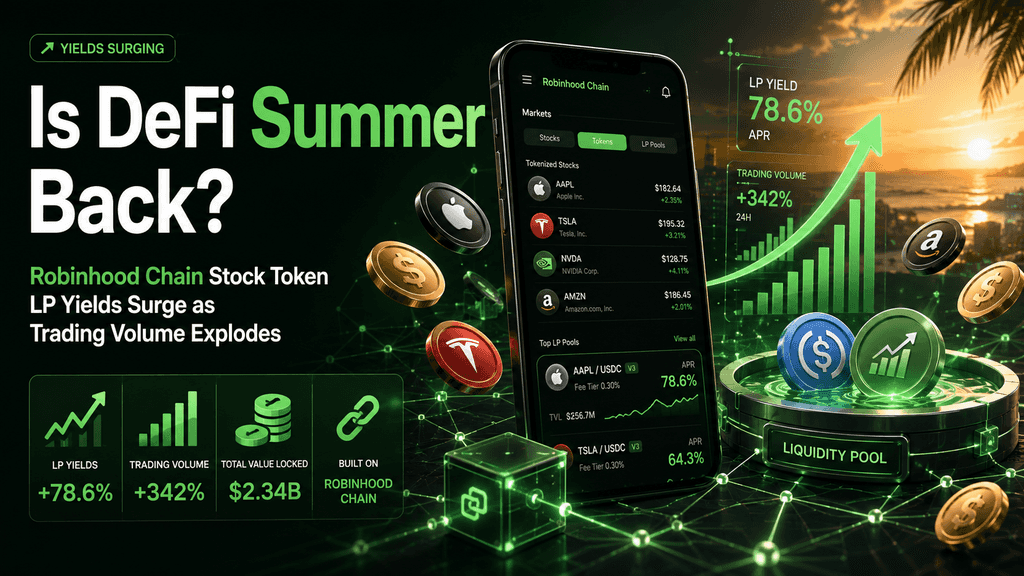
Robinhood Chain, the Ethereum Layer-2 network launched on July 1, 2026, has rapidly shifted focus toward tokenized equities and decentralized finance primitives. Built on Arbitrum Orbit technology with ETH as the gas token and roughly 100-millisecond block times, the chain introduced Stock Tokens, ERC-20 representations of U.S. equities and ETFs available through the Robinhood Wallet in more than 120 countries. Structured as tokenized debt securities rather than direct share ownership, these instruments enable 24/7 trading and integration into lending and liquidity protocols. Early data shows cumulative decentralized exchange volume exceeding $12 billion and over 150 million transactions within two months, according to reports from Zacks and on-chain trackers.
Liquidity pools pairing Stock Tokens such as NVDA and AAPL with stablecoins have recorded elevated fee generation, while total value locked has climbed into the hundreds of millions. Parallel activity in memecoin pairs has further amplified Stock Token turnover by locking equity tokens as collateral in automated market makers. This development raises the question of whether the combination of high trading volume, attractive liquidity provider returns, and expanding real-world asset integration signals a renewed period of DeFi expansion comparable to earlier cycles or reflects a more targeted, retail-driven phase centered on accessible tokenized markets.
Robinhood Chain Mainnet Metrics Reflect Rapid On-Chain Adoption
The public mainnet of Robinhood Chain activated on July 1, 2026, after a public testnet period that began in February. Designed as a permissionless, EVM-compatible Layer-2 optimized for financial services and tokenized real-world assets, the network immediately integrated partners including Uniswap for automated market making, Morpho for lending, Chainlink for price oracles, and BitGo for custody. Within the first weeks, decentralized exchange volume reached multi-hundred-million-dollar daily peaks, with one early reading of $878 million in a single day pushing the chain temporarily into the top ranks by activity. Total value locked advanced from initial levels near $100 million to peaks above $400 million and later stabilized in the $300 million range, according to DefiLlama and related dashboards, while stablecoin market capitalization approached $400 million. Transaction counts surpassed 150 million, supported by a 90-day gas subsidy program covering swaps, Stock Token trades, and bridge activity for eligible wallet users. This subsidy is scheduled to expire in early October 2026, creating a forthcoming test of organic retention. The absence of a native chain token has directed incentives toward application-layer rewards and protocol-specific emissions rather than broad airdrop speculation.
Adoption has been uneven across asset classes. Memecoin trading initially dominated volume, accounting for roughly 80 percent of activity in the first weeks, yet Stock Token and real-world asset volumes have expanded concurrently. Tokenized equities market capitalization rose fivefold in two weeks to approximately $70 million by late July, with daily Stock Token volume averaging nearly $30 million and occasionally exceeding $50 million. More than 200 tokenized U.S. stocks and ETFs are now listed, and Uniswap controls the large majority of their decentralized exchange liquidity across v3 and v4 pools. These figures place Robinhood Chain ahead of several competing venues for tokenized equity turnover in short windows, illustrating how distribution through an existing retail brokerage base can accelerate on-chain participation even when underlying legal structures limit ownership rights.
Stock Token Daily Volumes Surpass Multiple Competing Venues
Tokenized equities on Robinhood Chain have generated average daily decentralized exchange volume of $29.7 million over multi-week periods, exceeding the combined output of Solana-based platforms such as xStocks and Backpack Sunrise during the same intervals. Individual names have driven concentrated activity: tokenized GameStop recorded daily volumes near $26.6 million at peaks, Nvidia near $14 million, and SpaceX near $6.4 million. Twelve Stock Tokens have cleared more than $500,000 in daily volume, with several exceeding $1 million. Cumulative Stock Token trading volume has surpassed $1 billion, with a single-day high of $130 million reported in September data. Pricing relies on Chainlink oracles, and corporate actions such as dividends are reflected through an on-chain multiplier mechanism that adjusts economic exposure without distributing cash or altering token balances until redemption.
The structure of these tokens distinguishes them from direct equity. Issued as tokenized debt securities by a Robinhood entity and held in segregated custody, they provide economic performance tracking but no voting rights or direct claim on underlying shares. Availability outside the United States through the wallet interface has enabled global retail participation subject to local restrictions. Liquidity is concentrated on Uniswap, with v4 pools accounting for the majority share. Newer entrants such as PAIR allow simultaneous pairing of newly launched tokens against multiple Stock Tokens, creating additional pathways for volume. This concentration supports efficient price discovery during continuous trading hours yet also concentrates smart-contract and oracle dependency risk within a limited set of protocols.
Liquidity Provider Fee APRs Reach Elevated Levels in Key Pools
Liquidity pools on Robinhood Chain have displayed wide ranges of fee annualized percentage rates driven by high turnover relative to total value locked. Trackers list pairs such as WETH/USDG with 24-hour volumes exceeding $550 million against roughly $12 million in liquidity, producing estimated fee APRs in the mid-to-high hundreds of percent on an annualized basis for certain fee tiers. Stock Token pairs including NVDA/USDG have shown volumes above $20 million against sub-million-dollar liquidity in some instances, generating fee APRs well above 300 percent in short windows. Additional pools involving newer tokens or memecoin pairings have recorded even higher temporary rates, though these often reflect thin liquidity and rapid price movement. Total tracked liquidity across monitored pools has reached approximately $130 million, with aggregate 24-hour volume near $1.5 billion and estimated fees in the multi-million-dollar range.
These returns are fee-based rather than guaranteed yields and remain subject to impermanent loss when relative prices of paired assets diverge. High annualized figures typically arise in low-TVL pools experiencing concentrated trading interest and can compress quickly as additional capital enters or volume declines. Providers must weigh the fee capture against divergence risk, gas costs after the subsidy period, and the underlying volatility of Stock Tokens that track traditional equity markets. Data from specialized pool explorers indicate that the highest rates cluster in newly created or niche pairs, while more established Stock Token–stablecoin pools offer more moderate yet still elevated returns relative to many mature DeFi venues. Continuous monitoring of fee tiers, position ranges in concentrated liquidity designs, and overall pool utilization remains essential for assessing sustainability.
Memecoin Pairings Amplify Stock Token Liquidity Lockups
A distinctive feature of early activity has been the emergence of memecoin launch platforms that pair new tokens against Stock Tokens rather than solely against ETH or stablecoins. Platforms such as Bankr and long.xyz enabled issuance of memecoins collateralized by tokenized equities across dozens of tickers. Each trade in such pairs generates corresponding Stock Token volume and keeps the equity tokens locked inside the liquidity pool for the duration of the pairing. This mechanism has contributed meaningfully to measured Stock Token turnover, with estimates suggesting that stock-paired memecoin activity accounts for roughly one-third of total real-world asset volume in certain periods. One leading memecoin pair against Nvidia alone generated tens of millions in related Stock Token volume.
The feedback loop has drawn additional attention to the underlying equities while increasing the locked supply of Stock Tokens available for potential use as collateral elsewhere. Daily active Stock Token traders peaked above 20,000 in mid-to-late July, the highest recorded among tracked tokenized equity platforms at the time. Although pure memecoin market capitalization has fluctuated sharply, with one early leader declining substantially from its peak, the residual effect on equity token liquidity has persisted. This dynamic illustrates how speculative activity can bootstrap more fundamental asset classes on a new chain, yet it also introduces correlation risk between memecoin sentiment and measured Stock Token metrics. Protocols that can convert temporary speculative volume into durable liquidity and lending demand will determine the longer-term contribution of this channel.
Robinhood Earn Stablecoin Product Targets Consistent Returns
Robinhood Earn offers eligible users an estimated 7 percent annual percentage yield on USDG, the dollar-backed stablecoin, through a Morpho-powered lending market accessible from self-custody wallets inside the main application. Deposits enter Morpho lending pools where borrowers pay interest; net proceeds after protocol fees return to lenders. Organic vault yields have been lower, readings near 1.9 percent in mid-July, with the difference bridged by promotional incentives including Merkl campaigns and partner rewards. Ethena has offered additional collateral-side incentives on USDe deposits, enabling looped strategies that have produced estimated returns in the mid-teens under favorable conditions.
The product sits at the high end of contemporaneous audited stablecoin DeFi yields and has attracted deposits exceeding $200 million in early reports. Because users retain self-custody, smart-contract risk remains with the depositor rather than the brokerage. The 7 percent target is described as an estimate subject to market rates and incentive budgets; sustainability beyond the promotional period will depend on organic borrow demand and continued partner participation. Morpho markets on the chain have reached total sizes in the hundreds of millions, providing a core lending layer that can also accept Stock Tokens as collateral in complementary markets. This creates potential pathways for users to earn yield on stablecoins while deploying tokenized equities productively, though leverage and liquidation risks require careful position management.
Total Value Locked Expansion Tracks Protocol Diversification
Total value locked on Robinhood Chain advanced rapidly after launch, crossing $100 million within two weeks, peaking near $430–$590 million in July readings, and later settling in the $300 million range according to multiple trackers. Concentration has been notable: Morpho has accounted for a large share of early TVL through lending vaults, while Uniswap versions have held substantial liquidity for trading pairs. Stablecoin market capitalization has approached or exceeded $350–$400 million, reflecting both organic deposits and incentive-driven inflows. Real-world asset TVL, primarily Stock Tokens, grew from low-teen millions to approximately $70 million in a short window and has continued expanding with additional listings.
Diversification beyond the initial core protocols has included perpetuals venues, additional automated market makers, and emerging applications focused on yield aggregation or AI-assisted strategies. The 90-day gas subsidy has lowered barriers for experimentation, contributing to transaction counts and user onboarding. Retention after the subsidy ends in early October will provide clearer evidence of product-market fit. Cross-chain bridging activity has also been significant, with hundreds of millions of dollars moved onto the network. These flows support the thesis that an existing retail distribution channel can accelerate capital formation on a purpose-built Layer-2 more rapidly than purely organic crypto-native launches in some cases.
Tokenized Equity Structure Differs from Direct Ownership Claims
Stock Tokens function as limited-recourse debt instruments issued by a Robinhood entity rather than as equity shares. Holders receive economic exposure to price performance and corporate actions via an on-chain multiplier that adjusts the effective claim when dividends or splits occur, yet they hold no voting rights and no direct legal ownership of the underlying securities. Redemption pathways currently center on cash settlement through authorized participants, with potential future evolution toward physical delivery of securities under applicable rules. Custody of the underlying assets is maintained with a U.S. custodian under series-segregated arrangements.
This design enables continuous trading and DeFi composability while navigating securities law constraints that limit direct on-chain equity ownership for many retail participants. Availability in more than 120 countries through the wallet expands geographic reach beyond traditional brokerage hours and account requirements. Oracle dependency on Chainlink for pricing introduces a single point of reliance for accurate valuation across the listed universe of more than 200 assets. Users evaluating these instruments must distinguish price tracking from ownership rights and assess counterparty and smart-contract risks inherent in the tokenized structure. The model represents a pragmatic bridge between traditional market exposure and on-chain utility rather than a full replication of equity ownership.
Infrastructure Partners Enable Continuous Market Functionality
Core infrastructure includes Chainlink oracles for Stock Token pricing, Uniswap deployments across multiple versions for primary liquidity, Morpho for lending markets, and supporting services from Alchemy, BitGo, and others. The chain itself operates with a Robinhood-operated sequencer under a first-come-first-served ordering model and settles to Ethereum for security and data availability. Block times near 100 milliseconds support responsive trading interfaces suitable for both retail and potential agentic applications. Perpetual futures venues such as Lighter have integrated, offering additional derivatives exposure in selected jurisdictions.
These components collectively allow Stock Tokens to move freely between wallets, decentralized exchanges, and lending markets without returning to a centralized brokerage interface for each action. Gas costs remain low relative to Ethereum mainnet, further encouraged by the temporary subsidy. Developer tooling is fully EVM-compatible, lowering barriers for external builders. The combination supports the stated goal of embedding on-chain financial activity inside familiar retail interfaces while remaining permissionless for external protocols. Reliability of the sequencer and oracle feeds will remain critical as volumes scale and the subsidy period concludes.
Broader DeFi Market Context Frames Current Activity Levels
DeFi activity across major chains has shown recovery signals in recent months, with certain sector indices recording gains near 38 percent over multi-week periods in late August. Protocol revenues on leading decentralized exchanges and lending platforms have remained material, though still sensitive to overall market conditions. Against this backdrop, Robinhood Chain’s volume and TVL growth stand out for the speed of retail onboarding and the specific focus on tokenized equities rather than purely crypto-native assets. Earlier DeFi expansion phases were characterized by high yields on native tokens and leverage cycles; the present episode centers more on accessible real-world asset exposure and fee capture from continuous equity trading.
Whether the current metrics constitute a full return of “DeFi Summer” depends on the durability of yields, the conversion of speculative volume into sticky capital, and the ability of protocols to retain users after promotional incentives fade. Stock Token LP fee rates remain elevated in many pools relative to mature venues, yet they are volume-dependent and subject to compression. Lending yields near the advertised 7 percent target rely in part on subsidies. Sustained expansion would require organic borrow demand, continued growth in locked Stock Token liquidity, and successful navigation of the post-subsidy cost environment.
Risk Factors Include Impermanent Loss and Incentive Dependence
Liquidity providers face classic impermanent loss when Stock Token prices diverge from paired stablecoins or ETH, a risk amplified by the continuous 24/7 trading that can produce larger intraday moves than traditional market hours. High temporary APRs often coincide with thin liquidity and elevated volatility, increasing the probability of adverse price movement. Lending participants in Morpho markets confront smart-contract risk, potential liquidation cascades if collateral values decline, and the possibility that promotional top-ups decline over time. The gas subsidy expiration introduces a discrete cost increase that may reduce low-value experimentation and affect retention metrics.
Oracle reliability and the legal characterization of Stock Tokens as debt instruments rather than equity also constitute structural considerations. Users outside supported jurisdictions cannot access the tokens, limiting global uniformity. Concentration of liquidity on a small number of protocols raises systemic exposure should any single venue experience disruption. Careful position sizing, range management in concentrated liquidity designs, and ongoing monitoring of incentive schedules remain necessary for participants seeking to capture the elevated fee and lending rates currently available.
Retail Distribution Channel Differentiates Adoption Direction
Robinhood’s existing base of more than 20 million funded customers provides a distribution advantage that many pure crypto-native chains lack. Integration of the chain and Stock Tokens into the familiar wallet and application interface lowers the onboarding friction for users who may not previously have interacted with decentralized applications. Early transaction and user metrics, including peaks above 300,000 daily active users, reflect this channel effect. The ability to move from traditional brokerage exposure to on-chain Stock Tokens and lending products within a single ecosystem accelerates capital formation relative to standalone DeFi launches.
This distribution model also shapes the character of activity. Retail-driven flows have favored accessible products such as stablecoin lending and continuous equity trading over complex leverage strategies in the initial phase. The resulting volume profile combines speculative memecoin interest with growing real-world asset turnover. Long-term success will depend on converting first-time on-chain users into sustained participants who utilize Stock Tokens as collateral, provide liquidity across multiple pairs, and engage with additional protocol layers as the ecosystem matures.
Outlook Hinges on Post-Subsidy Retention and Organic Demand
The forthcoming expiration of the 90-day gas subsidy in early October 2026 will serve as a practical stress test for protocol retention and user activity. Protocols that have built durable fee or lending revenue independent of temporary incentives are better positioned to maintain liquidity and volume. Continued expansion of the Stock Token universe, deeper integration of equity tokens as collateral across lending markets, and development of additional applications leveraging the continuous trading capability will influence whether current metrics represent a temporary surge or a durable shift.
Broader market conditions, including equity volatility and overall risk appetite for tokenized assets, will also shape outcomes. If Stock Token volumes remain elevated relative to competing venues and LP fee capture stays competitive after cost normalization, the chain may contribute meaningfully to the next phase of real-world asset onboarding into DeFi. Conversely, sharp declines in volume or liquidity after the subsidy ends would indicate that promotional conditions played a larger role than product fundamentals. Ongoing data from pool explorers, TVL trackers, and volume dashboards will provide the clearest evidence in the coming weeks.
Operational Steps Liquidity Providers and Lenders Must Weigh on Robinhood Chain
Participants evaluating liquidity provision should examine current fee tiers, historical volume relative to TVL, and the degree of concentration risk in individual pools. Concentrated liquidity positions require active range management to remain in range and capture fees. Lending strategies involving USDG or looped collateral benefit from understanding the composition of organic versus incentive-driven yields and the terms of any partner reward programs. Bridging assets onto the chain and managing self-custody wallets introduce operational steps that differ from traditional brokerage accounts.
Risk management tools such as position sizing relative to overall portfolio exposure, monitoring of oracle health, and awareness of redemption mechanics for Stock Tokens help mitigate structural differences from conventional assets. The continuous nature of the market means that price discovery occurs outside traditional session hours, which can both increase opportunity and elevate overnight or weekend volatility. Users should treat elevated temporary APRs as indicators of current market conditions rather than guaranteed ongoing returns, and they should verify all on-chain data independently before committing capital.
FAQs
What factors have driven the rapid increase in Stock Token trading volume on Robinhood Chain since its July 2026 launch?
The combination of continuous 24/7 trading availability, integration into popular decentralized exchange interfaces, and the unexpected volume contribution from memecoin pairs that use Stock Tokens as collateral has produced cumulative volumes exceeding $1 billion. Retail access through an existing wallet interface in more than 120 countries has further accelerated participation relative to platforms requiring separate onboarding.
How do current liquidity provider fee rates on Stock Token pools compare with yields available on more established DeFi networks?
Many pools have displayed annualized fee rates well above 100 percent and in some cases several hundred percent during high-volume periods, driven by elevated turnover relative to liquidity depth. These rates remain volume-dependent and subject to compression as capital enters or trading interest shifts, and they must be evaluated net of impermanent loss.
Are the 7 percent yields advertised for Robinhood Earn fully organic or supported by temporary incentives?
Organic lending yields in the underlying Morpho vaults have registered lower figures near 2 percent in early readings, with promotional campaigns and partner rewards bridging the gap to the estimated 7 percent target. Sustainability after incentive budgets adjust will depend on organic borrow demand and market rates.
What happens to Stock Token economic exposure when the underlying equity pays a dividend?
Dividends are reflected through an on-chain multiplier that increases the effective claim represented by each token without distributing cash or changing the user’s token balance until redemption. The mechanism aims to preserve total-return tracking while remaining compatible with the debt-security structure.
How significant is the contribution of memecoin activity to measured Stock Token volume?
Stock-paired memecoin trading has accounted for a material share, estimates near one-third in some periods, of total real-world asset volume by locking Stock Tokens inside liquidity pools and generating corresponding turnover with every trade. This channel has helped bootstrap equity token activity beyond pure directional trading.
What risks should liquidity providers consider when supplying capital to high-APR pools on the chain?
Impermanent loss from relative price divergence, the potential for rapid rate compression as more capital enters thin pools, smart-contract exposure, and the upcoming increase in gas costs after the subsidy period ends are primary considerations. Position ranges and overall portfolio allocation require active oversight.
🔥 KuCoin Offers A More Stable Option in A Volatile Market
If you worry about the frequent ups and downs in the market, and pursue a more stable option to earn money passively, KuCoin is the right place to come:

Simple Earn: Deposit and withdraw tokens anytime, earning stable returns.
Kucoin Earn: Earn stable profits with professional asset management.
Hold to Earn: Earn rewards by holding assets in Funding, Trading, Margin, Futures, Mining, and Unified Accounts.
Staking: Unlock the earning potential of on-chain assets.
Advanced Investments: Advanced Investments offer a variety of structured products to help your money grow in any market.
Shark Fin: Principal Protection and Guaranteed Gains
Dual Investment: Buy low and sell high with transparent return calculations.
Snowball: High yields, with price protection.
Discount Buy: Buy crypto at discount prices.
KCS Loyalty: Level up to enjoy exclusive perks by staking ≥ 1 KCS.
KuCoin Wealth: Discover future value and begin your smart investing journey.
KCS Benefits: Hold and stake KCS to access benefits across the platform.
KCS Staking 2.0: Participate in KCS on-chain governance to earn yield.
Disclaimer: This content is for informational purposes only and does not constitute investment advice. Cryptocurrency investments carry risk. Please do your own research (DYOR).