

Ripple CEO Praises U.S. Treasury Secretary Scott Bessent Amid Major Corporate Crypto Rollouts
Introduction
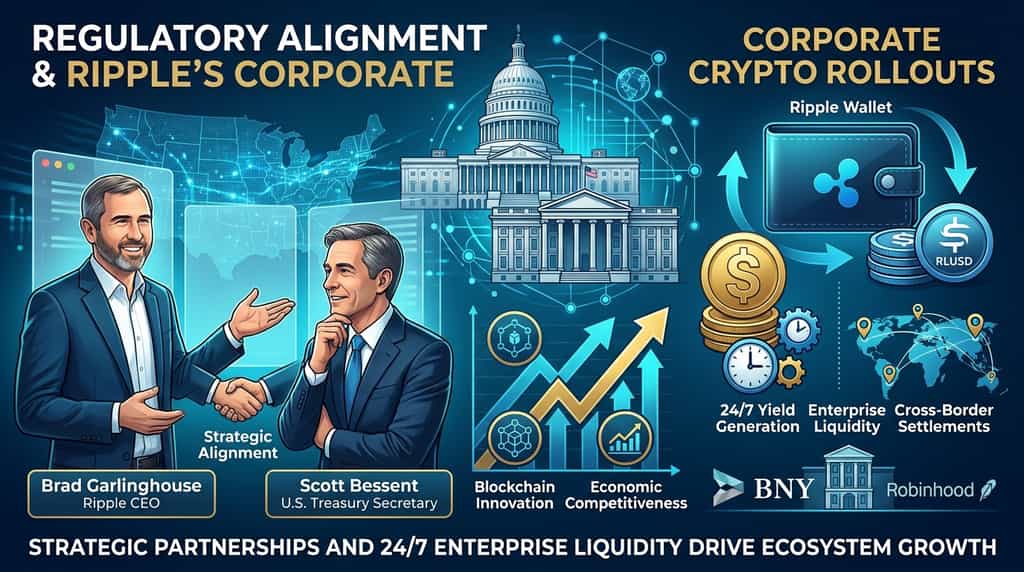
The intersection of regulatory alignment and institutional blockchain innovation reached a milestone as Ripple CEO Brad Garlinghouse publicly commended U.S. Treasury Secretary Scott Bessent during the opening of the Swell conference. According to official reports from financial data platforms and event coverage, Garlinghouse credited the administration's proactive stance with fostering an environment where responsible digital assets can scale safely within the United States. This high-profile endorsement coincided with major corporate product announcements, including a specialized digital asset cash return service tailored for enterprise liquidity management. As regulatory landscapes shift to embrace technological innovation, the convergence of government dialogue and enterprise-grade infrastructure is reshaping how corporations manage idle capital.
Strategic Alignment Between Ripple Leadership and the U.S. Treasury
Government backing for digital financial infrastructure has become a primary catalyst for institutional adoption, with Treasury Secretary Scott Bessent emphasizing that digital assets reinforce global dominance for the U.S. dollar. Speaking alongside Brad Garlinghouse at the Swell conference, Bessent noted that technological leadership in blockchain, artificial intelligence, and digital assets acts as a vital pillar of economic competitiveness. According to CoinGecko metrics cited during industry disclosures, more than 98% of stablecoins in circulation are denominated in U.S. dollars, meaning widespread adoption directly drives foreign demand for U.S. Treasury securities. Garlinghouse praised this administrative vision, stating that current leadership has been instrumental in clearing operational hurdles for compliant blockchain networks.
The alignment extends beyond rhetorical support into practical regulatory frameworks. According to statements released during the conference, the Treasury Department intends to coordinate with regulatory bodies like the SEC and CFTC to establish administrative guardrails that eliminate historical debanking pressures. By integrating digital assets into the broader economic strategy, the federal government aims to secure long-term technological superiority while providing legal certainty for financial institutions venturing into distributed ledger technology.
Ripple's New Corporate Crypto Cash Return Service
Enterprise treasury departments can now generate returns on idle operating capital outside traditional banking hours through Ripple's newly launched cash return service. Introduced to meet corporate demand for continuous asset productivity, the offering allows eligible businesses to earn yields on qualifying digital assets—including the dollar-backed stablecoin RLUSD—held securely within a designated Ripple wallet.
-
24/7 Yield Generation: Capital that traditionally sat idle overnight, over weekends, and during holidays can now be actively deployed.
-
Automated Cash Positioning: Artificial intelligence tools embedded within the platform coordinate liquidity management, forecasting, and reconciliation automatically.
-
Zero-Touch Execution: Businesses can participate in digital asset yield programs without requiring internal infrastructure to manage underlying blockchain transaction execution.
This service bridges the gap between traditional corporate treasury operations and high-speed blockchain settlements, transforming dead asset periods into continuous revenue streams.
Expanding Institutional Partnerships and Ecosystem Growth
Institutional confidence in Ripple's infrastructure has accelerated rapidly, driven by major partnership announcements across custody, retail services, and trust banking. According to recent corporate updates, Robinhood established an agreement with Ripple to integrate digital asset capabilities for its extensive customer base, touching customer-facing services and institutional financing. Simultaneously, Ripple expanded its cooperation with BNY across digital custody services and proposed tokenized trade finance instruments. These developments are further anchored by the final federal approval of the Ripple National Trust Bank, providing a fully regulated institutional foundation for enterprise-grade digital asset custody and settlement operations.
Enterprise Liquidity and the Future of Cross-Border Settlements
Corporate adoption of blockchain-based liquidity solutions is fundamentally changing how multinational firms move funds across global jurisdictions. Traditional correspondent banking networks often trap capital in transit for days, creating friction and high working capital costs. By utilizing high-throughput blockchain networks and native tokenized assets, enterprises can execute cross-border settlements in seconds rather than days. The integration of artificial intelligence with real-time ledgers allows treasury teams to predict cash flow deficits and automatically rebalance liquidity across international accounts. This operational efficiency drastically reduces the amount of trapped capital companies must maintain as buffer reserves, freeing up balance sheets for strategic corporate growth.
Conclusion
The convergence of high-level government endorsement and advanced enterprise utility marks a transformative turning point for the digital asset industry. Treasury Secretary Scott Bessent's acknowledgment of digital assets as a cornerstone of future economic strength validates the technology's role in fortifying the global standing of the U.S. dollar. Concurrently, Ripple's introduction of 24/7 corporate cash return services and major institutional integrations with entities like Robinhood and BNY demonstrate that blockchain utilities have matured into essential enterprise tools. As regulatory clarity solidifies and traditional financial institutions deepen their blockchain integration, digital assets are permanently embedding themselves into the core architecture of modern global finance.
Frequently Asked Questions
What is the primary function of Ripple's new corporate cash return service?
The service allows eligible enterprise customers to generate returns on operating cash and qualifying digital assets—such as dollar-backed stablecoins—during periods when traditional banks are closed, including overnight, weekends, and holidays.
How does the U.S. Treasury view the growth of dollar-denominated stablecoins?
According to official statements by Treasury Secretary Scott Bessent, dollar-denominated stablecoins strengthen the global dominance of the U.S. dollar by expanding its reach in international markets while increasing foreign demand for U.S. Treasury debt.
Which stablecoin is explicitly highlighted as eligible for Ripple's enterprise return programs?
Ripple USD (RLUSD), the company's native dollar-backed stablecoin, is designated as a qualifying asset eligible for participation in the newly announced enterprise cash return offerings.
What role do artificial intelligence tools play in Ripple's enterprise platform?
AI tools embedded within the system handle automated cash positioning, liquidity management, transaction forecasting, and account reconciliation without requiring manual oversight from corporate treasury staff.
Which major financial and retail institutions were tied to Ripple's recent ecosystem expansion?
Recent ecosystem growth highlights include expanded custody and trade finance cooperation with BNY, an integration agreement with Robinhood, and final federal approval secured for the Ripple National Trust Bank.
Disclaimer
This general market information, possibly from third-party, commercial, or sponsored sources, is provided for reference and educational purposes only and does not constitute financial or investment advice, an offer, solicitation, or guarantee. We disclaim liability for its accuracy, completeness, reliability, and any resulting losses. Investments/trading are risky; past performance doesn’t guarantee future results. Users should research, judge prudently, and take full responsibility. For further details, please consult KuCoin’s Terms of Use and Risk Disclosure.