

Raydium Q3 2026 Report: Revenue Growth, Tokenized Stocks, and RAY Buybacks
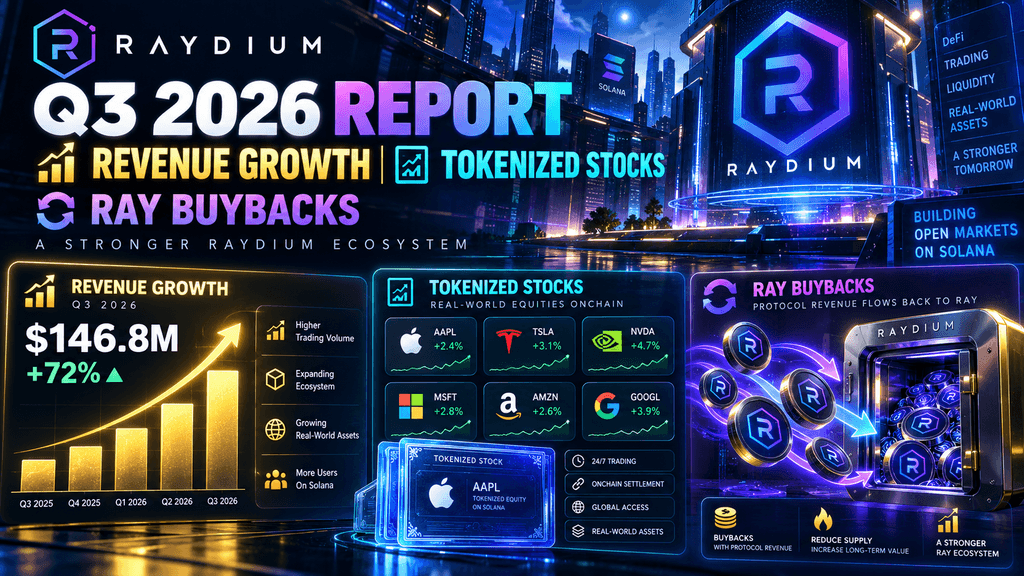
Raydium’s third-quarter 2026 performance highlights a growing connection between tokenized assets, decentralized trading infrastructure and crypto token economics. According to a Blockworks Advisory report published on October 21, Raydium generated $7.99 million in net revenue during Q3, up 264.2% from the previous quarter. The protocol also recorded approximately $5.23 million in RAY buybacks, while tokenized-asset trading volume reached $3.99 billion. These figures point to a strong quarterly rebound, but they also reveal a concentration risk: much of the improvement arrived in September after StonkFun moved its token launches to Raydium’s LaunchLab platform.
The central question is whether this activity can become a sustainable source of protocol revenue and demand for RAY. Higher-fee trading markets and revenue-linked buybacks create a potential connection between platform usage and token economics. However, the concentration of activity in one month means investors must distinguish a strong quarterly result from a durable growth trend.
Key Takeaways
-
Revenue rebounded sharply: Raydium reported $7.99 million in Q3 net revenue, up 264.2% from Q2, according to Blockworks Advisory.
-
Tokenized assets gained traction: Trading volume for tokenized assets reached $3.99 billion, an increase of 90.9% quarter over quarter.
-
RAY buybacks expanded: The protocol repurchased approximately $5.23 million worth of RAY, compared with $1.72 million in Q2.
-
LaunchLab drove a major activity shift: StonkFun’s September migration helped increase token launches and stock-linked trading.
-
Revenue concentration remains a concern: September accounted for $6.06 million of quarterly net revenue, making subsequent performance dependent on whether elevated activity persists.
-
Buybacks do not guarantee price appreciation: Revenue quality, market liquidity, trading demand and broader crypto conditions will continue to influence RAY.
Raydium Q3 2026 Report: Key Financial Results
Raydium’s Q3 results demonstrate a sharp recovery from a relatively weak start to the quarter. Blockworks Advisory reported $7.99 million in net revenue, a 264.2% increase from Q2. RAY buybacks reached $5.23 million, up 203.3%, while tokenized-asset volume climbed to $3.99 billion. The report was funded by Reactor Labs, Raydium’s developer entity, while Blockworks Advisory stated that it retained editorial control. These figures provide a useful starting point for evaluating the protocol’s performance, although the definitions used by different analytics providers should be checked before making direct comparisons.
| Metric | Q3 2026 | Change from Q2 2026 |
| Net revenue | $7.99 million | 2.642 |
| RAY buybacks | $5.23 million | 2.033 |
| Tokenized-asset volume | $3.99 billion | 0.909 |
| Share of Solana tokenized-asset spot volume | 49.80% | Up from 36.2% |
Source: Blockworks Advisory figures reported by Solana Compass on October 21, 2026.
The timing of the recovery matters as much as the headline growth rates. September generated $6.06 million of the quarter’s $7.99 million in net revenue, compared with $510,000 in July and $1.42 million in August. This distribution suggests that Raydium’s improvement was concentrated in the final month rather than spread evenly across the quarter. It raises an important question for Q4: did Raydium establish a stronger revenue base, or did a temporary surge in trading activity account for much of the improvement?
A separate Q3 analysis by Pine Analytics, published on October 5, estimated protocol revenue at $9.39 million and tracked approximately $5.15 million in RAY buybacks involving 4.58 million tokens. These figures differ from Blockworks Advisory’s estimates because the reports use different data sources and measurement definitions. Pine’s revenue estimate draws on DefiLlama fee data, while its tokenized-stock volume calculation includes trading pairs containing a stock-linked token. The figures should therefore be treated as separate research estimates rather than combined into one dataset.
Why Did Raydium Revenue Surge in Q3?
Raydium’s revenue rebound was driven primarily by LaunchLab upgrades, StonkFun’s migration and increased trading in tokenized assets. Rather than relying exclusively on activity in traditional token-swapping markets, Raydium expanded the ways third-party platforms could use its infrastructure to launch assets and generate trading activity. This created a new growth channel, although the concentration of activity in September suggests that the resulting revenue may be sensitive to changes in partner demand.
LaunchLab Expanded Its Role in Solana DeFi
LaunchLab is Raydium’s token-launch platform. During August, Raydium introduced upgrades that allowed external platforms to configure aspects of their launch mechanisms, fee structures, quote assets and launch parameters. These changes made the infrastructure more adaptable to partners with different product designs, rather than requiring every project to follow a fixed launch format.
The commercial significance is that third-party platforms can use Raydium’s infrastructure to introduce tokens, attract users and move successful launches into liquidity pools. Raydium can then benefit from the resulting trading activity through applicable fees. This model allows the protocol to participate in new token markets without operating every launch platform itself. Its effectiveness, however, depends on whether partner platforms can attract sustained demand rather than generate a short-lived wave of speculative trading.
StonkFun Triggered a September Surge
StonkFun announced on September 5 that new token launches would move to LaunchLab. According to Pine Analytics, LaunchLab recorded 156,294 launches in September, compared with 5,420 in August. StonkFun accounted for 149,085 of September’s launches, making it the dominant contributor to the monthly total.
Trading activity also increased substantially. StonkFun’s bonding curves generated approximately $921 million in September volume, while tokens that graduated into Raydium’s constant-product market maker pools generated another $1.89 billion. Together, these activities produced approximately $2.81 billion in trading volume, representing about 28% of Raydium’s September volume under Pine Analytics’ methodology.
The figures demonstrate the commercial value of infrastructure integrations, but they also expose a concentration risk. A significant portion of Raydium’s recent growth came from one partner and a short period of unusually high activity. If StonkFun launches fewer tokens or its users trade less frequently, Raydium could experience a meaningful reduction in fee generation.
Tokenized Stocks Become a Major Trading Driver
Tokenized stocks helped expand Raydium’s activity by introducing stock-linked assets into Solana’s onchain trading environment. These products represent or provide exposure to traditional financial assets through blockchain-based tokens, although their legal rights, backing structures and redemption mechanisms vary by issuer. On Raydium, stock-linked tokens can be traded against other tokens or used as quote assets for newly launched projects, creating additional transaction flows.
Pine Analytics estimated that trading pairs containing a tokenized-stock asset generated $4.14 billion in Q3 volume, more than double the $1.77 billion recorded in Q2. Direct trading between stock-linked tokens and SOL or stablecoins accounted for $2.43 billion, while newly launched tokens quoted in stock-linked assets contributed approximately $1.71 billion. These figures use Pine’s broader definition of stock-linked volume and should not be treated as directly interchangeable with Blockworks Advisory’s $3.99 billion tokenized-asset figure.
Why Tokenized Equities Matter to Raydium
Tokenized equities are attracting attention because blockchain infrastructure can make eligible financial exposures more transferable and composable. Depending on the product, users may be able to trade through compatible wallets and decentralized exchanges, while some tokenized assets may be integrated into lending or collateral systems. For Raydium, the immediate business opportunity is transaction activity: new asset pairs and more frequent trading can increase fees generated by supported pools.
The broader growth of tokenized stocks and onchain equity markets provides additional context for Raydium’s rising trading activity, although sustaining this momentum will depend on continued user demand and liquidity.
However, holder counts do not necessarily represent unique investors, and trading volume does not establish the value of legally owned underlying shares. Different issuers may offer different redemption rights, custody arrangements and economic exposures. The distinction matters because tokenized-stock growth depends not only on accessible trading infrastructure but also on users understanding what their tokens actually represent.
How Raydium Fits Into the Onchain Equity Race
The competition extends beyond Solana. BNB Chain, Robinhood Chain and Solana have emerged as important distribution networks for tokenized equities, but their approaches differ. Some ecosystems emphasize access for existing crypto users, while others connect brokerage-style products with blockchain infrastructure. Solana’s opportunity lies partly in its established DeFi environment, where eligible tokenized assets can interact with decentralized exchanges and other onchain applications.
Raydium’s Q3 market share indicates that it has captured a meaningful portion of Solana’s tokenized-asset trading activity. Maintaining that position will depend on liquidity, user experience, partner integrations and competition from other trading venues. The broader expansion of tokenized equities creates opportunities, but it does not guarantee that Raydium will retain its share or that higher trading volume will translate proportionately into net revenue.
How RAY Buybacks Work and Why They Matter
Raydium’s buyback program links eligible protocol activity to market purchases of its native token, RAY. Under the fee-allocation mechanism described in public materials, 12% of fees from applicable trading pools are directed toward buying RAY on the open market. The purchased tokens are held in a protocol-controlled wallet rather than automatically being burned. This distinction matters because repurchasing tokens and permanently removing them from circulation are not the same thing.
Blockworks Advisory reported that Raydium bought back approximately $5.23 million worth of RAY in Q3, compared with $1.72 million in Q2. Pine Analytics independently tracked approximately 4.58 million RAY purchased for about $5.15 million. Both reports indicate a substantial increase in repurchase activity, although their valuation methods and measurement dates differ slightly.
Buybacks Connect Protocol Activity With Token Demand
When eligible trading activity increases, the fees allocated to buybacks can also rise. These purchases create a potential link between Raydium’s usage and demand for RAY, although they do not guarantee price appreciation. The effect depends on whether buyback demand can offset selling pressure and broader market volatility.
Investors should assess buybacks alongside protocol revenue, liquidity and RAY price movements rather than treating repurchase activity as a standalone bullish signal. Sustained demand for the token ultimately depends on both market conditions and Raydium’s ability to maintain fee-generating activity.
Buybacks Are Not Token Burns
Because repurchased RAY is held in a protocol-controlled wallet, the full amount should not automatically be counted as permanently removed supply. The impact depends on how those holdings are managed and whether the protocol’s policies change. It is therefore more accurate to describe the program as a source of potential buying demand than as a guaranteed mechanism for reducing circulating supply.
The financial significance also depends on sustainability. A quarter with unusually high fees can support larger buybacks, but a decline in trading activity may reduce the amount available for future purchases. Investors should track both the quantity of RAY repurchased and the revenue that funds the program, rather than focusing exclusively on the dollar value of one quarter’s transactions.
What the Q3 Report Means for RAY
The report strengthens the case that RAY’s token economics are connected to Raydium’s usage, but it does not establish a predictable relationship between revenue and market price. Higher fees can support more buybacks, and tokenized-asset activity may provide additional sources of trading demand. Nevertheless, token prices also reflect market expectations, liquidity conditions, investor positioning and broader movements across Solana and the cryptocurrency market.
The recent rise in buybacks is therefore one indicator to monitor, not a standalone valuation signal. Investors should consider whether the protocol can sustain revenue beyond September, whether trading activity is spread across more partners, and whether the tokenized-asset market continues to grow. They should also distinguish between revenue generated by the protocol and trading activity that benefits external launch platforms or token issuers.
A more durable growth profile would involve multiple sources of activity, stable fee generation and continued integration of tokenized assets without excessive dependence on a single launchpad. If those conditions develop, Raydium may be better positioned to convert ecosystem growth into recurring protocol revenue. If activity falls sharply after the September spike, however, Q3 could prove to be an exceptional quarter rather than a new baseline.
Q4 Outlook: Growth Opportunities and Risks
Raydium enters Q4 with new opportunities, but the immediate challenge is maintaining activity after the StonkFun-driven surge. Pine Analytics reported that fees during the first four days of October were running approximately 43% below September’s daily average. This short observation window is not sufficient to establish a full-quarter trend, but it highlights the risk of extrapolating September’s results into the future.
One potential growth path is further adoption of LaunchLab by external platforms. More integrations could diversify the sources of token launches and reduce reliance on a single partner. Additional tokenized-asset listings could also expand the range of tradable markets. However, competition among Solana launchpads remains intense, and partners may change platforms as they seek better fees, user access or liquidity.
Another factor is the quality of trading activity. Raw volume can be inflated by wash trading or by transactions involving thinly traded assets. Pine Analytics excluded an estimated $7.01 billion in wash trading from its adjusted Q3 volume calculation, illustrating why headline totals need context. For a more accurate assessment, investors should compare adjusted volume, fee generation, liquidity and the distribution of activity across pools.
Ultimately, Raydium’s Q4 performance will depend on whether new integrations, tokenized-stock demand and fee-generating trading can offset any decline in launchpad activity. The most meaningful sign of progress would be a more diversified revenue base, rather than simply another short-lived increase in token launches.
Conclusion
Raydium’s Q3 2026 report marks a strong rebound in protocol revenue and highlights the growing role of tokenized stocks in Solana’s DeFi ecosystem. Blockworks Advisory reported $7.99 million in net revenue, $5.23 million in RAY buybacks and $3.99 billion in tokenized-asset volume. LaunchLab’s upgrades and StonkFun’s migration helped drive a sharp September surge, showing how third-party integrations can create new sources of activity for decentralized trading infrastructure.
Yet the same figures reveal the main uncertainty facing Raydium: much of the quarter’s improvement was concentrated in one month and closely tied to a single launch platform. Buybacks connect protocol activity with potential RAY demand, but they do not guarantee price appreciation or permanently reduce token supply. The next phase will depend on revenue diversification, sustained tokenized-asset trading and the ability to maintain liquidity as competition intensifies. Investors should treat Q3 as evidence of Raydium’s growth potential while waiting for subsequent data to confirm whether the rebound can persist.
FAQs
What blockchain does Raydium operate on?
Raydium is a decentralized finance protocol built on Solana. It provides token swaps and liquidity pools, alongside infrastructure for token launches through LaunchLab.
What is the difference between an AMM and a CLMM?
An automated market maker (AMM) uses a pricing formula and pooled assets to facilitate trades. A concentrated liquidity market maker (CLMM) allows liquidity providers to allocate capital within selected price ranges, potentially improving capital efficiency but requiring more active liquidity management.
Does RAY give holders ownership of Raydium?
Holding a governance or utility token does not automatically confer equity ownership in a protocol’s developer entity. The rights associated with RAY depend on the token’s design and applicable governance mechanisms, not on the ownership rights associated with company shares.
Can tokenized stocks be traded without a traditional brokerage account?
Some tokenized equity products can be accessed through compatible crypto wallets and onchain applications, subject to issuer rules and geographic restrictions. Availability does not mean that every product offers direct ownership of the underlying shares or is available to every investor.
Why can two research reports show different Raydium revenue figures?
Analytics providers may use different data sources, fee definitions, attribution methods and reporting periods. Protocol revenue, gross trading fees and other onchain activity measures are not necessarily equivalent. Readers should check each report’s methodology before comparing figures.
Disclaimer: This article is for informational purposes only and does not constitute financial or investment advice. Cryptocurrency investments carry significant risk. Always conduct your own research before trading.