

QUANT Meme Coin Explained: How Quantums Combines Robinhood Chain, NFTs and Tokenized SPY
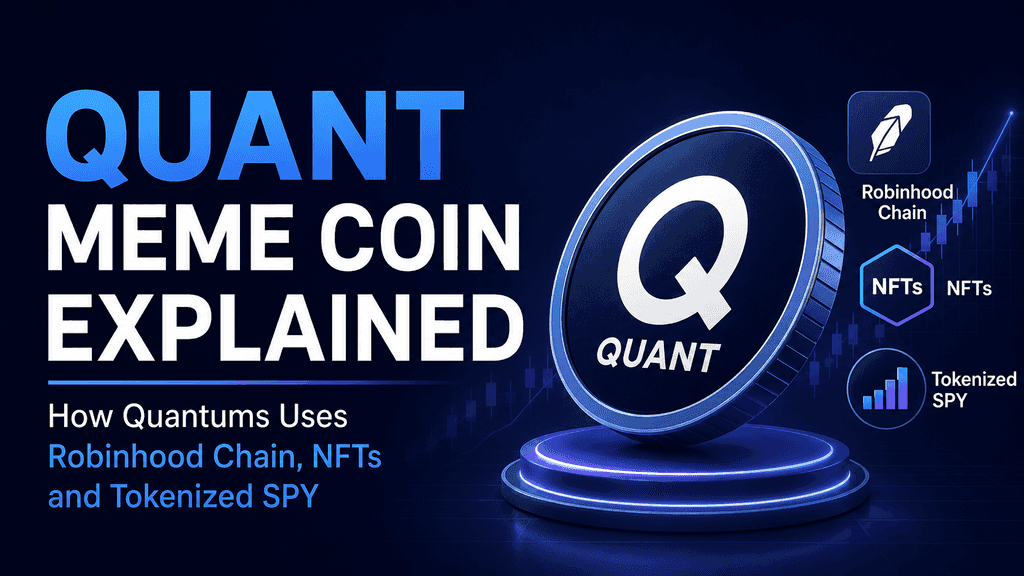
The QUANT meme coin is gaining attention for a structure that goes beyond the usual community-driven meme token model. At the center of the project is Quantums, an onchain ecosystem that connects $QUANT ownership with a limited collection of 4,000 Quantum NFTs, a tokenized SPY reserve and decentralized trading infrastructure on Robinhood Chain. Instead of separating its token, NFT collection and reserve into independent products, Quantums attempts to make each component interact within the same protocol.
That combination places Quantums at the intersection of several growing crypto trends, including meme coins, NFTs, tokenized real-world assets and decentralized finance. QUANT holders can participate in an NFT distribution system, while trading activity contributes to a reserve linked to tokenized SPY. The protocol is also designed to transition toward a buyback-and-burn model after its NFT distribution phase ends. Understanding how these mechanisms connect is essential for anyone researching what QUANT is, how the Quantums ecosystem works and what its tokenomics could mean for holders.
What Is QUANT Meme Coin and How Does the Quantums Ecosystem Work?
QUANT is the meme coin at the center of Quantums, an onchain ecosystem that connects token ownership with a limited collection of 4,000 Quantum NFTs. Built on Robinhood Chain, the project gives QUANT a role beyond ordinary meme-coin trading by using token balances to determine eligibility for recurring NFT distributions. Instead of relying on a traditional NFT mint, Quantums combines its meme coin, digital collectibles and an onchain reserve within one automated protocol, creating a structure designed around continued participation in the ecosystem. The model is intended to make the token more closely connected to protocol activity rather than functioning only as a standalone speculative asset. For crypto users researching what QUANT meme coin is, the key point is that QUANT acts as an entry point into several connected features of the Quantums system.
How QUANT Powers the Quantums NFT Ecosystem
Holding $QUANT gives users eligibility for the Quantums protocol's hourly Quantum NFT drawings. The system uses a balance-weighted selection mechanism, meaning a wallet's chance of being chosen is influenced by its share of qualifying QUANT holdings. When a wallet is selected, it receives a Quantum NFT without going through a conventional public mint, whitelist or separate NFT sale. This makes QUANT ownership a central part of the NFT distribution process rather than treating the token and collectible collection as completely independent assets. The hourly structure also spreads distribution across time instead of releasing the entire NFT supply during one mint event.
The Quantum collection has a fixed maximum supply of 4,000 NFTs, divided among several rarity categories. After receiving a Quantum, a holder can retain it, trade it on the secondary market or use the protocol's burn mechanism under the applicable reserve-claim rules. Burning removes that NFT from circulation rather than returning it to the distribution pool. As a result, the system introduces a changing relationship between the original collection size and the number of Quantums that remain active over time. This gives the NFTs a functional role alongside their collectible characteristics and ties them more closely to activity across the broader Quantums ecosystem.
What Makes QUANT Different From a Typical Meme Coin?
What distinguishes the QUANT meme coin from many conventional meme tokens is its integration with a broader onchain protocol. Rather than depending mainly on viral attention, social-media momentum or speculative trading, $QUANT is connected to NFT participation and an ecosystem reserve associated with tokenized SPY. The token, NFT collection and reserve therefore operate as parts of one economic design instead of existing as unrelated assets. This gives Quantums a more structured model than meme coins built primarily around branding or community narratives. However, additional utility does not remove the risks normally associated with emerging meme coins. QUANT can still experience significant price volatility, changing liquidity, speculative demand and smart-contract risks, so the mechanics of the ecosystem should be evaluated separately from expectations about future token prices.
How Quantums Uses Robinhood Chain, NFTs and Tokenized SPY
Quantums brings together meme-coin liquidity, NFTs and tokenized real-world asset exposure through Robinhood Chain. The network is an Ethereum-compatible Layer 2 designed to support smart contracts, decentralized applications and tokenized financial assets. For Quantums, this infrastructure makes it possible to connect $QUANT trading with tokenized SPY while keeping liquidity, reserve activity and NFT-related interactions within an onchain environment. Robinhood Chain's emphasis on programmable financial assets is especially relevant to the project because tokenized securities can potentially interact with decentralized protocols rather than remaining confined to traditional brokerage infrastructure. At the same time, Quantums being deployed on Robinhood Chain does not mean Robinhood created, approved or endorsed QUANT, since independent developers can build applications on the permissionless network.
How the QUANT and Tokenized SPY Liquidity Pool Works
A central feature of the Quantums model is the QUANT/SPY liquidity pool on Uniswap v4, which connects the project's meme coin with a tokenized asset providing economic exposure to the SPDR S&P 500 ETF Trust. Rather than pairing QUANT only with a conventional cryptocurrency such as ETH or a dollar-linked stablecoin, the protocol incorporates tokenized SPY into its trading and reserve structure. This creates an unusual connection between a speculative crypto asset and an onchain instrument linked economically to one of the world's best-known equity-market ETFs. From a broader crypto perspective, the structure illustrates how tokenized real-world assets can potentially become components of decentralized finance rather than functioning only as blockchain versions of traditional investments.
During the protocol's initial phase, the reported design directs 2% of QUANT trading activity toward building the SPY reserve. That reserve serves a functional purpose because it is connected to the claim mechanism available to qualifying Quantum NFT holders. Once the complete collection of 4,000 Quantums has been distributed, the model is designed to enter a different stage: the transaction fee is expected to decline from 2% to 1%, while a QUANT buyback-and-burn mechanism begins. This creates two distinct economic phases—an earlier period centered on NFT distribution and reserve accumulation, followed by a later stage focused more heavily on token supply dynamics. The eventual impact will depend on factors such as trading volume, liquidity, user participation and whether the protocol continues operating according to its stated design.
Why Tokenized SPY Matters to the Quantums NFT Reserve
The use of tokenized SPY gives the Quantums reserve system exposure to a type of real-world asset that is uncommon in many meme-coin ecosystems. Eligible Quantum holders can burn their NFTs through the protocol to access the applicable amount available under the reserve mechanism, creating a link between a blockchain collectible and tokenized financial exposure. However, Robinhood's tokenized SPY should not be confused with directly owning shares of the SPDR S&P 500 ETF Trust. Robinhood Stock Tokens are structured to provide economic exposure to referenced stocks or ETFs without giving token holders direct legal or beneficial ownership of the underlying securities. Because these assets exist onchain, they can interact with programmable smart contracts and decentralized applications. In Quantums, that programmability allows QUANT liquidity, Quantum NFTs and the SPY-linked reserve to operate within one protocol while also exposing participants to risks associated with liquidity, smart contracts, token prices and tokenized financial assets.
QUANT Tokenomics, NFT Rewards and What It Could Mean for Holders
QUANT tokenomics are built around a combination of trading activity, NFT incentives, reserve accumulation and a planned buyback-and-burn stage. Unlike token models centered primarily on staking rewards or continuous token emissions, Quantums creates different incentives as the ecosystem moves through its lifecycle. The NFT distribution stage encourages participation through QUANT ownership, while the later stage shifts attention toward trading fees and token supply reduction. For holders, the important consideration is not simply whether QUANT can become scarcer, but whether demand, liquidity and protocol usage remain strong enough to support these mechanisms over time.
NFT Rewards Create an Incentive to Hold QUANT
One of the main incentives for holding QUANT comes from eligibility for Quantum NFT rewards. Because the protocol uses balance-weighted selection, qualifying wallets with larger shares of eligible QUANT receive proportionally higher chances in the hourly draws rather than every wallet having identical odds. This gives token ownership a function beyond exposure to QUANT price movements and may encourage some participants to maintain holdings during the NFT distribution period. However, the system should not be viewed as a guaranteed source of yield. NFT selection remains probabilistic, individual Quantum values can fluctuate, and demand for the collection may rise or decline over time. Since only 4,000 NFTs are scheduled for distribution, this particular incentive is also inherently limited to one phase of the protocol.
The Fee Transition Changes QUANT's Tokenomics Over Time
The QUANT tokenomics model is designed to evolve once the NFT distribution process is completed. The earlier phase emphasizes building the ecosystem reserve, while the later structure is expected to lower the transaction fee and introduce QUANT buybacks. Moving from a 2% fee to a proposed 1% fee could reduce some trading friction, while allocating protocol economics toward repurchasing QUANT would introduce a new source of token demand if sufficient trading activity continues. The significance of that transition will depend heavily on actual usage. A mechanism can look deflationary on paper, but its economic impact is ultimately determined by how much volume and liquidity exist when it is operating.
Buyback and Burn Could Affect QUANT Supply Dynamics
A QUANT buyback-and-burn mechanism could gradually reduce circulating supply if tokens are purchased from the market and permanently removed. Lower supply can influence token economics, particularly when demand remains stable or increases, but scarcity should not automatically be interpreted as a guarantee of price appreciation. The effect depends on the size and frequency of actual buybacks relative to circulating supply, as well as broader market conditions. If QUANT attracts substantial trading activity, repeated burns could have a more noticeable impact on available supply. If trading activity declines significantly, the amount removed could be comparatively small. Liquidity, holder concentration, market sentiment and broader meme-coin conditions may therefore remain just as important as the burn mechanism itself.
Quantum NFT Burns May Increase Scarcity but Carry Trade-Offs
The NFT side of the ecosystem introduces its own supply dynamics because a Quantum that is burned to access its applicable reserve claim is permanently removed from circulation. If holders increasingly choose to burn their NFTs rather than keep or trade them, the number of surviving Quantums could decline below the original 4,000-unit collection size. That could make remaining NFTs scarcer, but scarcity does not automatically create higher market value. Individual rarity, collector interest, reserve economics, secondary-market liquidity and overall demand for the Quantums ecosystem will all influence how surviving NFTs are valued. Holders therefore face a trade-off between retaining an NFT as a potentially scarce collectible and using its protocol functionality.
What QUANT Tokenomics Could Mean for Long-Term Holders
For longer-term QUANT holders, the strength of the model will depend on whether its economic components continue attracting participation after the project's initial launch period. NFT eligibility may support interest during the distribution stage, while future buybacks and burns could shift attention toward supply reduction once all Quantums are issued. Still, QUANT remains a relatively speculative crypto asset, and token burns or limited NFT supply do not eliminate risks associated with low liquidity, sharp price movements, smart-contract vulnerabilities or declining user activity. Investors evaluating the project may find it more useful to follow measurable indicators such as QUANT trading volume, liquidity depth, NFT distribution progress, reserve changes and actual onchain burns rather than relying primarily on projected tokenomics.
Conclusion
Quantums gives the QUANT meme coin a more complex structure than a typical meme token by connecting token ownership, limited-edition NFTs, decentralized liquidity and a reserve based around tokenized SPY. Robinhood Chain provides the programmable infrastructure that allows these different components to operate onchain, while the protocol's staged tokenomics introduces different incentives before and after the 4,000-NFT distribution is completed.
That design makes QUANT an interesting example of how meme coins are beginning to intersect with NFT utility, DeFi and tokenized real-world assets. However, complexity should not be mistaken for guaranteed value. The long-term performance of QUANT will still depend on sustainable demand, trading liquidity, protocol usage and successful execution of its planned mechanisms. Anyone evaluating the project should therefore distinguish between its technical design and speculative expectations about future prices, while paying attention to observable onchain activity as the Quantums ecosystem develops.
FAQs
Is QUANT the Same Cryptocurrency as Quant Network's QNT?
No. Quantums (QUANT) and Quant Network (QNT) are separate crypto assets with different projects and purposes. QNT is associated with Quant Network and its blockchain interoperability infrastructure, while the QUANT discussed here belongs to the Quantums ecosystem on Robinhood Chain. Because their names are similar, users should always verify the network and official smart-contract address before trading.
Is QUANT an Official Robinhood Cryptocurrency?
No. QUANT operating on Robinhood Chain does not make it an official Robinhood cryptocurrency. Robinhood Chain is designed as a permissionless blockchain where independent developers can launch applications and tokens. Deployment on the network should therefore not be interpreted automatically as a Robinhood partnership, endorsement or approval.
How Can Users Verify the Correct QUANT Token?
Users should compare the token's smart-contract address with information published through the official Quantums website and supported blockchain explorers before making a transaction. Token names and ticker symbols can easily be copied, especially when a new meme coin begins attracting attention. Verifying the contract rather than relying only on the name “QUANT” can reduce the risk of interacting with an unrelated or fraudulent token.
What Type of Crypto Wallet Works With Robinhood Chain?
Because Robinhood Chain is EVM-compatible, wallets that support Ethereum-style networks can potentially interact with applications deployed on it when the correct network configuration is available. Users may also need the network's native gas asset to pay transaction fees. Before connecting a wallet to any new protocol, users should verify the network settings and application URL through official sources.
Is QUANT Automatically Available in the Robinhood App?
No. A token existing on Robinhood Chain does not necessarily mean it is listed in Robinhood's brokerage or cryptocurrency trading interface. The blockchain and Robinhood's consumer trading listings are separate. Users looking to trade QUANT should verify its current trading venues, supported networks and available liquidity rather than assuming it can be purchased directly through Robinhood.
Is Tokenized SPY the Same as Owning the SPY ETF?
No. A tokenized SPY asset is different from directly owning a share of the SPDR S&P 500 ETF Trust. Robinhood Stock Tokens are designed to provide economic exposure to referenced securities but do not provide the same legal or beneficial ownership rights as holding the underlying stock or ETF itself. This distinction matters when assessing the nature of the assets held within tokenized-finance protocols.
🔥 KuCoin Offers A More Stable Option in A Volatile Market
If you worry about the frequent ups and downs in the market, and pursue a more stable option to earn money passively, KuCoin is the right place to come:
Simple Earn: Deposit and withdraw tokens anytime, earning stable returns.
Kucoin Earn: Earn stable profits with professional asset management.
Hold to Earn: Earn rewards by holding assets in Funding, Trading, Margin, Futures, Mining, and Unified Accounts.
Staking: Unlock the earning potential of on-chain assets.
Advanced Investments: Advanced Investments offer a variety of structured products to help your money grow in any market.
Shark Fin: Principal Protection and Guaranteed Gains
Dual Investment: Buy low and sell high with transparent return calculations.
Snowball: High yields, with price protection.
Discount Buy: Buy crypto at discount prices.
KCS Loyalty: Level up to enjoy exclusive perks by staking ≥ 1 KCS.
KuCoin Wealth: Discover future value and begin your smart investing journey.
KCS Benefits: Hold and stake KCS to access benefits across the platform.
KCS Staking 2.0: Participate in KCS on-chain governance to earn yield.
Disclaimer: This content is for informational purposes only and does not constitute investment advice. Cryptocurrency investments carry risk. Please do your own research (DYOR).