

Qualcomm Q3 2026 Earnings: Revenue Beats Estimates at $9.95B as Automotive Surges 61% While Phone Business Drops 20%
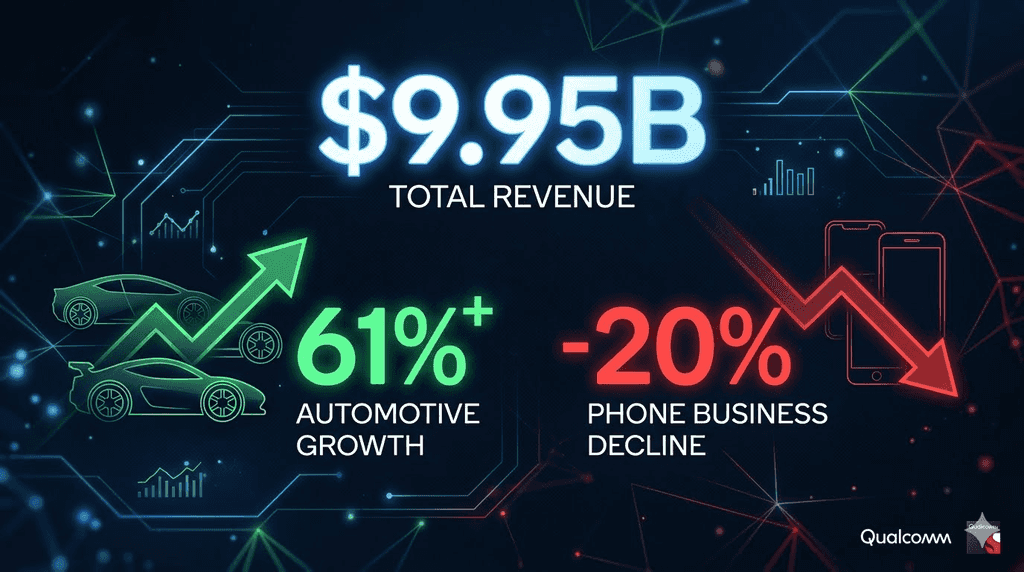
Qualcomm Incorporated delivered fiscal third-quarter 2026 results on July 29, showing total revenues of $9.95 billion, a 4% year-over-year decline that still surpassed analyst expectations near $9.67 billion. Non-GAAP earnings per share reached $2.21, a modest miss versus the $2.23 consensus, while GAAP EPS stood at $1.87. The standout performance came from the QCT Automotive segment, which posted a record $1.59 billion, surging 61% from the prior year and extending a streak of 23 consecutive quarters of double-digit growth. Handset revenues within QCT fell 20% to $5.09 billion amid industry-wide memory constraints and softer demand, particularly in certain markets.
IoT revenues advanced 9% to $1.83 billion, lifting combined non-handset QCT sales 28%. QTL licensing contributed $1.28 billion. Management raised its automotive annualized revenue run-rate outlook to approximately $7 billion and reaffirmed a longer-term target of $40 billion in total non-handset revenues by fiscal 2029. Shares declined roughly 4.4% following the release as fourth-quarter guidance came in lighter than hoped. These results illustrate Qualcomm’s ongoing transition from heavy reliance on smartphones toward diversified growth engines in automotive, IoT, and emerging data-center applications, even as near-term handset and cost pressures remain visible.
Revenue Composition Reflects Shifting Business Mix
Total revenues of $9,947 million for the quarter ended June 28, 2026, represented a high-end outcome relative to company guidance and a clear beat against the $9.67 billion consensus. QCT semiconductor revenues accounted for $8,504 million, down 5% year-over-year, while QTL licensing revenues totaled $1,278 million, a 3% decline. Within QCT, the mix shifted markedly: handsets contributed $5,086 million, automotive $1,588 million, and IoT $1,830 million. The 28% combined growth in automotive and IoT revenues offset a substantial portion of the handset shortfall, demonstrating the increasing contribution of non-handset categories. Gross margins faced pressure from elevated input costs across wafers, packaging, memory, and materials, a dynamic management described as industry-wide. Earnings before taxes for QCT declined to a 26% margin from 30% a year earlier, while QTL maintained a robust 69% EBT margin.
Net income fell 25% to $2,002 million. The company returned $2.3 billion to stockholders during the quarter through dividends and share repurchases. These figures, drawn from the official earnings release, confirm that diversification is progressing in absolute dollar terms even as overall top-line growth remains constrained by the still-dominant handset segment. Practical analysis shows that every percentage-point shift toward automotive and IoT improves the resilience of the revenue base against smartphone cycle volatility. The composition underscores a multi-year strategy in which non-handset categories are deliberately scaled to reduce cyclical exposure. Investors monitoring semiconductor valuations often examine similar diversification metrics when comparing chipmakers, including those tracking broader market indicators such as bitcoin price movements that reflect risk appetite across technology assets.
Handset Revenue Decline Driven by Memory Dynamics
Handset revenues within QCT dropped 20% year-over-year to $5,086 million from $6,328 million, reflecting industry-wide memory supply constraints, higher input costs, and inventory adjustments at major original equipment manufacturers. Management characterized the quarter as representing a bottom for certain Android-related pressures, particularly in China, though elevated memory pricing continued to influence device bill-of-materials and demand elasticity. The decline translated into more than $1.2 billion of lower sequential contribution relative to the year-ago period and weighed on overall QCT profitability. Despite the absolute reduction, handsets remained the largest single revenue stream inside the semiconductor business.
Qualcomm noted that pricing actions are underway to offset higher input costs and that these adjustments are expected to support gross-margin recovery over subsequent quarters as they phase into the customer base. The company also highlighted that the sharper-than-expected reduction in Apple modem-related sales contributed to the lighter fourth-quarter outlook. In practical terms, the handset shortfall illustrates the ongoing concentration risk that has prompted the aggressive diversification program. Market participants tracking smartphone unit forecasts and component cost trends will continue to watch whether the declared bottom holds in the current quarter. The 20% contraction stands as the clearest near-term headwind in the reported results. Sustained recovery in handset volumes will depend on memory market normalization and the success of price pass-through measures.
Automotive Segment Posts Record Quarter and Outlook Raise
Automotive revenues reached a record $1,588 million, advancing 61% from $984 million in the year-ago quarter and marking the 23rd consecutive period of double-digit year-over-year growth. The surge was attributed to accelerating demand for digital cockpits, advanced driver-assistance systems, and rising semiconductor content per vehicle. Qualcomm simultaneously raised its automotive annualized revenue run-rate outlook to approximately $7 billion exiting fiscal 2026, up from the prior $6 billion target. On the same day as the earnings release, the company announced an expanded relationship with BMW Group, under which Qualcomm becomes the lead compute silicon provider for digital cockpit and automated driving platforms through the next decade. Additional agreements with Stellantis further broadened the design-win pipeline.
These developments reinforce the durability of the automotive growth direction and support management’s longer-term ambition of $10 billion in automotive revenue by 2029. The absolute dollar increase of more than $600 million year-over-year provided a meaningful offset to the handset decline and improved the overall quality of the revenue mix. Industry context shows that vehicle electrification and software-defined architectures continue to elevate the value of Snapdragon-based platforms. Execution on the newly announced OEM programs will be a key monitorable in the coming quarters. The automotive momentum validates years of investment in Snapdragon Digital Chassis technology and positions the segment as a primary growth engine. Portfolio managers assessing long-duration technology themes often compare such structural shifts with other high-growth verticals when evaluating risk-adjusted returns.
IoT Revenues Deliver Steady Double-Digit-Adjacent Growth
IoT revenues climbed 9% year-over-year to $1,830 million from $1,681 million, driven by strength in industrial, networking, and robotics product categories. Combined with the automotive result, non-handset QCT revenues expanded 28%, illustrating the broadening application of Qualcomm’s connectivity and edge-compute platforms beyond mobile handsets. The IoT contribution remains smaller in absolute terms than automotive yet provides diversification across multiple end markets that are less correlated with consumer smartphone replacement cycles. Management pointed to robotics and industrial edge AI as areas of particular incremental opportunity.
The steady growth rate, while lower than automotive’s explosive advance, adds predictable volume and helps smooth quarterly fluctuations. Gross-margin dynamics within IoT benefit from the same platform leverage that supports higher-content automotive designs. Looking forward, the segment is expected to participate in the broader acceleration of non-handset growth projected for fiscal 2027. Practical examples include deployments in smart factories, connected infrastructure, and autonomous mobile robots that rely on Qualcomm’s low-power, high-performance silicon. Sustained mid-to-high single-digit to low-double-digit expansion would meaningfully compound the contribution to the $40 billion non-handset target. IoT’s consistent performance supplies a complementary growth vector that reduces reliance on any single non-handset category.
Licensing Business Maintains High-Margin Contribution
QTL licensing revenues totaled $1,278 million, a 3% year-over-year decline, yet the segment preserved a 69% earnings-before-taxes margin. The modest reduction reflected lower handset unit volumes among licensees rather than any fundamental change in royalty rates or portfolio strength. Licensing continues to generate substantial cash flow with relatively limited incremental cost, supporting overall corporate profitability and capital-return capacity. Management noted that QTL results aligned with internal expectations for the quarter. The high incremental margins of the licensing franchise remain a structural advantage that differentiates Qualcomm from pure-play semiconductor peers. Any recovery in global smartphone shipments would translate quickly into higher QTL revenues given the established 3G/4G/5G patent portfolio.
Conversely, prolonged handset weakness would keep licensing growth muted. The segment’s stability provided a partial buffer against the sharper swings observed in the QCT handset line. Investors focused on free-cash-flow generation continue to assign meaningful value to the predictability of QTL earnings. Ongoing renewal of key license agreements and expansion into new device categories remain important longer-term variables. The licensing franchise’s resilience underscores the enduring value of Qualcomm’s intellectual-property portfolio even during periods of unit-volume pressure. This cash-flow characteristic supports the company’s ability to fund diversification investments while returning capital to stockholders.
Input-Cost Inflation and Margin Response Measures
Elevated costs for wafers, advanced packaging, memory, and other materials compressed gross margins and contributed to the year-over-year decline in QCT earnings-before-taxes margin from 30% to 26%. Management described the cost environment as broad-based across the semiconductor industry and confirmed that concrete pricing actions have been initiated to offset the increases. These price adjustments are expected to phase into customer contracts gradually and to support sequential margin improvement over coming quarters. The same cost pressures influenced device manufacturers’ bill-of-materials and, in turn, smartphone demand elasticity, amplifying the handset revenue decline. Qualcomm’s ability to pass through higher costs without further volume destruction will be a critical near-term execution item.
Fourth-quarter guidance already incorporates the current cost landscape. Historical precedent in prior cost-inflation cycles suggests that successful price realization can restore margins once the new pricing is fully embedded. Monitoring of sequential gross-margin trends will therefore provide early evidence of whether the offset strategy is gaining traction. The margin dynamic remains one of the more immediate risks to earnings recovery even as top-line diversification advances. Successful navigation of the input-cost cycle would improve both absolute profitability and the quality of earnings as the non-handset mix rises. Cost-pass-through effectiveness is a key variable for valuation multiples in the current environment.
Fourth-Quarter Guidance Signals Continued Near-Term Caution
For the fourth fiscal quarter, Qualcomm guided total revenues to a range of $9.7 billion to $10.5 billion and non-GAAP diluted EPS to $2.05–$2.25. Both ranges sat below prevailing analyst consensus figures near $10.02 billion and $2.36, respectively. QCT revenues are expected between $8.4 billion and $9.0 billion, with QTL projected at $1.2–$1.4 billion. Management cited ongoing memory dynamics, the accelerated decline in certain modem sales, and the still-elevated input-cost environment as factors shaping the outlook. The midpoint of the revenue guide implies limited sequential growth, while the EPS range reflects continued margin pressure. Guidance excludes the impact of potential tax-law changes or other non-recurring items.
The lighter outlook contributed to the post-earnings share-price decline. Investors will parse the first-half fiscal 2027 commentary for signs that non-handset growth acceleration is beginning to outweigh residual handset weakness. Achievement of the upper half of the guided ranges would require stabilization in handset volumes and early benefits from pricing actions. The guidance therefore serves as a near-term litmus test of the diversification thesis’s ability to offset legacy-segment softness. The fourth-quarter framework sets a clear benchmark against which sequential progress on both revenue mix and margin recovery can be measured. Delivery relative to these ranges will influence sentiment heading into fiscal 2027.
Long-Term Non-Handset Revenue Ambition Takes Shape
CEO Cristiano Amon reiterated the target of $40 billion in total non-handset revenues by fiscal 2029, nearly double the objective articulated in November 2024. Near-term non-handset growth, inclusive of the nascent data-center initiative, is expected to accelerate from 24% in fiscal 2026 to greater than 60% in fiscal 2027. Achievement of these figures would fundamentally alter Qualcomm’s revenue concentration and reduce earnings volatility tied to smartphone cycles. The automotive run-rate increase to $7 billion provides an intermediate milestone, while IoT and data-center platforms are positioned as additional contributors. The recent completion of the Modular Inc. acquisition is intended to strengthen the open software foundation for generative and agentic AI workloads that span edge to infrastructure.
Execution against the 2027 growth inflection will be closely watched as evidence that the strategic pivot is gaining measurable scale. Success would support higher structural margins and potentially expanded valuation multiples. The $40 billion target remains aspirational yet is now underpinned by concrete design wins and rising content roadmaps. Progress updates at future investor events will refine the direction. The elevated non-handset objective crystallizes the strategic endpoint of the multi-year diversification program and provides a quantifiable framework for assessing long-term value creation.
Expanded Automotive Design Wins Reinforce Growth Visibility
Beyond the headline revenue numbers, Qualcomm announced that it has been named BMW Group’s lead compute silicon provider for digital cockpit and automated-driving platforms through the next decade. Parallel commercial momentum with Stellantis further expands the set of high-volume OEM platforms adopting Snapdragon Digital Chassis solutions. These multi-year agreements increase the predictability of automotive revenue and raise the barriers to competitive displacement. Rising semiconductor content per vehicle, driven by more sophisticated cockpit experiences and higher levels of driver assistance continue to expand the addressable opportunity.
The combination of volume commitments and content growth underpins the raised $7 billion run-rate outlook. Industry data indicate that software-defined vehicle architectures favor suppliers capable of delivering integrated compute, connectivity, and AI acceleration. Qualcomm’s ability to convert these design wins into sustained revenue ramps will determine the pace at which automotive approaches the longer-term $10 billion ambition. Customer diversification across European, American, and other regional OEMs reduces concentration risk within the segment itself. The BMW and Stellantis expansions convert pipeline potential into contracted visibility and strengthen the automotive segment’s role as a cornerstone of the non-handset strategy.
Data-Center Initiative Positions for Fiscal 2027 Inflection
Although still early, the data-center effort is explicitly included in management’s expectation of greater-than-60% non-handset growth in fiscal 2027. The modular acquisition is intended to accelerate development of an open software stack suited to generative and agentic AI workloads running from device to infrastructure. Qualcomm’s historical strengths in high-performance, low-power compute, and connectivity are being extended into rack-scale and edge-to-cloud use cases. Initial product introductions are anticipated later in the current calendar year, with meaningful revenue contribution expected to build thereafter. Success in data centers would add a high-growth vertical that is less correlated with both handsets and automotive cycles.
Competitive intensity in AI accelerators remains elevated, yet Qualcomm’s differentiation around power efficiency and integrated connectivity may prove relevant for certain inference and edge deployments. Progress on software maturity and early customer traction will be critical leading indicators. Inclusion of the data center in the 2027 growth guide signals management confidence that the initiative is moving from development into commercial scaling. The data-center roadmap supplies an additional growth vector that, if executed, would further diversify the revenue base and support the steep non-handset acceleration targeted for next fiscal year.
Capital Returns Continue Alongside Strategic Investment
During the third quarter Qualcomm returned $2.3 billion to stockholders, comprising $973 million in dividends ($0.92 per share) and $1.4 billion of share repurchases representing approximately 8 million shares. The capital-return program remains a consistent feature of the financial model even as the company funds diversification initiatives and the modular acquisition. Strong free-cash-flow generation from the licensing franchise and the higher-margin portions of QCT continue to underwrite both shareholder distributions and internal investment. Maintenance of the dividend and ongoing buybacks signal confidence in the durability of cash generation despite near-term earnings pressure.
The balance between returning capital and reinvesting in growth platforms will remain a focal point for income-oriented and total-return investors alike. Sequential tracking of repurchase activity and dividend sustainability provide insight into management’s assessment of intrinsic value and liquidity priorities. The $2.3 billion quarterly return represents a tangible component of total shareholder yield. Continued capital returns alongside growth investment illustrate the dual mandate of delivering near-term yield while funding the longer-term diversification that underpins the $40 billion non-handset objective.
Qualcomm shares closed approximately 4.4% lower on July 29 following the release, reflecting disappointment with the fourth-quarter EPS and revenue guidance ranges. The stock’s reaction incorporated both the handset softness and the recognition that margin recovery from pricing actions will take time to materialize. Automotive and IoT strength, the raised run-rate outlook, and the reaffirmed long-term targets provided partial offsets but were insufficient to fully counter the lighter near-term framework.
Analyst commentary focused on the pace of non-handset acceleration and the direction of gross margins under the new cost regime. Subsequent trading sessions will be influenced by any updates on memory-market conditions, early indications of price-pass-through success, and incremental design-win announcements. Valuation remains sensitive to evidence that fiscal 2027 can deliver the projected greater-than-60% non-handset growth.
Conclusion
The post-earnings decline creates a lower base from which sequential improvements can be measured. Overall sentiment hinges on whether the diversification narrative can outpace residual handset and cost headwinds in the coming two quarters. The market response shows the tension between proven long-term strategic progress and near-term earnings visibility, a dynamic that will shape trading patterns until clearer sequential evidence emerges.
FAQs
What were the exact revenue and earnings figures for Qualcomm’s fiscal third quarter 2026?
Qualcomm reported total revenues of $9,947 million, or approximately $9.95 billion, representing a 4% year-over-year decline yet exceeding the consensus estimate near $9.67 billion. Non-GAAP diluted earnings per share came in at $2.21, a slight miss against the $2.23 expectation, while GAAP EPS was $1.87. QCT semiconductor revenues totaled $8,504 million, and QTL licensing revenues were $1,278 million.
How significant was the automotive contribution in the quarter?
Automotive revenues reached a record $1,588 million, up 61% from $984 million in the prior-year period, marking the 23rd consecutive quarter of double-digit year-over-year growth. The segment’s absolute increase of more than $600 million provided a substantial offset to the handset decline and prompted management to raise the annualized automotive revenue run-rate outlook to approximately $7 billion.
Why did handset revenues decline so sharply?
Handset revenues within QCT fell 20% to $5,086 million, driven by industry-wide memory supply constraints, higher input costs that affected device pricing and demand, and inventory adjustments at major OEMs. Management indicated that certain Android-related pressures, particularly in China, appeared to bottom in the quarter, although elevated memory costs persisted.
What guidance did Qualcomm provide for the fourth fiscal quarter?
The company guided total revenues to a range of $9.7 billion to $10.5 billion and non-GAAP diluted EPS to $2.05–$2.25. Both ranges were below prevailing analyst consensus levels. QCT is expected to contribute $8.4–$9.0 billion and QTL $1.2–$1.4 billion, reflecting ongoing memory dynamics and residual modem-related softness.
What is the long-term non-handset revenue target?
Management reaffirmed the objective of reaching $40 billion in total non-handset revenues by fiscal 2029, nearly double the target set in late 2024. Near-term non-handset growth, including the data-center initiative, is projected to accelerate from 24% in fiscal 2026 to greater than 60% in fiscal 2027.
Join KuCoin 9th Anniversary Trading CampaignKuCoin is celebrating its 9th anniversary with a special platform campaign filled with exclusive rewards, trading activities, and limited-time offers. Don’t miss the chance to participate and enjoy the benefits as the exchange marks nine years of growth and innovation. Visit the official campaign page now:
 |
Disclaimer
The information provided on this page may originate from third-party sources and does not necessarily represent the views or opinions of KuCoin. This content is intended solely for general informational purposes and should not be considered financial, investment, or professional advice. KuCoin does not guarantee the accuracy, completeness, or reliability of the information, and is not responsible for any errors, omissions, or outcomes resulting from its use. Investing in digital assets carries inherent risks. Please carefully evaluate your risk tolerance and financial situation before making any investment decisions. For further details, please consult KuCoin’s Terms of Use and Risk Disclosure.