

What Role Does Blockchain Infrastructure Play in Prediction Markets, and Is Decentralization Still a Competitive Advantage?
Introduction
In July 2024, following the assassination attempt on Donald Trump at a Pennsylvania rally, prediction markets like Polymarket quickly reflected positive shifts in his election odds, with volumes surging as traders reacted in real time. Large bets, including multi-million-dollar positions from certain crypto wallets, contributed to moving the probabilities—sometimes dramatically—before traditional polls could fully capture public sentiment. This was not mere luck but an example of information aggregation and arbitrage enabled by blockchain-based infrastructure, which allows near-instant global participation and pricing far faster than legacy polling systems.
Prediction markets have existed for decades in centralized forms. Intrade, the Irish betting platform, operated from 2001 until around 2013 (with full wind-down by 2018), correctly forecasting numerous election outcomes before regulatory pressure from the U.S. CFTC forced its closure. But the rise of blockchain-based prediction markets like Polymarket represents a fundamental shift in how information is priced and transmitted—offering greater transparency, accessibility, and speed through decentralized, on-chain settlement.
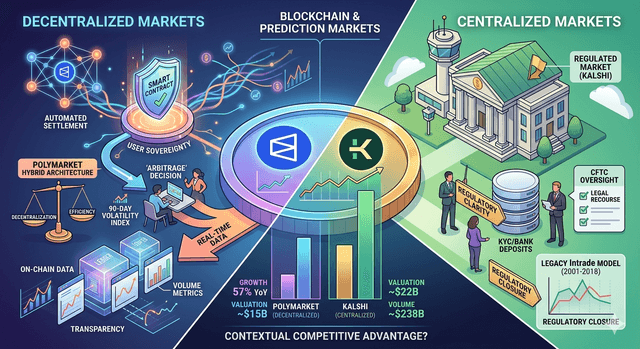
In 2025, Polymarket reached $22 billion in trading volume during the first eleven months, representing 57% growth over the full year of 2024. Together with its primary competitor Kalshi, which recorded $238 billion in 2025 trading volume, the two platforms control 97.5% of the prediction market. This duopoly demonstrates that blockchain prediction markets have achieved mainstream scale while raising critical questions about whether decentralization translates into tangible benefits for traders.
The Technical Foundation: How Blockchain Powers Prediction Markets
Smart Contracts as Settlement Layers
At its core, blockchain infrastructure provides prediction markets with automated settlement through smart contracts. When a user places a bet on whether a specific event will occur, the wager gets locked in a smart contract that automatically executes payouts based on predetermined conditions. This eliminates the counterparty risk inherent in traditional betting platforms users never need to trust that the platform will honor winning bets because the code enforces settlement independently.
The technical architecture varies across platforms. Polymarket operates on a hybrid model, using Polygon for trade execution while maintaining Ethereum mainnet for final settlement. This approach achieves transaction costs below $0.01 per trade while preserving the security guarantees of the underlying blockchain. Augur, the older decentralized platform built on Ethereum, processes settlements directly on-layer, incurring higher costs but offering greater decentralization guarantees.
The smart contract layer also enables fractional trading. Unlike traditional prediction markets that require minimum bet sizes, blockchain prediction markets allow traders to purchase fractions of shares. This democratizes access, enabling traders to build diversified positions across numerous events with minimal capital requirements.
Oracle Systems and Outcome Verification
Perhaps the most critical infrastructure component for prediction markets is the oracle system, the mechanism that determines whether an event actually occurred. A prediction market is only as valuable as its settlement accuracy. If users cannot trust that outcomes are correctly reported, the market loses its predictive value.
Centralized platforms employ internal teams to verify outcomes. This approach offers speed and consistency but introduces single points of failure and potential manipulation risk. Blockchain prediction markets typically use decentralized oracle networks that aggregate data from multiple sources. Augur uses a system where token holders vote on outcomes, with majority consensus determining the settlement price.
Polymarket has adopted a hybrid approach, using a designated reporter system for most markets while reserving the decentralized arbitration mechanism for contested outcomes. This balances efficiency with the philosophical commitment to decentralized resolution.
The oracle problem represents one of the most active areas of development in prediction market infrastructure. Multiple projects are experimenting with machine learning-based oracle systems that can automatically verify outcomes for clearly defined eventssports results, economic data releases, and scheduled announcements while escalating ambiguous cases to human arbitration.
Liquidity Aggregation and Cross-Chain Infrastructure
Blockchain interoperability enables prediction markets to aggregate liquidity across multiple networks. Modern platforms leverage cross-chain bridges that allow users to deposit assets from various blockchains, creating deeper order books than any single-chain platform could achieve.
This infrastructure development addresses one of the historical weaknesses of decentralized platformsisolated liquidity pools that prevented efficient price discovery. By connecting multiple blockchain ecosystems, modern prediction markets can achieve liquidity levels that rival centralized competitors.
The Decentralization Question: Competitive Advantage or Historical Artifact?
The Case for Decentralization as Competitive Advantage
Decentralization provides three primary benefits that translate into competitive advantages: censorship resistance, transparency, and user sovereignty.
Censorship resistance matters particularly for prediction markets because the events people most want to bet on often attract regulatory scrutiny. Political elections, controversial events, and markets that challenge established narratives all face potential suppression on centralized platforms. Polymarket's ability to operate without KYC requirements while processing billions of dollars in volume demonstrates the commercial value of censorship resistance. When users can bet on sensitive topics without fear of account termination or fund seizure, they participate more freely, generating more accurate prices.
Transparency through on-chain data provides verifiable proof of market integrity. Every trade, every payout, and every outcome settlement is publicly observable. This creates accountability that centralized platforms cannot match. Users can verify that the platform is not manipulating odds, that large traders are not receiving preferential treatment, and that settlement processes follow predetermined rules.
User sovereignty through self-custody eliminates the risk of platform failure. Unlike centralized exchanges where users must trust that platform operators will maintain solvency and return funds, blockchain prediction markets allow users to maintain control of their assets until the moment of settlement. This trust minimization has proven valuable during market stress events when centralized platforms have experienced outages or liquidity crises.
The Case Against Decentralization as Competitive Advantage
Critics argue that the competitive advantages of decentralization are diminishing as centralized alternatives improve their offerings and as regulatory frameworks mature.
User experience remains a significant barrier. Setting up a crypto wallet, managing private keys, understanding gas fees, and navigating blockchain transactions present onboarding challenges that centralized platforms have largely eliminated. Kalshi, the regulated centralized prediction market, offers instant account creation, familiar web interfaces, and customer support that blockchain platforms cannot match.
Regulatory clarity increasingly favors centralized platforms. As governments establish frameworks for prediction markets, compliant platforms like Kalshi can operate legally while decentralized platforms face uncertain legal status. The CFTC's oversight of Kalshi provides users with recourse in disputesa protection that no blockchain-based platform currently offers.
Performance limitations of blockchain infrastructure create practical constraints. Block confirmations, even on fast networks, introduce latency that centralized systems avoid. For time-sensitive trading around rapidly developing events, this latency can translate into meaningful execution disadvantages.
Market Structure: The 2025-2026 Landscape
Polymarket's Remarkable Growth
Polymarket achieved significant milestones in 2025. Trading volume reached $22 billion during the first eleven months of 2025, representing 57% growth compared to the full year of 2024. In March 2026, Polymarket reached $10.6 billion in monthly trading volumes six times the volume from six months earlier.
The platform's success stems from several design decisions: zero-KYC requirements, low fees, accessible interfaces, and integration with established crypto wallets. Polymarket is currently in talks to raise $400 million at a valuation of approximately $15 billion, according to recent reports. This would represent a more than 10x increase in valuation from earlier stages.
What distinguishes Polymarket from predecessors is its hybrid approach maintaining decentralized infrastructure while implementing centralized features where they improve user experience, including designated reporters for outcome verification, curated market listings, and customer support channels.
Competition with Kalshi
In 2025, the competition between Polymarket and Kalshi intensified significantly. Together, the two platforms controlled 97.5% of the prediction market, with combined trading volumes reaching $458 billion$238 billion for Kalshi and $220 billion for Polymarket.
Kalshi has emerged as the dominant regulated platform. In March 2026, the company raised over $1 billion in a funding round led by Coatue Management, doubling its valuation to $22 billion from $11 billion in December 2025. This makes Kalshi the more valuable of the two platforms, though both have achieved remarkable growth.
Each platform serves different user segments: Polymarket attracts crypto-native traders seeking censorship resistance and no KYC requirements, while Kalshi draws institutional and regulatory-conscious traders who value legal clarity and bank deposits.
Is Decentralization Still a Competitive Advantage?
The Evolving Meaning of Decentralization
The competitive value of decentralization depends heavily on context. For users in jurisdictions with restrictive regulations or for traders seeking to participate in markets on sensitive topics, decentralization provides clear advantages that cannot be easily replicated by centralized alternatives.
For mainstream users seeking familiar interfaces and regulatory protection, the decentralized label provides limited practical value. The masses of casual prediction market participants will likely continue using centralized platforms that prioritize user experience over ideological commitments.
The competitive advantage is therefore not universal, but contextuality serves specific user needs that centralized platforms cannot or will not address.
Infrastructure as the Differentiator
What may matter more than the decentralization label is the underlying infrastructure quality. Platforms that can offer fast transaction settlement, reliable oracle systems, deep liquidity, and intuitive interfaces will compete effectively regardless of their architectural philosophy.
The most successful prediction market platforms will likely be those that make strategic decisions about when to prioritize decentralization and when to adopt centralized efficiencies rather than dogmatically adhering to one approach.
Blockchain infrastructure provides genuine technical capabilities that enable prediction markets to operate in ways that were previously impossible: automated settlement, transparent on-chain data, cross-chain liquidity, and censorship resistance. These capabilities represent real competitive advantages when applied to specific use cases.
The Outlook for Blockchain Prediction Markets
The trajectory suggests continued growth for blockchain-based prediction markets. Polymarket's volumes are on pace to reach approximately $240 billion in 2026, representing roughly 80% compound annual growth. Whether this growth translates into sustained competitive advantage for decentralized platforms depends on how regulatory frameworks evolve.
If regulators crack down on decentralized platforms, the competitive advantage of censorship resistance becomes a liability. If centralized platforms improve transparency, the advantage of on-chain verification diminishes. The most likely scenario is continued coexistence, with blockchain prediction markets serving users who prioritize the unique advantages of decentralization, while centralized platforms serve mainstream adoption.
Conclusion
Blockchain infrastructure provides genuine technical capabilities that distinguish prediction markets from centralized alternatives. Smart contracts enable automated settlement without counterparty risk. On-chain transparency provides verifiable market integrity. Self-custody eliminates platform failure risk.
In 2025, Polymarket and Kalshi achieved combined trading volumes of $458 billion, with Polymarket recording $22 billion during the first eleven monthsa 57% increase over full-year 2024. Together, the two platforms control 97.5% of the prediction market.
Kalshi's recent $22 billion valuation following a $1 billion funding round demonstrates the market's confidence in regulated prediction markets. Polymarket's ongoing negotiations for a $15 billion valuation with planned $400 million new funding reflect the growth potential of decentralized alternatives.
For traders seeking censorship resistance, blockchain prediction markets offer clear benefits. For mainstream users prioritizing user experience and regulatory protection, centralized platforms may be more suitable.
The most successful platforms will make intelligent trade-offs rather than ideological commitments.
FAQs
Q: How do blockchain prediction markets ensure accurate outcome settlement?
A: Blockchain prediction markets use oracle systems to verify outcomes. Decentralized platforms like Augur rely on token holder voting to resolve contested outcomes. Hybrid platforms like Polymarket use designated reporters for routine verification while reserving decentralized arbitration for disputes. The oracle layer remains an active area of development, with machine learning systems increasingly handling clearly defined outcomes.
Q: What is the main advantage of decentralized prediction markets over centralized ones?
A: The primary advantages are censorship resistance, transparency, and user sovereignty. Decentralized platforms can operate without requiring user identity verification, offer publicly verifiable on-chain data for all transactions, and allow users to maintain self-custody of funds until settlement. These benefits are most valuable for traders seeking to participate in sensitive or regulated markets.
Q: Are blockchain prediction markets legal in the US?
A: The legal status varies by platform and market type. Polymarket operates without KYC and has faced regulatory scrutiny but continues operating. In January 2026, Polymarket received a no-action letter from the CFTC, providing temporary regulatory clarity. Kalshi operates as a CFTC-regulated platform with full compliance. The regulatory landscape remains uncertain, and users should evaluate the legal status of specific platforms and markets in their jurisdictions.
Q: How does trading volume compare between Polymarket and Kalshi in 2025?
A: In 2025, Polymarket recorded $22 billion in trading volume during the first eleven months, representing 57% growth over 2024. Kalshi recorded $238 billion in 2025, slightly ahead of Polymarket. Together, they control 97.5% of the prediction market with combined volumes of $458 billion.
Q: Can blockchain prediction markets achieve mainstream adoption without compromising decentralization?
A: This remains the central challenge. User experience barriers wallet setup, key management, gas feeslimit mainstream adoption. Platforms that achieve the best balance of usability while preserving decentralization principles will likely lead mainstream adoption. The hybrid approach adopted by Polymarket suggests that pragmatic compromises may be necessary for broader reach.