

Proof-of-Intelligence vs. Proof-of-Work: How AI-Powered Consensus Redefines Blockchain Mining in 2026
2026/04/30 12:03:02
Introduction
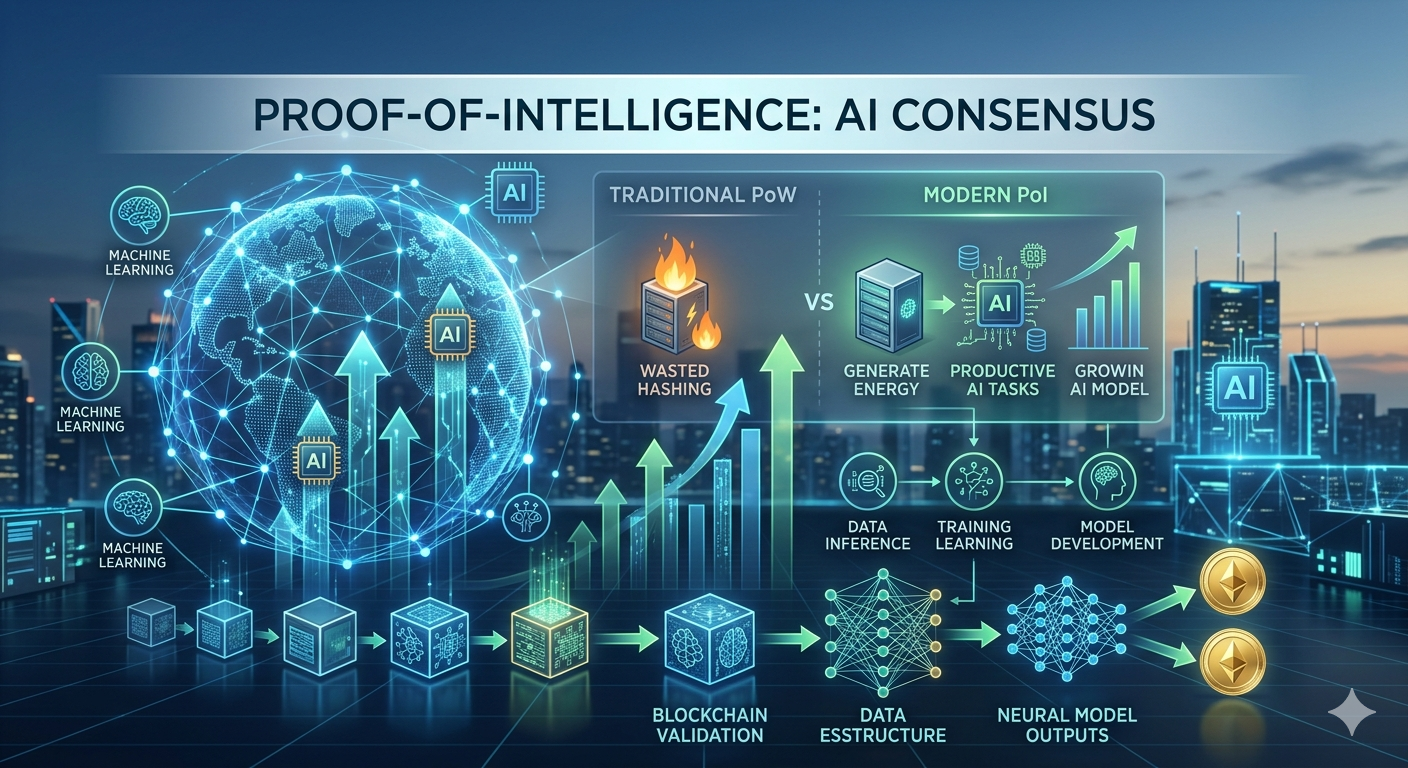
Proof-of-Intelligence (PoI) is a revolutionary blockchain consensus mechanism that replaces the computationally wasteful hashing of Proof-of-Work (PoW) with productive artificial intelligence (AI) tasks. By April 2026, the global demand for decentralized compute has surged by 340%, making PoI the primary solution for scaling large language models while securing distributed networks.
Unlike traditional systems that burn electricity on arbitrary puzzles, PoI requires participants to contribute "useful work"—such as training neural networks or processing data inference—to validate transactions and earn rewards. This shift ensures that every watt of energy spent on the blockchain directly advances the global AI infrastructure. Proof-of-Intelligence effectively bridges the gap between decentralized finance and the silicon-hungry AI economy by turning miners into decentralized data centers.
What is Proof-of-Intelligence (PoI)?
The AI crypto market has surged past $22.6 billion in total capitalization as of April 2026, according to industry analysis from EAK Digital. Yet traditional blockchain consensus mechanisms continue to waste enormous energy on meaningless puzzles or rely solely on capital staking. Proof of Intelligence (PoI) directly solves this inefficiency.
Proof of Intelligence is a blockchain consensus mechanism that rewards network participants for performing verifiable artificial intelligence tasks—such as model training, inference, optimization, and data processing—while simultaneously validating transactions and securing the chain. Unlike Proof of Work (PoW) or Proof of Stake (PoS), PoI turns the computational effort required for consensus into genuine, productive contributions to AI development. This creates a more sustainable, useful, and future-proof blockchain infrastructure that aligns incentives with real technological advancement rather than pure speculation or energy expenditure.
PoI emerged as blockchain projects sought to merge decentralized networks with the exploding AI sector. Early concepts appeared in research papers around 2025, but 2026 has seen concrete implementations gain traction, particularly with projects like Bittensor and Lightchain AI demonstrating live network activity. The mechanism addresses a core industry pain point: blockchain security no longer needs to come at the expense of environmental impact or missed opportunities for AI progress.
How Proof of Intelligence Works
Proof of Intelligence operates by directing computational resources toward valuable AI workloads that double as the consensus process. Nodes or validators compete or collaborate to solve AI-specific tasks assigned by the network, and their performance on these tasks determines both their eligibility to validate blocks and the rewards they receive.
The process begins when the network generates AI computation requests—ranging from training machine learning models on decentralized datasets to running inference on specific queries or optimizing existing algorithms. Participating nodes execute these tasks using their hardware, which often includes GPUs optimized for AI workloads. Once completed, the results undergo verification by other nodes or through built-in cryptographic proofs to ensure accuracy and prevent malicious submissions. Successful validators then bundle transactions into blocks, earning native tokens proportional to the quality and usefulness of their AI contributions.
This creates a self-reinforcing loop: higher-quality AI outputs lead to better network security and greater rewards, which in turn attract more sophisticated participants. According to project documentation from Lightchain AI, the mechanism leverages an Artificial Intelligence Virtual Machine (AIVM) to execute these tasks efficiently while maintaining deterministic verification where possible.
Key Components of a PoI Network
Several core elements make PoI functional. First, specialized nodes handle different roles: some focus on task generation and distribution, others on execution, and a subset on result verification. Second, incentive structures reward not just completion but measurable intelligence—often scored through peer review, benchmark performance, or cryptographic attestation of outputs. Third, slashing mechanisms penalize incorrect or low-quality submissions to maintain security. Finally, governance layers allow the community to adjust task types and reward parameters dynamically as AI technology evolves.
Lightchain AI’s implementation, for instance, integrates PoI with federated learning techniques so nodes can contribute to model training without exposing raw data, preserving privacy while advancing collective intelligence.
PoI vs. Proof of Work
PoW, the mechanism powering Bitcoin, requires miners to solve complex cryptographic puzzles that consume vast amounts of electricity with no external benefit. PoI eliminates this waste entirely. Instead of hashing for hashes’ sake, validators perform AI tasks that generate real value—training models that could power decentralized applications, optimize supply chains, or advance scientific research. Recent analyses show PoI networks achieve comparable or superior security while using a fraction of the energy, making them far more environmentally viable in an era of growing regulatory scrutiny on crypto energy use.
PoI vs. Proof of Stake
PoS selects validators based on the amount of tokens they lock up, which favors wealth concentration and can lead to centralization over time. PoI democratizes participation by emphasizing computational intelligence and contribution quality rather than pure capital. Anyone with suitable hardware and expertise can participate meaningfully, not just large token holders. This aligns incentives more closely with network utility and reduces the risk of “rich-get-richer” dynamics common in pure PoS systems.
A side-by-side comparison highlights the differences clearly:
| Aspect | Proof of Work | Proof of Stake | Proof of Intelligence |
| Resource Used | Electricity & hardware | Staked capital | AI computation & expertise |
| Output Value | None (security only) | None (security only) | AI models & insights |
| Energy Efficiency | Very low | High | High |
| Participation Barrier | Hardware investment | Capital requirement | Hardware + AI skills |
| Security Model | Computational difficulty | Economic stake | Verifiable AI performance |
Key Advantages of Proof of Intelligence
PoI delivers tangible benefits that extend beyond basic blockchain functionality, positioning it as a bridge between decentralized finance and the AI revolution.
Energy Efficiency and Sustainability
By repurposing computational effort into AI tasks, PoI dramatically reduces the environmental footprint of blockchain networks. Traditional PoW networks have drawn criticism for their carbon emissions; PoI channels the same hardware power into productive outcomes, effectively turning “waste” into innovation. Industry observers in early 2026 noted this alignment with global ESG standards as a major driver for institutional interest in PoI-based projects.
Real-World Utility and AI Acceleration
Every block validated under PoI contributes to decentralized AI progress. Networks can crowdsource model training, data labeling, or inference at scale without relying on centralized cloud providers. This creates a marketplace for intelligence where developers and enterprises access verifiable, decentralized compute for AI workloads. Bittensor’s subnet architecture exemplifies this: specialized sub-networks focus on different AI domains, with rewards distributed based on the measurable quality of contributions.
Enhanced Scalability and Security
Because verification relies on demonstrable intelligence rather than blind computation or stake size, PoI networks can scale more efficiently as AI hardware improves. Security remains robust because submitting fraudulent results carries both slashing penalties and reputational damage within the AI community. Recent network activity data from March 2026 shows leading PoI projects maintaining high throughput while handling increasingly complex AI workloads.
Leading Projects Implementing Proof of Intelligence
Several projects have brought PoI from theory to practice, each offering unique implementations.
Bittensor (TAO) – The Decentralized Intelligence Pioneer
Bittensor remains the most prominent PoI implementation in 2026. Its network consists of subnets where machine learning models compete and collaborate, with validators earning TAO tokens based on the intelligence and usefulness of their outputs. According to MEXC News reporting on March 24, 2026, TAO experienced a 15.17% surge against Bitcoin, reaching a market capitalization of approximately $3.18 billion amid growing institutional interest in decentralized AI infrastructure. By late April 2026, CoinGecko data placed its market cap around $2.4 billion, reflecting sustained but volatile growth typical of emerging AI narratives.
Lightchain AI (LCAI) – Layer-1 Optimized for AI Workloads
Lightchain AI launched its Mainnet V2 with full PoI consensus and Compute Marketplace functionality around April 18, 2026. The protocol rewards nodes specifically for AI model training, inference, and optimization while using an AIVM for efficient execution. This creates a dedicated environment for AI-native decentralized applications. Price predictions for 2026 range from $0.003 to $0.005, driven by expectations around staking rewards and ecosystem growth following the mainnet rollout.Other emerging initiatives continue to explore hybrid models, such as Proof of Useful Intelligence (PoUI) variants that combine AI tasks with staking elements, further expanding the PoI ecosystem.
Potential Challenges Facing PoI Adoption
Despite its promise, PoI faces several hurdles that projects must address for widespread success.
High Hardware and Expertise Requirements
Participating effectively requires specialized AI-capable hardware and technical knowledge, potentially limiting accessibility compared to simpler staking. Networks mitigate this through delegation and pooling mechanisms, but the barrier remains higher than basic PoS participation.
Verification Complexity
Ensuring AI task outputs are correct and non-manipulable demands sophisticated verification protocols. Projects rely on peer review, benchmark datasets, and emerging zero-knowledge machine learning techniques, but perfect verification at scale remains an active area of research.
Market Volatility and Adoption Risk
As with any new consensus model, early PoI projects experience price swings tied to AI narrative hype. Sustained adoption depends on delivering consistent real-world utility rather than speculative interest alone.
Conclusion
Proof of Intelligence transforms blockchain consensus from an energy-consuming necessity into a driver of meaningful AI advancement. By rewarding verifiable intelligence contributions instead of wasteful computation or pure staking, PoI creates networks that are more sustainable, useful, and aligned with the future of technology. Leading implementations like Bittensor and Lightchain AI have already demonstrated real network activity and market traction throughout early 2026, with Bittensor maintaining a multi-billion-dollar market cap amid strong institutional interest.
The mechanism addresses long-standing criticisms of traditional consensus models while opening new possibilities for decentralized AI applications. As the broader AI crypto sector continues expanding beyond $22 billion in capitalization, PoI stands out as a practical evolution that delivers both security and utility.
For traders and builders alike, PoI offers a compelling opportunity to participate in the convergence of blockchain and artificial intelligence. The coming years will likely see further refinement of verification techniques, broader hardware accessibility, and increased mainstream adoption as these networks prove their ability to deliver real-world value.
FAQs
What makes PoI different from other “useful” proof mechanisms like Proof of Useful Work? PoI specifically focuses on artificial intelligence tasks that advance machine learning models and inference capabilities, whereas general useful work mechanisms may involve any non-cryptographic computation.
Can individual users without advanced AI hardware participate in PoI networks? Yes—many PoI projects support delegation, pooling, or lighter client roles that allow smaller participants to contribute indirectly and still earn rewards.
How does PoI impact transaction fees and network speed compared to PoW or PoS? PoI often enables lower fees and higher throughput because AI-optimized hardware handles tasks more efficiently than general-purpose mining rigs, though actual performance varies by implementation.
Are PoI tokens more volatile than traditional crypto assets? PoI-related tokens tend to show higher volatility due to their tie to rapidly evolving AI narratives, but this also creates opportunities for significant upside as real utility materializes.
What regulatory considerations should investors keep in mind with PoI projects? As with any crypto investment, monitor evolving regulations around AI, energy use, and securities classification, though PoI’s productive nature may align better with future policy frameworks emphasizing technological utility.