

What Is edgeX and How to Buy EDGE?
Crypto keeps moving beyond simple token swaps. Newer projects are trying to rebuild trading infrastructure itself, with faster execution, broader market access, and systems that feel closer to professional trading platforms while still preserving the core DeFi principle of user control. That shift is where edgeX fits in.
edgeX is a decentralized trading platform built around perpetuals and spot markets, with its own execution-focused infrastructure called EDGE Stack. The project positions itself as a high-performance, orderbook-based DEX designed to deliver low-latency trading, self-custody, and round-the-clock access to markets.
By the end of this article, you will have a clear understanding of what edgeX is, how the project developed, what makes its technology stand out, how the EDGE token is structured, and what to know if you want to access EDGE through KuCoin or other supported crypto venues.
What Is edgeX?
edgeX is a decentralized exchange designed for more active trading use cases than a standard AMM-style DeFi app. Its official materials describe it as a high-performance, orderbook-based perpetual DEX with a native trading experience, and its platform supports both perpetual futures and spot trading.
At a technical level, the project is built around EDGE Stack, which edgeX describes as a parallel, modular, app-specific execution layer with Ethereum-level security. The goal is not just to run trading on-chain, but to redesign the execution layer so it can better handle the speed, throughput, and latency demands of professional-style markets.
edgeX also tries to make onboarding easier than many wallet-only DeFi platforms. Users can either connect an existing wallet such as MetaMask or Trust Wallet, or create an MPC account with email, which automatically generates a secure EVM wallet address. That gives the platform a broader appeal for users who want self-custodied access without having to manage every setup step manually from the start.
From a product perspective, edgeX is not limited to one trading screen. Its ecosystem includes spot, perpetuals, prediction-related modules, eStrategy, earn-oriented products, and additional community and rewards layers. That gives the project the feel of a growing trading ecosystem rather than a single-feature exchange app.
EDGE Token
The EDGE token is the native asset of the edgeX ecosystem and plays an important role in the project’s broader growth strategy. It is tied to the platform’s shift from being mainly a perpetual-focused trading product to becoming a larger ecosystem built around EDGE Chain and modular financial infrastructure.
EDGE Tokenomics
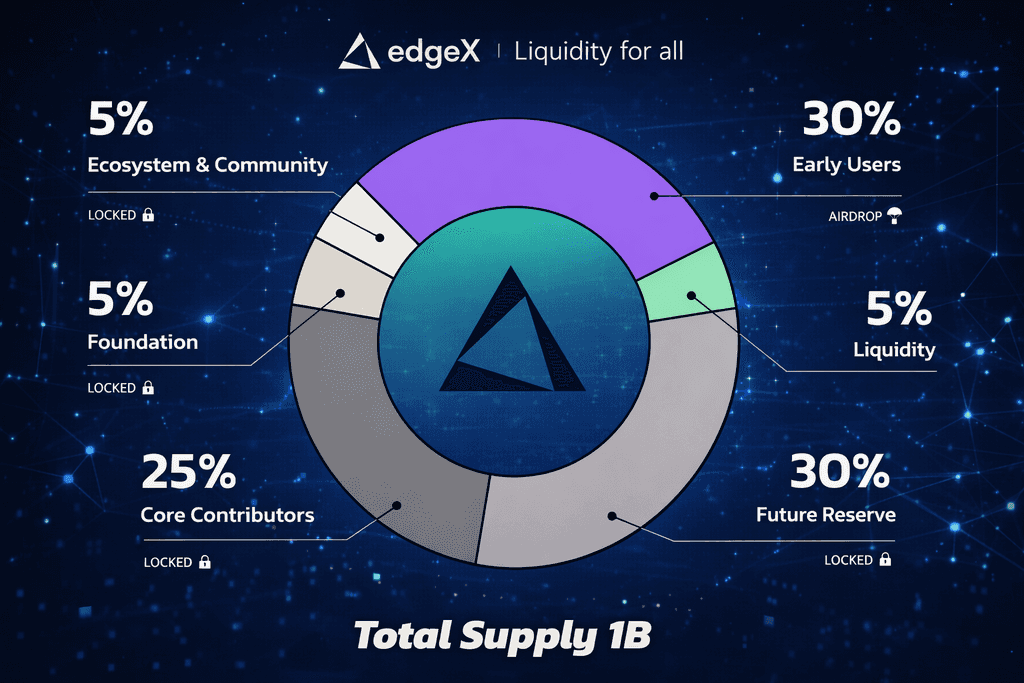
The EDGE token has a total supply of 1 billion tokens, with the allocation designed to balance early community participation, ecosystem development, long-term reserves, and contributor incentives. According to the official edgeX token page, 30% is allocated to Early Users, including 25% for the genesis distribution and 5% for the Pre-TGE Season. The remaining supply is split across Liquidity (5%), Ecosystem & Community (5%), Foundation (5%), Future Reserve (30%), and Core Contributors (25%).
Token Allocation
-
Early Users — 30% Includes 25% for genesis distribution and 5% for the Pre-TGE Season.
-
Liquidity — 5% Reserved to support market liquidity.
-
Ecosystem & Community — 5% Set aside for ecosystem growth and community-related initiatives.
-
Foundation — 5% Allocated to the foundation bucket.
-
Future Reserve — 30% Held for future use within the project’s broader development strategy.
-
Core Contributors — 25% Assigned to the team and core contributors supporting the project’s long-term buildout.
Vesting Schedule
The vesting structure shows that edgeX gives immediate access to some early-user allocations while placing longer lockups on ecosystem, reserve, and contributor tokens. Tokens from the genesis distribution are fully unlocked at genesis, while the Pre-TGE Season allocation becomes fully unlocked 24 hours after genesis.
For the remaining allocations, the vesting schedule is more gradual:
-
Ecosystem & Community: locked for 12 months after TGE, then vested linearly each month over 24 months.
-
Foundation: locked for 12 months after TGE, then vested linearly each month over 24 months.
-
Future Reserve: locked for 18 months after TGE, then vested linearly each month over 24 months.
-
Core Contributors: locked for 24 months after TGE, then vested linearly each month over 24 months.
History and Development
edgeX development story reflects a project that is gradually expanding from a trading-focused protocol into a broader infrastructure ecosystem. Its public documentation became more clearly structured in late 2025, when the team released a more complete set of support materials, beginner guides, and technical explanations. That period helped define how the project presents itself to users and the wider market.
A key part of edgeX’s background is its connection to Amber Group, which is referenced in the project’s official materials. This gives added context to the platform’s development and helps explain its strong focus on performance, trading infrastructure, and modular design.
As the project has evolved, its positioning has also become broader. What began primarily as a perpetual DEX narrative is now increasingly framed around EDGE Chain and a larger ecosystem vision.
Here are the main development highlights:
-
Late 2025 public rollout: edgeX published its core support center, onboarding guides, and technical materials during this period.
-
Amber Group incubation: the project presents itself as a modular financial system incubated by Amber Group.
-
Shift beyond perp trading: edgeX is no longer framed only as a perpetual DEX, but as a wider trading infrastructure project.
-
EDGE Chain expansion: the ecosystem is moving toward EDGE Chain, with development progressing from closed beta toward open beta.
This progression shows that edgeX is aiming to build more than a single trading product. It is positioning itself as a larger decentralized trading ecosystem with room for future expansion.
Project Mission and Vision
edgeX is built around the idea of improving the foundation of DeFi trading infrastructure. The project focuses on the limitations of many existing systems, especially where slower execution and rigid design can reduce efficiency for active trading and derivatives markets.
Rather than adapting a general-purpose blockchain for trading, edgeX is developing a more specialized execution layer designed specifically for this use case. The goal is to create an environment that can better support speed, scalability, and a smoother trading experience.
Its long-term vision goes beyond being only a perpetual trading platform. edgeX is positioning itself as a broader ecosystem of permissionless financial modules that can support more flexible, trader-focused applications over time.
Here are the main mission and vision highlights:
-
Fix DeFi infrastructure limits: edgeX aims to address bottlenecks caused by slower and more rigid blockchain designs.
-
Build for trading performance: the project is creating a specialized execution layer tailored for high-performance trading.
-
Support a broader ecosystem: the long-term plan goes beyond perpetuals into a modular financial network.
-
Enable flexible applications: edgeX wants to give traders and developers more freedom to build customizable tools and products.
-
Balance key strengths: the project’s core value lies in combining performance, self-custody, and composability.
This vision gives edgeX a broader role than a standard DEX. It is positioning itself as infrastructure for a more flexible and scalable on-chain trading environment.
Key Features and Innovations
-
Parallel Transaction Execution
One of edgeX’s most notable technical features is its parallel transaction execution model. Through EDGE Stack, the platform is designed to process non-conflicting transactions at the same time instead of handling everything in a strictly sequential way. This helps improve speed and throughput, which is especially important for trading-heavy environments.
-
Modular Multi-VM Architecture
Another major innovation is the project’s modular Multi-VM design. edgeX separates perpetual trading execution from standard DeFi logic by placing them in different environments. This structure allows the platform to optimize performance for trading while still keeping the ecosystem flexible enough to expand over time.
-
Orderbook-Based Trading Experience
edgeX also stands out for its orderbook trading model. Instead of relying only on a basic swap-style interface, it offers a setup that gives users more control over pricing, order placement, and execution. This makes the platform more appealing to active traders looking for a more professional-style trading experience.
-
Flexible User Onboarding
On the user side, edgeX makes onboarding more accessible by supporting both wallet connection and MPC account creation through email. This gives new users a simpler entry point while still maintaining the broader self-custody approach that is central to decentralized trading.
TLDR;
-
edgeX is a decentralized trading platform focused on both spot and perpetual markets.
-
It is built around EDGE Stack, a modular execution layer designed to improve speed, throughput, and trading efficiency.
-
The project combines orderbook-based trading, self-custody, and a more advanced trading experience than basic swap-style DEXs.
-
edgeX also supports flexible onboarding, allowing users to connect a wallet or create an MPC account via email.
-
The EDGE token has a total supply of 1 billion tokens.
Project Features
-
Orderbook-based trading — edgeX uses an orderbook model aimed at more precise execution than simple swap-style interfaces.
-
Parallel execution architecture — EDGE Stack is built to process non-conflicting transactions in parallel for higher throughput.
-
Wallet and MPC onboarding — users can connect a wallet or create an email-based MPC account for easier access.
-
Spot and perpetual markets — the platform supports both core trading modes within the same ecosystem.
-
Multi-module ecosystem direction — edgeX is expanding beyond basic trading into strategy, rewards, and broader modular financial applications.
How to Buy EDGE on KuCoin
Buying EDGE on KuCoin. Follow these steps:
-
Create a KuCoin account Sign up on the KuCoin website or app using your email address or phone number. Set a strong password and choose your country or region during registration.
-
Secure and verify your account Enable two-factor authentication (2FA) and add extra security settings such as an anti-phishing code. Complete identity verification if KuCoin requires it for trading access in your region.
-
Deposit funds Add funds to your KuCoin account by depositing crypto such as USDT, or use any supported payment method available on the platform to buy a funding asset first.
-
Search for EDGE Go to the trading section and search for EDGE. Check the available trading pairs and confirm whether EDGE is listed for the type of trading you want to use.
-
Choose the correct market Make sure you are in the right section before placing your order. Spot trading and perpetual trading are different products, so select the market that matches your purpose.
-
Place a buy order Choose a market order if you want to buy at the current market price, or a limit order if you want to set your own preferred buy price. Enter the amount you want to purchase and confirm the order.
-
Store or manage your EDGE After buying, you can keep your EDGE in your KuCoin account.
Conclusion
edgeX is positioning itself as more than just another decentralized exchange. With its focus on orderbook-based trading, modular execution infrastructure, and support for both spot and perpetual markets, the project is aiming to build a more advanced on-chain trading environment for active users. Its broader vision around EDGE Stack and ecosystem expansion also gives it a longer-term identity beyond a single trading product.
The EDGE token adds another important layer to that ecosystem, with a structured allocation model that covers early users, liquidity, community growth, reserves, and core contributors. For readers exploring the project, understanding both the platform itself and the token structure helps create a clearer picture of how edgeX is trying to grow over time.
Disclaimer: The information provided on this page may originate from third-party sources and does not necessarily represent the views or opinions of KuCoin. This content is intended solely for general informational purposes and should not be considered as financial, investment, or professional advice. KuCoin does not guarantee the accuracy, completeness, or reliability of the information, and is not responsible for any errors, omissions, or outcomes resulting from its use. Investing in digital assets carries inherent risks. Please carefully evaluate your risk tolerance and financial situation before making any investment decisions. For further details, please consult our Terms of Use and Risk Disclosure