

Trump’s Greenland Security Agreement With Denmark: What’s in the Deal and Why It Matters
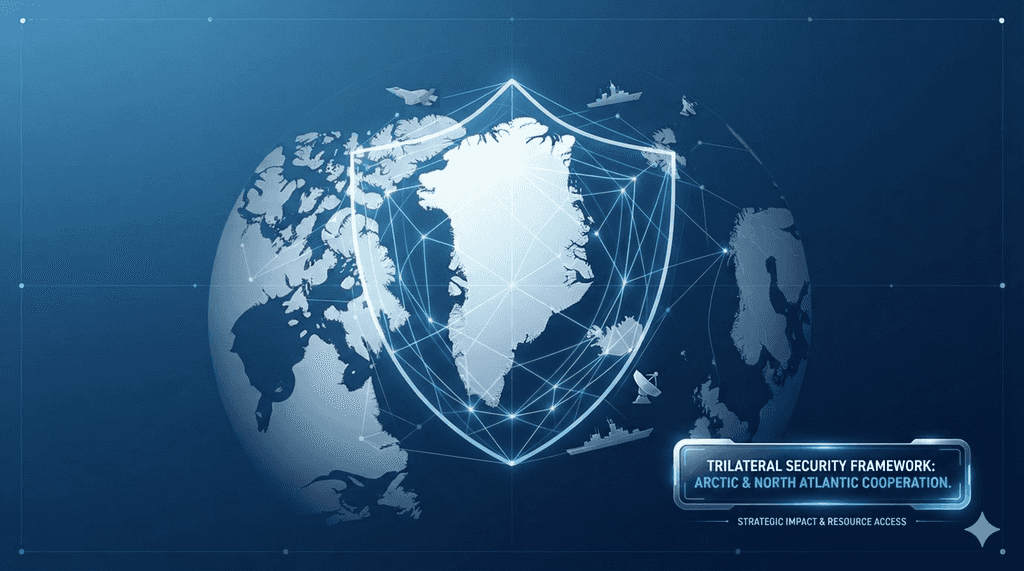
On September 22, 2026, during the United Nations General Assembly in New York, US President Donald Trump, Danish Prime Minister Mette Frederiksen, and Greenland Premier Jens-Frederik Nielsen formally signed a comprehensive trilateral security pact governing the defense of the world's largest island.
The agreement grants the United States permanent defense authority and new military installations across Greenland while preserving Danish sovereignty and island self-determination, resolving a historic transatlantic NATO rift. The diplomatic resolution concludes months of aggressive negotiations, punctuated by earlier US threats to forcibly purchase or seize the territory, that had temporarily fractured the NATO alliance and drawn European military deployments to the region in solidarity with Copenhagen.
Beyond its immediate military implications, the Greenland security agreement reshapes the global supply chain for critical minerals and redefines how Western capital will access the Arctic.
Key Takeaways
-
On September 22, 2026, US President Donald Trump, Danish Prime Minister Mette Frederiksen, and Greenland Premier Jens-Frederik Nielsen signed a comprehensive security agreement during the UN General Assembly.
-
The US Denmark Greenland agreement permits the construction of two new American military bases in Narsarsuaq and Mestersvig, alongside the deployment of the Golden Dome missile defense system.
-
A strict exclusionary clause bans non-NATO and non-EU entities from investing in or controlling Greenland's critical infrastructure and rare earth mining sectors without explicit US approval.
-
The pact resolves a severe diplomatic crisis within NATO, granting Washington permanent defense control while explicitly protecting Danish sovereignty and Greenlandic self-determination.
What Did the US, Denmark, and Greenland Agree To?
The text of the Trump Greenland deal outlines a substantial transfer of defense responsibility from Copenhagen to Washington, operating under a framework that resembles a US military protectorate without a formal transfer of territorial ownership.
New Military Footprints: Narsarsuaq, Mestersvig, and Golden Dome
Historically, the US military presence in Greenland was consolidated at the Pituffik Space Base (formerly Thule Air Base) in the deep north. The new agreement aggressively expands this footprint. The US military is now authorized to construct and operate two additional installations: one in Narsarsuaq in the south (repurposing a former Cold War-era airfield) and another in Mestersvig on the eastern coast.
Furthermore, the pact grants the US Department of Defense the right to deploy the "Golden Dome" missile defense system across the territory. To support these operations, the US Denmark Greenland agreement secures extensive, unrestricted transit rights for American military aircraft and naval vessels through Greenlandic airspace and territorial waters.
Shutting Out Foreign Adversaries
The most economically consequential section of the agreement is the exclusionary investment screening mechanism. The text explicitly prohibits any non-NATO, non-NATO partner, or non-EU state from acquiring controlling stakes or significant influence over Greenland's critical infrastructure, telecommunications, or resource extraction sectors.
Sovereignty vs. Defense Control
Danish Prime Minister Mette Frederiksen described the document as a deal that can "last forever," while President Trump emphasized it grants the US "permanent control over security". The pact contains no expiration date and can only be amended or dissolved by the unanimous consent of all three signatories.
Crucially, the agreement includes a continuity clause addressing the territory's long-term political status. Even if Greenland eventually exercises its right to full independence from the Kingdom of Denmark, the security pact remains legally binding. The agreement explicitly expects an independent Greenland to remain integrated within the NATO defense umbrella, ensuring that Washington's permanent defense control outlives any future sovereign transitions.
| Agreement Dimension | Status Under the New Trilateral Pact |
| Defense Authority | Retained by the Kingdom of Denmark alongside Greenland, with significantly expanded, permanent operational rights granted to the U.S. military. |
| Military Installations | Modernization of Pituffik Space Base, establishment of two new defense sites at Narsarsuaq and Mestersvig, and provisions for Golden Dome deployment. |
| Foreign Investment | Exclusion of non-NATO and non-EU entities from acquiring control or major influence over critical infrastructure and sensitive assets. |
| Territorial Sovereignty | Retained by the Kingdom of Denmark, with explicit reaffirmation of Greenland’s right to self-determination. |
| Future Independence | Pact remains in force indefinitely; an independent Greenland must remain in NATO and assume Denmark's treaty obligations. |
Geopolitical Ramifications
Defusing the Transatlantic Diplomatic Crisis
Earlier in 2026, the Trump administration's aggressive posturing regarding the potential acquisition or military occupation of Greenland triggered an unprecedented crisis within NATO. Viewing the rhetoric as a threat to a sovereign member state, European allies including the United Kingdom, France, Germany, and several Nordic nations deployed symbolic military assets to the region to support Denmark.
The Arctic Route
As climate change accelerates Arctic sea ice recession, the region is gradually seeing increased seasonal accessibility. While passages like the Northern Sea Route and the Northwest Passage theoretically offer significantly shorter maritime transit times between Asia, Europe, and North America, commercial viability remains heavily constrained by extreme polar navigation hazards, seasonal limitations, and an acute deficit of Arctic support infrastructure.
The Race for Critical Minerals: Energy Independence and Western Capital
The formalization of the US-Denmark-Greenland security framework provides strategic geopolitical clarity for long-term Western investment. The island hosts significant unexploited mineral resources, which are essential for advancing modern energy infrastructure and defense technologies.
Strategic Rare Earth Reserves and Western Capital Alignment
Greenland's geological formations hold globally significant deposits of critical elements, including neodymium, praseodymium, dysprosium, and terbium, vital for permanent magnets used in electric vehicles, wind turbines, and aerospace guidance systems.
While extraction has historically been constrained by prohibitive Arctic operating costs, infrastructure deficits, and local regulatory hurdles (such as restrictions on uranium-bearing ores), geopolitical uncertainty had further complicated Western private capital commitments. By excluding adversarial capital from critical sectors and anchoring Greenland firmly within the Western security perimeter, the US-Denmark-Greenland pact establishes the long-term policy predictability necessary to support high-risk, multi-year mineral supply chain ventures.
De-Risking Global Technology Supply Chains
The exclusionary clause in the agreement serves a dual purpose: it restricts adversarial capital from controlling these strategic assets while fostering a secure framework for allied investment. With non-NATO and non-EU state-owned entities effectively blocked from obtaining restrictive influence over critical resources, American, Canadian, Australian, and European mining enterprises can pursue multi-year ventures in a significantly de-risked geopolitical environment.
This defensive alignment tightly integrates with Washington’s broader macroeconomic strategy of "friend-shoring" critical supply chains. By establishing mechanisms to ensure Greenland’s rare earth resources are insulated from adversarial leverage, the agreement facilitates the integration of these materials into NATO and allied industrial bases, reducing reliance on dominant foreign suppliers and reinforcing the long-term resilience of the global technology manufacturing sector.
Conclusion
The signing of the trilateral security agreement in New York represents a defining moment in modern Arctic geopolitics. By establishing a permanent defense framework, the United States has solidified its northern flank, expanded its military projection capabilities to one of the most resource-rich territories on the planet. As global trade routes shift northward and the demand for rare earth minerals accelerates, the Trump Greenland deal ensures that the geopolitical and economic future of the world's largest island will remain firmly anchored within the Western strategic orbit.
FAQs
What is in the Greenland security agreement?
The agreement grants the US permanent defense control over Greenland, permits the construction of two new military bases (Narsarsuaq and Mestersvig), allows the deployment of the Golden Dome missile defense system, and explicitly bans adversarial non-NATO/EU investment in the island's sensitive sectors.
Does the US own Greenland now?
No. The United States did not purchase or annex the territory. The Kingdom of Denmark retains full territorial sovereignty, and Greenland maintains its right to self-determination. The agreement strictly transfers permanent military and defense authority to Washington.
Why is Greenland's geopolitical significance increasing?
Greenland's strategic value is rising due to the melting of Arctic sea ice, which is opening new global shipping lanes. Additionally, the island contains massive, unexploited deposits of rare earth minerals that are critical for aerospace, military technology, and global energy transitions.
What does Greenland deal mean for macro and crypto markets?
As geopolitical tensions ease, capital often rotates out of strict safe-haven hedges and back into risk-on assets. Furthermore, the stabilization of the mining sector opens long-term possibilities for the tokenization of critical mineral commodities (RWAs) on blockchain networks.
🔥 Beyond the Headlines: What KuCoin 5.0 Means for You
Market news moves fast — but where you act on it matters just as much. This October, KuCoin launches KuCoin 5.0, transforming KuCoin into a rebuilt platform. Here's what actually changes for you:
-
One account for everything. Older platforms split your money across separate "spot," "margin," and "futures" accounts and expected you to understand why. KuCoin 5.0's unified account removes that entirely — deposit once, and everything is simply there (only available to VIPs for now).
-
Stocks, indices, and commodities. KuCoin 5.0 expands beyond crypto into global markets. When crypto chops sideways and equities rally (or the reverse), you rotate in minutes instead of opening a brokerage account and waiting days for fiat rails.
-
Real-world assets (RWA). Tokenized exposure to traditional assets like commodities, right inside your crypto account. One of the fastest-growing segments in global finance is no longer reserved for institutions — you access it from the same balance you trade with.
-
Earn while you learn. Not ready to trade? KCUSD lets your stablecoins earn daily, auto-compounding interest. The lowest-stress way to put your idle deposit to work for 4% yield.
-
An AI assistant in plain language. Ask questions, get market context, understand what you're looking at — built into the platform, no jargon required.
-
An app that doesn't overwhelm. Faster, cleaner, and consistent — intuitive from the first tap, not after a tutorial.
-
Safety you can check, not just trust. A MiCAR-licensed EU entity, Proof of Reserves you can verify yourself, and internationally certified security (SOC 2 Type II, ISO 27001:2022).
Create your account in minutes — and start on the platform built for where crypto is going, not where it's been.
Disclaimer
The information provided on this page may originate from third-party sources and does not necessarily represent the views or opinions of KuCoin. This content is intended solely for general informational purposes and should not be considered financial, investment, or professional advice. KuCoin does not guarantee the accuracy, completeness, or reliability of the information, and is not responsible for any errors, omissions, or outcomes resulting from its use. Investing in digital assets carries inherent risks. Please carefully evaluate your risk tolerance and financial situation before making any investment decisions. For further details, please consult KuCoin’s Terms of Use and Risk Disclosure.