

SpaceX Valuation 2026: Why the $2 Trillion IPO Target Faces Its First Real Test
2026/05/19 11:45:02
Introduction
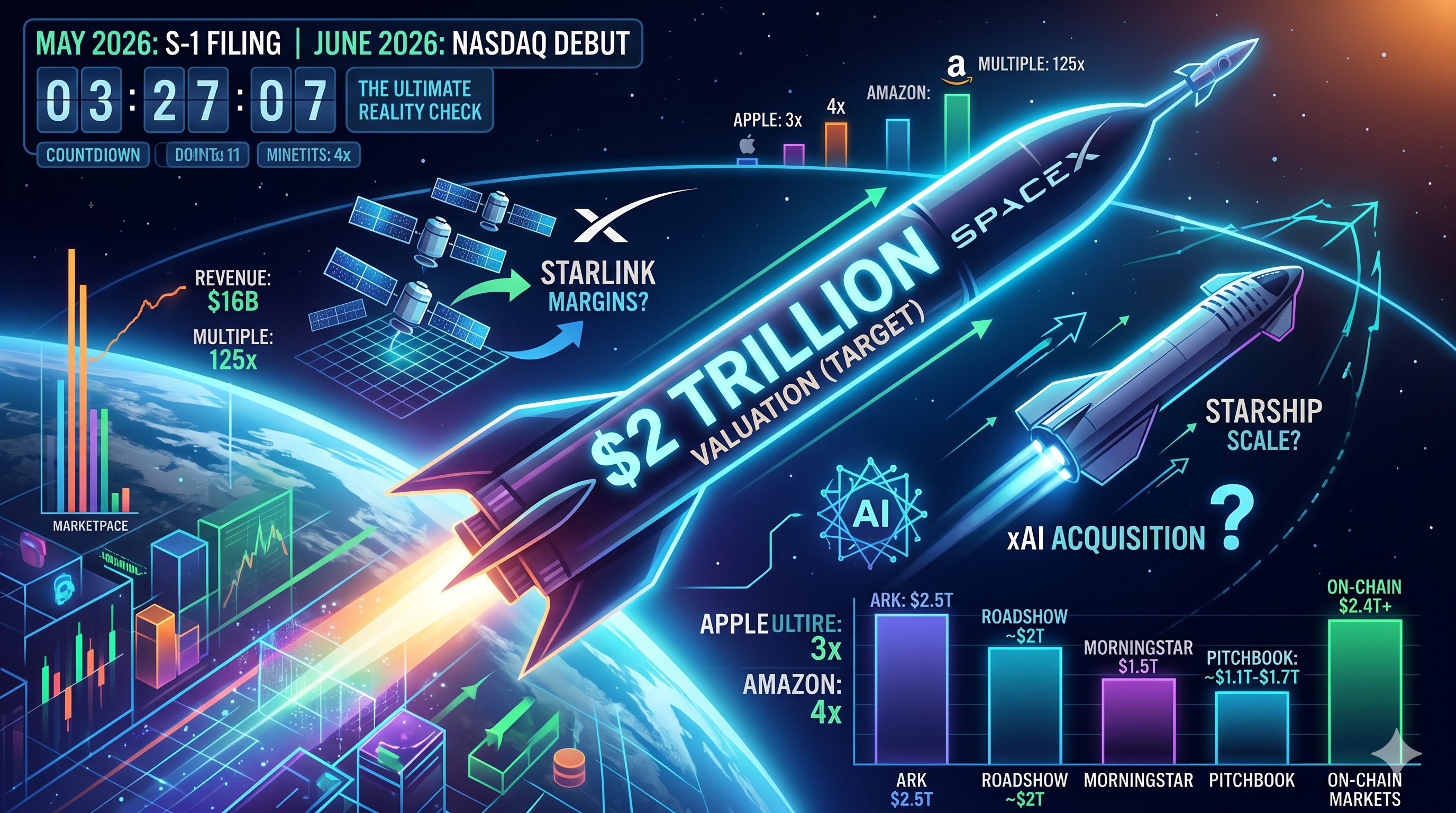
SpaceX is targeting a $2 trillion valuation on roughly $16 billion in revenue — a 125x revenue multiple with no precedent among publicly traded industrial companies. For comparison, Apple trades at approximately 3x revenue and Amazon at roughly 4x. The IPO is targeting pricing as early as June 11, 2026, with a Nasdaq debut on June 12, 2026.
The headline answer to "what is SpaceX's valuation?" depends entirely on who you ask. Traditional research houses cluster between $1.1 trillion and $1.75 trillion. ARK Invest's long-term 2030 projection reaches $2.5 trillion. On-chain pre-IPO markets are pricing it even higher. The S-1 filing — expected in late May — will be the first time in SpaceX's 24-year history that its financials are legally disclosed, and it will reset every one of these numbers against verifiable reality.
How Much Is SpaceX Worth Right Now?
SpaceX's pre-IPO valuation sits between $1.1 trillion and $2.5 trillion, with the IPO roadshow targeting approximately $2 trillion. The wide spread reflects how much of the valuation rests on unproven future business lines rather than current cash flow.
According to PitchBook research published ahead of the filing, a fair-value band of $1.1 trillion to $1.7 trillion implies roughly a 95x multiple on projected 2025 revenue. PitchBook notes that traditional valuation methods struggle to apply cleanly, but SpaceX's unique monopoly position in commercial launch supports the premium.
Morningstar, the independent research firm, has set its estimate at $1.5 trillion. Its analysts call SpaceX "expensive and risky, but not unreasonable" — provided Starship commercializes on schedule and investors hold top-decile confidence in Starlink's long-term growth.
ARK Invest, led by Cathie Wood, is the most aggressive among traditional institutions, citing $1.75 trillion as a credible IPO valuation and projecting roughly $2.5 trillion by 2030. ARK's thesis bundles Starlink, the launch business, and the absorbed xAI assets into a single compounding platform.
Why Did the Valuation Jump to $2 Trillion?
The valuation grew nearly 500% in 15 months while revenue grew approximately 60% — a gap created primarily by a single self-assessed acquisition rather than operating performance. In December 2024, insiders sold SpaceX shares at a $350 billion valuation. By early 2026, the IPO target had crossed $2 trillion.
The xAI Acquisition
The largest single step was the February 2026 all-stock acquisition of Musk's AI company xAI. The combined entity was valued at $1.25 trillion — SpaceX at $1 trillion and xAI at $250 billion. Musk controlled both sides of the transaction. According to The D&O Diary, a specialist publication tracking director and officer liability, the deal closed without independent fairness opinions and has been described as a "fiduciary stress test."
xAI at the time of acquisition was generating approximately $250 million in revenue over six months while losing roughly $2.5 billion. Within weeks of closing, Musk publicly acknowledged the core technology needed to be rebuilt. By March 2026, every xAI co-founder except Musk had departed the company.
The Roadshow Step-Ups
From the $1.25 trillion combined starting point, the target moved sequentially to $1.5 trillion, then $1.75 trillion, then above $2 trillion. Each step reflected testing-the-waters conversations guided by 21 underwriting banks whose fees depend on the deal closing.
What Does the Market Itself Say SpaceX Is Worth?
On-chain pre-IPO markets are pricing SpaceX significantly higher than traditional institutions, suggesting crypto-native capital views the upside more aggressively. Based on data from Hyperliquid-ecosystem trading venue trade.xyz, the SPCX pre-IPO contract was quoted at approximately $207 at launch, implying a roughly $2.46 trillion valuation — well above both Morningstar and PitchBook estimates.
According to PolyBeats monitoring data on the prediction market Polymarket, the implied probability that SpaceX closes its first trading day with a market cap above $2 trillion sits at approximately 71%. On-chain markets are treating a $2 trillion-plus debut as the base case rather than the bull case.
The divergence between traditional and on-chain pricing reveals two different frameworks. Institutional models discount unproven optionality. Prediction markets price narrative momentum and scarcity of access — fewer shares will trade publicly than demand suggests, which historically pushes Day 1 prices well above offering levels.
What Is the Starlink Margin Story Actually Worth?
Starlink's headline 54% EBITDA margin depends on internal launch pricing that almost certainly disappears at market rates. The single jurisdiction where Starlink has been legally required to disclose audited financials — its European subsidiary filed in the Netherlands — shows $2.7 billion in revenue and $72 million in net profit, a net margin under 3%.
The gap between 54% and 3% has a specific source: transfer pricing. SpaceX flies approximately 120 Starlink deployment missions per year. According to SpaceNews reporting, internal Starlink launches are charged at roughly $28 million each — well below the approximately $62 million external commercial rate.
Strip out the $4 billion annual internal subsidy and Starlink's standalone margins compress sharply. Vertical integration is a real, earned competitive advantage — SpaceX built it. The issue is that the margin figure used to justify $2 trillion is inseparable from intercompany pricing that has never been publicly disclosed and that the S-1 will surface for the first time.
What This Means for Competitors
Amazon's Project Kuiper has to purchase launches at market rates, in some cases from SpaceX itself. If Starlink generates under 3% net margin in its one disclosed jurisdiction with a $4 billion internal subsidy, the unit economics available to any competitor paying market rates are not a forecasting challenge — they are a structural wall.
How Much of the Valuation Depends on Starship?
Attributing even 20% of the $2 trillion valuation to Starship implies approximately $400 billion assigned to a vehicle that has never served a paying commercial customer. As of early 2026, Starship had launched 11 times with 6 marginally successful suborbital flights — genuine engineering progress, but unproven at commercial scale.
Sizing the Required Revenue
At a generous 30x revenue multiple for an industrial business, $400 billion of implied value requires Starship to eventually generate approximately $13 billion in annual launch revenue. At Musk's stated target price of $10 million per launch, that translates to roughly 1,300 commercial launches per year.
For context, the entire global launch market in 2025 was approximately 250 missions across all providers combined. The bull case — that radically cheaper launches expand the total addressable market by orders of magnitude — is logically coherent. Cheap launches do create demand that expensive launches cannot.
The question is not whether the expansion can happen. It is whether paying for it today, before it has happened, at a price that leaves no room for delays, is consistent with disciplined investment.
What Are the Biggest Risks to the $2 Trillion Target?
The four largest risks are intercompany pricing transparency, acquisition integrity, optionality timing, and governance dilution — each of which the S-1 will quantify for the first time.
Margin Reality
The single most important disclosure will be what Falcon 9 charges Starlink internally and what Starlink's margins look like at the rate external customers pay. The 54% headline and the 3% Netherlands filing are two ends of the same question.
Acquisition Integrity
The S-1 will carry xAI's financials as a subsidiary. Investors can compare the disclosed performance against the $250 billion value the self-assessed acquisition assigned to it. A quarter of the combined company's pre-IPO valuation rests on a line item whose seller priced it himself.
Optionality Timing
Development cost to date, forward capital requirements, and SpaceX's own Starship commercial timeline will be disclosed. That is the first moment optionality can be sized rather than assumed.
Governance Structure
According to Bloomberg reporting, SpaceX is weighing a dual-class share structure giving insiders 10 to 20 votes per share against one for public investors. Musk has stated he will not sell personal shares and intends to retain absolute control via the super-voting structure. Alphabet and Meta use similar structures, so it is not inherently disqualifying — but the price should reflect the governance premium being surrendered.
How Does SpaceX's Valuation Compare to Other Mega-Cap Companies?
SpaceX at 125x revenue would be the most expensively valued industrial company in public market history by a wide margin. Even at 10x revenue — a multiple that would already be a public market record for an industrial business — justifying $2 trillion requires $200 billion in annual revenue. Current 2026 projections sit at $23 to $24 billion.
|
Company
|
Approx. Revenue Multiple
|
|
Apple
|
~3x
|
|
Amazon
|
~4x
|
|
Nvidia (AI peak)
|
~30x
|
|
SpaceX (IPO target)
|
~125x
|
The comparison does not mean SpaceX is mispriced — monopoly positioning and optionality genuinely warrant a premium. It does mean that every optimistic assumption has to be correct for the math to work.
Conclusion
SpaceX's valuation question has no single answer in May 2026. Traditional research firms cluster between $1.1 trillion and $1.75 trillion, ARK Invest stretches to $2.5 trillion by 2030, the IPO roadshow targets $2 trillion, and on-chain pre-IPO markets are already pricing above $2.4 trillion with 71% odds of a $2 trillion-plus first-day close.
The number that matters most is the one inside the S-1 filing expected in late May. It will be the first time the world sees Starlink's true unit economics stripped of internal launch subsidies, xAI's standalone performance compared against the $250 billion value the self-assessed acquisition assigned to it, and the real cost trajectory of Starship development.
SpaceX is a genuinely extraordinary engineering business. The rockets work, the launch cadence is unmatched, and Starlink's subscriber base is real. The question for investors is not whether SpaceX deserves a premium — it does — but whether $2 trillion leaves any margin of safety if a single assumption proves wrong. The S-1 will be the moment that question moves from narrative to numbers.
Frequently Asked Questions (FAQs)
When is SpaceX's IPO date?
SpaceX is targeting pricing as early as June 11, 2026, with Nasdaq trading expected to begin on June 12, 2026. The S-1 registration statement is expected to be filed in late May 2026, which is when full financial disclosures will become public for the first time in the company's 24-year history.
Will Elon Musk sell shares in the SpaceX IPO?
No. Musk has publicly stated he will not sell any personal shares in the offering and intends to retain absolute control of the company through a dual-class super-voting share structure. According to Bloomberg, the structure under consideration gives insiders 10 to 20 votes per share against one vote per share for public investors.
What ticker symbol will SpaceX trade under?
SpaceX's final ticker symbol has not been officially confirmed in the pre-S-1 reporting available as of May 2026. Pre-IPO contracts on on-chain venues like trade.xyz are currently using the placeholder SPCX. The official ticker will be disclosed in the S-1 filing.
Is SpaceX profitable?
SpaceX's consolidated profitability has never been publicly disclosed and will be reported for the first time in the S-1. The only disclosed segment financials — Starlink's European subsidiary in the Netherlands — show a net margin under 3% on $2.7 billion in revenue, but those figures benefit from an estimated $4 billion annual internal launch subsidy that may not survive market-rate accounting.