

SpaceX IPO Could Threaten Bitcoin: Analysts Warn of Major Capital Outflow
2026/06/11 16:55:00
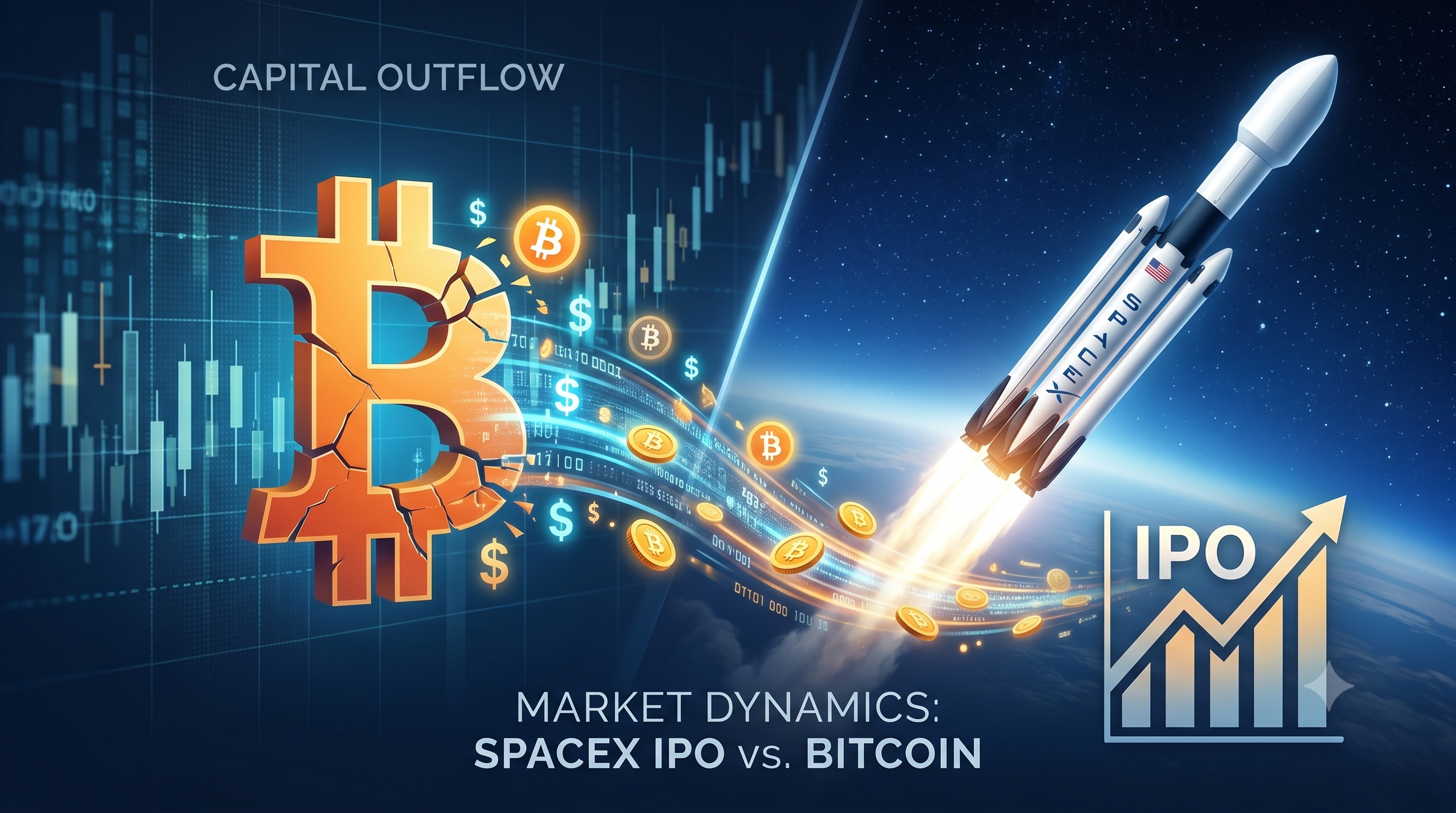
The global financial ecosystem is currently navigating a historic tectonic shift, and the epicenter is not located within the traditional trading floors of Wall Street, but rather on the launchpads of Boca Chica, Texas. As the highly anticipated June 2026 SpaceX Initial Public Offering (IPO) approaches, a surprising, almost counterintuitive narrative has seized the markets: the world's most dominant cryptocurrency, Bitcoin, is suddenly facing immense, sustained selling pressure. But why exactly would a commercial space exploration company's public debut cause cryptocurrency traders to lose sleep and watch their portfolios bleed red?
The answer lies in a powerful, invisible macroeconomic force known as Capital Rotation. SpaceX has effectively become a trillion-dollar "liquidity black hole," inadvertently sucking up the risk capital that traditionally flows into digital assets. In this comprehensive, deep-dive analysis, we will unpack the mechanics of this massive capital outflow, examine the institutional and retail shifts driving the frenzy, explore the broader macroeconomic backdrop of 2026, and definitively answer what this historical market event means for the future of your crypto portfolio.
💡 Tips: New to crypto? KuCoin's Knowledge Base has everything you need to get started.
The Catalyst: Unpacking the SpaceX IPO "Black Hole"
To truly understand why Bitcoin is feeling the heat right now, we first must comprehend the sheer gravitational pull of the SpaceX IPO. We are not just talking about another standard Silicon Valley tech listing; we are talking about a generational wealth-creation event that has captured the imagination of both institutional powerhouses and everyday retail investors worldwide.
According to recent SEC filings and widespread Wall Street consensus, SpaceX is targeting an unprecedented valuation range of $1.75 Trillion to $2 Trillion. The company plans to raise approximately $75 Billion in fresh capital, making it one of the absolute largest public offerings in human history. To put this into perspective, this single IPO seeks to absorb more capital than the entire market capitalization of many mid-sized sovereign nations.
This staggering valuation is not built on mere speculation or tech-bubble hype. SpaceX possesses an impenetrable commercial moat that traditional investors salivate over:
-
Starlink's Monopoly: Its satellite internet constellation has achieved near-global monopoly status in remote connectivity, generating massive, recurring free cash flow that rivals major legacy telecom giants.
-
Starship's Dominance: The Starship program has fundamentally altered the economics of space travel, dropping the cost of orbital delivery by orders of magnitude and cementing the company's dominance in heavy-lift transport and deep space exploration contracts with NASA and the Department of Defense.
For institutional investors, SpaceX is no longer just an eccentric billionaire's rocket company; it is the foundational infrastructure for the next century of the space economy. Because of this, asset managers view participation in this IPO not as an optional luxury, but as an absolute fiduciary necessity.
The "FOMO" Phenomenon in Traditional Finance
Fear Of Missing Out (FOMO) is a psychological driver that moves markets just as much as fundamental data, and the current hype surrounding the SpaceX ticker (expected to be SPCX) is deafening. In the dual narrative of artificial intelligence and the commercialization of space, SpaceX is widely regarded as the ultimate "buy-and-hold" wealth code for the next decade.
Investors are currently scrambling to raise cash to participate in the IPO lottery. When a "super-unicorn" of this magnitude opens its doors to the public, investors must liquidate their current holdings to free up capital. They are literally selling what they have to buy what they desperately want. Unfortunately for the crypto market, highly liquid, high-return assets like Bitcoin are often the very first to be liquidated to fund these new ventures.
The Macro Backdrop: Why 2026 is a "Cash-Strapped" Market
To grasp the full picture of this capital drain, we must look at the broader economic environment of mid-2026. The "liquidity pie" is simply not as endlessly expandable as it was during the zero-interest-rate era of 2020-2021.
In previous years, if institutional investors or aggressive retail traders wanted to buy a hot new IPO, they could easily take out cheap margin loans to fund their purchases without selling their existing assets. However, with the Federal Reserve maintaining a relatively normalized, moderate interest rate environment in 2026 to keep inflation in check, borrowing money remains relatively expensive.
-
No Free Lunch: Because margin borrowing is costly, investors cannot artificially inflate their purchasing power.
-
The Zero-Sum Game: Therefore, the market has become a strict zero-sum game. To allocate $100,000 into the SpaceX IPO, an investor must physically sell $100,000 worth of another asset. There is no new money being printed by central banks to bail out the demand; the capital must be rotated from within the existing financial system.
This macroeconomic reality is exactly why the SpaceX IPO is acting like a vacuum cleaner. It is forcing market participants to make hard choices, and right now, Bitcoin is on the chopping block.
The Mechanics of "Capital Outflow": Why Are They Connected?
For many casual observers, the connection between a physical space logistics company and a decentralized digital currency seems entirely disjointed. Why wouldn't investors just sell slow-moving utility stocks, bonds, or real estate? The reality comes down to how investors categorize risk and reward in their portfolios.
Both Bitcoin and newly listed mega-tech stocks occupy the exact same sleeve in an investor's portfolio: the "Risk-On" bucket. When investors want aggressive, market-beating growth, they allocate money to this specific bucket.
Retail vs. Institutional Shifts
The capital drain is happening on two distinct, highly coordinated fronts:
-
Retail Behavior: The everyday investor has a fixed "wallet share." Over the past few years, a significant portion of retail speculative money has been parked in Bitcoin and altcoins, enjoying substantial gains. To buy SpaceX shares on opening day, retail investors are forced to hit the "sell" button on their crypto exchange apps to realize profits and transfer cash to their stock brokerages.
-
Institutional Behavior: Institutional fund managers operate strictly on quantitative risk models and mandatory portfolio rebalancing. With a $2 Trillion behemoth entering the public markets, mutual funds, hedge funds, and broad tech ETFs must legally rebalance their portfolios to include SpaceX. To maintain their mandated risk exposure limits, portfolio managers are systematically reducing their high-risk weightings in cryptocurrencies and rotating those billions into the tangible, high-growth equity of SpaceX.
To visualize why these two assets are fighting for the exact same dollar, consider their current profiles in the 2026 macroeconomic landscape:
| Feature | Bitcoin (BTC) | SpaceX Stock (SPCX) |
| Asset Class | Digital Store of Value / Crypto | High-Growth Tech Equity |
| Current Sentiment | Maturing / Price Discovery | Extreme Hype / Market Debut |
| Risk Profile | High Volatility | High Risk, Tangible Backing |
| Liquidity Profile | 24/7 Global Liquidity | Highly anticipated lock-up periods |
| Investor Base | Tech-savvy, Institutional | Universal (Retail + Wall Street) |
As the table illustrates, both assets appeal to investors seeking massive upside. However, SpaceX currently possesses the shiny allure of "discovery" and novelty, causing a severe temporary imbalance in demand.
How the Liquidity Drain Impacts Bitcoin Now
The theory of capital outflow is not just academic; it is playing out in real-time data across global financial exchanges. The liquidity vacuum created by SpaceX is actively suppressing Bitcoin's price action right now.
-
Big outflows from Bitcoin ETFs
The most glaring evidence of this institutional capital rotation is visible in the U.S. Spot Bitcoin ETF market. Recent reports from prime brokerages indicate consecutive weeks of multi-billion dollar net outflows from major Bitcoin ETFs (such as IBIT, FBTC, etc.).
How does this work behind the scenes? When Wall Street clients tell their brokers they want cash for the SpaceX IPO, they sell their Bitcoin ETF shares. The ETF issuers (like BlackRock or Fidelity) use entities called Authorized Participants (APs) to literally redeem those ETF shares by selling the underlying, physical Bitcoin on the open market. This directly translates to massive sell walls on crypto exchanges. Analysts note that these outflows correlate perfectly with the timelines for institutional book-building ahead of the SpaceX listing. Wall Street is literally draining the Bitcoin ETF pool to fill the SpaceX IPO reservoir.
-
Bitcoin’s price lacks momentum
From a technical charting perspective, this severe liquidity drain has left Bitcoin looking temporarily vulnerable. The cryptocurrency has recently been pushed down to test critical psychological and technical support levels, hovering nervously around the $60,000 to $64,000 mark.
Because so much capital is sitting on the sidelines—parked in money market funds waiting for the SpaceX ticker to go live—the crypto market is suffering from a severe lack of upward momentum. Even when positive macro news breaks, Bitcoin struggles to rally because the buy-side volume simply is not there. The "dry powder" that would normally fuel a crypto bull run is currently earmarked for Elon Musk's enterprise.
The Elon Musk Paradox: SpaceX's Hidden Bitcoin Treasury
In what can only be described as ultimate financial irony, the very company draining liquidity from the Bitcoin ecosystem is simultaneously one of its most ardent corporate backers.
When SpaceX filed its S-1 registration document with the SEC to initiate the IPO process, eagle-eyed financial analysts uncovered a massive surprise buried deep within the corporate balance sheet. As of early 2026, SpaceX holds exactly 18,712 Bitcoin, valued at roughly $1.45 Billion at current market prices.
This revelation creates a fascinating, mind-bending paradox. The impending IPO is starving the crypto market of short-term cash, yet the success and public debut of SpaceX will simultaneously make it one of the largest publicly traded corporate holders of Bitcoin in the world. It will trail only pure-play accumulation companies like MicroStrategy. This proves a critical point for anxious investors: the current capital outflow is a purely mechanical market function, not a fundamental rejection of digital assets by the tech elite.
Musk's Enduring Crypto Influence on Cryptocurrency
Elon Musk's relationship with cryptocurrency has always been theatrical, chaotic, and highly influential. From sending Dogecoin surging with a single late-night meme to Tesla's early adoption of Bitcoin payments, Musk commands unparalleled attention in the digital asset space.
With SpaceX now entering the highly regulated public sphere boasting a massive Bitcoin treasury, market speculators are already questioning his next strategic move. Will SpaceX aggressively add to this Bitcoin position post-IPO using their newly raised capital? Will Starlink eventually integrate crypto payments for its global internet services? While the short-term IPO mechanics are bruising Bitcoin's price, Musk's underlying alignment with the crypto ecosystem provides a massive, undeniable bullish backstop for the long term.
The Ripple Effect: Altcoins and DeFi Aren't Safe Either
The liquidity drain is not isolated strictly to Bitcoin. Global financial markets are deeply interconnected ecosystems, and a vacuum of this magnitude creates a brutal ripple effect across the entire digital asset board.
The Bloodbath in the Altcoin Market
There is a time-tested adage in crypto trading: When Bitcoin sneezes, altcoins catch a severe cold. Because Bitcoin is the most liquid and trusted asset in the crypto space, it is the first to be sold for cash. However, as Bitcoin's price drops and its dominance wavers, it triggers algorithmic liquidations and sheer panic selling across smaller, far less liquid markets.
Ethereum (ETH), Solana (SOL), and a myriad of smaller altcoins have faced even steeper percentage drops than Bitcoin. The risk-capital pie is shrinking rapidly, and retail investors are abandoning highly speculative altcoins entirely to ensure they have enough safe cash on hand for the SpaceX offering.
The Drain on Decentralized Finance (DeFi)
We are also seeing the SpaceX effect in the DeFi metrics. The Total Value Locked (TVL) across major lending protocols has dipped. Crypto natives are unstaking their assets, withdrawing liquidity from yield farms, and bridging their capital back to centralized fiat off-ramps. The opportunity cost of missing the SpaceX IPO is currently viewed as higher than the 8% to 12% yield they might earn in a DeFi lending pool.
Furthermore, high-valuation AI and semiconductor stocks in traditional markets are also experiencing unusual, correlated sell-offs. Hedge funds are trimming their bloated positions in inflated AI tech to rotate into the fresh, untapped equity of the aerospace sector.
Historical Precedents: What Past Mega-IPOs Teach Us
While the specific scale of the SpaceX IPO is entirely unprecedented, the mechanical nature of market liquidity drains is not new. History provides a highly comforting roadmap for Bitcoin investors who are currently panicking over the red charts on their screens.
The Facebook and Alibaba Lessons
We can look back at the mega-IPOs of Facebook (now Meta) in 2012 and Alibaba in 2014. During the anxious weeks leading up to both of these historic listings, broader market liquidity in parallel tech sectors notably dried up. Smaller tech stocks, emerging market equities, and early-stage growth assets suffered distinct short-term corrections as global capital re-routed to participate in the blockbuster IPOs. However, the key, undeniable takeaway from historical financial data is that the "vampire effect" is strictly short-lived. A market cannot hold its breath forever, and capital always seeks out discounted assets once the main event concludes.
The Post-IPO Rebound Strategy
What actually happens after the SpaceX IPO dust settles? Typically, a highly anticipated IPO of this caliber is vastly oversubscribed. Millions of investors who wanted to buy $10,000 worth of shares might only be allocated $1,000 worth by their brokerages due to limited supply.
This mechanical bottleneck leaves an enormous mountain of "rejected" cash suddenly unlocked and sitting idle in brokerage accounts. Within 1 to 3 months following a mega-IPO, this frozen capital aggressively hunts for new opportunities. Historically, this leads to a sharp, violent V-shaped recovery in the assets that were previously sold off. Analysts heavily predict that once the SpaceX listing is finalized and trading normalizes, a massive wave of liquidity will flood right back into Bitcoin, potentially sparking a massive fourth-quarter rally as investors buy back the crypto they sold at a discount.
The impending SpaceX IPO is an undisputed financial leviathan, temporarily distorting global market liquidity and drawing vital capital away from Bitcoin. However, as our comprehensive deep dive reveals, this is a mechanical macroeconomic event driven by portfolio rebalancing and retail FOMO, not a fundamental flaw in the cryptocurrency thesis.
For investors looking at their portfolios right now, the strategy moving forward requires strict discipline and historical perspective:
-
For Long-Term Holders: Ignore the short-term noise. The fact that SpaceX itself holds nearly 19,000 BTC completely validates the asset class. The current price suppression is a liquidity mirage, not a permanent devaluation. HODLers should view this as a stress test that Bitcoin will inevitably survive.
-
For Short-Term Traders: Be highly defensive and preserve your capital. The weeks surrounding the June 2026 IPO will likely feature erratic, choppy price action, lower-than-usual buy volume, and potential sudden downside wicks in the crypto market as last-minute capital rotation occurs.
The clash between SpaceX and Bitcoin is a testament to the incredible innovation driving modern financial markets. Both represent the absolute bleeding edge of human technological progress, and eventually, the global market will find more than enough liquidity to support both titans.
Frequently Asked Questions (FAQs)
Will the SpaceX IPO crash Bitcoin to zero?
Absolutely not. Bitcoin operates on an independent, globally decentralized value network. While a massive IPO can temporarily divert cash and cause short-term price drops due to supply and demand imbalances, it cannot erase the fundamental demand, absolute scarcity, or institutional adoption that Bitcoin has aggressively built over the last decade.
How much Bitcoin does SpaceX actually own?
According to the company's official S-1 filing submitted ahead of the public offering, SpaceX holds 18,712 Bitcoin directly on its corporate balance sheet. At current 2026 market prices, this treasury is valued at over $1.45 Billion, making them one of the largest corporate holders globally.
When will the liquidity return to the crypto market?
Based on historical data from previous mega-IPOs (like Alibaba, Facebook, and even the Coinbase direct listing), the "capital drain" effect is usually resolved within 1 to 3 months after the company officially goes public. Once the IPO allocations are settled and early lock-up periods establish a baseline, excess sidelined cash typically flows rapidly back into risk-on assets like Bitcoin.
Should I short Bitcoin before the SpaceX IPO happens?
Attempting to short Bitcoin based purely on the SpaceX IPO timeline is extremely risky. While capital rotation is causing downward pressure, Bitcoin is notoriously volatile and can spike instantly on unrelated macroeconomic news (such as unexpected Federal Reserve rate cuts or regulatory approvals). Shorting a historically appreciating asset during a liquidity crunch often leads to severe short squeezes.
Will the SpaceX IPO affect Ethereum and other altcoins similarly?
Yes, and likely more severely. Because Bitcoin acts as the reserve currency of the crypto ecosystem, when it loses liquidity, altcoins suffer an amplified effect. Ethereum, Solana, and DeFi tokens are experiencing higher percentage drawdowns because they sit even further out on the "risk curve" than Bitcoin. Investors are draining these smaller pools first to ensure they have pristine fiat currency ready for the SpaceX launch.
Does SpaceX's Starlink have any technological crossover with the crypto ecosystem?
Yes, and it is a fascinating long-term bullish narrative. Many global Bitcoin miners and decentralized node operators heavily rely on SpaceX's Starlink satellite internet to maintain their connections to the blockchain in remote, off-grid locations where cheap renewable energy is abundant (such as hydro-dams in rural mountains or remote solar farms). While the IPO is draining financial liquidity today, SpaceX's technology is actively supporting the physical infrastructure of the Bitcoin network.