

Trading 101: Importance of "Market Sentiment Analysis" In Crypto Trading
Introduction
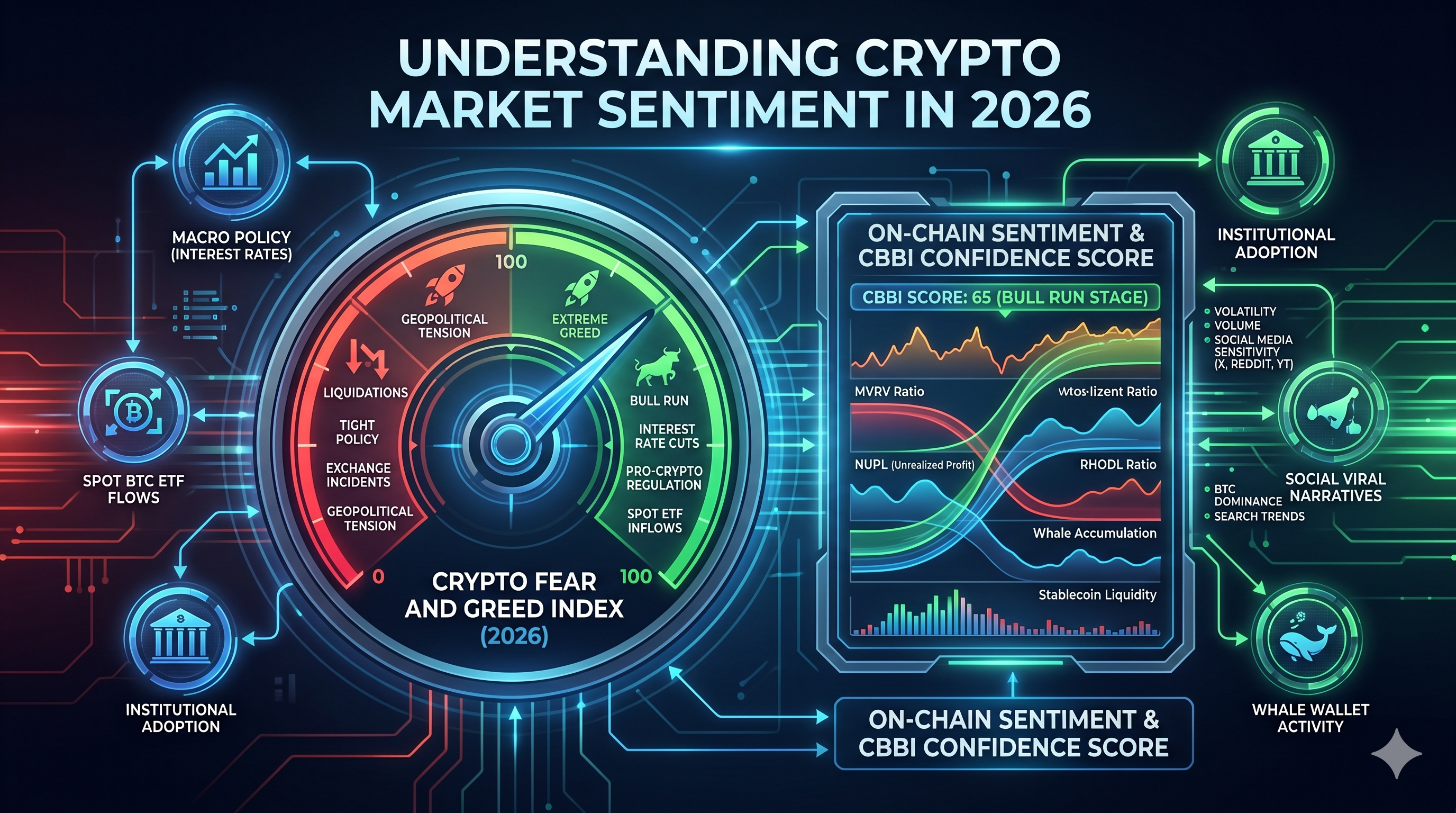
Over the past few years, crypto market sentiment has evolved far beyond celebrity endorsements and retail hype. Today in 2026, Bitcoin and the broader crypto market react not only to social media trends, but also to institutional adoption, spot Bitcoin ETF inflows, macroeconomic policy decisions, and global liquidity conditions.
For example, positive developments surrounding Bitcoin ETFs, interest rate cuts from central banks, or pro-crypto regulatory updates often trigger strong bullish momentum across the market. On the other hand, tighter monetary policy, exchange-related incidents, geopolitical uncertainty, or large-scale liquidations can rapidly shift sentiment toward fear.
Unlike traditional financial markets, the cryptocurrency market operates 24/7 and reacts almost instantly to news and online discussions. A single viral narrative on X, Reddit, or YouTube can influence short-term trading behavior within hours. At the same time, whale wallet activity and on-chain data have become increasingly important indicators for understanding market psychology.
As crypto markets mature, understanding market sentiment has become an essential skill for traders looking to identify trends, manage risks, and avoid emotional decision-making.
What is Market Sentiment?
Sentimental analysis in one sentence is "emotions first, reactions later". If you've heard the phrase "To the moon" or have seen social media pictures with Laser eyes, then you should understand the influence social media plays on cryptocurrencies. These unquantifiable acts guide the demand and supply of cryptocurrencies and hence, affect prices.
Traditionally, cryptocurrency traders use different analyses to determine what the market is saying and the direction it seems to be heading. The two major ones that stand out are Fundamental Analysis and Technical Analysis. While these two are non-negotiable as they look at the short-term and long-term direction of the stock, there is a third type of analysis that stands out as the fulcrum for the previous two and can alter charts in split seconds. And, that is Market Sentiment analysis.

Why Should You Know About It?
Information is a key part of trading and you can't accept one type of analysis at the expense of another. Cryptocurrency traders are familiar with FOMO (Fear of Missing out - where everyone wants to enter a trend so as not to be left behind). With sentimental analysis, you can:
- Have a Bird's-eye view of the market in the short term
- See opportunities either with a trend or against a trend.
- Reduce the influence of emotional trading.
- Understand the level of Fear to Greed In the market and channel your trades accordingly.
How to Perform Market Sentiment Analysis?
Every market is monitored and one way to know the general perception of traders to the current cryptocurrency market is through sentimental indicators. Hedge funds use indicators worth more than the average trader can afford so for this article, let's look at one free but very powerful indicator:
Fear and Greed Index
Remember one of the most successful investors' quotes? Be greedy when others are fearful and fearful when they are greedy. How do you know the minds of others? In the cryptocurrency world, the answer is the "Fear and Greed Index." The fear and greed index is a powerful sentimental analysis tool that takes the aggregate results of five distinct market forces. The forces include
- Market Volatility
- Trading Volume
- Social Media Sentiments
- Bitcoin Dominance
- Search Trends
The aggregates of these five are gauged into Fear or Greed. When volatility is high, Bitcoin dominance is high and the remaining three are negative or low, then the market is predicting a dip. If the reverse is the case, then we are either in a bull run or preparing for one. The Fear and Greed index is used over longer time frames as it is updated once every day.
On-Chain Indicators Are Becoming Increasingly Important
Besides social media and volatility-based indicators, many crypto traders today also rely on on-chain analysis. Unlike traditional financial markets, blockchain networks provide transparent public data that allows traders to monitor wallet activity, exchange inflows and outflows, whale accumulation, and stablecoin liquidity in real time.
For instance, Crypto Bitcoin Bull Run Index (CBBI) is such an indicator designed to evaluate the stages of Bitcoin’s market cycle. By analyzing multiple on-chain and technical metrics in real-time, it generates a “Confidence Score” to help investors determine whether the market is nearing a bull run peak or a bear market bottom.
The CBBI Index combines 9 key metrics (which may evolve with updates), including but not limited to:
- Bitcoin Price Trends (e.g., moving average crossovers)
- MVRV Ratio (Market Value to Realized Value)
- RHODL Ratio (short-term vs. long-term holder ratio)
- NUPL (Net Unrealized Profit/Loss)
- Reserve Risk
These metrics are processed with a unique weighting algorithm, producing a score from 0 to 100, to suggest wheter the market is overheated or undervalued.
Conclusion
Market sentiment analysis has become one of the most important components of modern crypto trading. In a market that operates around the clock and reacts instantly to news, social media narratives, ETF flows, and macroeconomic events, understanding investor psychology can provide traders with a valuable edge.
However, sentiment alone should not determine every trading decision. The most effective traders combine sentiment analysis with technical indicators, fundamental research, on-chain data, and proper risk management strategies. By doing so, they can better identify market opportunities while avoiding emotional reactions during periods of extreme fear or greed.
As the crypto industry continues to evolve and attract more institutional participation, market sentiment is likely to remain a major driver of short-term price movements. Learning how to interpret these signals can help traders navigate volatility more confidently and make more informed decisions over the long term.
FAQs
What is market sentiment in crypto trading?
Market sentiment refers to the overall attitude and emotional outlook of traders toward the cryptocurrency market. It is influenced by news events, social media discussions, macroeconomic developments, price momentum, and investor psychology.
Why is sentiment analysis important in crypto?
Crypto markets are highly emotion-driven compared to traditional financial markets. Sentiment analysis helps traders identify potential market trends, avoid emotional trading decisions, and better understand whether fear or greed is dominating the market.
Which tools are commonly used for crypto sentiment analysis?
Popular sentiment analysis tools include the Fear and Greed Index, social media monitoring platforms, on-chain analytics tools, Bitcoin ETF flow trackers, and whale activity trackers.
Can market sentiment predict Bitcoin price movements?
Market sentiment alone cannot guarantee price predictions, but it can provide valuable insight into trader behavior and momentum. Many traders combine sentiment analysis with technical and fundamental analysis to improve decision-making.