

Why Hyperliquid’s Compliant U.S. Push Could Be a Turning Point for DeFi
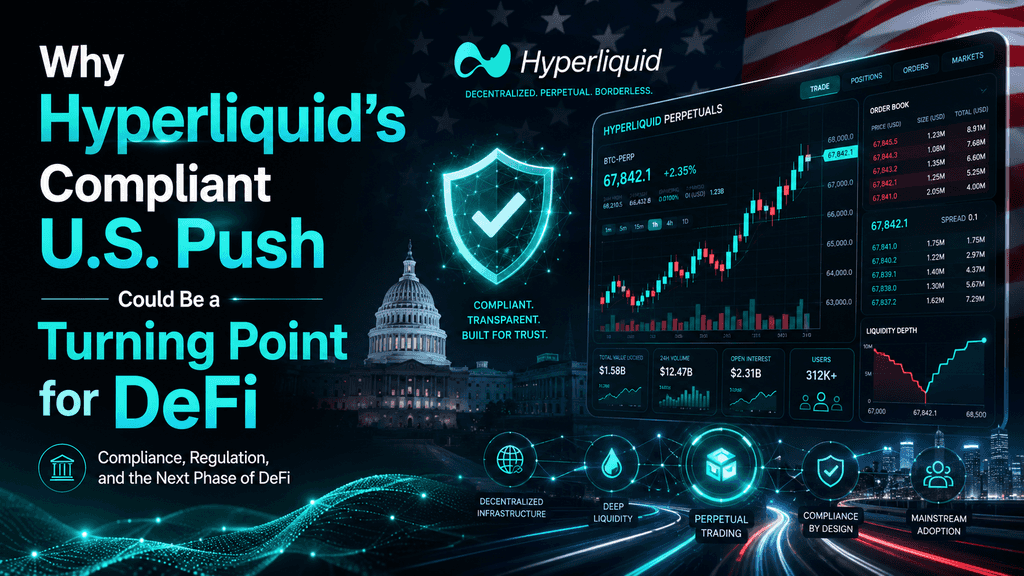
Hyperliquid is moving into a new phase of its growth story. The onchain trading platform has already built a strong position in perpetual futures and decentralized derivatives, but its potential move toward a compliant U.S. structure could take the project into a very different league. The story picked up on August 19, 2026, when President Donald Trump said CFTC Chairman Michael Selig was working to bring Hyperliquid into the United States in a “fully compliant and legal fashion.” That comment does not mean Hyperliquid has received regulatory approval or that a U.S. launch is confirmed. Instead, it highlights a much bigger shift taking place around crypto regulation, perpetual futures and onchain markets. The CFTC has been developing a clearer approach to perpetual contracts, including a May 2026 policy statement and approval of a Bitcoin-referenced perpetual futures product. For readers looking to understand Hyperliquid's model, its underlying infrastructure helps explain why the potential U.S. regulatory path is significant. If its technology can eventually be adapted to meet U.S. regulatory requirements. It could become an early example of how DeFi infrastructure can connect with regulated financial markets.
Why the CFTC Is Exploring a Compliant Path for Hyperliquid in the U.S.
Hyperliquid's potential U.S. market entry comes at a time when regulators are taking a closer look at the rapidly growing market for crypto perpetual futures and onchain derivatives. For years, much of this activity developed outside the United States, giving traders access to products that were difficult to offer through traditional American financial infrastructure. Hyperliquid became one of the leading examples of this model by combining an onchain order book with continuous derivatives trading and a blockchain-based settlement environment. The regulatory question is now shifting from whether these markets should exist to how they might operate within a framework that protects customers, manages leverage and maintains market integrity. Trump's August 19 comments therefore matter because they suggest that policymakers may be considering a route that brings a major onchain derivatives platform into the U.S. rather than leaving this activity primarily offshore.
Trump’s Hyperliquid Statement Signals a New U.S. Regulatory Direction
The immediate catalyst was President Trump's statement that CFTC Chairman Michael Selig was working to bring Hyperliquid into the United States through a “fully compliant and legal” structure. The announcement attracted considerable attention in crypto markets and helped push HYPE higher as traders assessed the possibility of a future U.S. presence. However, there is an important distinction between political support and formal regulatory action. Hyperliquid has not been granted CFTC approval, and there is no confirmed U.S. launch date or final licensing structure. The statement is better understood as a signal that a regulatory pathway is being explored rather than evidence that the process is already complete. That distinction is important for investors because regulatory discussions can change substantially before a platform receives any formal authorization to operate.
The timing is particularly notable because the CFTC has been addressing the regulatory treatment of perpetual contracts. On May 29, 2026, the agency issued a perpetual policy explaining how it would approach the listing of perpetual contracts and approved a Bitcoin-referenced perpetual futures contract submitted by KalshiEX. The development gives exchanges and market participants a clearer idea of how perpetual products could fit within the U.S. derivatives system. For Hyperliquid, that matters because perpetual futures are at the heart of its trading ecosystem and account for a significant portion of its activity. A regulatory framework that recognizes these products could make the discussion around a compliant U.S. version more practical, although it would not automatically establish a legal pathway for Hyperliquid itself.
The CFTC's approval of the Bitcoin-referenced product also provides a concrete example of how a perpetual futures product can be evaluated within the existing U.S. derivatives framework. That does not establish a precedent that automatically applies to every onchain perpetual market, but it shows that regulators are actively considering how these products can operate under U.S. rules. For Hyperliquid, the development is relevant because its core business is closely tied to perpetual futures and the infrastructure supporting continuous derivatives markets.
Why Hyperliquid Could Become a Test Case for Regulated DeFi
Hyperliquid is different from a traditional derivatives exchange because its infrastructure is built around blockchain-based trading and settlement. That creates a unique regulatory challenge because a potential U.S. structure would need to address familiar issues such as customer eligibility, margin requirements, risk controls, market surveillance and investor protection while still preserving some of the advantages of onchain infrastructure. This is where the Hyperliquid story becomes bigger than one exchange. If regulators can find a way to accommodate an onchain trading model without removing the technological features that make it attractive, Hyperliquid could provide a useful reference point for other DeFi platforms looking for a legitimate route into regulated markets.
There is already evidence that the market is large enough to attract serious attention. Hyperliquid processed more than $633 billion in combined spot and perpetual futures volume during Q1 2026, according to figures cited by Fortune from VanEck. That level of activity shows that onchain derivatives have moved well beyond being a small experimental segment of the cryptocurrency industry. The Hyperliquid Policy Center has also been calling for clearer rules around perpetual contracts and greater coordination between U.S. regulators. The result is an increasingly important policy question: can the United States bring major onchain markets under regulatory oversight while allowing the technology to retain its efficiency, transparency and continuous-market characteristics?
How HIP-3 and Onchain Perpetual Futures Could Fit Into U.S. Regulation
The regulatory debate becomes even more interesting when HIP-3 enters the picture. Hyperliquid's Builder-Deployed Perpetuals model allows outside builders to create new perpetual markets using the platform's underlying infrastructure. Instead of every market being created directly by the core team, HIP-3 opens the door to a more modular ecosystem where different builders can design and operate their own markets. That architecture could eventually provide a useful foundation for regulated applications because individual markets could potentially be structured around different access requirements and risk controls. However, HIP-3 itself does not provide an exemption from U.S. securities or derivatives laws. Any U.S. product would still need to comply with the rules applicable to its operator, underlying asset and market structure.
HIP-3 Creates a Modular Model for Onchain Perpetual Markets
HIP-3 allows independent builders to deploy perpetual markets on Hyperliquid's infrastructure, making it one of the platform's most important developments beyond its original trading markets. Builders can create markets with their own specifications while relying on the broader Hyperliquid architecture for execution and settlement. From a regulatory perspective, that separation could eventually make it easier to design individual markets around specific compliance requirements. For example, a regulated operator could potentially use restricted access, approved collateral, customer eligibility requirements and additional risk controls while still relying on blockchain-based infrastructure. The important caveat is that this remains a potential model, not an approved U.S. framework. Regulatory treatment would depend on the specific market, operator, underlying asset and structure of the product. The growing importance of builder-deployed markets has also become a major part of the broader Hyperliquid ecosystem, with HIP-3 markets expanding the range of assets and trading structures available on the network.
U.S. Regulators Are Moving Toward a Framework for Perpetual Futures
The U.S. regulatory conversation around perpetuals is changing quickly. The CFTC's May 2026 policy statement recognized the importance of perpetual contracts and outlined how certain products could be reviewed within the existing derivatives framework. That is significant because it gives the industry something more concrete to work with than the uncertainty that previously surrounded many crypto derivatives products. At the same time, the regulatory picture becomes more complicated when perpetuals track assets such as stocks, where securities regulation can become relevant. The Hyperliquid Policy Center has therefore called for the SEC and CFTC to develop a more consistent framework, arguing that the economic characteristics of perpetual contracts should be considered when determining how they are regulated. A clearer division of responsibilities could ultimately help market participants understand which rules apply to different types of onchain financial products.
A Compliant HIP-3 Market Could Bridge DeFi and Traditional Finance
A future U.S. model could look less like a simple approval of today's offshore platform and more like a regulated access layer built around onchain infrastructure. Customer verification, eligibility checks, margin requirements, market surveillance and other controls could be incorporated into the structure while blockchain technology handles parts of execution, settlement or market infrastructure. Such a model could allow regulated financial firms to interact with blockchain-based markets while maintaining the safeguards expected in traditional finance. That approach would not make Hyperliquid automatically compliant, but it shows why HIP-3 is relevant to the regulatory discussion. If regulators eventually accept this type of architecture, financial institutions could gain a way to use blockchain-based markets without abandoning established compliance and risk-management standards. For DeFi, that would represent a significant step toward connecting blockchain-native infrastructure with institutional capital.
Why Hyperliquid’s Compliant U.S. Push Could Be a Turning Point for DeFi
The significance of Hyperliquid's potential U.S. market entry goes beyond whether American traders will eventually be able to access the platform. The bigger issue is whether onchain financial markets can become part of the regulated financial system. Hyperliquid has already shown that traders are willing to use blockchain-based infrastructure for large-scale derivatives activity, while the CFTC is exploring how perpetual contracts can fit into U.S. markets. At the same time, HIP-3 is broadening the range of markets that can be created on the network. These developments are happening as traditional financial institutions are also becoming more interested in tokenization, blockchain settlement and round-the-clock markets. If these trends continue to converge, Hyperliquid's regulatory path could become an important case study for the future of DeFi in the United States.
A Bridge Between DeFi and Traditional Financial Markets
Hyperliquid could become an important bridge between DeFi and traditional finance if regulators eventually approve a structure that combines onchain technology with familiar financial safeguards. The potential advantage is not simply lower costs or faster transactions. Blockchain infrastructure can provide continuous market availability, programmable settlement and transparent transaction records, while regulated entities can provide customer protections, eligibility controls and oversight. This combination could make blockchain-based financial infrastructure more practical for institutions that have historically been cautious about interacting with permissionless networks. The challenge is finding the right balance. Too many restrictions could remove the characteristics that make onchain markets attractive, while too little oversight would make the model difficult to integrate into the U.S. financial system.
That is why Hyperliquid's regulatory journey could influence the wider DeFi sector. If a major onchain derivatives platform can establish a compliant U.S. presence, other protocols may have a clearer example to follow when considering licensing, market structure and customer protections. The outcome could encourage more institutional participation in blockchain-based markets and gradually make the distinction between decentralized and traditional finance less important than it is today. Instead of viewing DeFi and TradFi as completely separate systems, financial markets could increasingly combine elements of both.
24/7 Onchain Markets Could Challenge Traditional Trading Infrastructure
One of the biggest advantages of onchain derivatives is their ability to operate around the clock. Traditional financial markets still rely heavily on defined trading sessions, holidays and settlement schedules, while blockchain networks can operate continuously. Perpetual futures are naturally suited to this environment because they do not have the fixed expiration dates associated with conventional futures contracts. The CFTC has also addressed 24/7 trading, clearing and settlement as part of its recent work on digital-asset market infrastructure. If regulated onchain venues gain wider access to U.S. markets, they could put pressure on traditional exchanges to rethink how trading hours, settlement and market infrastructure work. Continuous markets could also become increasingly relevant as global investors demand access to financial products across different time zones.
That does not mean Hyperliquid or other DeFi platforms will simply replace established exchanges. Traditional venues still have major advantages in liquidity, institutional relationships, compliance infrastructure, market experience and established customer networks. A more likely outcome is competition followed by convergence, with traditional financial firms adopting more blockchain technology while crypto-native platforms develop stronger compliance systems. Over time, the most successful market infrastructure may combine the accessibility and programmability of blockchain networks with the protections and oversight expected from regulated financial institutions.
The Bigger Opportunity for DeFi
The biggest opportunity may ultimately sit beyond perpetual futures. A successful regulatory framework for onchain derivatives could encourage the development of tokenized stocks, commodities, credit products and other financial instruments on blockchain networks. It could also give banks, asset managers and other institutions greater confidence in using public blockchain infrastructure for trading, settlement and financial applications. For DeFi developers, that would open a much larger potential market than crypto-native trading alone and could accelerate the development of new forms of programmable financial infrastructure.
Hyperliquid is not guaranteed to lead that transition. It faces competition from established exchanges, other blockchain networks and new regulated digital-asset platforms. Its U.S. regulatory push also remains a work in progress, with important questions still surrounding licensing, market access and the exact structure of any future operation. However, the project has reached a scale where its regulatory treatment could have implications for the entire industry. If the U.S. can create a workable framework for Hyperliquid-style markets, it could help establish a new category of regulated onchain finance, where blockchain technology becomes part of mainstream market infrastructure rather than operating separately from it.
Conclusion
Hyperliquid's potential compliant U.S. market entry could become one of the defining tests for the next stage of DeFi because it brings together perpetual futures, blockchain-based trading and U.S. financial regulation at a time when all three are evolving rapidly. Trump's August 19 statement about a compliant path for Hyperliquid is an important signal, but it is not the same as regulatory approval, and significant questions remain around licensing, market access, customer protection and oversight. At the same time, the CFTC's evolving approach to perpetual contracts gives the industry a clearer regulatory framework than it had in previous years, while HIP-3 shows how onchain markets can be expanded through a modular builder model. If regulators eventually find a way to combine those technologies with appropriate safeguards, Hyperliquid could help demonstrate that DeFi does not necessarily have to choose between decentralization and compliance. The bigger story is whether onchain markets can move from largely offshore crypto venues into regulated global finance, bringing 24/7 trading, programmable infrastructure and blockchain settlement closer to the mainstream financial system.
FAQs
Is Hyperliquid available to U.S. users?
Hyperliquid has historically restricted U.S. persons from accessing its main trading platform. A compliant U.S. structure is now being discussed, but there is no confirmed launch date or final approval for U.S. operations. Any future availability for American users would depend on the regulatory structure, applicable licenses and access requirements established for the U.S. market.
Has the CFTC approved Hyperliquid?
No. The CFTC has not approved Hyperliquid itself. The agency has taken important steps toward defining how certain perpetual contracts can be listed and regulated in the United States, which could become relevant to a future Hyperliquid structure. However, a policy development involving perpetual futures should not be interpreted as approval of Hyperliquid or its existing offshore operations.
What is HIP-3 on Hyperliquid?
HIP-3 stands for Builder-Deployed Perpetuals. It allows independent builders to create perpetual markets using Hyperliquid's infrastructure, expanding the network beyond markets created directly by the core platform. The model is significant because it creates a more flexible environment for launching different onchain markets, although each market would still be subject to the laws and regulations applicable to its structure and operator.
Why are perpetual futures important to Hyperliquid?
Perpetual futures are one of the platform's main products and allow traders to maintain leveraged exposure without a traditional futures expiration date. They also fit naturally with 24/7 blockchain markets, making perpetual contracts an important part of Hyperliquid's trading infrastructure and broader DeFi strategy. Their popularity has also made the regulatory treatment of crypto perpetuals increasingly important to the future of onchain derivatives.
Could HIP-3 help Hyperliquid meet U.S. regulatory requirements?
HIP-3 could potentially support different market structures and compliance controls, but it does not make a market legally compliant by itself. Each U.S. product would need to satisfy the regulations applicable to its operator and underlying asset. Depending on the product, requirements could include customer eligibility, registration, margin rules, market surveillance and other financial safeguards.
Why do the SEC and CFTC both matter?
The regulator involved can depend on the product's structure and underlying asset. Commodity-related derivatives generally fall under the CFTC, while products involving securities can raise SEC issues. This becomes particularly important for stock-linked perpetual contracts, where the regulatory classification, underlying asset and market structure can determine which rules apply. A clearer framework from both agencies could therefore have a significant impact on the development of regulated onchain markets.
🔥 KuCoin Offers A More Stable Option in A Volatile Market
If you worry about the frequent ups and downs in the market, and pursue a more stable option to earn money passively, KuCoin is the right place to come:

Simple Earn: Deposit and withdraw tokens anytime, earning stable returns.
Kucoin Earn: Earn stable profits with professional asset management.
Hold to Earn: Earn rewards by holding assets in Funding, Trading, Margin, Futures, Mining, and Unified Accounts.
Staking: Unlock the earning potential of on-chain assets.
Advanced Investments: Advanced Investments offer a variety of structured products to help your money grow in any market.
Shark Fin: Principal Protection and Guaranteed Gains
Dual Investment: Buy low and sell high with transparent return calculations.
Snowball: High yields, with price protection.
Discount Buy: Buy crypto at discount prices.
KCS Loyalty: Level up to enjoy exclusive perks by staking ≥ 1 KCS.
KuCoin Wealth: Discover future value and begin your smart investing journey.
KCS Benefits: Hold and stake KCS to access benefits across the platform.
KCS Staking 2.0: Participate in KCS on-chain governance to earn yield.
Disclaimer: This content is for informational purposes only and does not constitute investment advice. Cryptocurrency investments carry risk. Please do your own research (DYOR).