

Ethena Overhauls ENA Tokenomics With Seed Investor Buyout, Revenue Buybacks and End to Monthly VC Unlocks
2026/08/31 10:58:00
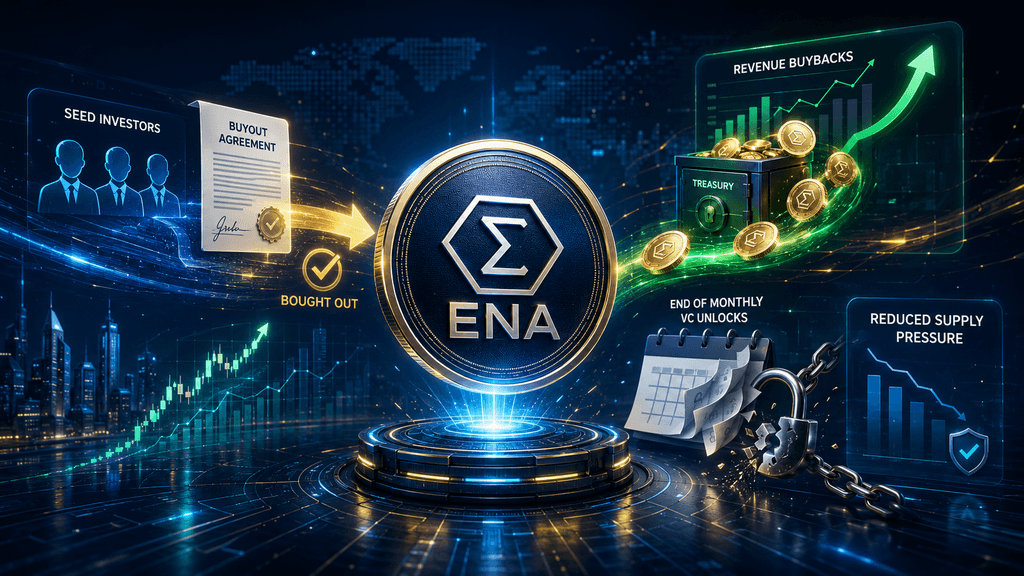
Ethena is restructuring ENA tokenomics through four coordinated changes covering early-investor holdings, protocol ownership, revenue-funded token purchases, and the remaining venture-capital unlock schedule. Announced in an official ecosystem update on August 27, 2026, the overhaul is intended to address recurring investor selling pressure and uncertainty over how Ethena’s commercial growth benefits ENA. The changes arrive as the protocol works to rebuild demand for the USDe synthetic-dollar model, which combines crypto collateral with offsetting derivatives positions to manage market exposure and generate returns.
Although the announcement initially improved market sentiment, its long-term implications are more complex than the headline suggests. Ethena completed a targeted purchase of locked tokens from selected seed investors, but its broader revenue-funded buyback program remains conditional on future USDe growth. Monthly VC vesting will end, yet the outstanding investor allocations will be accelerated rather than destroyed. Whether the overhaul creates lasting value for ENA holders will depend on USDe adoption, protocol revenue, investor behavior, governance execution, and the transparency with which the Foundation manages purchased tokens.
What Are Ethena’s Four Major ENA Tokenomics Changes?
Ethena’s overhaul combines four measures affecting different parts of the ENA ecosystem. Two changes focus on investor supply and vesting, while the others clarify protocol ownership and introduce a possible source of market demand. Understanding these distinctions is important because the completed seed-investor buyout and the proposed programmatic ENA purchases are separate mechanisms with different funding sources, conditions, and potential effects.
Ethena Buys Locked ENA From Selected Seed Investors
The Ethena Foundation completed over-the-counter purchases of locked ENA from certain major seed investors who had sold tokens during the preceding nine months. The review reportedly focused on investors who originally allocated more than 0.25% of ENA’s total supply and considered whether they had sold after the token reached a market peak on October 10, 2025. The Foundation purchased the remaining locked allocations from participating investors who had already sold ENA, although one eligible wallet reportedly declined the offer. Investors who had not sold during the same period were also offered an opportunity to exit at their original purchase price without a discount, but none accepted.
This was a targeted investor buyout rather than a repurchase of the complete seed allocation or a general market buyback. Ethena has not identified the participating investors, disclosed how many tokens it acquired, revealed the total amount paid, or confirmed how the purchased ENA will ultimately be managed. The transaction may reduce potential selling from selected early backers who had previously distributed tokens, but the missing information prevents an exact calculation of how much future supply pressure has been removed.
Protocol Ownership and Value Accrual Move to the Ethena Foundation
Ethena Labs and the Ethena Foundation reached a Master Framework Agreement intended to clarify where protocol ownership and economic value sit within the ecosystem. Under the announced framework, protocol-related intellectual property and ownership of value generated by Ethena are assigned exclusively to the Foundation, where they become subject to ENA-holder governance. Equity investors in Ethena Labs would not retain residual claims on protocol cash flows, reducing the possibility that value generated by Ethena’s products benefits company shareholders without producing a corresponding economic connection to the governance ecosystem.
The agreement gives ENA governance a more meaningful role in decisions involving protocol assets and future value allocation, but it does not make ENA equivalent to company equity. Individual tokenholders are not automatically entitled to dividends, direct revenue payments, or ownership of Foundation assets. Any economic benefit would still depend on governance-approved mechanisms, financial performance, treasury decisions, and how the Foundation implements the new framework.
Revenue-Funded ENA Buybacks Go to a Governance Vote
Ethena’s third change is an ENA fee-switch proposal that would direct part of the revenue generated by Ethena-branded businesses toward programmatic token purchases. The proposal covers income associated with USDe savings, white-label stablecoins, and future products developed under the Ethena brand. Its purpose is to create a measurable relationship between ecosystem growth and demand for ENA rather than leaving the token dependent mainly on governance utility and market speculation.
The proposal was submitted for tokenholder approval after receiving support from Ethena’s Risk Committee. As of August 30, 2026, voting was scheduled to close on September 2, with interim results showing more than 17 million ENA in favor and the required quorum already exceeded. These figures were not the final result, and approval would establish only the operating framework. Actual purchases would remain inactive until USDe reaches the first required circulating-supply milestone.
Monthly VC Unlocks End With an Accelerated October Release
Ethena and its lead investors agreed to replace the remaining monthly VC vesting schedule with an accelerated release on October 5, 2026. The change removes the recurring investor-unlock events that traders had monitored as a possible source of continued selling, but it does not burn or cancel the outstanding tokens. They will instead become transferable earlier than originally scheduled. Team allocations are excluded and will continue under their existing vesting terms, while approximately 12% of ENA’s total supply is expected to remain locked across team, ecosystem, and Foundation holdings after the investor restructuring.
How Ethena’s ENA Buybacks and New Investor Unlock Schedule Will Work
The revised tokenomics change both potential demand for ENA and the timing of investor supply, but the two mechanisms operate independently. The investor restructuring brings outstanding allocations forward, whereas the proposed buybacks require future growth before they can begin. Neither measure changes ENA’s fixed maximum supply of 15 billion tokens, and neither guarantees that the amount circulating in the market will decline.
How Ethena’s Revenue-Funded ENA Buyback Mechanism Works
Ethena’s official fee-switch parameters use the 14-day average circulating supply of USDe to determine the applicable gross-revenue capture rate. Using an average helps prevent a temporary minting surge or one-time transaction from immediately activating a higher tier. The proposed schedule captures 5% of gross protocol revenue when USDe reaches $7.5 billion, 10% at $10 billion, 15% at $15 billion, and 20% at $20 billion. Revenue captured under the active tier would be paid to the Ethena Foundation, which would then direct 95% of the applicable net amount toward programmatic ENA purchases while retaining 5% for ecosystem growth. This distinction matters because the proposal does not place 95% of all Ethena revenue into the market; the percentage applies only after the appropriate gross-revenue tier and applicable expenses are considered.
As of August 30, 2026, USDe had approximately $4.07 billion in circulation, meaning it would need to add about $3.43 billion or roughly 84% to reach the initial $7.5 billion requirement. The fee switch could therefore receive governance approval without producing any immediate purchases. If it eventually activates, the amount of ENA acquired would depend on protocol returns, operating costs, the active revenue tier, market liquidity, and ENA’s price at the time of execution. Ethena has not confirmed that purchased tokens will be permanently burned, so the mechanism should be understood as a potential source of recurring demand rather than a guaranteed reduction in total or circulating supply.
How Ethena’s New Investor Unlock Schedule Changes ENA Supply
Investors received 25% of ENA’s 15 billion maximum supply, equal to 3.75 billion tokens. Under the original ENA tokenomics, investor allocations were subject to a one-year lock, followed by a cliff release and linear monthly vesting. This structure gradually increased transferable supply and produced recurring dates around which traders could anticipate potential investor activity. The revised arrangement accelerates the remaining original investor allocations into a release on October 5, 2026, after which those investors will no longer have tokens waiting under the former monthly schedule. Because the Foundation separately acquired locked allocations from selected seed investors, not every previously unvested token will necessarily return to its original holder, although the precise amount affected has not been disclosed.
Accelerating the schedule changes the timing of available supply rather than eliminating it. The market may benefit from no longer facing repeated monthly VC releases, but October 5 could become a concentrated liquidity event if investors transfer significant balances to exchanges. Its actual effect will depend on the number of tokens released, investor intentions, available demand, market depth, and broader crypto conditions. Team, ecosystem, and Foundation allocations remain relevant, so holders should examine the complete distribution schedule rather than assume the end of monthly VC vesting removes every source of future dilution.
What the Tokenomics Overhaul Could Mean for ENA Holders and Price
Ethena’s restructuring could improve ENA’s long-term position by clarifying its role in protocol governance and establishing a conditional relationship between business revenue and token demand. The framework may strengthen alignment, but its value will depend on measurable execution rather than the announcement itself. Holders will need to evaluate whether Ethena can expand USDe, generate sustainable revenue, maintain adequate reserves, manage treasury assets responsibly, and report future purchases transparently.
ENA Could Gain a Clearer Value-Accrual Role
ENA has historically been viewed mainly as a governance token, making it difficult to determine how Ethena’s commercial performance should influence its valuation. Assigning protocol intellectual property and accrued value to the Foundation gives tokenholder governance greater relevance, while the proposed fee switch could create a recurring source of market demand tied to the performance of Ethena-branded products. This remains an indirect value-accrual model rather than a dividend arrangement: ENA holders do not receive a guaranteed share of profits, and any benefit will depend on business performance, governance quality, Foundation disclosures, and the treatment of acquired tokens.
Investor Supply Pressure May Become More Predictable
Ending monthly VC vesting could make ENA’s longer-term supply structure easier to assess because market participants will no longer need to evaluate repeated investor releases. After the accelerated event, investors may hold, stake, transfer, or sell their available tokens without waiting for additional monthly vesting. This greater visibility could reduce uncertainty over time, although the single October release may initially attract speculative positioning and higher volatility. The most important evidence will come from investor wallet activity and exchange inflows after the tokens become transferable.
USDe Growth Will Become More Important to ENA’s Valuation
The proposed model makes USDe circulating supply a central indicator for ENA holders. Sustained growth would move Ethena closer to fee-switch activation, expand the revenue base available to the Foundation, and strengthen expectations of future market purchases. Continued contraction would delay the mechanism and weaken the immediate connection between the approved framework and actual ENA demand. Investors may therefore begin valuing ENA more directly through indicators such as USDe supply, protocol income, operating expenses, and the competitiveness of sUSDe returns.
USDe adoption also depends on the performance of Ethena’s underlying strategy. Lower derivatives funding income, prolonged negative funding conditions, stronger yields elsewhere, counterparty concerns, or reduced demand for leveraged crypto markets could limit growth. New business lines may diversify the protocol’s income, but they must attract meaningful users and capital before they can materially improve ENA’s value-accrual outlook.
Buybacks Could Support Demand but Cannot Guarantee a Higher Price
Programmatic purchases could support ENA’s live market price if their size becomes meaningful relative to trading volume, investor selling, and newly circulating supply. Smaller purchases may have little effect in a liquid market, while consistent acquisitions could influence supply-and-demand conditions more noticeably. The treatment of acquired ENA will also matter because treasury-held, locked, redistributed, and permanently burned tokens have different economic consequences. The positive initial market reaction reflected improved expectations rather than proof that the restructuring will produce lasting appreciation. ENA remains exposed to Bitcoin and Ethereum market cycles, altcoin liquidity, derivatives conditions, regulation, governance participation, and risks affecting USDe’s collateral and counterparties. Long-term holders should focus on verified purchase transactions, detailed treasury reporting, sustained protocol revenue, stable reserve management, and genuine recovery in USDe demand rather than relying on projected buyback values.
In Conclusion
Ethena’s ENA tokenomics overhaul attempts to address two weaknesses in the token’s original structure: recurring investor-supply pressure and limited clarity over how protocol value reaches the governance ecosystem. The targeted seed-investor buyout, new ownership framework, conditional revenue purchases, and accelerated investor release create a more coordinated model. However, Ethena has not disclosed the size or price of the seed transactions, the October release may generate short-term volatility, and programmatic purchases cannot begin until USDe reaches the first supply threshold. ENA holders should therefore evaluate the overhaul through verifiable outcomes instead of treating it as automatically bullish. USDe’s 14-day average supply, Ethena’s gross and net revenue, Foundation treasury activity, investor exchange flows, reserve strength, and completed ENA purchases will provide the clearest evidence of whether the revised tokenomics can generate sustainable value or primarily improve the market narrative surrounding the token.
FAQs
Has Ethena’s ENA fee-switch proposal been approved?
As of August 30, 2026, governance voting remained open and was scheduled to end on September 2. Interim results showed sufficient participation to exceed the stated quorum, with voting power overwhelmingly supporting the proposal at that time. A final result should be confirmed after the voting period closes, and approval would not produce immediate purchases while USDe remains below the first activation threshold.
Will Ethena burn the ENA tokens it buys back?
Ethena has not confirmed that tokens purchased through the proposed program will be permanently burned. The Foundation could retain them in its treasury, lock them, redistribute them for ecosystem purposes, or manage them through a future governance decision. Until a formal policy is published, market purchases should not be described as permanent reductions in ENA’s maximum or circulating supply.
Is ENA becoming a deflationary cryptocurrency?
Not automatically. ENA retains a maximum supply of 15 billion tokens, and the restructuring does not introduce a confirmed automatic burn mechanism. The token would become structurally deflationary only if ENA were permanently removed from circulation faster than additional allocated tokens entered the market over the same period.
How can ENA holders verify future token purchases?
Ethena plans to track accumulated purchases through its transparency infrastructure. Holders should examine disclosed Foundation wallets, on-chain transactions, governance reports, execution prices, purchase frequency, and changes in treasury balances. Consistent reporting will be necessary to confirm that funds are being deployed according to the approved parameters.
Why does the fee switch use a 14-day average for USDe supply?
A 14-day average reduces the influence of temporary supply spikes, one-time minting activity, and unusually large redemptions. USDe must remain above a threshold for a sustained period before the corresponding revenue tier becomes active. This design creates more stable activation conditions than relying on a single daily circulating-supply figure.
Could ENA purchases reduce rewards for sUSDe holders?
The fee switch could affect how gross protocol revenue is divided among existing uses. Funds captured for ENA purchases might otherwise support sUSDe rewards, partner incentives, lending programs, reserves, or business expansion. The practical effect will depend on whether Ethena’s earnings grow sufficiently to fund purchases while maintaining competitive returns and adequate financial buffers.
Disclaimer: This article is for informational purposes only and is not financial, investment, legal or regulatory advice. Crypto assets and derivatives involve significant risk, and regulatory developments can change rapidly. Always conduct your own research before making investment decisions.
🔥 KuCoin Offers A More Stable Option in A Volatile Market
If you worry about the frequent ups and downs in the market, and pursue a more stable option to earn money passively, KuCoin is the right place to come:

Simple Earn: Deposit and withdraw tokens anytime, earning stable returns.
Kucoin Earn: Earn stable profits with professional asset management.
Hold to Earn: Earn rewards by holding assets in Funding, Trading, Margin, Futures, Mining, and Unified Accounts.
Staking: Unlock the earning potential of on-chain assets.
Advanced Investments: Advanced Investments offer a variety of structured products to help your money grow in any market.
Shark Fin: Principal Protection and Guaranteed Gains
Dual Investment: Buy low and sell high with transparent return calculations.
Snowball: High yields, with price protection.
Discount Buy: Buy crypto at discount prices.
KCS Loyalty: Level up to enjoy exclusive perks by staking ≥ 1 KCS.
KuCoin Wealth: Discover future value and begin your smart investing journey.
KCS Benefits: Hold and stake KCS to access benefits across the platform.
KCS Staking 2.0: Participate in KCS on-chain governance to earn yield.
Disclaimer: This content is for informational purposes only and does not constitute investment advice. Cryptocurrency investments carry risk. Please do your own research (DYOR).