

Apple Tests CXMT DRAM for iPhones and MacBooks Amid AI-Driven Memory Shortage
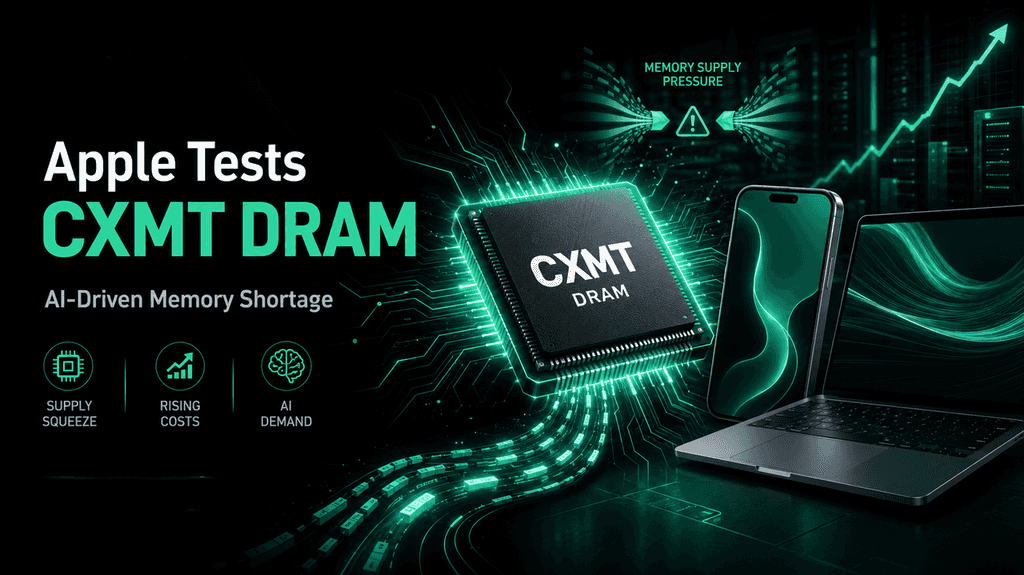
Apple is reportedly testing DRAM memory chips from Chinese semiconductor manufacturer ChangXin Memory Technologies (CXMT) as rising memory prices and booming artificial intelligence infrastructure demand reshape the global chip supply chain. The potential addition of CXMT would give Apple another source of memory for products such as the iPhone and MacBook at a time when Samsung Electronics, SK Hynix and Micron are directing more manufacturing resources toward high-bandwidth memory and server DRAM used in AI data centres. The broader expansion of the AI and Big Data sector is also increasing demand for computing infrastructure across technology markets. Conventional DRAM supply has consequently become tighter and more expensive, increasing pressure on consumer electronics manufacturers.
Apple has not confirmed that CXMT has secured a supply contract, and testing does not guarantee commercial adoption. Still, the evaluation highlights how the AI-driven DRAM shortage, rising iPhone memory costs and U.S.-China semiconductor tensions are beginning to influence one of the world's largest consumer technology supply chains.
Why Apple Is Testing CXMT DRAM for iPhones and MacBooks
Apple is reportedly evaluating DRAM memory chips from ChangXin Memory Technologies (CXMT) as it looks for more flexibility in its iPhone and MacBook supply chain. The move comes as AI infrastructure demand is reshaping the global memory market, with major suppliers allocating more capacity to high-bandwidth memory and server products. For Apple, qualifying another DRAM source could help reduce supply risk, strengthen purchasing flexibility and limit exposure to rising component costs. However, testing does not mean CXMT has already secured a commercial contract, and no formal Apple-CXMT supply agreement has been publicly confirmed.
Apple Wants More Flexibility as DRAM Supply Tightens
Apple currently depends on established memory suppliers including Samsung Electronics, SK Hynix and Micron, but the rapid expansion of AI data centres is putting increasing pressure on conventional DRAM availability. Memory manufacturers are directing more production resources toward HBM and server DRAM because these products are central to AI accelerators and large-scale computing infrastructure. The wider growth of AI infrastructure is increasing demand for the computing resources required to train and operate increasingly sophisticated AI systems. That shift can leave less capacity available for LPDRAM used in smartphones and memory used in laptops, increasing costs for consumer-device makers. By testing CXMT DRAM for possible use in iPhones and MacBooks, Apple could create another sourcing option, improve its negotiating position with existing suppliers and make its supply chain more resilient if the AI-driven DRAM shortage continues.
CXMT Could Become a New Apple Memory Supplier in China
CXMT has been expanding its position in China's semiconductor industry and is increasingly viewed as a potential alternative to the world's three dominant DRAM manufacturers. Reports suggest Apple's discussions have included the possibility of using CXMT memory chips in devices sold in China, which could allow the company to diversify sourcing while taking advantage of a growing domestic semiconductor supply chain. Any adoption would still depend on whether CXMT can meet Apple's strict requirements for performance, power efficiency, reliability and large-scale production consistency. Regulatory and geopolitical concerns could also limit how broadly Apple uses CXMT components, but successful qualification would give the company another potential source of iPhone and MacBook memory at a time when global DRAM supply remains under pressure.
How the AI-Driven DRAM Shortage Is Reshaping Apple’s Supply Chain
The global memory market has changed quickly as artificial intelligence infrastructure absorbs a growing share of advanced semiconductor capacity. Demand from AI servers, cloud data centres and accelerators is pushing manufacturers toward high-bandwidth memory and server-class DRAM, while smartphone and PC makers compete for a tighter pool of conventional memory.
As AI technology expands across emerging sectors, demand for powerful processors, data-centre infrastructure and memory-intensive computing continues to grow alongside it. For Apple, the impact goes beyond paying more for individual chips. Higher memory costs can influence product margins, storage configurations, procurement schedules and decisions about how aggressively the company secures components ahead of future iPhone and MacBook launches. The AI-driven DRAM shortage in 2026 is therefore becoming a broader supply-chain issue rather than simply a temporary increase in semiconductor prices. If tight conditions persist, memory availability could play a larger role in how Apple plans future devices, negotiates supplier contracts and manages production across different markets.
AI Servers and HBM Are Pulling Capacity Away From Consumer DRAM
The rapid expansion of AI computing has made high-bandwidth memory one of the industry's most valuable products. HBM requires significant manufacturing resources, and memory companies have increasingly prioritised AI servers and data-centre customers over lower-margin consumer applications. This matters for Apple because iPhones depend heavily on mobile LPDRAM, while MacBooks require memory products that compete for some of the same manufacturing capacity and investment. Even when Apple is not buying HBM directly for an iPhone, the wider shift toward AI memory production can still affect how much conventional DRAM is available and what Apple ultimately pays for it.
As hyperscale cloud companies continue expanding AI infrastructure and the growth of AI agents creates additional computing workloads, competition for memory manufacturing resources could remain unusually strong. That puts smartphone and PC manufacturers in a market where securing predictable supply may become almost as important as negotiating the lowest possible component price.
-
Conventional DRAM contract prices jumped about 93–98% quarter over quarter in Q1 2026, showing how quickly the supply-demand balance tightened.
-
TrendForce projected another 58–63% QoQ increase in Q2 2026, partly because manufacturers continued moving capacity toward server products.
-
Q3 conventional DRAM prices were expected to rise a further 13–18% QoQ, suggesting that price pressure was easing from extreme levels but had not disappeared.
-
Micron has said industry DRAM and NAND demand is exceeding supply and expects tight conditions to remain a factor beyond 2027.
These figures help explain why the current shortage is different from a temporary component disruption. AI investment is changing where memory manufacturers allocate capital and production capacity, creating a structural challenge for companies that need enormous volumes of consumer-grade memory every year. For Apple, whose annual hardware production spans iPhones, Macs, iPads and other devices, even relatively small changes in memory pricing can become significant when multiplied across millions of units.
Rising Memory Costs Are Becoming a Bigger Part of Apple’s Device Economics
Memory is also taking up a much larger share of the cost of building premium Apple devices. TrendForce estimated in August 2026 that the bill of materials for a 256GB iPhone 18 Pro could rise by around 38% year over year, with memory accounting for roughly 34% of total BOM costs in Q3 2026, compared with about 10% a year earlier. That shift matters because Apple cannot absorb unlimited component inflation without affecting margins, pricing or product configurations. It also makes decisions about RAM capacity and storage tiers more financially significant than they were when memory was a relatively small portion of the overall device cost. Rising iPhone and MacBook memory costs could therefore influence everything from entry-level specifications to the price gap between different storage configurations. Memory procurement is becoming a more important part of Apple's overall product economics as DRAM and NAND account for a larger share of hardware expenses.
-
A larger memory-cost share can put pressure on gross margins, particularly on high-volume iPhone models.
-
Apple may negotiate longer-term supply commitments when securing memory becomes more important than waiting for lower spot prices.
-
Higher DRAM and NAND costs can influence decisions about base storage, RAM configurations and price differences between models.
-
Memory inflation may have a greater effect on lower-priced devices, where Apple has less room to absorb component increases without changing retail pricing or specifications.
This does not mean every increase in DRAM pricing will automatically appear in the price of an iPhone or MacBook. Apple can offset some component inflation through supplier negotiations, product mix, manufacturing efficiencies and other cost reductions. But as memory becomes a much larger part of the total hardware bill, it becomes harder for even a company of Apple's scale to treat rising DRAM prices as a minor supply-chain expense. The longer memory prices stay elevated, the more likely they are to become an important factor in Apple's pricing and product-planning decisions.
Apple Has to Plan for a Longer Memory-Supply Cycle
The broader challenge is that the current memory shortage may last much longer than the short disruptions electronics companies experienced during earlier supply-chain shocks. AI infrastructure spending continues to encourage manufacturers to invest in HBM and server memory, while new fabrication capacity takes years rather than months to build and qualify. At the same time, consumer demand remains significant: global smartphone shipments fell about 11% year over year in Q2 2026, with rising memory costs identified as one of the pressures facing the industry. Apple therefore has to plan its memory purchases around a market where supply, pricing and product availability may remain unusually volatile well into 2027. That could lead to earlier procurement decisions, larger long-term commitments and tighter coordination between Apple's hardware roadmap and the availability of DRAM and NAND across future iPhone, MacBook and iPad generations.
A prolonged global DRAM shortage could also make supplier diversification more strategically important, particularly if Apple wants to reduce its exposure to sudden price increases or production bottlenecks. In that environment, memory sourcing becomes a long-term supply-chain decision rather than a routine purchasing exercise.
Could CXMT Help Apple Lower Rising iPhone and MacBook Memory Costs?
CXMT could give Apple another way to manage rising iPhone and MacBook memory costs, but the financial benefit would depend on pricing, production scale and whether its DRAM can consistently meet Apple's technical standards. Adding a fourth major memory source alongside Samsung, SK Hynix and Micron could improve Apple's bargaining power when negotiating long-term supply contracts and reduce its exposure to sudden DRAM price increases.
CXMT has been expanding its position in the global memory market, and if Apple eventually approves its chips for selected devices, particularly those sold in China, the company could gain more flexibility in sourcing mobile LPDRAM and PC memory during periods of tight supply. However, lower component prices are not guaranteed, because qualification costs, regulatory risks and limits on where CXMT chips can be used may reduce the potential savings. Even so, as the AI-driven DRAM shortage keeps memory prices elevated, a broader supplier base could help Apple protect margins, stabilise production costs and reduce some of the pressure that higher memory prices are placing on future iPhone and MacBook models.
Can U.S.-China Chip Restrictions Limit an Apple-CXMT Partnership?
U.S.-China semiconductor restrictions could become the biggest obstacle to any deeper Apple-CXMT partnership, even if CXMT's DRAM passes Apple's technical qualification process. ChangXin Memory Technologies has been placed on the U.S. Department of Defense's Section 1260H list of companies identified as having links to China's military, a designation that increases political scrutiny around American companies doing business with the chipmaker. Importantly, this is not the same as being placed on the U.S. Commerce Department's Entity List, so it should not be described as a blanket ban on Apple purchasing CXMT memory.
Even so, changing export controls, procurement rules or future sanctions could make long-term sourcing more complicated, particularly if Apple wanted to use CXMT DRAM in products sold outside China. The company would therefore need to weigh regulatory uncertainty, supply-chain compliance and geopolitical risk alongside price and performance. This could explain why any initial use of CXMT memory in iPhones or MacBooks may be more practical in the Chinese market, while broader adoption would depend heavily on how U.S. semiconductor policy evolves.
What Apple’s CXMT Testing Means for the Future of iPhone and MacBook Memory
Apple's reported CXMT testing shows how deeply the AI memory boom is beginning to affect consumer technology supply chains. As HBM and server DRAM absorb more investment and conventional memory prices remain elevated, Apple has stronger incentives to diversify beyond its traditional suppliers and secure additional sources of mobile and PC memory. CXMT could eventually provide useful pricing leverage and additional supply, particularly for devices manufactured or sold in China, but qualification does not guarantee that its chips will appear in commercial iPhones or MacBooks. Regulatory uncertainty surrounding U.S.-China semiconductor relations adds another layer of risk.
For consumers and investors, the most important developments to watch are whether CXMT receives final Apple approval, whether memory prices remain elevated through 2027, and whether higher component costs ultimately affect future iPhone and MacBook prices, specifications or availability.
FAQs
Is Apple already using CXMT memory chips in iPhones?
There is no public confirmation that Apple has started shipping iPhones with CXMT memory. Current reports concern testing and supplier qualification, which usually takes place before a component is approved for mass production. Apple may test several suppliers without ultimately using all of them, so CXMT's evaluation should not be treated as evidence that its DRAM is already inside retail iPhones.
What type of memory could CXMT supply to Apple?
CXMT specialises in DRAM, including memory designed for smartphones, PCs and other electronic devices. For iPhones, the most relevant category would be low-power mobile DRAM such as LPDDR-type memory, while Mac products have different memory requirements depending on their architecture. This is separate from NAND flash, which is primarily used for long-term storage rather than active system memory.
What is the difference between DRAM, LPDDR and HBM?
DRAM is the broader category of volatile working memory used by computers and mobile devices. LPDDR is a power-efficient form of DRAM designed mainly for smartphones and portable electronics, while HBM, or high-bandwidth memory, is optimised for extremely fast data transfer and is widely used alongside AI accelerators. Strong HBM demand matters to Apple indirectly because it can influence how manufacturers allocate investment and production resources across the wider memory market.
Would CXMT memory make future iPhones cheaper?
Not necessarily. Adding another supplier could improve Apple's negotiating position and potentially reduce procurement costs, but lower component costs do not automatically translate into lower retail prices. Apple also considers processor costs, displays, cameras, storage, manufacturing expenses, exchange rates and product positioning when setting iPhone prices. CXMT could therefore help contain cost increases without necessarily making an iPhone cheaper for consumers.
How long does Apple take to approve a new chip supplier?
Apple does not publish a fixed qualification timetable for every component. Testing can involve reliability, thermal behaviour, power consumption, performance consistency, manufacturing yields and the supplier's ability to deliver very large volumes. A component may undergo months of evaluation before it is approved, and successful laboratory testing does not guarantee that Apple will place a large commercial order.
Disclaimer
The information provided on this page may originate from third-party sources and does not necessarily represent the views or opinions of KuCoin. This content is intended solely for general informational purposes and should not be considered financial, investment, or professional advice. KuCoin does not guarantee the accuracy, completeness, or reliability of the information, and is not responsible for any errors, omissions, or outcomes resulting from its use. Investing in digital assets carries inherent risks. Please carefully evaluate your risk tolerance and financial situation before making any investment decisions. For further details, please consult KuCoin’s Terms of Use and Risk Disclosure.