

AI vs. Your Wallet: How to Protect Your Crypto from Artificial Intelligence Hackers
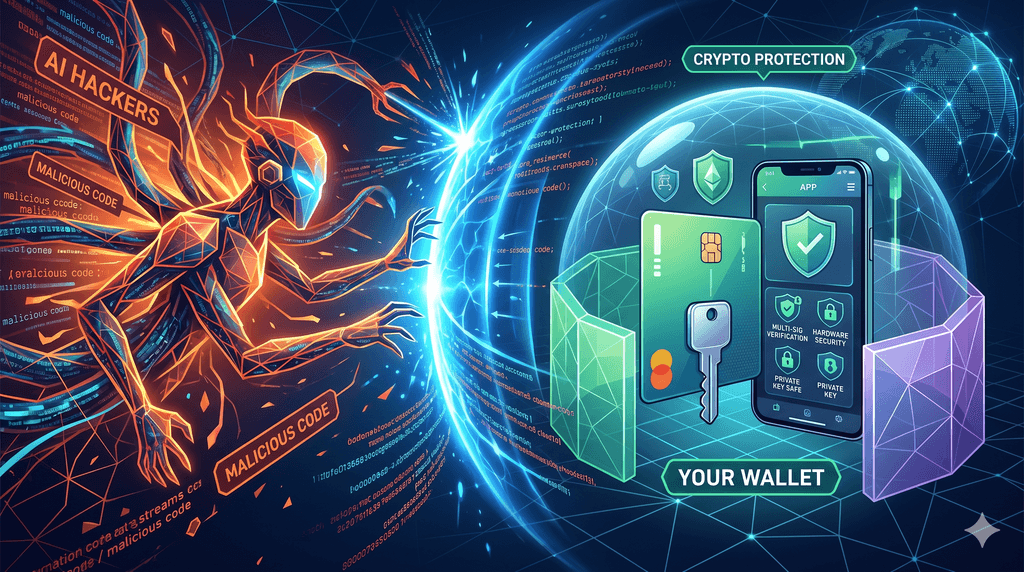
Here is a number worth sitting with: the crypto industry has already lost over $600 million to hacks in just the first four months of 2026. And the most alarming part is not the dollar figure — it is the technology behind the attacks. Artificial intelligence is no longer just a tool for productivity or chatbots. State-sponsored hacking groups and cybercriminal networks are now wielding AI to craft deepfake impersonations, launch hyper-personalized phishing campaigns, and deploy autonomous agents that scan smart contracts for exploitable bugs — all at machine speed.
The good news is that your wallet does not have to be a casualty. Protecting yourself starts with understanding exactly how AI-powered attacks work, and then building a simple, layered defense that makes you a far harder target than the average crypto holder. This guide covers exactly that.
Key Takeaways
-
Crypto losses exceeded $600 million in early 2026, with AI-driven tactics — including deepfakes, agentic exploit bots, and social engineering — playing a growing role.
-
Phishing losses jumped 207% in January 2026 compared to December 2025, with attackers shifting toward fewer but wealthier "whale hunting" targets.
-
AI-powered attacks are faster and cheaper to launch than ever — tasks that once took skilled hackers months can now be automated in seconds.
-
Cold wallets remain the single most effective defense against remote theft; they allow transaction signing without ever exposing private keys.
-
AI is also being deployed defensively — agentic security tools and platforms like Anthropic's Claude Mythos are now scanning for vulnerabilities before attackers can exploit them.
-
Exchanges are among the highest-risk targets due to the volume of personal data and funds they hold; choosing an exchange with layered security features matters enormously.
-
A multi-layered personal security stack — combining hardware wallets, 2FA, URL verification, and withdrawal whitelisting — dramatically reduces your exposure.
The AI Threat Landscape: What's Actually Happening in 2026
Crypto Losses Hit $600 Million — And AI Is Making It Worse
The crypto industry's security crisis has accelerated sharply in 2026. Crypto losses have crossed $600 million in 2026, driven largely by major exploits linked to North Korean actors. A $293 million Kelp DAO breach tied to LayerZero infrastructure failure and a $280 million Drift Protocol hack accounted for most April losses.
But the raw numbers tell only part of the story. The deeper issue is the technology enabling these attacks. Security has long relied on an imbalance: it should be harder and more expensive to hack a system than the potential reward. But AI is eroding that advantage. Tasks that once took skilled researchers months, like reverse engineering software or chaining exploits, can now be done in seconds with the right prompts.
Ledger CTO Charles Guillemet put it bluntly: there is no "make it secure" button, and the industry risks producing a lot of code that will be insecure by design as more developers rely on AI tools.
The Four AI-Powered Attack Vectors Threatening Your Wallet
Security experts at CertiK have mapped the primary threat vectors for the rest of 2026. Real-time deepfakes, phishing attacks, supply chain compromises and cross-chain vulnerabilities will likely be the root of some of the biggest hacks in 2026. Here is how each one works against individual holders:
-
AI-Generated Phishing
The era of the obviously fake phishing email is over. AI-generated messages now perfectly mimic the tone, branding, and writing style of legitimate companies. Attackers scrape social media and professional profiles to craft personalized messages that feel urgent and credible. The scale is staggering: signature phishing losses jumped 207% in January 2026 compared to December, according to Scam Sniffer. Interestingly, the total number of victims dropped by 11%, revealing a strategic shift — instead of targeting thousands of small wallets, attackers now focus on fewer but wealthier victims, an approach security researchers call "whale hunting."
-
Real-Time Deepfakes
Fraudsters now deploy advanced deepfake technology to create video and audio content featuring celebrities, financial experts, or government officials endorsing fake token launches or giveaways. According to cybersecurity research from 2025-2026, deepfake-related financial fraud increased by 340% compared to previous years, with cryptocurrency scams representing the largest category. These schemes typically impersonate trusted crypto founders or exchange executives to redirect funds to unrecoverable wallets.
-
Agentic AI Exploit Bots
This is the most alarming development for protocol-level security. There are now more convincing deepfakes, autonomous attack agents, and "agentic AI" that can autonomously scan smart contracts for bugs, draft exploit code, and execute attacks at machine speed. For individual users, this means that DeFi protocols you interact with could be compromised by an automated agent before any human developer spots the vulnerability.
-
KYC-Bypass Tools and Social Engineering
A threat actor known as "Jinkusu" was reportedly offering cybercrime tools designed to bypass Know Your Customer checks across banks and crypto platforms, relying on voice manipulation and deepfake technology. Meanwhile, a third DPRK-linked incident showed a different tactic entirely — hackers used AI in a sustained social engineering campaign, ultimately stealing roughly $100,000 from Zerion's hot wallets. This illustrates how AI extends beyond technical exploits into long-duration human manipulation campaigns.
Who Is Most at Risk: Exchanges, DeFi, and You
Why Exchanges Are Prime Targets
Exchanges like Coinbase, Robinhood, Gemini, or Bullish are perhaps the most at-risk areas due to the large amounts of personal identifiable information and money they handle. Cosmo Jiang of Pantera Capital noted that while the threat factor exists for everyone, financial services companies and exchanges are likely to be the ones targeted first.
The Bitcoin blockchain itself remains structurally sound — Bitcoin is fundamentally secured by cryptography and a set of shared rules enforced by a network of people running Bitcoin nodes all over the world, making it very difficult to modify the rules without full network consensus. The real risks for most holders therefore sit at the application layer: exchanges, wallets, bridges, and the individual devices used to access them.
The Supply Chain Problem
Supply chain attacks have also become a critical issue, accounting for $1.45 billion in losses during 2025. The Bybit hack, which cost $1.4 billion in February 2025, highlights how attackers are targeting infrastructure providers to maximize damage. For users, this means a trusted app or browser extension could be compromised at the source, not by you clicking a malicious link, but by the software itself being weaponized upstream.
Address Poisoning and Wallet Malware
Beyond high-profile exchange hacks, individual holders face increasingly targeted attacks. A single phishing incident involving "address poisoning" in January 2026 resulted in a $12.25 million loss. Address poisoning works by injecting a visually similar but malicious wallet address into a victim's transaction history, exploiting the human tendency to copy-paste addresses without checking every character.
Malware grows more advanced — attacks now scan compromised phones for wallet seed phrases, allowing hackers to drain funds without user interaction.
Your Defense Playbook: 8 Concrete Steps to Protect Your Crypto
Protecting your crypto in 2026 requires a multi-layered approach. No single measure is sufficient on its own — but combining the following practices dramatically reduces your attack surface.
Step 1: Move Long-Term Holdings to Cold Storage
This is the single highest-impact action you can take. CertiK's Natalie Newson advises: using cold wallets can help keep assets that you don't use regularly safe and allows you to sign transactions without ever exposing your private keys. A hardware wallet keeps your private keys physically isolated from any internet-connected device. Even if your computer or phone is compromised by malware, the keys remain safe.
For seed phrase backup, use physical, offline media — fireproof and waterproof stainless steel plates are the industry standard for 2026, protecting your phrase from environmental disasters. For an extra layer of encryption, implement a "passphrase," often called a 25th word.
Step 2: Enable Multi-Factor Authentication Everywhere
Two-factor authentication (2FA) is a mandatory baseline for any exchange account. Use an authenticator app rather than SMS where possible — SMS is vulnerable to SIM-swapping attacks. On KuCoin specifically, activating two-factor authentication is one of the most secure ways to protect your account and crypto-assets. KuCoin supports Google Authentication, phone binding, and email binding, protecting your account during logins, withdrawals, API creations, and other sensitive operations.
Step 3: Verify Every URL and Smart Contract
The best way for investors to protect themselves is to be aware of the current threats — always verify the authenticity of URLs and smart contracts before interacting. Before approving any transaction, cross-reference the contract address against the official project documentation. Bookmark the sites you use regularly and type URLs directly rather than clicking links from emails or social media messages.
Step 4: Use Anti-Phishing Codes and Withdrawal Whitelisting
When logging into a website or receiving an email from KuCoin, your safety phrase will be displayed. If the safety phrase is not displayed or is displayed incorrectly, it means you are on a phishing site or have received a phishing email — do not proceed any further.
Similarly, withdrawal address whitelisting ensures funds can only be sent to pre-approved addresses. Even if an attacker gains access to your account credentials, they cannot redirect funds to a new wallet without triggering an additional verification step.
Step 5: Audit Browser Extensions Regularly
One malicious browser extension can compromise your entire wallet. Remove unused extensions and review permissions regularly. Consider maintaining a dedicated browser profile used exclusively for crypto activity, with only the minimum necessary extensions installed. Never install wallet extensions or apps from sources other than official repositories.
Step 6: Never Trust Deepfake "Endorsements"
When you encounter a video of a crypto founder, exchange executive, or influencer promoting an investment opportunity, treat it as a potential deepfake until verified through multiple independent sources. Legitimate platforms never request private keys, seed phrases, or passwords through email, social media, or unsolicited messages. Any communication demanding urgency around an investment opportunity or account security issue should be independently verified through official channels.
Step 7: Keep All Software Updated
Ensure your devices, wallets, and other software are always up-to-date. Updates often include security patches that protect against known vulnerabilities. Use reliable antivirus software and keep it updated to detect and block phishing attempts. The Ledger CTO's warning that AI-generated code will increasingly contain hidden vulnerabilities makes this step more critical than ever — outdated software carries unpatched attack surfaces that autonomous exploit bots can find rapidly.
Step 8: Avoid Public Wi-Fi for Crypto Transactions
Avoid using public Wi-Fi networks when accessing your crypto wallet or performing transactions. These networks can be insecure and could be monitored by malicious actors. If you must transact on the go, use a mobile data connection or a trusted VPN, and never complete a withdrawal on a network you don't control.
Quick Security Checklist: Hot Wallet vs. Cold Storage Use Cases
| Scenario | Recommended Storage | Key Protection |
| Daily trading & active positions | Exchange/hot wallet | 2FA, anti-phishing code, withdrawal whitelist |
| Medium-term holdings (weeks/months) | Software wallet with hardware backup | Strong seed phrase storage, regular audits |
| Long-term savings (HODL) | Hardware cold wallet | Offline seed phrase on steel plate, passphrase |
| DeFi interactions | Hot wallet with limited funds | Smart contract verification, extension audit |
| Large single-asset positions | Air-gapped hardware wallet | Dedicated device, no internet exposure |
AI Is Also Fighting Back: The Defensive Revolution
The picture is not entirely grim. AI can also serve as a defensive tool — so-called agentic AI, which automatically detects smart-contract vulnerabilities, has recently emerged and is strengthening security response capabilities.
Anthropic recently launched Claude Mythos, a program that supposedly identifies flaws in major operating systems, in a beta version for some tech companies. Security firms are deploying similar AI-driven systems to scan for vulnerabilities across DeFi protocols before malicious actors can exploit them. The regulatory environment is also catching up: the U.S. Department of the Treasury's Office of Cybersecurity and Critical Infrastructure Protection announced in April 2026 that it would expand its threat identification program to include digital asset companies.
For traders, the takeaway is that the industry's defensive capabilities are maturing — but they cannot substitute for personal operational security. Platform-level defenses protect infrastructure; personal security practices protect your specific assets.
How to Protect Your Account with Kucoin's Security Settings?
Protecting your account in the AI-driven landscape of 2026 requires a proactive approach to security. According to the official KuCoin support documentation, there are three primary pillars to securing your account:
-
Robust Password Management
KuCoin enforces strict criteria for Login Passwords to prevent brute-force attacks.
-
Your password must be 10 to 32 characters long.
-
It must include at least one uppercase letter, one lowercase letter, and one number.
-
Multi-Factor Authentication (MFA)
MFA adds a critical second layer of protection, ensuring that even if an AI-powered hacker discovers your password, they cannot access your funds. KuCoin supports:
-
Google Authenticator (2FA): A time-based one-time password (TOTP).
-
SMS & Email Verification: Codes sent directly to your verified devices.
-
Passkeys & Biometrics: High-security options such as fingerprint and facial recognition on the KuCoin app.
-
Verification Links: For high-risk actions or anomalous IP detections, KuCoin may require email link confirmation to thwart phishing.
-
The Trading Password
Unique to KuCoin, the Trading Password is a specialized six-digit code required for:
-
Executing spot or futures trades.
-
Initiating withdrawals.
-
Creating or managing API keys.
This password is distinct from your login password, providing a final "circuit breaker" against unauthorized transactions.
💡 New to crypto? KuCoin's Knowledge Base has everything you need to get started — from setting up your first wallet to understanding security best practices.
Conclusion
The AI arms race in crypto security is real, and it is accelerating. With over $600 million already lost in 2026, state-sponsored groups and cybercriminal networks are deploying deepfakes, autonomous exploit bots, and hyper-targeted phishing campaigns that bear little resemblance to the crude scams of previous years. The cost of launching a sophisticated attack has collapsed; the sophistication of those attacks has soared.
But the fundamentals of personal security still hold. Moving long-term holdings to cold storage, enabling robust 2FA, verifying every URL and smart contract before interaction, maintaining withdrawal whitelists, and auditing your browser extensions regularly are not glamorous precautions — but they are effective ones. The vast majority of successful crypto thefts still rely on one core vulnerability: human behavior under pressure. Slow down. Verify. Never let urgency override process.
AI is also becoming a formidable defensive tool, with agentic security systems and regulatory oversight expanding rapidly. The traders who emerge from 2026 with their portfolios intact will be those who treat personal security as a core discipline — not an afterthought.
FAQs
Can AI actually crack a hardware wallet or steal from cold storage?
No — hardware wallets store private keys on isolated chips that never connect to the internet, making remote AI-driven exploitation essentially impossible. The risk with cold storage is physical: someone with physical access to your device and your seed phrase could steal funds. AI does not change this threat profile. The primary danger AI introduces is social engineering attacks designed to trick you into transferring your own funds, not technically cracking the device itself.
What is "address poisoning" and how do I avoid it?
Address poisoning is an attack where hackers send tiny transactions from a wallet address that visually resembles one you've transacted with before. When you later copy-paste an address from your transaction history, you may accidentally select the malicious address. The defense: always verify the full wallet address character by character before sending any funds, never copy-paste from transaction history, and use saved address books or QR codes from verified official sources.
How does AI-generated phishing differ from old-school phishing?
Traditional phishing relied on generic, often poorly written messages sent to large batches of users. AI-generated phishing is personalized — attackers use machine learning to scrape your social media profiles, trading history, and behavioral patterns to craft messages that appear to come from sources you personally trust, referencing real details about your activity. The result is a message that feels far more legitimate and urgent than anything a human scammer could produce at scale.
Are decentralized wallets (non-custodial) safer than exchange accounts against AI attacks?
Non-custodial wallets remove the risk of an exchange being hacked and losing your funds, but they transfer full responsibility to you. If your device is compromised by malware that scans for seed phrases, or if you are tricked into approving a malicious smart contract, a non-custodial wallet offers no recourse. The safest setup combines non-custodial hardware cold storage for long-term holdings with a secured exchange account — with full 2FA and withdrawal whitelisting — for active trading.
Is it safe to use AI-powered crypto trading bots given these threats?
AI trading bots carry specific security risks: they require API keys connected to your exchange account, and if those keys are compromised or the bot's underlying code contains vulnerabilities, an attacker could drain your account. Mitigate this by creating API keys with trade-only permissions (no withdrawal rights), using IP whitelisting so API keys only work from your own IP address, auditing any third-party bot's code and reputation thoroughly, and revoking unused API keys immediately. Never grant a trading bot withdrawal permissions.
Disclaimer: This article is for informational purposes only and does not constitute financial or investment advice. Cryptocurrency investments carry significant risk. Always conduct your own research before trading.