

Polygon to Permanently Burn 100 Million POL: How the New Burn Mechanism Works
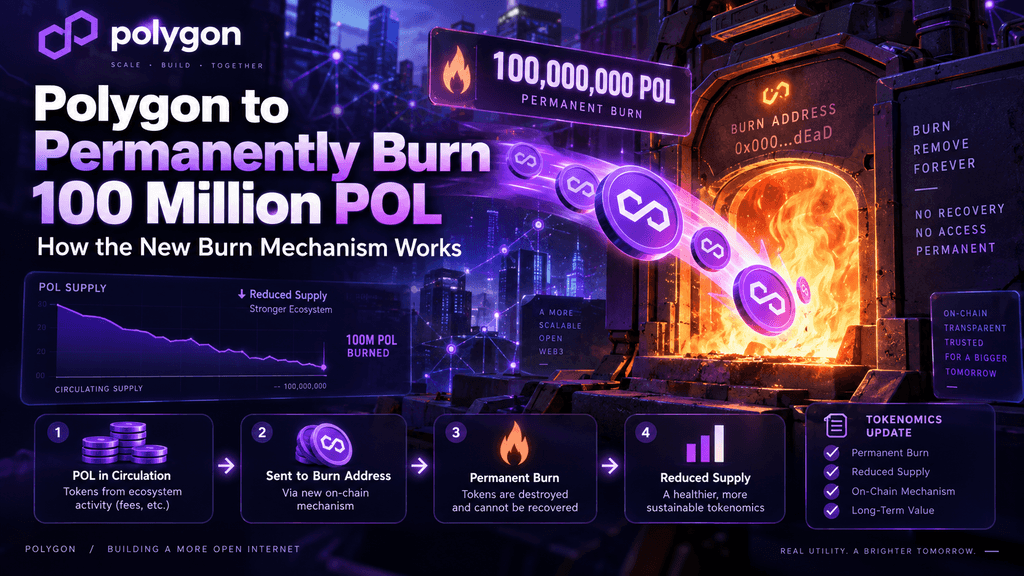
Polygon is preparing one of the largest single POL token burns since the network completed its transition from MATIC. Polygon Foundation CEO Sandeep Nailwal said a new permissionless burn contract is already running on testnet and is waiting for final Security Council signatures before moving to mainnet. Once deployed, any community member will be able to trigger the first transaction, permanently removing 100 million POL from supply. The tokens come from a base-fee collector that has accumulated roughly 121 million POL from network activity.
The headline number is significant, but the deeper story is not simply that Polygon is destroying almost 1% of POL’s current supply. The new mechanism is designed to turn transaction-generated base fees into a recurring supply sink, with additional community-triggered burns planned on a quarterly basis. At the same time, POL continues to have an annual emissions mechanism of roughly 2%, meaning burns and new issuance will operate simultaneously. The real question is therefore whether Polygon can eventually burn POL quickly enough for growing network usage to offset ongoing token emissions.
What Is Polygon’s 100 Million POL Burn?
Polygon plans to permanently remove 100 million POL in the first execution of its new burn contract. Nailwal said the Polygon base-fee collector currently holds approximately 121 million POL, meaning the first burn would eliminate about 83% of the balance already accumulated there. Recent reporting puts POL’s total supply at roughly 10.716 billion tokens, making the planned burn equivalent to approximately 0.93% of current supply, or 1% of POL’s original 10 billion-token base.
The distinction between “planned” and “completed” is important. As of September 21, 2026, Polygon has not yet executed the 100 million POL burn on mainnet. The relevant contracts are on testnet and still require the final Security Council signatures before deployment. Once that process is finished, the first burn can be called by any community participant. Subsequent burns are expected to become available on a quarterly basis as additional base fees accumulate.
The tokens are also not simply being taken from a general Polygon treasury as a discretionary attempt to reduce supply. They have accumulated through Polygon’s transaction-fee system. That makes the burn more closely connected to network economic activity: users transact, base fees accumulate, and those fees can eventually be removed permanently from POL supply.
Where Does the 100 Million POL Come From?
Polygon has used an EIP-1559-style transaction-fee mechanism since January 2022. Under this model, a transaction fee is divided into a base fee and a priority fee. The base fee responds to network demand and is designated for removal from supply, while priority fees compensate block producers or validators. Polygon originally implemented a two-stage burn process because MATIC existed as an ERC-20 token on Ethereum even though transactions occurred on Polygon PoS.
Polygon’s governance later updated parts of that architecture as the network moved toward Polygon 2.0 and eventually migrated from MATIC to POL. PIP-24, for example, changed the EIP-1559 burn recipient contract while retaining the basic principle that user-paid base fees are removed from supply. More recent Polygon proposals continue to distinguish burned base fees from priority fees distributed through validator-related systems.
The new 100 million POL burn therefore does not introduce the concept of Polygon fee burning from scratch. Polygon has had EIP-1559-based fee destruction for years. What is changing now is the execution framework around the large amount of POL that has accumulated in the current collector and how future burns can be triggered. The first transaction clears most of the existing backlog; later quarterly executions are intended to turn newly accumulated base fees into recurring permanent supply reductions.
How Does the New POL Burn Contract Work?
The mechanism can be understood as a sequence rather than a single event. First, transactions on Polygon generate base fees in POL. Those fees accumulate in the network’s burn collector. Polygon has now deployed the new burn contracts on testnet, where the implementation can be tested before mainnet use. After final signatures from the Security Council, the contracts are expected to move to mainnet. At that point, a community participant can call the function that permanently destroys the first 100 million POL.
| Stage | What Happens |
| Network activity | Users pay transaction fees in POL |
| Fee collection | Base-fee POL accumulates in the designated collector |
| Testnet | New burn contracts are tested before live deployment |
| Security approval | Final Security Council signatures are required |
| Mainnet launch | Burn contract becomes available on the live network |
| First execution | Any community member can trigger the 100M POL burn |
| Future burns | Additional accumulated POL can be burned quarterly |
The “anyone can trigger it” element is central to the new design. Polygon Foundation does not need to manually initiate every eligible burn once the mechanism is deployed. Instead, the contract determines what can be executed, while individual users can call the relevant function. Nailwal said the first call will remove 100 million POL and that the community will subsequently be able to execute further burns every quarter.
Importantly, “quarterly” should not be confused with “automatically every three months.” Current descriptions indicate that the burns will be community-triggered, not a completely automatic scheduled process. The mechanism makes execution permissionless, but somebody still needs to submit the transaction when a burn becomes available.
Why Make the POL Burn Permissionless?
A permissionless burn reduces dependence on a central team for routine execution. In many token projects, a foundation, multisig or governance body must periodically decide when to destroy tokens and then manually perform the transaction. That leaves token holders dependent on a future organizational action even if a burn policy has already been announced. Polygon’s model shifts more of the final execution step into an open smart-contract process.
That does not mean the entire mechanism is governance-free. The contracts themselves still have to pass Polygon’s security process and receive the required Security Council signatures before they reach mainnet. Protocol rules can also continue to evolve through Polygon governance. Permissionless in this case is best understood as referring to execution after deployment: once the conditions are established and the contract is live, the community does not need special permission from Polygon Foundation to call an eligible burn.
This also improves verifiability. Rather than relying only on a press release saying tokens have been burned, users will be able to inspect the relevant on-chain transaction and contract activity once the mainnet execution takes place. For tokenomics, that distinction matters because “earmarked for burn,” “sitting in a collector,” and “permanently destroyed” are not necessarily identical supply states.
How Much Does Burning 100 Million POL Really Matter?
The headline number sounds enormous in isolation, but its significance becomes clearer when compared with Polygon’s overall token supply. Based on the roughly 10.716 billion POL supply cited in recent reporting, the initial burn equals about 0.93% of total supply. It also represents around 83% of the roughly 121 million POL currently sitting in the base-fee collector.
| Tokenomics Metric | Approximate Figure |
| Original POL supply base | 10 billion POL |
| Recent total supply estimate | ~10.716 billion POL |
| Base-fee collector | ~121 million POL |
| First planned burn | 100 million POL |
| Share of collector burned | ~83% |
| Burn as share of current supply | ~0.93% |
| POL annual emissions rate | ~2% |
A reduction of slightly less than 1% is meaningful, but it is not large enough on its own to transform POL’s entire supply profile. The more important feature is that the 100 million POL is intended to be the first large execution of a recurring mechanism. If Polygon continues generating substantial base fees, repeated quarterly burns could accumulate into a much larger reduction over several years than the first transaction suggests.
That is also why focusing exclusively on the initial $10 million-plus value of the tokens can be misleading. The long-term economic question is not the dollar value destroyed on one day. It is the rate at which real Polygon activity produces burnable fees in subsequent quarters.
Why Is POL Still Inflationary by Design?
The burn needs to be viewed alongside POL’s issuance model. When Polygon migrated from MATIC to POL, it introduced an annual emissions rate of approximately 2%, subject to future community adjustment. Polygon’s official tokenomics framework allocates about half of that issuance—roughly 1% of supply—to validator rewards designed to support network security. The remaining 1% is allocated to the Community Treasury to fund protocol development, research, grants and broader ecosystem growth.
This means POL can be minted and burned at the same time. A 100 million-token burn does not automatically mean POL’s total supply will decline permanently from that point onward. The better framework is to compare two ongoing flows: new POL issuance versus permanently burned POL. If annual emissions exceed annual burns, the total supply can continue expanding even while millions of tokens are destroyed. If fee burns eventually exceed issuance, the supply can contract on a net basis.
Nailwal has said POL has been deflationary since January 2026 based on recent fee-burn activity, but that statement should be understood within the accounting method being used. Tokens accumulated in a collector but not yet permanently burned can be treated differently by supply trackers, and POL’s formal emissions mechanism remains active. The first mainnet burn and subsequent quarterly executions should make the distinction between collected fees and completed destruction easier to evaluate.
Can the New Burn Make POL Truly Deflationary?
For POL to become structurally deflationary, recurring burns need to exceed recurring issuance over the relevant measurement period. That sounds simple, but both sides of the equation can change. Polygon governance can ultimately modify the emissions model, while burn volume depends heavily on network usage, base-fee levels and any protocol programs that alter how fees are treated.
This makes the burn mechanism fundamentally different from a fixed halving schedule or a hard supply cap. Polygon’s supply economics are dynamic. More transactions can produce more base fees available for destruction, while annual emissions continue to fund security and ecosystem development. The balance between those two flows determines the final outcome. Polygon community discussions have already considered ideas such as reducing emissions, broadening fee burns and introducing buyback-and-burn policies, although those discussions should not be confused with current binding tokenomics.
This is why the strongest long-term thesis is not simply that “100 million POL disappears.” The more consequential possibility is that Polygon establishes a repeatable mechanism through which network-generated economic activity continually removes supply. If that burn rate grows faster than issuance, the supply trajectory changes. If network fees remain too small relative to emissions, POL can still remain inflationary despite regular burns.
Why Network Activity Matters More Than the First Burn
The future burn rate ultimately depends on what people actually do on Polygon. That link has become more relevant as Polygon increasingly positions its PoS chain around payments and stablecoin settlement. In June 2026, Polygon said an upgrade raised capacity to as much as 5,000 payments per second, following a series of changes that increased the block gas limit while maintaining roughly 1.5-second blocks. The network has also emphasized stablecoin payments, tokenized assets and enterprise settlement as major sources of future activity.
The network has announced several payment-related integrations this year. Polygon says PayPal USD is now available on the chain, Revolut launched its euro-backed EURR stablecoin on Polygon, and Stable.com added Polygon for direct-to-bank stablecoin transfers. Polygon also reported that Credible routed more than $152 million in stablecoin payments through the network in a single quarter. These figures come from Polygon’s own ecosystem reporting, but they illustrate the strategy behind the burn narrative: Polygon wants more economic transactions to settle on its chain, not simply more speculative token trading.
The tokenomics connection is straightforward. More economic activity can generate more transactions; more transactions can generate more base fees; more accumulated base fees can create more POL eligible for future burns. But the relationship is not automatic in dollar terms because fees depend on network conditions and protocol parameters. Higher throughput can also keep individual transaction fees low. The burn mechanism therefore needs sustained usage at scale, not merely technical capacity, to create a material long-term supply sink.
Will the 100 Million POL Burn Push POL Price Higher?
POL traded around $0.10 after the announcement, with market data cited on September 19 showing the token near $0.104 after closing around $0.0979 two days earlier. That produced renewed attention to the possible price implications of the burn. However, the move occurred during a broader rebound across the cryptocurrency market, so it would be difficult to attribute the change entirely to Polygon’s announcement.
From a tokenomics perspective, permanent burns reduce supply relative to what it otherwise would have been. If demand remains unchanged, lower supply can improve scarcity at the margin. But a token burn does not itself create demand. Polygon still needs users, developers, payments, DeFi activity, tokenized assets and investors willing to hold POL. A reduction equivalent to about 0.93% of current supply is also smaller than POL’s stated annual emissions rate of roughly 2%, although recurring burns could change the long-term comparison.
For that reason, the more useful question is not whether the first burn will “send POL higher.” It is whether Polygon can build an economic model in which network growth increases fee generation, fee generation increases POL burns, and those burns eventually offset or exceed new issuance. Price will still depend on broader crypto-market conditions, liquidity and demand alongside that supply equation.
What Happens After the First 100 Million POL Burn?
The immediate milestone is the final Security Council approval and mainnet deployment of the contracts. Until that happens, the 100 million POL remains scheduled for destruction rather than already destroyed. Once the mainnet contract is available, any community participant should be able to trigger the initial burn, creating an on-chain transaction that confirms the permanent removal.
After that, attention should shift away from the 100 million headline and toward quarterly execution. New base fees will continue accumulating as the network processes transactions, and community members are expected to be able to trigger future burns every quarter. The amount available each period will give investors a much more useful measure of the mechanism’s long-term economic significance.
That creates a simple way to evaluate the system over time: compare POL burned per quarter with POL issued over the same period. A large first burn can clear fees accumulated over a long period, but that does not reveal the sustainable burn rate. Several quarters of data will provide a much better answer.
What Should POL Holders Watch Next?
The first indicator is the mainnet transaction itself. Until it can be verified on-chain, the 100 million POL figure remains a planned burn. After execution, the focus should move to the collector balance, quarterly burn transactions and the net change in POL supply after emissions are included. Those numbers matter more for long-term tokenomics than announcements about cumulative tokens “ready to burn.”
Network economics should also be followed alongside supply. Polygon’s payment throughput, active usage, stablecoin settlement and fee generation can indicate whether recurring burns are being supported by real activity. High transaction counts are useful, but the amount of POL actually entering the base-fee collector is the more direct metric for evaluating future burns.
Finally, holders should separate the burn mechanism from changes to staking economics. Polygon’s approximately 2% emissions model still supports validator rewards and the Community Treasury. Unless future governance changes that structure, burning POL does not automatically eliminate new issuance or staking rewards. The most meaningful number after the first burn will therefore no longer be 100 million; it will be Polygon’s recurring burn rate relative to its recurring issuance rate.
🔥 Beyond the Headlines: What KuCoin 5.0 Means for You
Market news moves fast — but where you act on it matters just as much. This October, KuCoin launches KuCoin 5.0, transforming KuCoin into a rebuilt platform. Here's what actually changes for you:
-
One account for everything. Older platforms split your money across separate "spot," "margin," and "futures" accounts and expected you to understand why. KuCoin 5.0's unified account removes that entirely — deposit once, and everything is simply there.
-
Stocks, indices, and commodities. KuCoin 5.0 expands beyond crypto into global markets. When crypto chops sideways and equities rally (or the reverse), you rotate in minutes instead of opening a brokerage account and waiting days for fiat rails.
-
Real-world assets (RWA). Tokenized exposure to traditional assets like commodities, right inside your crypto account. One of the fastest-growing segments in global finance is no longer reserved for institutions — you access it from the same balance you trade with.
-
Earn while you learn. Not ready to trade? KCUSD lets your stablecoins earn daily, auto-compounding interest. The lowest-stress way to put your idle deposit to work for 4% yield.
-
An AI assistant in plain language. Ask questions, get market context, understand what you're looking at — built into the platform, no jargon required.
-
An app that doesn't overwhelm. Faster, cleaner, and consistent — intuitive from the first tap, not after a tutorial.
-
Safety you can check, not just trust. A MiCAR-licensed EU entity, Proof of Reserves you can verify yourself, and internationally certified security (SOC 2 Type II, ISO 27001:2022).
Create your account in minutes — and start on the platform built for where crypto is going, not where it's been.
Conclusion
Polygon’s planned 100 million POL burn is notable both for its size and for the mechanism being built around it. The first execution would remove roughly 0.93% of POL’s recent total supply estimate and about 83% of the approximately 121 million POL that has accumulated in the network’s base-fee collector. More importantly, Polygon intends to make future burn execution permissionless, allowing community members to trigger additional burns on a quarterly basis once the contracts are live on mainnet.
That does not automatically make POL a permanently deflationary asset. Polygon still operates an annual emissions mechanism of roughly 2%, designed to fund validator security and ecosystem development. The long-term supply outcome will depend on whether transaction-generated burns can consistently offset those new tokens.
The first 100 million POL burn should therefore be viewed less as a one-time supply shock and more as the beginning of a larger tokenomics experiment. If Polygon can convert growing payments and network usage into recurring fee destruction at a rate that rivals or exceeds issuance, the burn mechanism could become far more important than the first 100 million tokens suggest.
FAQs
Do POL Holders Need to Do Anything Before the 100 Million POL Burn?
No. The planned burn concerns POL held by the protocol’s fee-collection mechanism rather than tokens sitting in ordinary user wallets. Holders do not need to claim, move or surrender POL because of the burn. Users holding legacy MATIC on Ethereum may still need to migrate separately if they want POL, but that process is unrelated to the 100 million-token burn.
Can Burned POL Ever Be Recovered?
A completed permanent burn is designed to make the affected tokens unusable and remove them from effective supply. Polygon’s historical EIP-1559 implementation ultimately transferred burned tokens to an unusable burn address on Ethereum. Once a properly executed permanent burn is finalized, those tokens cannot be returned to normal circulation through an ordinary wallet transaction.
How Can Users Verify That the 100 Million POL Burn Happened?
After mainnet execution, users can inspect the relevant burn-contract transaction using a blockchain explorer and verify the amount moved through the burn mechanism. This provides stronger confirmation than relying solely on an announcement. The contract address and final transaction details should be checked against official Polygon governance or Foundation communications when they become available.
Will the POL Burn Reduce Staking Rewards?
Not automatically. Staking rewards and fee burns are different parts of POL’s tokenomics. Polygon’s current emissions model allocates roughly 1% of annual supply toward validator rewards and another 1% toward the Community Treasury. A fee burn does not by itself change those emission parameters; altering them would require a separate governance or protocol decision.
Is MATIC Still Used for Gas on Polygon?
POL has replaced MATIC as the native gas and staking token on Polygon PoS. Polygon reported in September 2025 that the migration was about 99% complete and that every Polygon PoS transaction had been using POL as its native gas token since September 2024. Users who still hold MATIC on Ethereum can use Polygon’s migration interface to upgrade it to POL at a 1:1 ratio.
Disclaimer: This article is for informational purposes only and does not constitute investment advice. Crypto assets can be highly volatile, and market conditions, token liquidity and project developments may change rapidly. Readers should conduct their own research and assess their risk tolerance before making financial decisions.