

ZEC Price Prediction 2026: Does 10x Price Surge YTD Mean New Bull Cycle?
Introduction
Zcash (ZEC) has delivered one of the most explosive performances among major altcoins in recent months, surging over 4,500% from its 2024 lows and attracting renewed institutional attention. As the cryptocurrency market enters what many analysts believe is a new bullish phase, ZEC stands out with its unique combination of privacy-focused technology, fixed supply mechanics, and increasing adoption metrics. The question on every investor's mind: Is ZEC poised for another major move higher, or is the recent rally merely a dead cat bounce?
The answer requires examining the convergence of multiple bullish catalysts: a massive surge in trading volume indicating genuine capital commitment, continued development activity despite governance transitions, growing institutional support from prominent investors, and the broader macro environment favoring privacy assets. This comprehensive analysis breaks down the data, separates signal from noise, and provides actionable insights for traders and investors considering ZEC exposure on KuCoin.
ZEC's Explosive 2025-2026 Rally: From $50 to Near $700
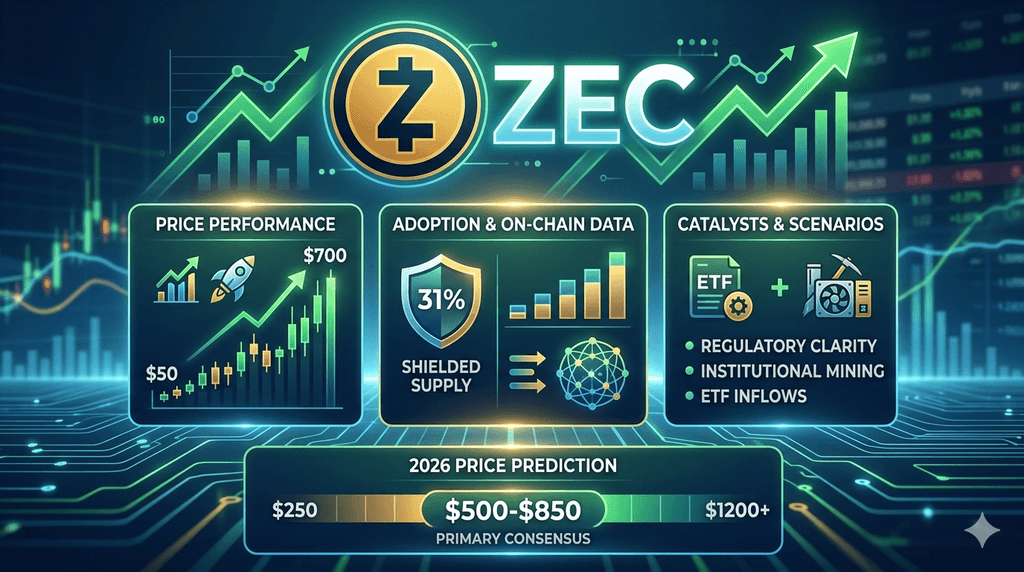
Zcash experienced a remarkable price appreciation cycle that caught many market participants off guard. The cryptocurrency climbed from approximately $50 in early 2025 to nearly $700 by November 2025, representing gains exceeding 1,200% in under twelve months. This performance made ZEC one of the top-performing major altcoins during that period, outpacing most competing assets in the cryptocurrency market.
The rally was catalyzed by multiple factors converging simultaneously. Naval Ravikant, a prominent tech entrepreneur and investor, publicly endorsed Zcash as a privacy solution with genuine utility, sparking FOMO (fear of missing out) among retail traders and institutional allocators alike. High-profile social media mentions from influential voices amplified the narrative, driving retail interest to levels not seen since Zcash's earlier market cycles.
The technical foundation for appreciation was arguably already in place. Zcash had maintained consistent protocol development throughout the preceding bear market, with the Electric Coin Company (ECC) continuing to improve the user experience and developer ecosystem. The introduction of the Zashi wallet (later rebranded to Zodl) represented a pivotal UX improvement, making shielded transactions significantly more accessible to non-technical users. By the time price catalysts materialized, the underlying infrastructure had been substantially strengthened.
Following the November 2025 peak, ZEC underwent a substantial correction, declining approximately 60% from its all-time highs. This pullback was consistent with historical cryptocurrency market patterns, where parabolic advances are typically followed by mean-reversion phases that purge excess speculation. The correction from $700 to approximately $280 brought ZEC back to levels that more reasonably reflected its underlying utility value proposition, setting the stage for a potential second wave of appreciation.
On-Chain Metrics Reveal Structural Adoption, Not Speculation
Zcash’s shielded-pool activity reached all-time highs in April 2026, underscoring real user demand for privacy. Shielded supply climbed to approximately 5.17 million ZEC, representing 31% of circulating supply—up sharply from 11% a year earlier. Shielded transactions accounted for 59.3% of total activity in February 2026 data, with year-to-date averages near 40%.
The Orchard pool alone holds over 4.5 million ZEC, and default routing in wallets such as Zodl has accelerated adoption. These metrics matter because they measure actual privacy usage rather than price speculation. Higher shielded activity reduces sell pressure from transparent holdings and increases the monetary premium attached to private ZEC.
Network hashrate also strengthened after Foundry Digital—the world’s largest Bitcoin mining pool—launched an institutional-grade Zcash mining pool in April 2026. Foundry quickly captured roughly 30% of total hashrate, adding credibility and security to the network.
Institutional and Regulatory Tailwinds Accelerate the Bull Case
Several high-impact developments in early 2026 removed major overhangs and opened new demand channels. The U.S. Securities and Exchange Commission closed its long-running investigation into the Zcash Foundation without enforcement action in January 2026. Grayscale followed by filing to convert its Zcash Trust (ZCSH) into the first-ever spot ETF for a privacy coin.
Additional institutional moves included Cypherpunk Technologies and other funds accumulating meaningful percentages of supply. Robinhood listings and THORChain integrations expanded retail and DeFi access. These catalysts arrived alongside a geopolitical risk-off environment that favored privacy assets, as traders sought censorship-resistant stores of value.
The combination of regulatory clarity and infrastructure support differentiates ZEC’s 2026 cycle from previous hype-driven rallies. Demand now stems from both speculative capital and longer-term holders who value the protocol’s zk-SNARK privacy technology.
ZEC Price Prediction 2026: Base, Bull, and Bear Scenarios
ZEC price forecasts for the remainder of 2026 vary by scenario, but the consensus tilts bullish. Most models project an average year-end price between $500 and $850, with upside potential to $1,200 in optimistic cases.
-
Base Case ($500–$700): Privacy demand grows steadily, shielded usage stabilizes above 30%, and ETF approval proceeds without major delays. ZEC trades in a higher range throughout the second half of 2026, supported by consistent volume and moderate Bitcoin correlation.
-
Bull Case ($850–$1,200+): Grayscale’s ETF attracts $500 million–$2 billion in inflows, institutional mining expands further, and privacy becomes a dominant macro narrative amid regulatory tightening elsewhere. Shielded transactions exceed 70% of activity, driving scarcity and premium pricing.
-
Bear Case ($250–$400): Regulatory setbacks delay ETF approval, or a broader crypto winter reduces risk appetite. Shielded adoption stalls, and sell pressure from new issuance overwhelms demand.
These ranges derive from aggregated forecasts by CoinCodex, Traders Union, and other analysts updated in April 2026. Short-term targets for May–June 2026 hover around $400–$500 if current momentum persists.
Risks That Could Limit ZEC’s 2026 Upside
Privacy coins face persistent headwinds. Regulatory scrutiny remains elevated in certain jurisdictions, and potential delistings on centralized exchanges could cap liquidity. Zcash’s inflation schedule—approximately 54% annualized from new issuance in some periods—creates ongoing sell pressure that must be absorbed by genuine demand.
Competition from newer privacy protocols and layer-2 solutions could divert capital. Broader market correlation with Bitcoin stays high, so any sharp BTC correction would likely drag ZEC lower in the near term. Finally, execution risk around wallet adoption and developer momentum could slow shielded growth if new tools fail to gain traction.
How to Buy and Trade ZEC on KuCoin
ZEC’s combination of strong fundamentals and explosive momentum makes it a compelling addition to any diversified crypto portfolio. KuCoin offers seamless access to ZEC/USDT spot and futures pairs with deep liquidity, low fees, and advanced trading tools designed for both beginners and experienced traders.
To get started, simply deposit funds, search for ZEC, and execute market or limit orders. KuCoin’s futures platform also supports leveraged positions for those looking to capitalize on short-term volatility while the bull cycle unfolds. With 24/7 availability, real-time charts, and secure custody, KuCoin provides the ideal venue to participate in ZEC’s potential 2026 upside.
New users can now register at KuCoin and Get Up to 11,000 USDT in New User Rewards.

Conclusion
Zcash has transitioned from a forgotten privacy coin to one of 2026’s standout performers. April’s 50%+ price surge, record trading volumes, 31% shielded supply milestone, and institutional catalysts collectively confirm the start of a new bull cycle. On-chain metrics show genuine adoption rather than speculation, while regulatory clarity and infrastructure upgrades remove previous barriers to growth.
Price predictions for year-end 2026 range from $500 in conservative scenarios to well above $1,000 if ETF inflows materialize and privacy demand accelerates. Risks remain—regulatory uncertainty, issuance pressure, and macro correlation—but the structural setup strongly favors upside.
Traders and investors who recognize the shift in privacy-asset fundamentals now have a clear window to position ahead of further catalysts. ZEC’s 2026 trajectory hinges on continued shielded usage and successful ETF outcomes, but the foundation for multi-hundred-percent gains is already in place.
FAQs
What makes ZEC different from other privacy coins like Monero?
ZEC uses zk-SNARKs for optional shielded transactions that allow selective disclosure, whereas Monero enforces privacy by default. This flexibility appeals to institutions seeking regulatory compliance alongside confidentiality.
Will the Grayscale Zcash ETF approval drive significant inflows?
Analysts estimate $500 million to $2 billion in potential inflows if approved, marking the first regulated on-ramp for a privacy coin and substantially increasing institutional demand.
How does the Zcash halving cycle affect price in 2026?
The most recent halving reduced issuance, tightening supply. Combined with rising shielded holdings, this creates deflationary pressure on liquid supply and supports higher prices over time.
Is ZEC suitable for long-term holding or better for short-term trading?
Both approaches work. Long-term holders benefit from adoption trends and potential ETF effects, while traders can capitalize on volatility around news events and technical breakouts.
What on-chain metric should investors watch most closely in 2026?
Shielded transaction percentage and total shielded supply provide the clearest signal of real privacy demand. Readings above 50% transaction share and 35% supply shielded would strongly reinforce the bull thesis.