

Why Did Sky’s USDS Stablecoin Shrink 35% After an Illicit-Finance Report?
Introduction
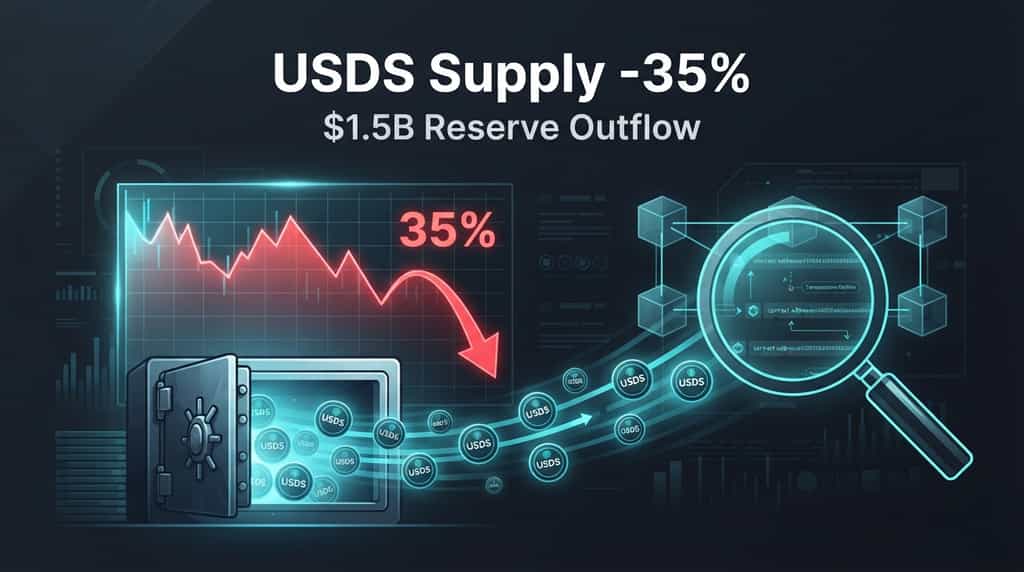
Sky’s USDS stablecoin contracted by 35% following a November 2026 illicit-finance report that prompted roughly $1.5 billion in reserve redemptions and liquidity withdrawals. When compliance scrutiny targets a decentralized or semi-decentralized stablecoin protocol, institutional depositors, liquidity providers, and yield seekers often redeem tokens early to reduce counterparty, regulatory, and freeze risk.
As of November 20, 2026, the contraction in USDS highlights how sensitive stablecoin supply has become to anti-money laundering (AML) narratives, compliance audits, and institutional risk management. Rather than stemming from a technical smart-contract exploit or an immediate failure of collateral backing, the 35% supply reduction reflects rapid capital reallocation after public allegations drew attention to potential illicit-finance exposure within the ecosystem.
Key Takeaways
A 35% drop in Sky’s USDS supply—accompanied by approximately $1.5 billion exiting reserves—was driven primarily by compliance-led de-risking after an illicit-finance report surfaced in mid-November 2026.
-
Primary Trigger: An illicit-finance report examining digital asset flows heightened perceived compliance and regulatory exposure around USDS, prompting large holders and liquidity pools to unwind positions.
-
Scale of Outflows: Roughly $1.5 billion left USDS reserves, reducing circulating supply by 35% from its prior peak level as of November 2026.
-
Mechanism of Contraction: Stablecoin supply shrinks when holders redeem tokens for underlying reserve assets or unwind leveraged positions, burning the returned stablecoins rather than leaving them idle.
-
Risk vs. Solvency Distinction: Reserve outflows test liquidity depth and governance response, but they are distinct from insolvency unless reserve assets suffer valuation losses or redemption bottlenecks.
What Is Sky’s USDS Stablecoin and How Does Its Supply Contract?
USDS is a decentralized dollar-pegged stablecoin issued within the Sky ecosystem—the rebranded evolution of MakerDAO—whose circulating supply expands when collateral is deposited to mint tokens and contracts when tokens are redeemed and burned.
In decentralized finance (DeFi) and crypto-collateralized or real-world-asset-backed (RWA) stablecoin systems, token supply is elastic. When market participants mint USDS against approved collateral or convert eligible assets into USDS, total supply increases. Conversely, when holders swap or redeem USDS back into underlying reserve assets—such as other stablecoins, tokenized treasuries, or collateral vaults—and those returned tokens are burned, circulating supply falls.
A 35% contraction paired with roughly $1.5 billion in reserve exits indicates that redemptions and liquidity unwinds substantially outpaced new minting over the observed window. In practice, large stablecoin contractions often accelerate when DeFi vaults unwind yield strategies, market makers rebalance inventory, or institutional treasuries pull capital ahead of potential regulatory inquiries or exchange delisting risks.
How Does an Illicit-Finance Report Trigger Stablecoin Redemptions?
An illicit-finance report triggers stablecoin redemptions by raising fears of regulatory enforcement, banking friction, smart-contract freeze actions, or secondary-market liquidity impairment. Even when a report does not constitute a formal enforcement order by a government authority, market participants treat compliance allegations as an early warning signal.
Institutional desks, custodians, and compliance-sensitive funds operate under strict risk mandates. When a stablecoin is linked—directly or indirectly—to alleged illicit transactions, mixer activity, sanctioned entities, or weak transaction monitoring, several risk channels activate simultaneously:
-
Compliance and Counterparty Risk: Regulated entities may restrict exposure to tokens flagged in compliance reports to protect their own licensing standing and banking relationships.
-
Liquidity and Peg Sensitivity: If large holders exit liquidity pools or redeem reserves at once, order books and automated market makers (AMMs) can experience temporary slippage or peg pressure.
-
Governance and Freeze Uncertainty: Protocols with on-chain freeze capabilities, governance modules, or compliance controls face heightened scrutiny over whether and how they will respond to allegations.
By contrast, retail users sometimes focus solely on whether a token trades near $1.00 at a given moment, overlooking how large capital allocators react to reputational and regulatory tail risks long before any formal legal action occurs.
What Happened to USDS Reserves and Supply in November 2026?
Following a November 19, 2026 report highlighting illicit-finance concerns tied to the ecosystem, USDS experienced roughly $1.5 billion in reserve outflows and a 35% decline in supply, according to market reporting as of November 20, 2026.
Because stablecoin reserves back outstanding liabilities, a $1.5 billion exit represents a major liquidity event for any dollar-pegged digital asset. When depositors pull capital out of backing reserves or unwind positions backed by those reserves, the protocol's balance sheet shrinks alongside its circulating token supply.
| Dimension | Stablecoin Contraction (35% Supply Drop) | Reserve Outflow (~$1.5 Billion Exit) |
| Core Metric | Circulating token supply reduction | Capital withdrawn from backing reserves |
| Immediate Catalyst | Illicit-finance report in November 2026 | Holder redemptions and liquidity unwinds |
| Primary Market Impact | Smaller circulating float and pool depth | Lower reserve balance and shifting asset mix |
| Key Analytical Question | Are redemptions orderly at or near peg? | Do remaining reserves cover all obligations? |
Evaluating an event like this requires separating flow dynamics from balance-sheet solvency. Large outflows reduce available liquidity and can widen spreads across decentralized and centralized venues, but a contraction in supply does not automatically mean a stablecoin is undercollateralized—provided remaining reserves match outstanding tokens and remain liquid.
How Should Users Evaluate Stablecoin Risk After a Compliance Shock?
Users evaluating a stablecoin after an illicit-finance report should examine reserve composition, redemption mechanics, governance controls, and exchange liquidity rather than relying on headlines or short-term price stability alone.
A structured risk review after a compliance event typically covers four areas:
-
Reserve Transparency and Liquidity: Check what assets back the stablecoin, how quickly those assets can be converted into cash or liquid equivalents, and whether on-chain or third-party attestations clearly document liabilities.
-
Redemption Pathways: Determine whether holders can redeem directly through the protocol or approved channels, what fees or minimums apply, and whether redemption queues or delays exist during high-volume exits.
-
Protocol Governance and Controls: Review how token minting, collateral parameters, and any compliance or freeze mechanisms are governed, and whether protocol operators have issued formal clarifications.
-
Venue and Market Depth: Observe trading volume, bid-ask spreads, and liquidity depth across major spot markets and DeFi pools, noting that thinner liquidity can amplify volatility during stress periods.
What Practical Steps Should Risk-Conscious Users Take?
When a stablecoin faces a sharp supply contraction after a compliance report, prudent risk management focuses on verification, position sizing, and avoiding rushed decisions based on unverified rumors.
First, verify primary protocol disclosures and on-chain supply metrics rather than relying on secondary social media summaries. Second, assess concentration risk if a large share of a portfolio is held in a single stablecoin or yield vault tied to that asset. Third, account for transaction fees, network congestion, and potential slippage before moving funds between wallets, protocols, or trading venues.
Conclusion
The 35% contraction in Sky’s USDS supply and the roughly $1.5 billion exit from reserves following the November 2026 illicit-finance report demonstrate how rapidly compliance concerns can reshape stablecoin liquidity. Even without a technical exploit, allegations involving illicit finance can prompt institutions and liquidity providers to withdraw capital to limit regulatory, operational, and counterparty exposure.
For market participants, the episode underscores an important distinction between token supply contractions and solvency failures. While rapid outflows shrink market depth and test redemption infrastructure, a lower circulating supply simply reflects capital leaving the system when holders redeem tokens. Evaluating stablecoins objectively requires looking past headline shocks to inspect reserve backing, redemption reliability, liquidity depth, and official protocol responses.
FAQs
Why does a stablecoin's supply shrink when money leaves its reserves?
A stablecoin's supply shrinks when users redeem tokens for underlying reserve assets or close positions that require minting, causing those returned tokens to be burned out of circulation. In a stablecoin system, circulating supply expands with net minting and contracts with net redemptions.
Does a 35% drop in USDS supply mean the stablecoin lost its peg or became insolvent?
Not automatically; a 35% supply drop measures a reduction in circulating tokens rather than a permanent peg break or insolvency. Solvency depends on whether remaining reserves match outstanding liabilities, while peg stability depends on liquidity and arbitrage efficiency during redemptions.
How can an illicit-finance report affect a stablecoin even before regulators take action?
An illicit-finance report can prompt compliance-sensitive institutions, custodians, and liquidity providers to reduce exposure preemptively to avoid regulatory scrutiny, banking restrictions, or secondary-market liquidity shocks. Market participants frequently de-risk at the prospect of enforcement rather than waiting for formal penalties.
What is the difference between reserve outflows and smart-contract exploits?
Reserve outflows occur when holders withdraw capital or redeem tokens through normal or stressed market activity, whereas a smart-contract exploit involves unauthorized manipulation or vulnerability in code. Both can disrupt liquidity, but they pose different technical and governance challenges.
What should readers check first when researching a stablecoin news event?
Readers should check the date of the report, the specific claims made, official statements from the protocol or project team, and verifiable on-chain or reserve data. Distinguishing confirmed facts from market speculation helps prevent misinterpreting normal redemption mechanics as a system failure.
Disclaimer
This general market information, possibly from third-party, commercial, or sponsored sources, is provided for reference and educational purposes only and does not constitute financial or investment advice, an offer, solicitation, or guarantee. We disclaim liability for its accuracy, completeness, reliability, and any resulting losses. Investments/trading are risky; past performance doesn’t guarantee future results. Users should research, judge prudently, and take full responsibility. For further details, please consult KuCoin’s Terms of Use and Risk Disclosure.