

Why Did Anthropic Stock Fall Below Its $83 IPO Price Just Days After Its Record-Breaking Debut?
Introduction
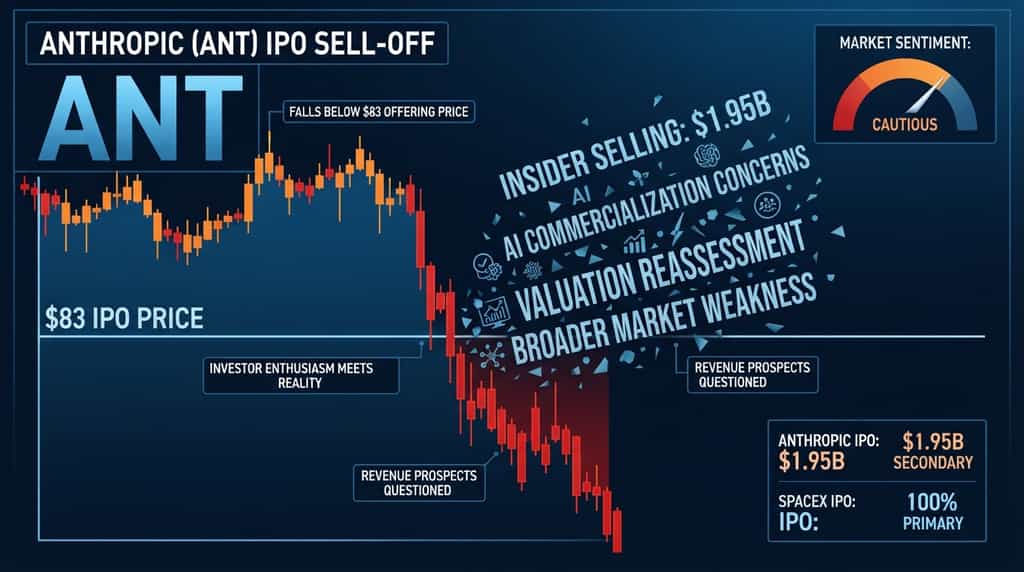
Anthropic (NASDAQ: ANT) fell below its $83 initial public offering (IPO) price just five trading days after its November 19, 2026, Nasdaq debut, raising questions about insider selling, AI valuations, and the commercial prospects of frontier AI models. The stock initially traded at $111.50, but its subsequent decline erased much of the IPO rally and exposed a gap between investor enthusiasm and public-market demand.
Three factors help explain the reversal: existing shareholders sold approximately $1.95 billion in shares through the IPO, investors began reassessing the economics of large-scale AI development, and concerns emerged about whether increasingly capable models could translate into sustainable commercial returns. Meanwhile, Wedbush initiated coverage with an Outperform rating and a $120 price target, illustrating the disagreement between bullish long-term expectations and near-term market sentiment.
Anthropic's IPO sell-off is therefore more than a stock-price correction. It offers a useful case study in how AI companies are valued when capital requirements, insider liquidity, and commercial execution become public-market concerns.
Quick Answer: Why Did Anthropic Stock Fall Below $83?
Anthropic shares fell below their $83 IPO price because the initial listing demand was not sufficient to sustain the valuation as investors reassessed supply, AI spending, and future profitability.
The main factors were:
-
Insider selling: Existing shareholders sold approximately $1.95 billion of shares in the IPO, according to Anthropic's SEC prospectus.
-
IPO valuation: The stock's opening price of $111.50 was substantially above its $83 offering price, creating room for a sharp post-debut correction.
-
AI commercialization: Investors are questioning whether expensive frontier models can generate sufficient recurring revenue and margins.
-
Analyst disagreement: Wedbush initiated coverage with an Outperform rating and a $120 target, despite the stock's declining price.
-
Broader market conditions: Weakness in technology shares and concerns about AI infrastructure spending added pressure to the valuation.
The decline does not establish that Anthropic's business prospects have deteriorated permanently. It does show that a successful IPO and strong demand for AI products do not automatically translate into sustained public-market performance.
Existing shareholder sales created an additional supply of shares during Anthropic's IPO, potentially affecting how investors interpreted the listing. However, insider selling should be distinguished from a direct explanation for every subsequent price decline.
According to Anthropic's November 2026 SEC prospectus, 23,648,646 shares were sold by existing shareholders at the $83 offering price. The gross proceeds attributable to those sales were approximately $1.95 billion before underwriting discounts and other expenses.
This is an important figure because the proceeds went to selling shareholders rather than Anthropic itself. The company received approximately $91.6 billion from the completed IPO, while existing shareholders received the proceeds from their portion of the offering.
How Much Did Dario and Daniela Amodei Sell?
Public reporting on the offering indicated that Anthropic CEO Dario Amodei and President Daniela Amodei each sold approximately $280 million in shares, representing roughly $560 million combined.
The SEC prospectus separately confirms that existing shareholders sold approximately $1.95 billion in aggregate. The distinction matters because the total secondary sale included more than the two executives' transactions.
The IPO also included shares sold by other existing shareholders, with seven co-founders among the company's principal stakeholders. The total amount should not be attributed exclusively to the founders without examining the individual selling-stockholder disclosures.
From a market perspective, these transactions raise a legitimate question: how should public investors interpret significant insider liquidity at the moment a company enters the stock market?
There is no universal answer. Founders and early employees may sell shares to diversify personal wealth, meet financial obligations, or realize part of the value accumulated over many years. Such transactions do not necessarily indicate a loss of confidence in the company's business.
Nevertheless, the timing and scale of insider sales can influence investor sentiment, particularly when a newly listed company is trading at a valuation based on ambitious future expectations.
How Does Anthropic's IPO Compare With SpaceX's June 2026 IPO?
SpaceX provides an interesting comparison because its June 2026 IPO was structured entirely around newly issued shares rather than secondary sales by existing shareholders.
According to SpaceX's June 15 announcement, the company issued and sold 638,888,888 shares, including the fully exercised overallotment option, raising approximately $85.7 billion in gross proceeds. Its IPO offering was 100% primary according to the company's IPO roadshow documentation.
The distinction is straightforward:
-
Anthropic: Its IPO included both newly issued shares and approximately $1.95 billion in gross secondary proceeds for existing shareholders.
-
SpaceX: Its IPO consisted entirely of newly issued shares, with the proceeds going to the company.
This comparison also explains why the two offerings generated different investor narratives. Anthropic's offering provided liquidity to some existing shareholders while raising capital for the business. SpaceX's offering emphasized corporate fundraising through newly issued equity.
However, the comparison should not be reduced to whether one founder has more commitment to a company than another. The capital structures, financing requirements, ownership arrangements, and personal circumstances of the two businesses are different.
The more relevant question for public investors is whether the amount of newly issued and secondary stock is consistent with the company's long-term capital requirements and the market's willingness to absorb additional supply.
Are Anthropic and OpenAI Facing a Commercialization Problem With Advanced AI Models?
The commercialization of frontier AI models is becoming a central question for investors because technological progress does not automatically translate into sustainable revenue or operating profits.
Anthropic and OpenAI have both invested heavily in developing increasingly capable models. However, the commercial value of those systems depends on more than benchmark performance. Companies must also demonstrate that customers are willing to pay for the capabilities, that products can be deployed reliably, and that the resulting revenue can cover the substantial costs of development and operation.
Two related concerns are particularly important: the safety constraints surrounding powerful models and the economics of deploying them at scale.
Why Does Better AI Performance Not Always Mean Higher Revenue?
Better AI performance does not guarantee proportional revenue growth because the economic value of a model depends on how customers use it and how much they are willing to pay.
Consider three potential commercialization challenges.
First, the cost of inference can remain substantial. Inference refers to the computing required to generate responses or perform tasks after a model has been trained. More complex reasoning and agentic workflows can require significantly more computing resources than simple text generation.
Second, enterprise adoption requires measurable returns. A company may be impressed by a model's capabilities but still hesitate to deploy it widely if the productivity improvements do not justify subscription, API, integration, and infrastructure costs.
Third, competition can reduce pricing power. As alternative models improve, AI developers may face pressure to reduce prices or provide more capabilities within existing subscription plans. This can increase adoption while limiting revenue growth per user.
The distinction between technological leadership and commercial profitability is particularly important for public-market valuations. Investors are not simply valuing the quality of an AI model; they are estimating the future cash flows that the technology can generate.
Could Anthropic's Stock Decline Affect the Broader AI Industry?
Anthropic's stock performance could influence investor expectations for other AI companies because its IPO provides a new public-market reference point for valuing frontier AI businesses. However, the impact on individual companies will depend on their business models, financial structures, and exposure to AI infrastructure spending.
The connection extends beyond AI developers. Companies supplying semiconductors, data-center infrastructure, cloud computing, and networking equipment may also be affected by changes in expectations for AI investment.
Why Are OpenAI and Anthropic Important to the AI Supply Chain?
OpenAI and Anthropic are important participants in the AI infrastructure ecosystem because their model development and deployment require substantial computing resources. Their spending creates demand for several categories of products and services:
-
Semiconductors: Advanced GPUs and other specialized processors used for model training and inference.
-
Cloud computing: Computing capacity, storage, and infrastructure services required to operate AI applications.
-
Data centers: Facilities, power systems, cooling equipment, and networking infrastructure.
-
Enterprise software: Applications that integrate AI capabilities into business workflows.
A change in the expected growth rate of frontier AI companies can therefore influence expectations across these related industries.
For example, if investors believe AI developers will continue expanding their computing capacity, semiconductor and data-center companies may benefit from stronger expected demand. Conversely, if AI companies begin reducing infrastructure commitments because monetization is slower than anticipated, suppliers could face weaker growth expectations.
This relationship does not mean that a decline in Anthropic shares automatically indicates falling semiconductor demand. Infrastructure suppliers have multiple customers, different revenue sources, and varying levels of exposure to individual AI developers.
Conclusion
Anthropic's decline below its $83 IPO price just days after its November 2026 debut highlights the challenges of translating technological leadership into sustainable public-market valuation. Although the company completed a record-breaking offering and attracted substantial institutional investment, its shares quickly came under pressure as investors reassessed insider selling, AI infrastructure costs, and the commercial economics of frontier models.
The approximately $1.95 billion in secondary share sales created an additional supply of stock during the IPO, although it should not be treated as the sole explanation for the subsequent decline. The comparison with SpaceX's entirely primary June offering also demonstrates how different IPO structures can shape investor perceptions.
More fundamentally, Anthropic's financial disclosures highlight the difficulty of converting rapid AI adoption into sustainable profitability. The company's future valuation will depend on revenue growth, compute efficiency, enterprise adoption, and its ability to commercialize increasingly capable models.
For the broader AI industry, the key question is whether technological progress can ultimately generate sufficient economic returns to justify the enormous capital investment behind it.
FAQs
-
What is Anthropic's stock ticker symbol?
Anthropic trades on the Nasdaq Global Select Market under the ticker symbol ANT. Its Class A common stock began public trading on November 19, 2026.
-
How much money did Anthropic raise in its IPO?
Anthropic raised approximately $93.5 billion in gross IPO proceeds after the full exercise of the underwriters' additional-share option. Approximately $91.6 billion went to the company, while the remainder represented gross proceeds from existing shareholder sales.
-
Why did Anthropic choose an IPO instead of another private funding round?
An IPO allows a company to raise capital from public-market investors, establish publicly traded shares, and provide liquidity to eligible existing shareholders. Anthropic's offering also expanded its access to public equity financing, although listing brings additional disclosure obligations and market scrutiny.
-
What is the difference between primary and secondary shares in an IPO?
Primary shares are newly issued by a company, with proceeds going to the company. Secondary shares are existing shares sold by current shareholders, with proceeds going to those sellers rather than the issuer.
-
Does Anthropic's stock decline mean the AI industry is entering a bubble?
Not necessarily. A sharp correction in one AI company's shares does not establish that the entire industry is overvalued. Investors need to examine revenue growth, infrastructure investment, customer demand, profitability, and valuations across individual companies before drawing broader conclusions.
Disclaimer
This general market information, possibly from third-party, commercial, or sponsored sources, is provided for reference and educational purposes only and does not constitute financial or investment advice, an offer, solicitation, or guarantee. We disclaim liability for its accuracy, completeness, reliability, and any resulting losses. Investments/trading are risky; past performance doesn’t guarantee future results. Users should research, judge prudently, and take full responsibility. For further details, please consult KuCoin’s Terms of Use and Risk Disclosure.