

Big US Banks Report Strong Q3 2026 Earnings and Remain Bullish on AI
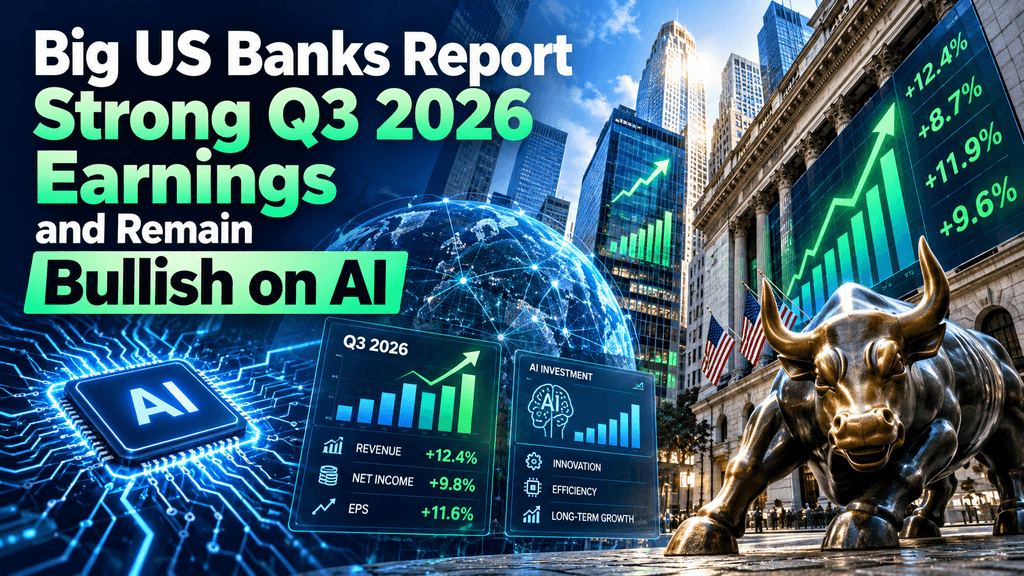
Major US Banks Post $43.5 Billion in Q3 Profits as AI Investment Drives Growth
Major US banks have reported a notable increase in their profits for the third quarter of 2026, a development that has garnered significant attention this week. This positive financial performance has been bolstered by a combination of resilient equity trading, robust advisory activity, and steady consumer performance, all occurring despite the challenges posed by inflation and rising interest rates, which have created certain headwinds for the economy. Executives from prominent financial institutions, including JPMorgan Chase, Goldman Sachs, Citigroup, Wells Fargo, Bank of America, and Morgan Stanley, have described continued momentum in financing the ongoing buildout of artificial intelligence. They emphasized that their capital expenditure plans remain firmly intact and that their deal pipelines are showing no signs of material slowdown. However, they also acknowledged the presence of leverage risks, energy constraints, and the potential for project delays.
In a related note, the International Monetary Fund has separately highlighted the elevated chances of a market correction related to AI, adding another layer of complexity to the financial space. According to aggregated reporting, the combined profits for these six largest institutions reached an impressive total of approximately $43.5 billion, generated from roughly $165 billion in revenue. The strong results reported for the third quarter, along with explicit commentary from management, clearly demonstrate that leading US banks continue to view the ongoing AI investment cycle as a durable and multi-year driver of financing, trading, and advisory revenue. This perspective persists even as they recognize the macroeconomic and project-specific risks that could potentially moderate the pace of activity in the near future.
Equity Trading Surge Powers Goldman Sachs and Morgan Stanley Results
Goldman Sachs delivered one of the standout performances of the reporting cycle, with net earnings rising 29 percent year over year to $5.29 billion and diluted earnings per share reaching $17.01, well above consensus expectations near $13. Equity trading revenue jumped 72 percent, showing elevated client activity across products and regions during a period of market volatility linked to geopolitical tensions and shifting rate expectations. Management described the current environment as a strong technology super-cycle and stated that demand for financing related to AI infrastructure remains robust. David Solomon, Goldman Sachs chief executive, noted that while the precise path of capital and compute needs is uncertain, the underlying technology is real, and the push behind major AI ventures continues. The bank indicated it is selective in underwriting risk and capital commitments, balancing opportunity against potential overbuilding or higher borrowing costs that could pressure project economics. These results contributed meaningfully to the broader Wall Street total and underscored how equity market activity has become a primary earnings engine in the current cycle.
Morgan Stanley similarly benefited from equity strength, reporting net revenues of $20.3 billion, up roughly 12 percent, and earnings per share of $3.03, exceeding estimates. Equities revenue rose 41 percent to $5.8 billion, more than offsetting softer fixed-income trading. Wealth management delivered record results, with net new assets of $232 billion in the quarter and total client assets reaching new highs. The firm’s institutional securities business generated $10 billion in revenue, up 18 percent, supported by client engagement and advisory work. Executives pointed to the integrated model connecting wealth, investment banking, and markets as a source of resilience amid late-quarter uncertainty. The performance illustrates how diversified platforms can capture both market-driven trading gains and longer-term asset gathering tied to broader economic and technological shifts.
JPMorgan Posts Profit Growth Despite Missing Consensus Forecasts
JPMorgan Chase reported net income of $15.3 billion, a 6 percent increase from the prior year, with diluted earnings per share of $5.57. Revenue reached approximately $50.2 billion. The result fell short of FactSet consensus expectations near $15.85 billion, marking a rare miss driven in part by $658 million in securities investment losses and a 12 percent rise in expenses linked to compensation, technology, and marketing. Equity trading revenue increased 49 percent to about $5 billion, helping offset moderation in investment banking fees, which declined sequentially. Chief Financial Officer Jeremy Barnum stated that AI-related capital expenditure continues to be spent, deals still need to be completed, and market access demand remains present. The bank’s return on tangible common equity stood at 20 percent, and its common equity tier 1 ratio was reported at 13.9 percent.
Management showed ongoing monitoring of AI exposure, describing it as modest relative to overall wholesale portfolios while noting that a broad sentiment shift could still affect the industry. Consumer health remained a positive factor, with clients continuing to meet obligations despite inflation pressures. Net interest income trends provided additional support, rising on higher loan and deposit balances. Expenses reflected both volume growth and strategic investments in technology. Credit costs stayed manageable. The overall picture shows a bank generating solid absolute profits and maintaining capital strength while navigating higher rates and selective market activity. Analysts noted that the miss was largely attributable to specific investment losses rather than core franchise weakness, allowing focus to remain on the durability of non-interest income drivers, including those linked to technology infrastructure financing.
Citigroup and Wells Fargo Highlight Broad Franchise Strength
Citigroup reported net income of approximately $5.2 billion and earnings per share of $2.85, exceeding expectations, on revenue of $23.8 billion. Equity markets activity contributed positively, rising around 14 percent, while investment banking and wealth management also showed gains. The bank raised its full-year net interest income outlook, citing balance sheet growth. Management discussed operational benefits from AI tools, including faster product development and reduced vendor costs in certain technology areas. Consumer and corporate client activity supported results, with particular strength in multinational transaction services. Capital ratios remained solid, and the franchise continued to benefit from global diversification. These outcomes reinforced the view that diversified banks can generate earnings growth even when certain market segments moderate.
Wells Fargo posted net income near $5.95 billion and earnings per share of $1.87, with revenue of about $21.9 billion. Return on tangible common equity reached 16.3 percent. Chief Executive Charlie Scharf described the AI investment cycle as a complicated macroeconomic force that has driven demand across semiconductors, power generation, cooling systems, cybersecurity, and data-center infrastructure. He noted that the scale increasingly resembles prior infrastructure booms, creating both opportunities and risks from leverage and supply-chain price pressures. Scharf expressed the view that concerns about AI agents rapidly shifting deposits remain overdone for the foreseeable future, as clients maintain balances for multiple reasons beyond rate maximization. The bank continues to fund related activity while remaining attentive to credit quality and concentration risks. Consumer metrics stayed constructive.
Bank of America reported net income of $6.9 billion, or $0.91 per share, which included a $1.2 billion non-tax-deductible regulatory settlement charge. Adjusted net income stood at $8.1 billion, or $1.08 per share. Revenue reached $30 billion, supported by an 8 percent rise in net interest income to $16.6 billion on higher loan and deposit balances and asset repricing. Equity trading rose 11 percent. Management projected continued net interest income growth into 2027 and highlighted headcount reductions of nearly 3,500 year over year as automation and process simplification advanced. Wealth management achieved record client balances. The commercial bank continued adding new relationships and deployed generative AI tools for prospecting and onboarding efficiency.
Despite the charge weighing on reported figures, core lending and fee businesses demonstrated resilience. Executives addressed AI financing as an important contributor to investment-grade debt and leveraged finance activity while monitoring broader economic conditions. The adjusted results and forward guidance on net interest income underscored balance-sheet momentum. Expense discipline and technology investments aimed at productivity gains positioned the franchise for operating leverage. Client acquisition in consumer and commercial segments remained a priority, with AI tools beginning to support efficiency in specific workflows.
Combined Industry Profits Reach $43.5 Billion on Trading Leadership
Across the six largest US banks, third-quarter profits totaled roughly $43.5 billion on aggregate revenue near $165 billion. Equity trading emerged as the clear standout, with Goldman Sachs up 72 percent, JPMorgan Chase up 49 percent, Morgan Stanley up 41 percent, and more moderate gains at Citigroup and Bank of America. Fixed-income trading was generally flat to lower. Wealth management flows were robust, particularly at Morgan Stanley. Net interest income rose at the major money-center banks, supported by balance-sheet growth and higher rates. Capital ratios remained healthy across the group, with CET1 levels ranging from approximately 10 percent to nearly 15 percent.
These figures illustrate a sector capable of generating substantial absolute earnings even amid sequential moderation in certain investment banking and fixed-income activities. The concentration of gains in equities trading highlights sensitivity to market volatility and client risk appetite, both of which were elevated during the period. Return metrics varied, with several institutions delivering returns on tangible common equity above 15–20 percent. Expense growth at some banks reflected compensation and technology investments, while others emphasized efficiency ratios. Overall credit quality held up, consistent with management commentary on consumer and corporate health.
Management Commentary Affirms Ongoing AI Capital Expenditure Momentum
Bank executives consistently stated that AI-related capital spending and financing demand show no appreciable slowdown. JPMorgan Chase’s Jeremy Barnum emphasized that capex continues, deals require completion, and market access remains sought after. Goldman Sachs’ David Solomon described a strong technology super-cycle and affirmed the reality of the underlying technology while acknowledging that numerous factors could slow progress. Wells Fargo’s Charlie Scharf framed the cycle as a macroeconomic force driving multi-industry demand and noted resemblances to historical infrastructure expansions. Bank of America showed the importance of AI investment to its debt and leveraged finance franchises.
These statements were delivered alongside recognition of risks, including project leverage, energy and water demands of data centers, potential overbuilding, and evolving capital needs as the ecosystem matures. No institution signaled an immediate pullback in financing activity. The collective tone reflected confidence in medium-term durability while incorporating caution on underwriting standards and concentration. Exposure estimates for AI-adjacent sectors across the banking system have been placed around $800 billion, representing a relatively modest share of total assets, though indirect effects through markets and supply chains remain relevant.
IMF Highlights Elevated Risks of AI-Related Market Correction
On the same day, several banks reported, and the International Monetary Fund released analysis warning of elevated risks associated with the AI investment boom. The Fund noted that weaker or less durable AI investments and profitability could trigger a market correction, potentially amplified by rising leverage, concentrated exposures, and circular financing arrangements. A steep drop in AI investment was modeled as capable of reducing global GDP by 1.1 percent by 2028, with a larger impact in the United States. Hyperscalers’ share of investment-grade bond issuance has risen sharply, and circular deals involving equity, debt, and future revenue commitments totaling substantial sums were flagged as sources of interconnected risk.
Policymakers were urged to avoid complacency and consider measures addressing excessive leverage. These warnings arrived against a backdrop of geopolitical tensions, including energy price effects from regional conflict and recent central bank rate increases responding to inflation. Bank executives acknowledged public concerns, including potential job displacement and resource demands, yet maintained that momentum in the buildout persists. The divergence between official-sector caution and private-sector financing appetite forms a central tension for the period ahead.
Rising Rates and Inflation Create Dual Pressures on Consumers and Dealmaking
Higher Treasury yields and persistent inflation featured prominently in management discussions. Net interest income benefited at most institutions from asset repricing and balance-sheet growth, yet funding costs and potential impacts on loan demand and consumer spending were monitored closely. Investment banking activity moderated sequentially in some categories, with global M&A volumes declining and certain IPOs delayed amid rate uncertainty. Consumer metrics remained constructive, with clients continuing to service obligations and deposit behavior showing stability.
Geopolitical factors, including energy price effects, added complexity to the outlook. Banks generally described the US consumer as resilient, supporting confidence in credit performance while preparing for possible gradual softening if inflation proves stickier or rates remain elevated longer. Expense management balanced investment in technology and talent against efficiency goals. Several institutions noted wage inflation and higher compensation tied to performance and hiring in growth areas.
Operational AI Adoption Begins Delivering Measurable Efficiency Gains
Beyond financing the external AI boom, banks reported internal progress with artificial intelligence tools. Citigroup cited faster product development cycles and meaningful reductions in certain technology vendor expenses. Bank of America described generative AI applications in commercial prospecting and onboarding, alongside broader automation contributing to headcount optimization. JPMorgan noted ongoing testing of multiple use cases, observing that benefits at an institutional scale require time to appear in financial results.
These internal applications complement the revenue opportunity from financing external infrastructure. Efficiency gains support expense control and free resources for client-facing investment. Adoption remains in relatively early stages for large, complex institutions, yet early indicators of productivity improvement are emerging in targeted areas such as coding, document processing, and customer interaction workflows.
Wealth Management Captures New Asset Flows Tied to Market Gains
Wealth and asset management businesses delivered notable contributions, particularly at Morgan Stanley, where record net new assets and fee-based flows reflected both market appreciation and organic gathering. Other banks reported growth in client balances and advisory revenue. The creation of new high-net-worth clients through technology and equity market gains has supported demand for sophisticated wealth services.
Higher asset levels translate into recurring fee income, providing a stabilizing element relative to more volatile trading and investment banking lines. Banks emphasized the integrated nature of their platforms, allowing institutional relationships to feed wealth opportunities and vice versa. Sustained equity market performance remains an important variable for continued flow momentum.
Selective Underwriting Reflects Awareness of Project and Macro Risks
While maintaining financing activity, several executives described a selective approach to AI-related credit. JPMorgan indicated tightening of certain terms in response to project risks. Goldman Sachs emphasized evolving uncertainty around ultimate capital and compute requirements. Wells Fargo highlighted leverage used in the buildout and resulting price pressures in supply chains. These comments suggest that banks are calibrating risk appetite rather than exiting the opportunity.
Exposure monitoring, diversification across counterparties and project types, and attention to energy and siting constraints form part of the risk framework. The relatively limited reported percentage of total assets dedicated to AI-adjacent lending provides a buffer, yet secondary effects through market valuations and economic growth remain under continuous assessment.
Market Reaction and Forward Impacts for Banking Sector Earnings
Despite several strong absolute results and beats, bank stocks experienced mixed to negative reactions in the immediate aftermath, reflecting a broader investor focus on inflation data, rate direction, and questions about the sustainability of technology-driven growth. Analysts noted that equity trading strength may prove difficult to sustain at the same elevated levels, while net interest income provides more structural support if rates remain higher.
The fourth-quarter outlook will depend on deal completion rates, trading volumes, and any shifts in AI capital expenditure announcements from major technology companies. Banks enter the period with solid capital, constructive credit trends, and explicit management confidence in the medium-term AI financing opportunity. The combination positions the sector to continue participating in the cycle while managing the risks that both internal risk teams and external observers have identified.
🔥 Beyond the Headlines: What KuCoin 5.0 Means for You
Market news moves fast — but where you act on it matters just as much. This October, KuCoin launches KuCoin 5.0, transforming KuCoin into a rebuilt platform. Here's what actually changes for you:
-
One account for everything. Older platforms split your money across separate "spot," "margin," and "futures" accounts and expected you to understand why. KuCoin 5.0's unified account removes that entirely — deposit once, and everything is simply there (only available to VIPs for now).
-
Stocks, indices, and commodities. KuCoin 5.0 expands beyond crypto into global markets. When crypto chops sideways and equities rally (or the reverse), you rotate in minutes instead of opening a brokerage account and waiting days for fiat rails.
-
Real-world assets (RWA). Tokenized exposure to traditional assets like commodities, right inside your crypto account. One of the fastest-growing segments in global finance is no longer reserved for institutions — you access it from the same balance you trade with.
-
Earn while you learn. Not ready to trade? KCUSD lets your stablecoins earn daily, auto-compounding interest. The lowest-stress way to put your idle deposit to work for 4% yield.
-
An AI assistant in plain language. Ask questions, get market context, understand what you're looking at — built into the platform, no jargon required.
-
An app that doesn't overwhelm. Faster, cleaner, and consistent — intuitive from the first tap, not after a tutorial.
-
Safety you can check, not just trust. A MiCAR-licensed EU entity, Proof of Reserves you can verify yourself, and internationally certified security (SOC 2 Type II, ISO 27001:2022).
Create your account in minutes — and start on the platform built for where crypto is going, not where it's been.
FAQs
How did the largest US banks perform in aggregate during the third quarter of 2026?
The six largest US banks generated combined net income of approximately $43.5 billion on revenue of roughly $165 billion. Equity trading provided the primary growth engine, with particularly sharp increases at Goldman Sachs, JPMorgan Chase, and Morgan Stanley. Net interest income rose at the major commercial banks, wealth management flows were robust at several institutions, and capital ratios remained healthy. Results were mixed relative to consensus at the individual bank level, yet absolute profitability demonstrated resilience amid higher rates and geopolitical uncertainty.
What specific comments did bank executives make about the durability of AI investment?
Executives described ongoing capital expenditure, continued deal activity, and persistent demand for market access. Goldman Sachs characterized the period as a strong technology super-cycle grounded in real technology. JPMorgan noted that spending continues and transactions still need to be completed. Wells Fargo framed AI as a macroeconomic force resembling prior infrastructure booms. No major bank signaled an imminent reduction in financing appetite, although selectivity and risk awareness were emphasized.
What risks did the International Monetary Fund associate with the AI boom?
The IMF warned that weaker or less durable AI investment and profitability could trigger a market correction, amplified by leverage, concentrated exposures, and circular financing arrangements. A significant drop in AI investment was projected as capable of reducing global GDP by more than 1 percent by 2028. Rising hyperscaler bond issuance and interconnected deals were cited as potential transmission channels for stress. Policymakers were advised against complacency regarding these financial stability considerations.
How did higher interest rates affect bank results and outlooks?
Higher rates supported net interest income growth through asset yields and balance-sheet expansion at most institutions. At the same time, elevated yields contributed to sequential moderation in some investment banking categories and increased funding cost awareness. Consumer credit performance remained solid, and banks generally described the US household sector as resilient. Forward guidance on net interest income was constructive at several banks, assuming continued modest loan and deposit growth.
Did banks report meaningful internal benefits from adopting AI tools?
Several institutions cited early operational gains. Examples included faster product development, reduced technology vendor expenses, generative AI applications in commercial prospecting, and contributions to process automation that supported headcount discipline. Benefits at the scale of large banks were described as taking time to appear fully in financial statements, yet targeted efficiency improvements are already observable in specific workflows.
Disclaimer: This content is for informational purposes only and does not constitute investment advice. Investments carry risk. Please do your own research (DYOR).