

Trump Delays AI Executive Order: Why This is a Massive Bull Signal for AI Crypto Tokens
2026/05/22 16:57:02
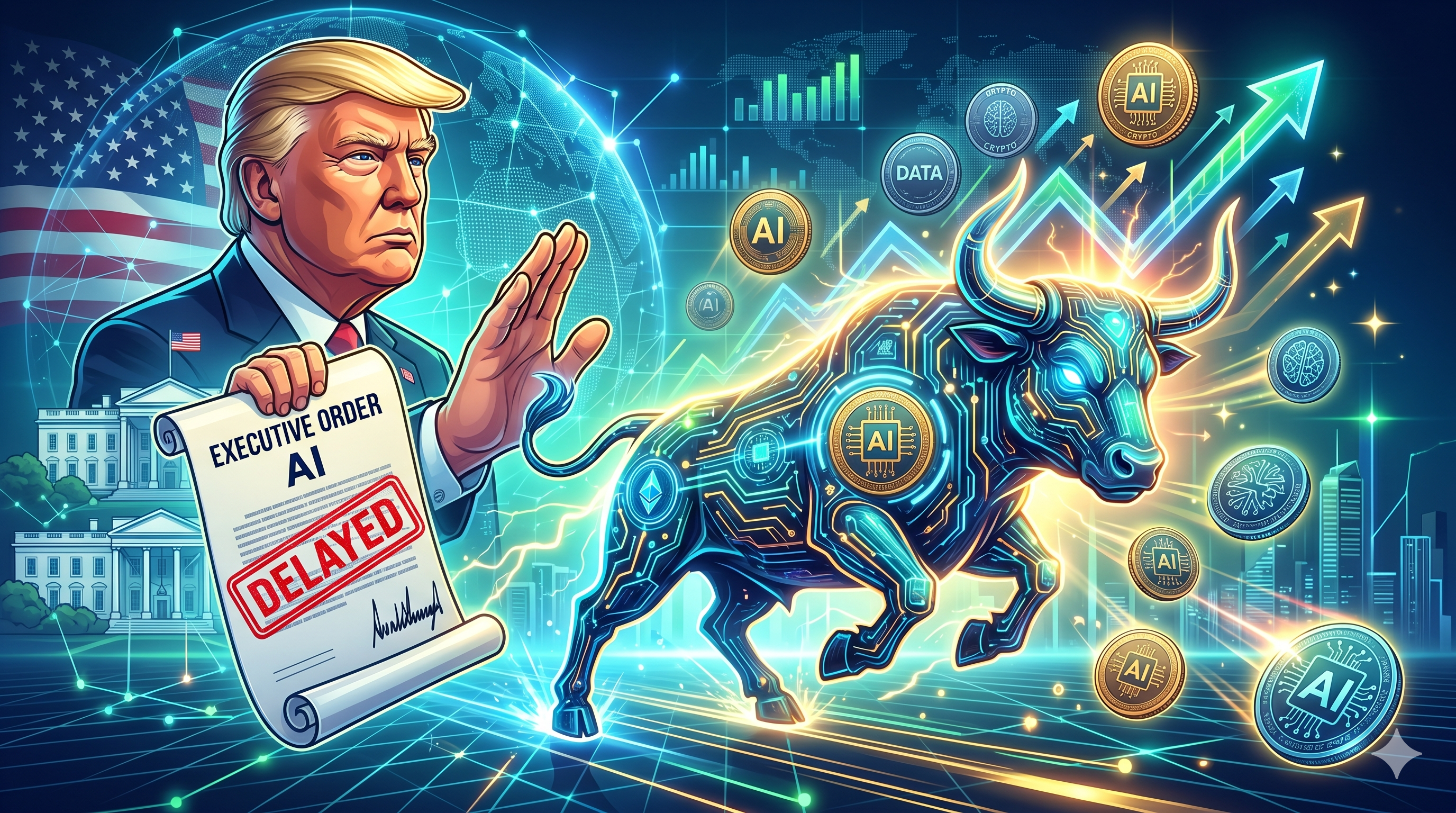
On May 21, 2026, in a sudden White House announcement, President Donald Trump postponed signing an executive order that would have established a voluntary government review framework for advanced AI models. The reason? Trump cited an urgent need to maintain America's technological lead over China, stating "We lead China, we lead everybody, and I don't want to do anything that's going to get in the way of our lead". This decision represents more than a regulatory footnote for cryptocurrency traders. It signals a strategic pivot toward deregulation in America's technology sector, with profound implications for the converging AI and cryptocurrency markets.
The AI-crypto convergence has emerged as one of the most compelling investment narratives of 2025-2026. AI-powered trading bots, decentralized machine learning protocols, and blockchain-based AI marketplaces are gaining institutional traction. Now, with the Trump administration prioritizing innovation over oversight, AI-focused cryptocurrency tokens may be poised for significant upside. This comprehensive analysis examines what the delayed AI executive order would have required, why deregulation benefits both AI and crypto sectors, which AI tokens are positioned to outperform, trading strategies for capitalizing on this policy shift, how to access AI tokens through established exchanges like KuCoin, and risk management frameworks for volatile AI-crypto trades.
What Happened: Trump's AI Executive Order Delay Explained
On Thursday, May 21, 2026, Trump was scheduled to sign an AI executive order in the Oval Office. AI industry leaders, including Anthropic CEO Dario Amodei, had been invited to witness the ceremony. Just hours before the event, the White House cancelled the signing, announcing the order would be delayed. Trump's stated reason was clear: he worried regulations could harm U.S. competitiveness against China. The original proposal would have required AI developers to submit advanced models to federal agencies for up to 90 days before public release, allowing government assessment of dangerous capabilities. The National Security Agency would determine which models posed sufficient risk to warrant government monitoring, marking unprecedented federal involvement in AI development. Reviews would assess model safety, identify security vulnerabilities, and develop countermeasures against potential exploitation by hackers or foreign adversaries. The order would also mandate use of advanced AI models to strengthen federal systems and critical infrastructure like banks and healthcare networks against cyber threats, while the administration planned to recruit additional cybersecurity and AI experts to support the review framework.
No revised timeline has been announced, and the White House declined to comment on when or if the order will be rescheduled. This uncertainty creates a regulatory gray area that market participants must navigate while assessing the implications for their portfolios.washingtonpost
| Key Event Details | Specification |
| Date of Delay | May 21, 2026 scmp |
| Trump's Stated Reason | Worried regulations could harm U.S. competitiveness against China scmp |
| Original Proposal | Up to 90-day voluntary government review of advanced AI models before public release scmp |
| Custodian Agency | National Security Agency (NSA) would identify models requiring oversight washingtonpost |
| Current Status | No revised timeline announced; White House declined comment washingtonpost |
Why This Matters to Crypto Traders?
The AI and cryptocurrency sectors are increasingly interconnected, creating multiple investment and trading opportunities. AI-powered trading bots, predictive analytics, and portfolio optimization tools are driving higher trading efficiency and reduced human error across crypto markets. Blockchain-based marketplaces for AI models, data, and compute resources are creating new revenue streams for protocol tokens. Tokens like OCEAN enable secure data sharing for AI model training, providing direct utility for tokenholders. RNDR enables decentralized GPU rendering for AI workloads, where hardware demand drives token value. FET powers autonomous AI agents that execute on-chain transactions, offering real-world utility beyond speculation.
Trump's deregulation-first approach creates a favorable policy environment for AI-crypto convergence projects. Reduced oversight burden means faster product launches and lower compliance costs. Government prioritization of competitiveness over precaution creates innovation incentives. Deregulation signals government support for tech sector growth, boosting investor confidence. Both AI and crypto benefit from streamlined regulatory frameworks, creating cross-sector synergies.
The crypto market has shown increasing sensitivity to technology policy developments in recent months. Bitcoin and major altcoins increasingly correlate with NVIDIA, Microsoft, and Google stock movements. AI-focused tokens exhibit higher sensitivity to AI policy announcements than broader crypto assets. AI-crypto projects are attracting attention from venture capital and quantitative funds seeking exposure to the convergence narrative. For traders, this means AI policy news now matters for crypto portfolio construction, and ignoring this intersection could mean missing significant alpha opportunities.
AI Tokens to Watch: Fundamental Analysis and Trading Opportunities
Comprehensive Token Analysis
The following table provides a detailed breakdown of leading AI cryptocurrency tokens, their fundamental value propositions, and price sensitivity to regulatory developments:
| Token | Market Cap (Approx.) | Core Value Proposition | Revenue Model | Regulatory Sensitivity |
| FET | $2.5–3.0B | Autonomous AI agent platform | Transaction fees, enterprise partnerships | High |
| OCEAN (Ocean Protocol) | $800M–1.2B | Decentralized data marketplace for AI | Data licensing fees, protocol fees | Medium-High |
| AGIX (SingularityNET) | $1.5–2.0B | AI algorithm marketplace | Transaction fees, staking rewards | High |
| NEAR Protocol | $4.0–5.0B | AI + blockchain infrastructure | Transaction fees, validator stakes | Medium |
| RNDR (Render) | $2.0–2.5B | Decentralized GPU rendering for AI | Rendering fees, network demand | Medium-High |
| BONSAI | $50–100M | AI model training on-chain | Training fees, compute costs | Medium |
| AIOZ Network | $200–300M | AI compute + CDN infrastructure | Storage fees, streaming revenue | Medium |
*Note: Market cap figures are approximate and based on May 2026 data
Deep Dive: Top 3 AI Tokens for Q2-Q3 2026
-
Fetch.ai (FET) — The AI Agent Leader
Thesis: FET powers autonomous AI agents that can execute transactions, negotiate with other agents, and perform complex tasks on-chain. As AI agents become more sophisticated, FET's utility increases.
Catalysts:
-
Enterprise partnerships with major corporations
-
AI agent adoption in DeFi and trading
-
Potential merger with other AI tokens (ASI alliance)
Risk Factors:
-
High correlation with broader AI sentiment
-
Competition from centralized AI platforms
-
Ocean Protocol (OCEAN) — Data for AI
Thesis: AI models require massive datasets for training. OCEAN enables secure, privacy-preserving data sharing, creating a marketplace for AI-ready data.
Catalysts:
-
Growing demand for high-quality training data
-
Regulatory tailwinds for decentralized data
-
Potential integration with major AI models
Risk Factors:
-
Competition from centralized data providers
-
Data privacy regulation uncertainty
-
Render (RNDR) — GPU Compute for AI
Thesis: AI model training and inference require significant GPU compute power. RNDR enables decentralized GPU sharing, potentially reducing costs for AI developers.
Catalysts:
-
GPU shortage creates demand for alternatives
-
NVIDIA partnership potential
-
AI compute market growth
Risk Factors:
-
Competition from cloud providers (AWS, Google Cloud)
-
High capital requirements for GPU infrastructure
Trading Strategies: How to Capitalize on the AI Policy Shift
Strategy 1: Momentum Trading (Short-Term, High Risk)
Objective: Capture immediate price movement following AI policy news
Execution:
-
Monitor AI token price action on regulatory announcements
-
Enter positions on confirmed breakouts above key resistance levels
-
Set tight stop-losses at 8-12% below entry
-
Take profits at 20-30% gains
Time Horizon: 1-7 days
Risk Management:
-
Position size: 2-5% of portfolio per trade
-
Avoid over-leveraging (max 2x leverage)
-
Use technical indicators (RSI, MACD) for timing
Best For: Active traders with experience in volatile assets
Strategy 2: Dollar-Cost Averaging (Medium-Term, Moderate Risk)
Objective: Build positions in top AI tokens over time, reducing timing risk
Execution:
-
Select 3-5 top AI tokens (FET, OCEAN, AGIX, NEAR, RNDR)
-
Allocate equal amounts weekly or bi-weekly
-
Continue DCA regardless of short-term price movements
-
Rebalance quarterly based on fundamentals
Time Horizon: 3-12 months
Risk Management:
-
Total AI allocation: 10-20% of crypto portfolio
-
Individual token cap: 5% of total portfolio
-
Stop DCA if project fundamentals deteriorate
Best For: Investors seeking exposure without timing perfection
Strategy 3: Core-Satellite Approach (Long-Term, Lower Risk)
Objective: Balance AI exposure with established crypto assets
Portfolio Allocation:
| Asset Class | Allocation | Rationale |
| Bitcoin (BTC) | 40-50% | Store of value, market stability |
| Ethereum (ETH) | 20-30% | Smart contract platform, DeFi infrastructure |
| AI Tokens (FET, OCEAN, AGIX, etc.) | 10-15% | High-growth satellite positions |
| Stablecoins | 10-15% | Dry powder for opportunities |
Execution:
-
Establish core BTC/ETH positions first
-
Add AI tokens as satellite positions
-
Rebalance when AI allocation exceeds target by 5%
-
Hold through volatility if fundamentals remain intact
Time Horizon: 12-36 months
Best For: Conservative investors seeking growth exposure
Strategy 4: Event-Driven Trading (Policy Catalysts)
Objective: Trade around specific regulatory and policy events
Key Events to Monitor:
-
White House AI announcements (executive orders, policy statements)
-
Congressional AI legislation progress
-
Tech stock earnings (NVIDIA, Microsoft as leading indicators)
-
AI token partnership announcements
-
Broader crypto market sentiment (Bitcoin dominance, stablecoin flows)
Execution:
-
Identify upcoming events with potential AI-crypto impact
-
Build positions 1-2 weeks before expected catalyst
-
Take profits on news release (sell the news pattern)
-
Re-enter if price dips post-announcement
Time Horizon: 1-4 weeks per event
Best For: Traders who follow news and policy developments closely
Accessing AI Tokens on KuCoin: A Practical Guide for Traders
Why KuCoin for AI Token Trading?
For traders seeking exposure to AI cryptocurrencies, KuCoin offers several structural advantages that align with the needs of active and long-term investors:
| Feature | Advantage for AI Token Traders |
| 700+ Cryptocurrencies | Access to major AI tokens (FET, OCEAN, AGIX, NEAR, RNDR) plus emerging projects |
| Low Trading Fees | Competitive maker/taker fees reduce costs on frequent AI token trades |
| 24/7 Trading | React instantly to AI policy news without market hour limitations |
| AI Trading Assistant (Kia) | AI-powered insights and execution support for complex strategies |
| Staking Rewards | Earn passive income on AI token holdings while waiting for appreciation |
| Security Infrastructure | Cold storage, multi-signature wallets, 2FA protection |
| Advanced Trading Tools | Trading bots, limit orders, margin trading for sophisticated strategies |
Step-by-Step: How to Trade AI Tokens on KuCoin
Step 1: Create Your KuCoin Account
To begin your trading journey, visit KuCoin's registration page and sign up using either your email address or phone number. You will need to set a highly secure password—aim for at least 12 characters blending letters, numbers, and symbols—and finalize the setup by completing the email verification step.
Step 2: Secure Your Account
Once your account is registered, securing your assets becomes the top priority. Enable Google Authenticator to activate two-factor authentication (2FA), configure an anti-phishing code so you can confidently identify legitimate emails from KuCoin, and establish a unique trading password that is completely separate from your main login credentials.
Step 3: Complete KYC Verification
To unlock higher withdrawal limits and full platform functionality, you must complete the Know Your Customer (KYC) verification process. Simply upload a clear photo of a government-issued ID, such as a passport or driver's license, and complete the quick facial verification. KuCoin typically processes these applications within a swift 5 to 15 minutes.
Step 4: Fund Your Account
You can fund your new account through a traditional fiat on-ramp or a direct crypto deposit. For fiat deposits, you can use a Visa or Mastercard, initiate an ACH or wire bank transfer, or utilize the peer-to-peer (P2P) fiat exchange network. Alternatively, you can deposit cryptocurrency directly by transferring assets like USDT, USDC, BTC, or ETH from an external wallet, making sure to use the exact KuCoin deposit address for your chosen blockchain network.
Step 5: Find AI Tokens
With your account fully funded, use the platform's search function to locate popular AI trading pairs such as FET/USDT, OCEAN/USDT, AGIX/USDT, NEAR/USDT, or RNDR/USDT. Before entering a trade, be sure to review the 24-hour volume—favoring tokens with over $10 million in daily volume for optimal liquidity—and check the order book depth to help minimize price slippage during your purchase.
Step 6: Execute Your Trade
Most users will want to navigate to the Spot Market to execute their trades. Once there, select your desired trading pair and choose a Market Order for immediate execution, or a Limit Order to specify your exact entry price, before entering your purchase amount and clicking "Buy" to finalize the transaction. If you are a beginner, the KuCoin Convert feature offers a much simpler alternative; just navigate to the Convert page, select your base currency, choose your target AI token, enter the amount, and confirm the instant swap.
Step 7: Explore the KuCoin Trading Bot (Optional)
If you are interested in a more hands-off approach, you can set up automated trading for your AI tokens using KuCoin's built-in trading bots. By configuring a grid trading bot, a Dollar-Cost Averaging (DCA) bot, or a rebalancing bot, you can easily establish a reliable, long-term accumulation strategy without having to monitor the charts constantly.
💡 Tips: New to crypto? KuCoin's Knowledge Base has everything you need to get started.
What's Next for AI and Crypto?
Trump's decision to delay the AI executive order reflects a broader strategic priority of maintaining U.S. technological competitiveness, which has implications beyond AI regulation. The deregulation trend aligns with Trump's innovation-first stance and crypto industry preferences. U.S.-China tech competition may lead to increased government spending on AI and crypto infrastructure. Congressional action may still advance mandatory AI oversight bills despite White House delay. The Trump administration is challenging state AI laws, reducing regulatory fragmentation. Industry lobbying from the crypto sector should engage on AI-crypto convergence policy to shape favorable outcomes.
Traders should monitor tech stock performance from NVIDIA, Microsoft, and Google as leading indicators for AI-crypto market sentiment. AI token price action from FET, OCEAN, and AGIX provides sentiment shifts. Bitcoin dominance matters as high BTC dominance may suppress altcoin including AI token performance. Stablecoin flows from USDT and USDC inflows signal buying power for crypto markets. White House announcements regarding any revised AI executive order or policy statements will drive near-term volatility. Understanding these correlation dynamics enables traders to position ahead of market-moving events rather than reacting after the fact.
Conclusion:
The decision by the US administration to delay the AI Executive Order on May 21, 2026, marks a watershed moment for the technology sector. By prioritizing global competitiveness and innovation speed over bureaucratic caution, the government has fired the starting gun for the next phase of the AI boom.
For cryptocurrency traders, this is an unprecedented opportunity. The bottlenecks of centralized compute, the demand for permissionless innovation, and the massive inflows of speculative capital create a perfect storm for DePIN and AI tokens. By focusing on fundamentally strong networks like Render, Bittensor, and Akash, and maintaining rigorous risk management, traders can position themselves to capture the immense upside of the decentralized artificial intelligence revolution.
The AI arms race has been unleashed. The only question is: how are you positioned?
FAQs: Crypto Traders' Questions About Trump's AI Policy
Is deregulation actually good for crypto long-term?
Generally yes, but with caveats. Benefits include lower compliance costs, faster innovation, and reduced regulatory uncertainty. Risks include less consumer protection, potential for scams, and possible future backlash. The net effect is that Trump's approach aligns with crypto industry preferences for streamlined oversight.
Should I buy AI tokens now or wait for policy clarity?
It depends on your risk tolerance and investment horizon. Aggressive traders should buy now to capitalize on the deregulation narrative. Conservative investors should wait for policy clarity, then enter on dips. A balanced approach is to dollar-cost average into positions over 4-8 weeks. AI tokens are inherently volatile, so only invest what you can afford to lose.
How can I trade AI tokens safely?
Use established exchanges with strong security like KuCoin, Coinbase, or Binance. Enable 2FA on all accounts. Store large holdings in cold storage using a hardware wallet. Set stop-losses to manage downside risk. Diversify across AI tokens and don't concentrate in one project.
Will this AI policy delay affect Bitcoin ETF approvals?
Not directly. AI policy focuses on AI model oversight, not cryptocurrency regulation. However, broader tech regulation trends may influence future crypto ETF approvals. HYPE ETF performance demonstrates institutional interest in non-BTC crypto assets. Regulatory sentiment matters, as deregulation may accelerate crypto product approvals.
What should crypto traders watch next?
Key indicators to monitor include White House follow-up on whether a revised AI order will be announced, Congressional AI legislation as bi-partisan oversight bills may still advance, tech stock performance from NVIDIA and Microsoft as leading indicators, AI token price action for breakout patterns on policy news, and broader crypto sentiment measured by Bitcoin dominance, stablecoin flows, and institutional adoption.washingtonpost
Disclaimer: This article is for informational purposes only and is not financial advice. Always do your own research before buying or trading crypto.