

What TON’s Catchain 2.0 Upgrade Means for Telegram Users and Mini Apps
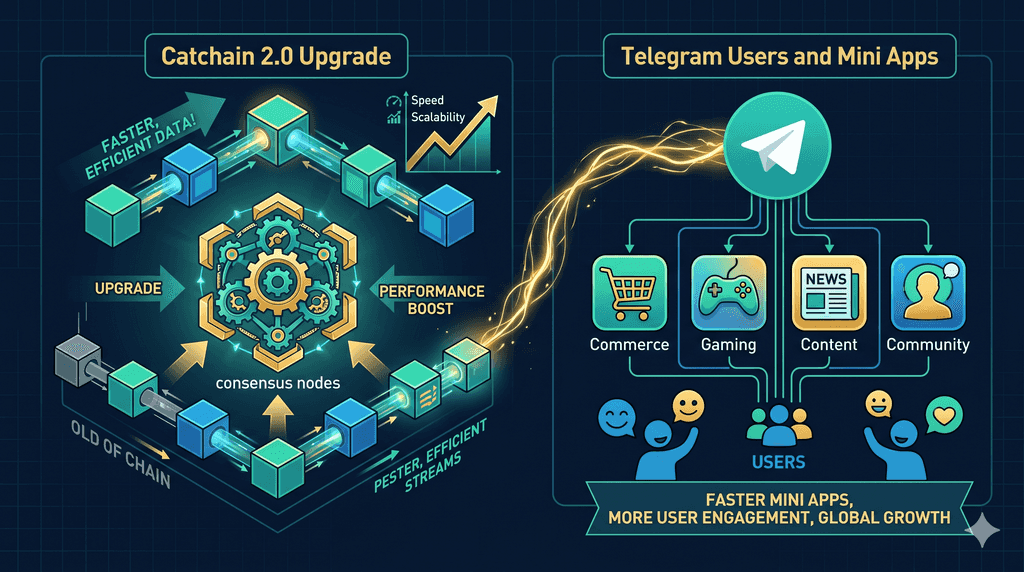
The blockchain landscape is witnessing a seismic shift as The Open Network (TON) officially activated its Catchain 2.0 upgrade on April 9, 2026. As of today, the TON ecosystem is operating at a scale previously reserved for traditional centralized servers. This upgrade isn't just a technical footnote; it is the cornerstone of Pavel Durov’s "Make TON Great Again" (MTONGA) initiative, aiming to fully merge the worlds of social messaging and decentralized finance.
For the over one billion Telegram users, the Catchain 2.0 activation marks the moment the "loading" spinner effectively disappears from their digital lives. By slashing block times to under 400 milliseconds and increasing throughput tenfold, TON has positioned itself as the fastest Layer-1 blockchain in existence. This comprehensive guide explores the deep-reaching implications of this upgrade for everyday users, the developer community, and the broader economic health of the Toncoin ($TON) token.
Key Takeaways
-
Instant Finality: Block creation times have dropped from 2.5 seconds to 400ms, enabling sub-second transaction confirmations.
-
Throughput Surge: The network is now 10x faster, handling complex DeFi and gaming interactions with zero lag.
-
Mini App Evolution: Telegram Mini Apps (TMAs) now support full-screen modes, home-screen shortcuts, and near-instant blockchain state sync via Streaming API v2.
-
Validator Economics: Base APR for stakers has spiked as rewards are issued 6x more frequently, though an inflation-control proposal is currently being voted on.
-
Future Roadmap: Catchain 2.0 is step one of seven; the next phase involves a 6x reduction in transaction fees.
The Technical Core of Catchain 2.0: Beyond the Hype
To understand why Catchain 2.0 is revolutionary, we must look at how consensus algorithms function. The original Catchain used a Byzantine Fault Tolerant (BFT) approach that was efficient but struggled with the massive burst in activity seen during the 2025 "Tap-to-Earn" craze. The 2.0 upgrade optimizes the communication protocol between validators, allowing them to agree on the next block in a fraction of the time.
Catchain 2.0 introduces a more streamlined messaging layer. In the previous version, validators spent a significant portion of the block time communicating to reach consensus. The new protocol allows more messages to be processed per unit of time, which essentially eliminates network congestion during peak activity. This results in a "heartbeat" for the blockchain that is now faster than a human blink.
This speed is not just for bragging rights. In the world of decentralized exchanges (DEXs) like STON.fi or DeDust, speed translates directly to better pricing. When a user swaps tokens, a 2.5-second delay can lead to price slippage. With 400ms block times, "instant swaps" are finally a reality, making the user experience indistinguishable from using a centralized exchange like Binance.
Impact on Telegram Mini Apps: A New Era for Developers
The biggest beneficiaries of the Catchain 2.0 upgrade are the developers and users of Telegram Mini Apps (TMAs). Until now, blockchain-based games within Telegram often felt "clunky" because every on-chain action required a multi-second wait. With the 2026 upgrade, the gap between a user's action and the on-chain confirmation has effectively collapsed.
Developers are encouraged to transition to the new Streaming API v2, which delivers four transaction statuses in sequence: pending, confirmed, finalized, and trace_invalidated. This allows an app to react to a user's payment or move in a game in as little as 30 to 100 milliseconds.
| Performance Metric | Pre-Catchain 2.0 (2025) | Post-Catchain 2.0 (April 2026) |
| Block Creation Time | ~2.5 Seconds | ~400 Milliseconds |
| Transaction Confirmation | 6–10 Seconds | < 1 Second |
| Network Throughput | Standard L1 Speed | 10x Faster |
| User Experience | Noticeable Latency | Near-Instant / Fluid |
| Annual Inflation Rate | 0.60% | 3.6% (Provisional) |
Furthermore, the simultaneous release of Mini Apps 2.0 features—such as device motion tracking, geolocation access, and home-screen shortcuts—means these apps no longer feel like simple bots. They feel like native iOS or Android applications, powered by a backend that never sleeps and cannot be censored.
Tokenomics and Validator Rewards: The Inflation Debate
Speed comes with significant economic consequences. Because the blockchain is now producing blocks six times faster, validators are earning rewards six times more frequently. This has caused an immediate spike in the Annual Percentage Rate (APR) for Toncoin stakers, which initially pushed the price of $TON up by 5% following the April 9 activation.
However, this increased reward frequency poses a long-term inflation risk. Under current parameters, the annual inflation rate of $TON is projected to climb from 0.6% to approximately 3.6%. To counteract this, the TON Foundation has already initiated a governance vote among validators that will conclude in June 2026.
The proposal aims to reduce the reward per block to maintain a stable supply. Specifically, masterchain rewards may drop from 1.7 TON to 0.35 TON per block. This "re-balancing" is designed to ensure that while the network stays fast, the value of Toncoin isn't diluted. For users, this means that while their staking APR might normalize this summer, the long-term scarcity and value of their $TON is being actively protected by the DAO.
Enhancing User Privacy and Social Integration
A core tenet of the 2026 TON roadmap is the deepening of privacy-centric features. Catchain 2.0 doesn't just speed up money; it speeds up data. Telegram's integration with TON Storage and TON Proxy is becoming more efficient, allowing users to share encrypted files and host decentralized websites with significantly lower latency.
For the average user, this means that "Secret Chats" and private transactions are now more robust. The upgrade allows for faster zero-knowledge proof (ZKP) verifications on-chain, which is the gold standard for privacy in 2026. As global regulations on data privacy tighten, Telegram’s ability to offer a decentralized, high-speed alternative becomes a massive competitive advantage against legacy social media platforms.
The integration of self-custodial vaults within the Telegram Wallet also benefits from this upgrade. Users can now move assets between their "Spending" and "Vault" accounts instantly. This makes the management of Bitcoin, USDT, and Toncoin as simple as sending a text message, removing the psychological barrier that has kept many "normies" away from crypto for years.
Real-World Adoption: The Rakuten Wallet Integration
The market response to Catchain 2.0 has been swift and institutional. On April 15, 2026, Rakuten Wallet, the crypto arm of the Japanese e-commerce giant, officially added Toncoin for spot trading. This move provides millions of Japanese retail investors with a regulated gateway to the TON ecosystem.
The Japanese market is known for its strict regulatory environment and high standards for technical reliability. Rakuten's decision to list $TON immediately following the Catchain 2.0 upgrade is a major vote of confidence in the network's stability. It signals that TON has moved past its "experimental" phase and is now viewed as a legitimate piece of global financial infrastructure.
This listing, combined with the technical upgrades, has helped $TON maintain a neutral-to-positive sentiment despite broader market volatility. Analysts suggest that as more global exchanges follow Rakuten’s lead, the liquidity and utility of the token will reach a tipping point, potentially decoupling it from the price action of Bitcoin.
The Roadmap Ahead: Seven Steps to MTONGA
Pavel Durov was clear that Catchain 2.0 is only the first of seven major steps scheduled for 2026. The community is now looking toward "Step 2," which focuses on fee optimization. While TON fees are already low (often just a few cents), the goal is to reduce them by an additional six times.
This would make micro-transactions—such as tipping a content creator $0.05 or buying a digital sticker for $0.10—economically viable for everyone. When transaction fees become negligible, the final barrier to entry for the "next billion users" disappears. Following fee reductions, the roadmap hints at "TON Teleport," a trustless bridge for Bitcoin and Ethereum that will operate at the same sub-second speeds enabled by Catchain 2.0.
By the end of 2026, the vision is to have Telegram act as the primary interface for the entire crypto world. Whether a user is holding Ethereum, Bitcoin, or stablecoins, the underlying TON infrastructure will allow them to swap, spend, and send those assets with the same speed and ease as sending a GIF in a chat.
Conclusion: A Turning Point for Web3 Adoption
The activation of Catchain 2.0 is more than just a software patch; it is the fulfillment of the original whitepaper's promise. By achieving sub-second finality, TON has solved the "scalability trilemma" in a way that is actually accessible to the general public through an app they already use daily.
For Telegram users, the blockchain has finally become invisible—operating in the background with the speed and reliability of the traditional web, but with the freedom and security of decentralization. As we move further into 2026, the "Make TON Great Again" initiative is setting a benchmark that other Layer-1 networks will struggle to match. Whether you are a gamer, a trader, or just someone sending money to a friend, the TON network is now faster, stronger, and more integrated than ever before.
FAQs
Q1: How does Catchain 2.0 affect my daily Telegram use?
Most changes happen in the background. You will notice that the "Wallet" bot and Mini Apps load faster, and when you send Toncoin or USDT to a friend, the "Transaction Confirmed" message will appear almost instantly rather than after a few seconds.
Q2: Is my Toncoin safe during this upgrade?
Yes. The upgrade was a consensus-layer change that was approved by over 85% of the network's validators. There is no need for users to move their funds or "claim" new tokens.
Q3: Why did the inflation rate go up?
Inflation is tied to block production. Since the network now produces blocks 6x faster, the total amount of new $TON being minted for validators increased. However, a proposal to lower the reward per block is currently being voted on to return inflation to its previous 0.6% level.
Q4: What is the Streaming API v2?
It is a new tool for developers that allows Mini Apps to receive "live" updates from the blockchain. This is what allows for real-time gaming and instant trading within the Telegram interface.
Q5: What should I expect in the next update?
According to the MTONGA roadmap, the next major update (Step 2) will focus on reducing transaction fees by approximately six times, making the network even cheaper to use for small payments.