

Standard Chartered Predicts ARB Could Hit $10 by 2030 : 70x Potential Explained
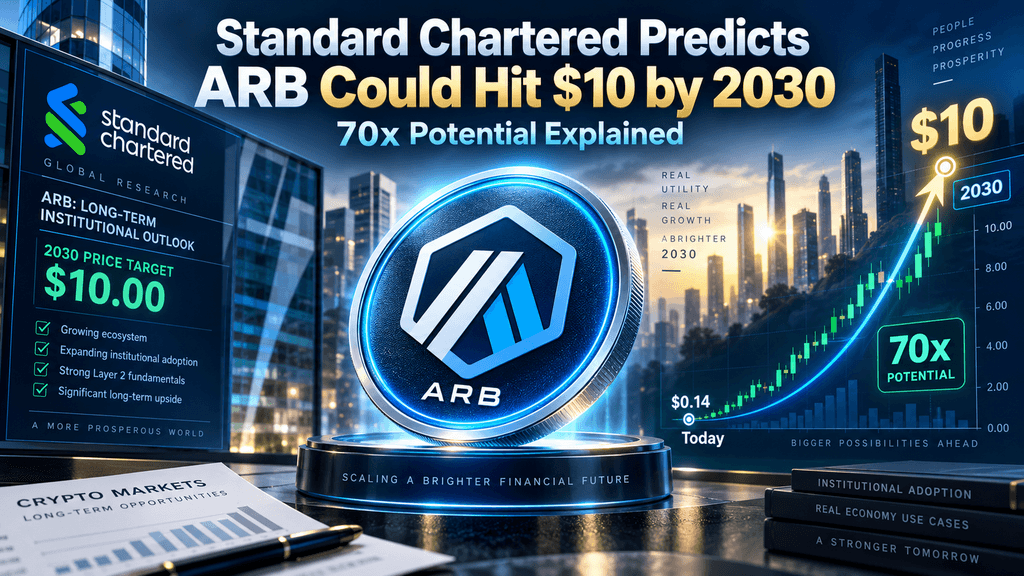
Standard Chartered has put Arbitrum (ARB) in the spotlight with a long-term price forecast that sees the token potentially reaching $10 by the end of 2030. When the projection was released in September 2026, ARB was trading near $0.13–$0.14, putting the bank's target at roughly 70 times the report-time price. The forecast comes as Arbitrum expands beyond its original role as an Ethereum Layer 2 scaling network, with Robinhood Chain, institutional blockchain infrastructure and real-world asset tokenization creating new potential sources of activity and revenue. However, reaching a $10 ARB price would require sustained adoption, stronger network economics and a clearer connection between Arbitrum's ecosystem growth and demand for the ARB token itself.
Standard Chartered ARB Price Prediction $10 by 2030
Standard Chartered has set a $10 price target for Arbitrum (ARB) by the end of 2030, making it one of the most bullish institutional forecasts for the Ethereum Layer 2 token. The bank initiated coverage of ARB in September 2026 and linked its long-term outlook to Arbitrum’s expanding role in blockchain infrastructure, institutional adoption and real-world asset tokenization. When the forecast was published, ARB was trading near $0.13–$0.14, meaning the $10 target represented roughly 70x upside from the report-time price. The size of that projected move makes the assumptions behind the forecast just as important as the headline target itself.
ARB Price Forecast From 2026 to 2030
Standard Chartered expects the ARB price prediction to unfold gradually rather than through a single explosive rally. Its forecast places ARB at $0.50 by the end of 2026, followed by $1.50 in 2027, $3.50 in 2028 and $6.50 in 2029 before reaching $10 in 2030. The projections suggest that the bank expects Arbitrum’s value to increase alongside broader adoption of its technology over several years. This staged outlook also gives the market intermediate levels that can be compared with Arbitrum’s actual adoption and ecosystem performance over time.
A $10 ARB price would also place the token well above its previous all-time high of around $2.39. With Arbitrum having a total supply of 10 billion ARB, a $10 price would imply a fully diluted valuation of roughly $100 billion if the total supply remains unchanged. That scale highlights how much network adoption, revenue growth and institutional demand would need to develop for the Arbitrum price prediction for 2030 to become achievable. Reaching such a valuation would likely require Arbitrum to establish a much larger economic footprint across crypto-native applications and institutional blockchain markets.
Why Standard Chartered Is Bullish on Arbitrum
The bank’s bullish outlook is closely tied to Arbitrum’s potential to become more than an Ethereum scaling network. Arbitrum technology can also be used by companies to launch dedicated blockchain networks, creating another source of activity and revenue for the ecosystem. Robinhood Chain, which is built using Arbitrum technology, has become an important early example of this model and is one of the main factors supporting Standard Chartered’s long-term ARB forecast. If this approach attracts other large organizations, Arbitrum could gain exposure to activity occurring outside its traditional Layer 2 environment.
Tokenization is another major part of the thesis. Standard Chartered expects tokenized financial assets to expand significantly over the coming years as banks, fintech companies and other institutions move more traditional assets on-chain. If Arbitrum captures a meaningful share of this activity through its own network and chains built with its technology, the ecosystem could generate considerably more usage and revenue. However, reaching the $10 ARB target by 2030 will still depend on sustained adoption and a stronger link between Arbitrum’s economic growth and the value of the ARB token itself. The pace at which financial institutions adopt blockchain infrastructure could therefore become one of the most important factors shaping the long-term ARB outlook.
Robinhood Chain and Tokenization Drive Arbitrum Growth
Arbitrum’s long-term growth story is increasingly tied to how its technology is used beyond its main Layer 2 network. Robinhood Chain is one of the clearest examples of that expansion, showing how companies can build dedicated blockchain infrastructure with Arbitrum technology while contributing revenue back to the wider ecosystem. At the same time, rising demand for tokenized real-world assets could create another source of activity as financial institutions move stocks, funds, stablecoins and other assets on-chain. Together, these trends could diversify Arbitrum’s economic base and make its infrastructure relevant to a wider group of users and businesses. Robinhood officially launched the chain's public mainnet on July 1, 2026.
Robinhood Chain Expands Arbitrum’s Revenue Model
Robinhood Chain launched its public mainnet in July 2026 using Arbitrum technology, creating a blockchain designed around financial applications and tokenized assets. Through the Arbitrum Expansion Program, eligible chains operating outside Arbitrum One and Nova return 10% of their net protocol revenue to the Arbitrum ecosystem. For Robinhood Chain, 8% is allocated to the ArbitrumDAO treasury and 2% to the Arbitrum Developer Guild, giving Arbitrum a revenue stream that does not depend solely on activity on its own Layer 2. This structure gives Arbitrum an opportunity to benefit economically when external networks built with its technology attract users and generate fees.
Early figures show why this model has attracted attention. Robinhood Chain contributed about $360,000 in licensing fees in July, accounting for roughly 35% of ArbitrumDAO income that month. Activity accelerated further after launch, with higher trading volumes, stablecoin liquidity and decentralized application usage strengthening the network’s early economics. If more financial companies eventually launch chains using similar infrastructure, Arbitrum could develop a broader blockchain-as-infrastructure revenue model rather than relying only on transaction fees from Arbitrum One. That could create a more diversified source of income while giving the ecosystem greater exposure to institutional blockchain adoption.
Real-World Asset Tokenization Creates a Larger Opportunity
The growth of real-world asset tokenization could make that infrastructure model more valuable over time. Traditional financial assets such as equities, bonds, funds and private-market products are increasingly being represented on blockchain networks, creating demand for systems capable of handling large transaction volumes while remaining compatible with Ethereum. Standard Chartered expects the broader tokenized-asset market to expand significantly through 2028, making institutional blockchain infrastructure an important part of its long-term Arbitrum thesis. The opportunity could become especially important if tokenized markets move beyond pilot projects and begin attracting sustained institutional capital.
Arbitrum already has a growing presence in this market. Its ecosystem hosts thousands of RWA deployments alongside billions of dollars in stablecoin liquidity, while Robinhood Chain provides another route for bringing traditional financial products on-chain. The key opportunity is not simply higher transaction activity, but whether Arbitrum can become infrastructure used by multiple institutions and financial platforms. Sustained adoption across tokenized finance would give the ecosystem more diversified usage and revenue, strengthening the fundamental growth case behind ARB over the longer term. The durability of that activity will matter more than short-lived increases in volume when evaluating Arbitrum’s position in tokenized finance.
ARB at $10 Market Cap Valuation and Tokenomics
A $10 ARB price would represent much more than a major move on the price chart. It would place Arbitrum among the largest crypto networks by valuation and raise an important question about whether the ecosystem can generate enough economic value to support that scale. Looking at the Arbitrum market cap, ARB supply and tokenomics helps put Standard Chartered’s 2030 target into context and separates headline price potential from the fundamentals required to sustain a much larger valuation.
What a $10 ARB Price Would Mean for Market Cap
Arbitrum has a total supply of around 10 billion ARB, so a $10 token price would imply a fully diluted valuation of approximately $100 billion. Using the current circulating supply of roughly 6.68 billion ARB as a simple reference, the corresponding market capitalization would be about $66.8 billion, although circulating supply is expected to change before 2030. This makes the relationship between ARB price and market cap particularly important when evaluating long-term forecasts. Supporting a valuation at that level would likely require stronger network economics, deeper liquidity, sustained institutional activity and continued demand for ARB rather than price growth driven mainly by speculation.
ARB Tokenomics and Value Accrual Remain Critical
ARB is primarily a governance token, giving holders voting power over decisions involving the ArbitrumDAO, treasury spending and ecosystem development, but holders do not currently receive an automatic share of transaction fees or licensing revenue. That makes value accrual one of the biggest questions surrounding the long-term ARB price outlook. By August 2026, about 9.23 billion ARB, or 92.3% of total supply, had either been unlocked or allocated to the ArbitrumDAO treasury, while the actual circulating supply remained lower, and the original vesting schedule is expected to finish in 2027. As unlock pressure declines, investor attention may increasingly shift toward whether governance, treasury policy and future token mechanisms can create stronger and more sustainable demand for ARB as the ecosystem grows.
Arbitrum 70x Potential Growth Drivers and Key Risks
The idea that ARB could deliver roughly 70x growth from Standard Chartered’s report-time price depends on much more than a broader crypto bull market. Arbitrum would need to expand its economic role, attract sustained institutional and developer activity, and create stronger demand for the ARB token itself. Several catalysts could support that path, but the scale of the $10 target also leaves significant execution, competition and token-demand risks. Tracking how these drivers develop may provide a more useful measure of progress than focusing only on short-term ARB price movements.
Institutional Adoption Could Expand Beyond Early Partners
One of the strongest long-term opportunities is Arbitrum’s ability to provide blockchain infrastructure for companies that want their own customized networks without building the underlying technology from scratch. Financial institutions, fintech platforms and asset issuers may increasingly seek Ethereum-compatible systems for payments, trading and tokenized products. If Arbitrum can attract several large institutional deployments over the coming years, it could diversify ecosystem activity and reduce its dependence on conventional Layer 2 transaction demand. For the ARB price outlook through 2030, the number and quality of organizations choosing Arbitrum technology may therefore become more important than short-term transaction spikes. Repeat adoption by established financial companies would also help show whether Robinhood Chain represents the start of a broader trend rather than an isolated partnership.
Developer and Application Growth Could Strengthen Network Effects
A larger developer ecosystem could also support Arbitrum’s long-term growth potential. More applications can create additional demand for blockspace, liquidity and stablecoins while encouraging users to remain within the wider Arbitrum ecosystem. The network already supports decentralized exchanges, lending platforms, gaming projects and financial applications, but maintaining developer interest will require reliable infrastructure, competitive transaction costs and continued technical improvements. Stronger network effects would make Arbitrum harder to replace and could improve its position as Ethereum scaling competition becomes more intense. Developer retention and successful applications may ultimately prove just as important as the number of new projects launching on the network.
ARB Needs a Clearer Link Between Ecosystem Growth and Token Demand
The largest fundamental challenge is still ARB value accrual. Arbitrum can process more transactions, generate more treasury revenue and attract additional institutions without automatically creating proportional buying pressure for ARB. Because the token is mainly used for governance, investors will be watching whether future DAO decisions, treasury strategies or other mechanisms create a stronger economic relationship between ecosystem success and ARB demand. Without that connection, Arbitrum could continue growing as a network while the token captures only part of the value created, making the 70x ARB potential harder to justify on fundamentals alone. Clearer token utility could therefore become an increasingly important part of the investment case as the ecosystem matures.
Competition and Slower Tokenization Could Limit the 2030 Upside
Arbitrum is also operating in an increasingly crowded market. Other Ethereum Layer 2 networks and alternative blockchains are competing for developers, institutional partnerships, liquidity and real-world asset issuance, so future growth cannot be assumed to flow toward one ecosystem. The tokenization market itself could also expand more slowly than expected if regulation, infrastructure or institutional adoption delays major deployments. Combined with changing crypto market conditions and future supply entering circulation, these factors could put pressure on the Arbitrum price prediction for 2030 even if the underlying network continues to grow. Arbitrum will therefore need to maintain technological relevance and attract meaningful economic activity as the broader blockchain infrastructure market develops.
The path toward a $10 ARB price therefore depends on whether Arbitrum can convert technological adoption into sustainable economic activity and, eventually, stronger demand for its token. Institutional expansion, developer growth and tokenized finance provide meaningful upside drivers, while value-accrual uncertainty and blockchain competition remain the main issues to watch as the 2030 forecast develops. Progress across these areas would provide stronger evidence for the long-term thesis than price performance alone. Conversely, weaker adoption or limited ARB utility could make the $10 target increasingly difficult to support.
Where to Trade Arbitrum ARB on KuCoin
Traders looking to access Arbitrum (ARB) can use KuCoin for both spot and futures trading. ARB is available through the ARB/USDT spot pair, while eligible users can also access an ARB/USDT perpetual futures contract. KuCoin also provides live ARB price and market data for tracking short-term moves and broader trends. The ARB/USDT spot trading page is currently live, and KuCoin's ARB market listings also show an ARBUSDT perpetual market.
-
ARB/USDT Spot — Buy or sell ARB directly against USDT and hold the tokens after the trade is completed.
-
ARB Perpetual Futures — Eligible traders can take long or short positions using ARBUSDT perpetual futures, with leverage and liquidation risk.
-
Track ARB Market Data — KuCoin provides ARB price, trading volume, supply data and recent market performance to help users follow the token before trading.
Conclusion
Standard Chartered’s $10 ARB price prediction for 2030 has brought renewed attention to Arbitrum as its economic model expands beyond traditional Ethereum Layer 2 activity into Robinhood Chain, institutional blockchain infrastructure and tokenized financial assets. If more organizations adopt Arbitrum technology, the ecosystem could gain new revenue streams and strengthen its position within Ethereum’s scaling landscape, but moving from roughly $0.13–$0.14 at the time of the forecast to $10 would still require an extraordinary increase in valuation. Network adoption, developer activity, institutional demand, tokenization growth and ARB value accrual would all need to develop substantially, making Standard Chartered’s 70x projection an ambitious long-term scenario rather than a guaranteed price path. Revenue growth, supply dynamics, ARB utility and the strength of real ecosystem adoption will therefore remain important indicators for assessing whether the $10 ARB target becomes more plausible through 2030.
🔥 Beyond the Headlines: What KuCoin 5.0 Means for You
Market news moves fast — but where you act on it matters just as much. This October, KuCoin launches KuCoin 5.0, transforming KuCoin into a rebuilt platform. Here's what actually changes for you:
-
One account for everything. Older platforms split your money across separate "spot," "margin," and "futures" accounts and expected you to understand why. KuCoin 5.0's unified account removes that entirely — deposit once, and everything is simply there.
-
Stocks, indices, and commodities. KuCoin 5.0 expands beyond crypto into global markets. When crypto chops sideways and equities rally (or the reverse), you rotate in minutes instead of opening a brokerage account and waiting days for fiat rails.
-
Real-world assets (RWA). Tokenized exposure to traditional assets like commodities, right inside your crypto account. One of the fastest-growing segments in global finance is no longer reserved for institutions — you access it from the same balance you trade with.
-
Earn while you learn. Not ready to trade? KCUSD lets your stablecoins earn daily, auto-compounding interest. The lowest-stress way to put your idle deposit to work for 4% yield.
-
An AI assistant in plain language. Ask questions, get market context, understand what you're looking at — built into the platform, no jargon required.
-
An app that doesn't overwhelm. Faster, cleaner, and consistent — intuitive from the first tap, not after a tutorial.
-
Safety you can check, not just trust. A MiCAR-licensed EU entity, Proof of Reserves you can verify yourself, and internationally certified security (SOC 2 Type II, ISO 27001:2022).
Create your account in minutes — and start on the platform built for where crypto is going, not where it's been.
FAQs
What does Standard Chartered’s 70x ARB forecast actually mean?
The 70x figure compares Standard Chartered’s $10 ARB target for 2030 with the token’s price of roughly $0.13–$0.14 when the forecast was published in September 2026. It should not be treated as a fixed return from today’s price because ARB continues to trade up and down. As the market price changes, the potential multiple to $10 changes as well. This is why the 70x figure is best understood as the upside calculated from the price level used when the forecast was released.
Is Standard Chartered’s $10 ARB target guaranteed?
No. The $10 ARB price prediction is an institutional forecast based on assumptions about adoption, tokenization, network economics and future demand. Crypto markets can change significantly over a four-year period, and forecasts can be revised as new data emerges. The target is better viewed as one possible long-term scenario rather than a guaranteed outcome. Investors can compare future network and token data with the assumptions behind the forecast to judge whether the thesis remains on track.
How fast would ARB need to grow to reach $10 by 2030?
Starting from around $0.13–$0.14 in September 2026, ARB would need to rise by roughly 70 times to reach $10. Spread across the period to the end of 2030, that would require an exceptionally high compound annual growth rate of roughly 170%–175%, depending on the exact starting price and timing. That illustrates how aggressive the forecast is compared with a normal long-term asset growth rate. Such a trajectory would likely involve periods of substantial volatility rather than a smooth increase each year.
Could ARB reach $10 without returning to its old all-time high first?
Technically, yes, but a move toward $10 would naturally require ARB to pass its previous all-time high of around $2.39 along the way. Breaking and holding above an earlier peak can be an important market milestone because it shows demand is strong enough to absorb sellers at historically high price levels. However, moving beyond an old high does not by itself confirm that a much larger target will be reached. Network fundamentals and broader crypto-market conditions would still play an important role after any new price record.
Does ARB have a maximum supply?
ARB was launched with a 10 billion token initial supply, but investors should distinguish between total supply, circulating supply and tokens controlled by the DAO treasury. These figures can affect valuation differently. When assessing an ARB price prediction, market capitalization is often more useful than looking at the token price alone because it reflects how much supply is actually being valued by the market. Changes in circulating supply can therefore affect ARB’s market capitalization even when the token price remains unchanged.
What is ARB mainly used for today?
ARB is primarily a governance token for the Arbitrum ecosystem. Holders can participate in decisions involving protocol governance, treasury allocations, ecosystem funding and other DAO proposals. ARB is therefore different from tokens that automatically pay staking income, dividends or a direct share of protocol fees to every holder. Its long-term value proposition may evolve if governance introduces additional utility or economic mechanisms in the future.
Disclaimer: This article is for informational purposes only and does not constitute investment advice. Crypto assets can be highly volatile, and market conditions, token liquidity and project developments may change rapidly. Readers should conduct their own research and assess their risk tolerance before making financial decisions.