

Stable Whitepaper Update: 82% of STABLE Supply Enters Universal Lock With Unlocks Through 2029
2026/08/22 11:12:00
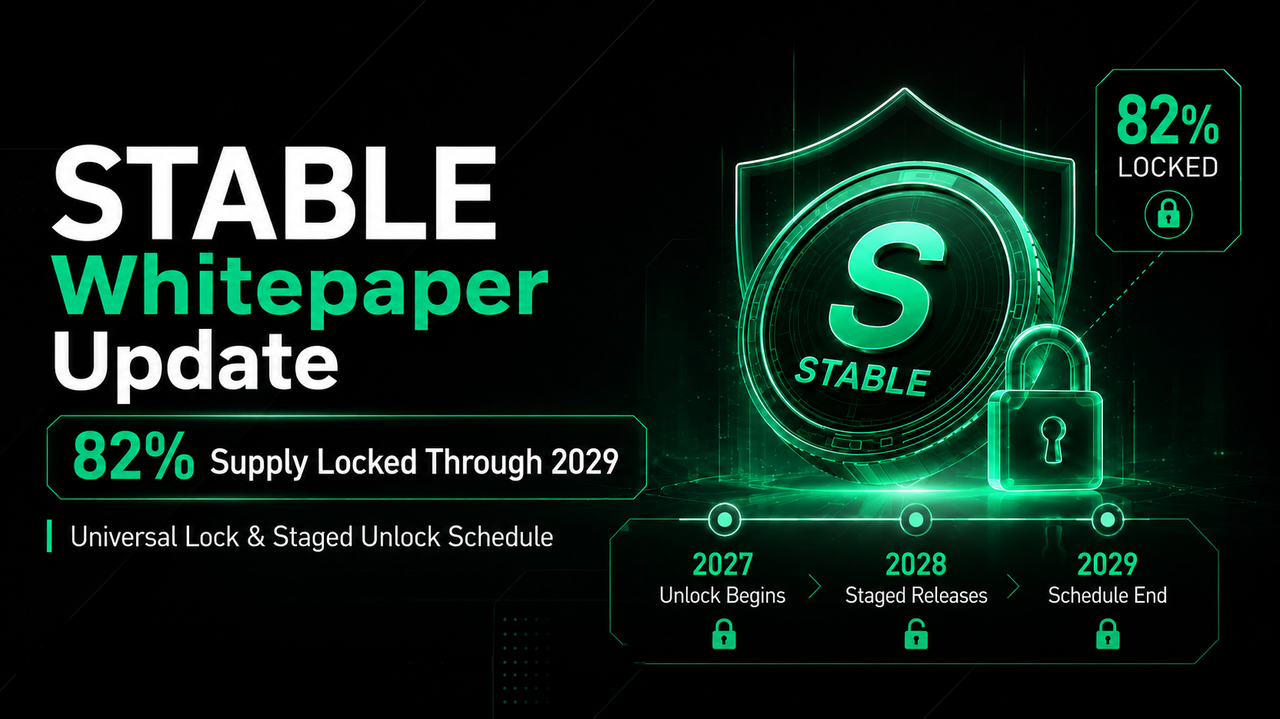
Stable’s revised whitepaper introduces a major change to STABLE tokenomics, placing 82% of the token supply under a Universal Lock and establishing a staged release framework extending through 2029. The update is significant because token unlocks can influence circulating supply, liquidity and investor expectations, particularly when large team, investor and ecosystem allocations are involved. Rather than relying on a single cliff unlock, Stable’s new framework spreads releases across several phases and includes additional conditions that can delay when certain tokens begin vesting. With a fixed maximum supply of 100 billion STABLE, the scale and timing of future releases will remain an important factor for investors assessing the token’s long-term supply outlook. The revised structure combines a large locked allocation with daily linear vesting, a $0.025 VWAP-based delay mechanism and progressively larger release stages toward 2029. Understanding how these rules work is therefore essential for separating scheduled token availability from actual selling pressure and evaluating how Stable’s tokenomics could evolve as its ecosystem develops.
How Stable’s New Universal Lock Changes STABLE Tokenomics
Stable’s revised tokenomics reshape how most of the 100 billion STABLE supply is expected to reach circulation over the next several years. Instead of maintaining several separate vesting arrangements, the updated framework brings 82 billion tokens under a single Universal Lock. For investors, the important change is not simply that a large share of supply is restricted, but that future releases become more structured, easier to track and subject to specific conditions.
-
Why 82% of the STABLE Supply Is Moving Into One Universal Lock
Under the revised structure, 82 billion STABLE, equal to 82% of total supply, is grouped into one long-term locking framework. The pool combines major allocations that previously followed different vesting rules, including 25 billion tokens assigned to the team, 25 billion allocated to investors and advisers, and about 32 billion from the locked ecosystem and Foundation allocation. Bringing these balances together gives the market a clearer view of when a large portion of STABLE may eventually become liquid instead of requiring investors to follow several independent vesting schedules.
The structure also changes how supply risk should be evaluated. A high locked percentage can restrict near-term token availability, but it does not remove future dilution. What matters is how those tokens are released once restrictions begin to expire. Several features make the Universal Lock different from a conventional cliff unlock:
-
The locked supply is divided into multiple release stages extending through 2029, rather than becoming available on one date.
-
Most scheduled tranches are designed to vest gradually after their release period begins, reducing reliance on a single large unlock event.
-
Certain unlocks can be postponed when specified market-price conditions are not met, adding a conditional element to the vesting framework.
This gives investors more visibility into future supply changes while still leaving the eventual market impact dependent on demand, liquidity and holder behaviour.
-
How the Universal Lock Changes STABLE’s Circulating Supply Outlook
The new framework makes the distinction between total supply and circulating supply especially important. STABLE retains a fixed maximum supply of 100 billion tokens, but only part of that supply will be freely available while the Universal Lock remains in effect. Under the revised structure, roughly 18 billion tokens are expected to remain outside the locked pool at the stated effective point, while the other 82 billion follow the staged release system. That does not mean every token released from the lock will immediately enter exchanges or create selling pressure. Tokens can remain held, be used for staking or participate elsewhere in the Stable ecosystem after becoming transferable.
Current supply figures also require context. Recent official circulating-supply data has shown more than 25 billion STABLE in circulation, which is higher than the 18 billion figure associated with the revised Universal Lock structure. Investors comparing those figures can also follow STABLE live price and market data alongside supply changes to see how liquidity and valuation evolve as the new framework is implemented. The difference appears connected to the planned treatment of certain Foundation-related tokens that became available under the earlier vesting model and are expected to be relocked under the new framework. Investors should therefore avoid comparing the two figures as though they represent the same point in time. Watching official circulating-supply updates and on-chain implementation will be important for understanding how the transition actually affects available STABLE supply.
-
Why Relocking Tokens Could Matter for STABLE Investors
Relocking previously available tokens makes the tokenomics update more significant than a simple adjustment to future vesting dates. If eligible Foundation-related balances are returned to the Universal Lock, a larger share of STABLE would remain restricted for longer and enter the market according to the new staged schedule. That could improve visibility around future dilution, although it does not guarantee stronger prices or eliminate supply pressure once unlocks begin.
For investors following STABLE tokenomics, several factors will matter more than the headline 82% lock figure:
-
Actual circulating supply: Changes in official supply data can show whether the relocking process is being reflected in practice.
-
Token utility after unlocks: STABLE used for staking, validator participation or governance may behave differently from tokens moved directly into liquid markets.
-
Holder behaviour: Unlocking makes tokens transferable, but it does not automatically mean recipients will sell them.
-
Network demand: Growth in Stable’s ecosystem could influence how effectively additional supply is absorbed as more tokens become available.
The Universal Lock therefore gives the market a clearer framework for evaluating STABLE’s long-term supply rather than removing dilution risk altogether. The next key issue is the STABLE token unlock schedule from 2027 to 2029, which determines how quickly the 82 billion-token pool can begin moving back into circulation.
How the STABLE Unlock Schedule Will Work From 2027 to 2029
The STABLE token unlock schedule is designed as a multi-stage release process rather than a series of one-day token drops. Beginning in December 2027, different portions of the locked pool are scheduled to enter their respective vesting periods at three-month intervals, with later stages becoming progressively larger. The structure continues through 2029 and includes both gradual daily releases and a price-based mechanism that can postpone individual stages.
-
STABLE Unlocks Begin in December 2027 and Increase Through 2029
The first scheduled STABLE release begins on December 8, 2027, when 5% of the locked pool, equivalent to 4.1 billion tokens, enters its vesting period. A second 5% stage follows on March 8, 2028, before the allocation rises to 10% on June 8 and 15% on both September 8 and December 8, 2028. The schedule becomes heavier in 2029, with 20% of the pool, or 16.4 billion STABLE, assigned to the March 8 stage and the final 30%, equal to 24.6 billion STABLE, scheduled from June 8. This back-loaded design means the largest portions are positioned toward the later part of the timetable rather than at the beginning, making 2029 particularly important for investors tracking future token availability.
-
Each Unlock Stage Uses Daily Linear Vesting Instead of an Immediate Release
The dates in the STABLE vesting schedule should not be interpreted as moments when billions of tokens suddenly become transferable at once. Floors one through six are scheduled to release their respective allocations linearly on a daily basis over 180 days, while the seventh and final stage runs for 183 days through December 8, 2029. Because a new stage can begin before the previous 180-day vesting period has finished, several release streams may operate at the same time. This overlapping structure means the rate at which STABLE becomes available can change throughout the schedule, making the daily vesting pace more useful for assessing potential supply growth than simply looking at each headline unlock date.
-
The $0.025 VWAP Rule Can Postpone a Scheduled STABLE Unlock
A distinctive feature of the revised STABLE unlock mechanism is a market-condition test tied to a $0.025 threshold. Before a scheduled stage begins, the framework evaluates STABLE's 30-day volume-weighted average price (VWAP) across eligible spot markets. If that average is below $0.025 on the relevant assessment date, the upcoming stage can be postponed by three months rather than starting as originally planned. Additional delays may occur if the condition remains unmet, with cumulative postponements capped at nine months. The rule acts as a delay mechanism rather than a guaranteed token price floor: it can change when restricted tokens start vesting, but it does not guarantee that STABLE will trade at or above $0.025.
-
December 2029 Sets the Final Boundary for the STABLE Vesting Schedule
The conditional delay mechanism does not extend indefinitely. Under the updated schedule, December 8, 2029 serves as the final boundary for the Universal Lock framework, meaning outstanding restrictions cannot simply continue being postponed because the VWAP test remains unmet. Any portion still affected by previous deferrals is expected to be handled within the framework's maximum lock period as the schedule reaches its endpoint. This final cutoff is important when modelling the STABLE supply outlook because the actual timing of individual stages could differ from the original calendar if price-based delays occur, while the broader release programme is still designed to conclude by the end of 2029.
What the 82% Token Lock Could Mean for STABLE Supply and Selling Pressure
The size of the 82% STABLE token lock makes future supply conditions an important part of the token’s market outlook, but the headline percentage alone does not determine what happens to price or liquidity. A large restricted balance can reduce the amount of supply immediately competing for buyers, while later releases can change that balance over time. The eventual effect will depend on market depth, demand for STABLE, recipient behaviour and how much newly available supply actually reaches secondary markets.
Why Future STABLE Selling Pressure Will Depend on Market Liquidity
Selling pressure is better measured against available market liquidity than against the nominal size of an unlock. Even a relatively small amount of newly released STABLE could have a noticeable effect if trading depth is limited, while a larger release may be absorbed more easily if volumes, market participation and demand have expanded by that point. Investors can compare these conditions with broader crypto market data as the larger release phases approach in 2028 and 2029. Investors may also pay closer attention to the gap between STABLE’s market capitalization and fully diluted valuation (FDV), since a large amount of supply that is not yet freely circulating can create a substantial difference between the token’s current valuation and its valuation assuming the full supply were available.
The identity and behaviour of token recipients will matter as well. Team members, early investors and ecosystem participants do not necessarily make the same decisions once their tokens become transferable. Some may continue holding, use STABLE within the network or maintain long-term exposure, while others could reduce their positions. This is why an increase in available supply should be viewed as potential selling capacity rather than automatic selling pressure. The market response could also vary from one release period to another depending on broader crypto conditions, network activity and investor sentiment at the time.
What Investors Can Watch as More STABLE Becomes Available
Rather than relying only on headline unlock percentages, investors can follow several indicators that may provide a clearer picture of whether additional STABLE supply is actually reaching the market:
-
Exchange inflows: Large increases in STABLE transferred to trading venues around release periods could indicate greater near-term liquidity available for selling.
-
Large-holder balances: Changes in wallets associated with major recipients can help show whether newly available tokens are being retained or redistributed.
-
Trading depth and volume: Stronger liquidity may make it easier for the market to absorb additional supply without the same level of price disruption.
-
Market cap versus FDV: A narrowing gap over time can show how much of the previously restricted supply has already been incorporated into the liquid market.
-
Network activity and token demand: Growth in validator participation, governance use and broader Stable ecosystem activity could influence demand as the available token base expands.
These indicators can provide more useful context than assuming every scheduled release will produce the same market reaction. Token unlocks create the possibility of additional supply, not a predetermined price outcome. For STABLE, the key question through 2029 will be whether demand and liquidity develop quickly enough to absorb the portions of supply that gradually become available without creating persistent pressure on the market.
Conclusion
Stable’s Universal Lock represents a substantial restructuring of the STABLE token unlocking and vesting framework, with 82% of the fixed supply placed on a multi-year path toward potential circulation. The system stands out because it combines staggered starting dates, daily linear vesting and a $0.025 VWAP-based delay rule instead of relying on a single large cliff release. That structure may make future supply changes easier to anticipate, although it does not remove dilution or market-liquidity risks. For investors, the most useful approach will be to look beyond the headline 82% lock figure. Circulating supply, exchange inflows, liquidity, holder behaviour, network usage and the implementation of each unlock stage will ultimately determine how additional STABLE affects the market. With the largest scheduled allocations concentrated toward 2029, the relationship between ecosystem demand and expanding token availability is likely to remain an important part of the long-term STABLE tokenomics discussion.
FAQs
What is the STABLE Universal Lock?
The STABLE Universal Lock is a unified token-restriction framework introduced in Stable’s updated tokenomics. Instead of managing several major allocations under separate vesting arrangements, the system places a large portion of the supply under common release rules. For investors, its main purpose is to make future token availability more structured and easier to assess over a multi-year period.
Is STABLE a stablecoin?
No. Despite its name, STABLE is not designed to maintain a fixed $1 value. It is the native token associated with the Stable network and is used for functions such as governance, staking and network participation. Stable’s blockchain is focused on stablecoin payments, but assets such as USDT are separate from the STABLE token itself.
Does an STABLE token unlock automatically increase circulating supply?
Not necessarily. An unlock removes restrictions that previously prevented tokens from being transferred, but unlocked tokens do not have to enter active circulation immediately. Recipients may continue holding them, stake them, delegate them or use them elsewhere in the ecosystem. Circulating-supply figures therefore need to be monitored separately from the amount technically eligible for release.
What is the difference between STABLE circulating supply and fully diluted supply?
Circulating supply measures tokens considered available in the market, while fully diluted supply assumes the entire maximum token supply is included. Because STABLE has a substantial amount of restricted supply, its market capitalization can differ considerably from its fully diluted valuation. That gap can help investors understand how much potential supply has yet to become economically available.
How can investors verify whether STABLE tokens have actually been unlocked?
Investors can compare official circulating-supply disclosures, blockchain wallet movements and project documentation around scheduled release periods. On-chain data can be particularly useful for confirming whether restricted balances have moved and where they were transferred. However, a wallet transfer alone does not prove that tokens were sold, so exchange inflows and subsequent transactions should be interpreted separately.
KuCoin Offers A More Stable Option in A Volatile Market
If you worry about the frequent ups and downs in the market, and pursue a more stable option to earn money passively, KuCoin is the right place to come:
Simple Earn: Deposit and withdraw tokens anytime, earning stable returns.
Kucoin Earn: Earn stable profits with professional asset management.
Hold to Earn: Earn rewards by holding assets in Funding, Trading, Margin, Futures, Mining, and Unified Accounts.
Staking: Unlock the earning potential of on-chain assets.
Advanced Investments: Advanced Investments offer a variety of structured products to help your money grow in any market.
Shark Fin: Principal Protection and Guaranteed Gains
Dual Investment: Buy low and sell high with transparent return calculations.
Snowball: High yields, with price protection.
Discount Buy: Buy crypto at discount prices.
KCS Loyalty: Level up to enjoy exclusive perks by staking ≥ 1 KCS.
KuCoin Wealth: Discover future value and begin your smart investing journey.
KCS Benefits: Hold and stake KCS to access benefits across the platform.
KCS Staking 2.0: Participate in KCS on-chain governance to earn yield.
Disclaimer
The information provided on this page may originate from third-party sources and does not necessarily represent the views or opinions of KuCoin. This content is intended solely for general informational purposes and should not be considered financial, investment, or professional advice. KuCoin does not guarantee the accuracy, completeness, or reliability of the information, and is not responsible for any errors, omissions, or outcomes resulting from its use. Investing in digital assets carries inherent risks. Please carefully evaluate your risk tolerance and financial situation before making any investment decisions. For further details, please consult KuCoin’s Terms of Use and Risk Disclosure.