

SpaceX Surpasses TSMC to Become 8th Largest Global Asset, Bitcoin Hits 16th
2026/06/18 19:00:00
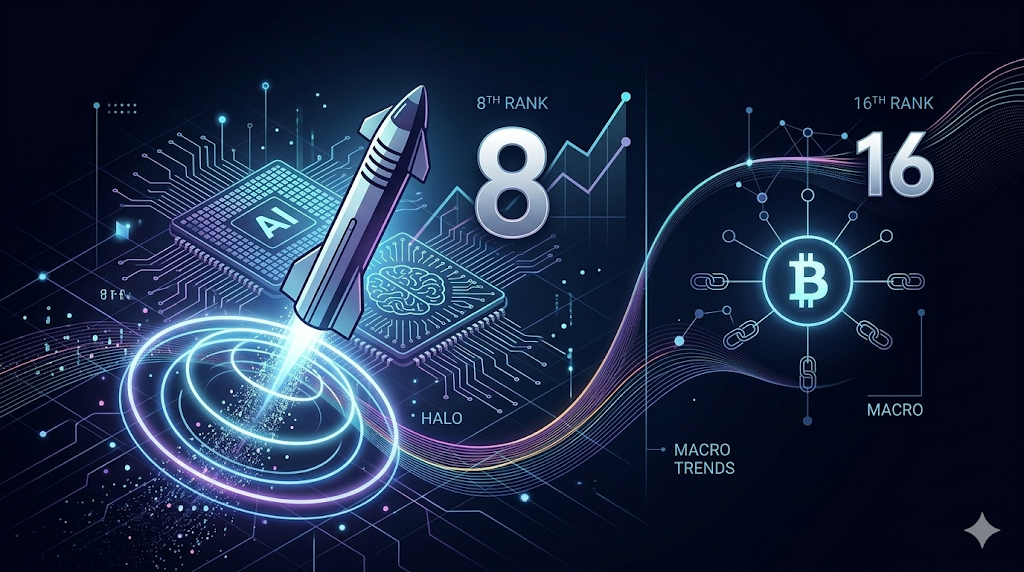
Did you know that an aerospace company recently surpassed the world's leading semiconductor manufacturer in market value? Following its initial public offering in mid-June 2026, SpaceX reached a valuation of $2.32 trillion, overtaking TSMC to rank among the top ten largest global assets. Concurrently, Bitcoin maintained a $1.34 trillion market capitalization, holding the 16th position worldwide. These capital shifts reflect a growing market premium for vertically integrated infrastructure and decentralized digital assets over traditional hardware manufacturing ecosystems.
The 2026 Shifts in Global Asset Rankings
The global financial landscape experienced notable movements in June 2026 as aerospace and space-based computing sectors attracted substantial institutional interest. SpaceX absorbed significant capital post-listing, temporarily rearranging the rankings of top global assets. Concurrently, some traditional hardware providers, such as TSMC, saw their market-cap premiums narrow relative to newly public platforms scaling integrated AI and physical network infrastructure.
SpaceX Enters the Top Ten
SpaceX advanced in global asset rankings after its market capitalization breached $2.32 trillion during its initial trading sessions. Following its Nasdaq debut under the ticker SPCX, the company closely trailed Amazon's $2.65 trillion valuation based on mid-June 2026 data from global tracking platforms. Institutional inflows reflect investor interest in the company’s combined launch logistics, Starlink satellite network, and space-based compute initiatives.
TSMC and Evolving Hardware Valuations
As SpaceX climbed the rankings, TSMC ranked behind it, with its market value hovering slightly below the $1.9 trillion mark. Despite maintaining high operational profitability, the semiconductor foundry faced a temporary valuation compression. Market analysts attribute this to a selective rotation of capital toward integrated tech ecosystems that combine proprietary hardware with software layers, tempering the pure-play hardware manufacturing premium seen in prior years.
Bitcoin Sustains Market Cap Near $1.34 Trillion
Bitcoin held its position within the top 20 global assets, maintaining a total market capitalization of approximately $1.34 trillion. A recent 4.47 percent daily increase highlighted its relative resilience during a period of broader macroeconomic volatility. This valuation underscores Bitcoin's sustained role in institutional asset allocation, continuing to compete alongside sovereign currencies and large multinational corporations for global liquidity.
Drivers Behind the SpaceX Valuation
SpaceX achieved its multi-trillion-dollar valuation following the completion of the largest initial public offering in history. The company raised $75 billion at an initial offering price of $135 per share, indicating strong institutional demand. This capital influx is designated to support the expansion of its space-based internet infrastructure and artificial intelligence computing capabilities.
Record-Breaking IPO Capitalization
The June 2026 SpaceX IPO secured a record-setting $75 billion, bringing the company’s debut valuation to approximately $1.77 trillion based on its final pricing. First-day trading saw the stock close nearly 20 percent higher, driving its market capitalization past the $2.1 trillion threshold during early sessions. Underwriters noted significant investor demand throughout the initial book-building phase, providing the company with substantial liquidity to advance its technological deployment timelines.
Vertical Integration Advantages
Vertically integrated operations remain a core driver of SpaceX's valuation premium. The company manufactures its own launch vehicles, manages its proprietary satellite network, and builds its internal data centers. This localized supply chain mitigates some of the geopolitical and supply chain risks currently impacting broader hardware manufacturing sectors. Investors frequently reward this operational autonomy with higher valuation multiples.
Starlink and xAI Synergy
Starlink's satellite internet operations provided a stable recurring revenue baseline heading into the listing. By layering xAI's advanced machine learning models over its global satellite connectivity, SpaceX aims to deploy highly optimized communication and compute networks, establishing a distinct competitive profile compared to pure-play technology companies.
Strategic Compute Collaborations
SpaceX has diversified its commercial revenue streams by allocating idle or specialized computing infrastructure to enterprise partners. The company recently formalized a $920 million monthly compute capacity deal with Google that extends through June 2029. Additionally, SpaceX partnered with delivery platform GoPuff to launch specialized agentic commerce solutions utilizing its AI infrastructure. These high-margin contracts demonstrate the commercial utility of the company's computing ecosystem.
Evaluating AI Compute Market Dynamics
The integration of artificial intelligence into aerospace and logistics ecosystems continues to influence market valuation models. SpaceX is leveraging its post-IPO market capitalization to integrate specialized software capabilities and expand its technology footprint. This strategic positioning introduces new competitive dynamics into the broader computing and infrastructure landscapes.
The $60 Billion Cursor Acquisition
SpaceX recently finalized a agreement to acquire Anysphere, the developer of the AI-powered coding platform Cursor, in an all-stock transaction valued at $60 billion. This acquisition is designed to integrate advanced software development tools into the broader SpaceX and xAI developer ecosystems. By securing this specialized talent, the company aims to optimize its proprietary hardware arrays and accelerate the deployment of autonomous machine learning applications.
The Terafab Semiconductor Initiative
To support its massive hardware scaling requirements, a joint semiconductor manufacturing venture known as the Terafab project has been established between Tesla, SpaceX, and Intel. Located near Austin, Texas, this captive fabrication project aims to build advanced, highly optimized chips for vehicular inference and space-based AI data centers. By developing in-house semiconductor manufacturing assets alongside major industry partners, Elon Musk’s corporate ecosystem intends to reduce its long-term reliance on third-party pure-play foundries.
Impacts on Decentralized Compute Protocols
The significant concentration of AI computing infrastructure by heavily capitalized corporations presents a changing environment for decentralized Web3 protocols. Blockchain-based AI and cloud networks must adapt to compete with the extensive capital expenditures and hardware pipelines of these large conglomerates. Consequently, digital asset investors are closely monitoring how decentralized compute tokens differentiate their utility and long-term economic models in an era of corporate infrastructure consolidation.
TSMC and Evolving Semiconductor Valuations
TSMC is experiencing a period of minor valuation multiple compression as global capital flows adjust to accommodate major new technology listings. While the semiconductor industry remains central to artificial intelligence development, institutional asset managers are expanding their mandates to include alternative technology and space infrastructure platforms, partly driven by ongoing macroeconomic and geographic considerations.
Capital-Intensive Production Dynamics
TSMC’s valuation multiples reflect the complex global supply chains and high capital expenditure required to maintain its market dominance. While the company leads the contract semiconductor foundry market, scaling raw hardware production follows a different growth trajectory compared to high-margin, vertically integrated software ecosystems. This operational structure can temper the near-term valuation ceilings typically granted to pure-play platform technology models.
Regulatory and Regional Risk Factors
Strategic considerations regarding regional manufacturing concentration in the Asia-Pacific continue to influence TSMC's long-term valuation model. Additionally, recent patent inquiries initiated by certain parties before U.S. regulators have introduced near-term headline risks. While analysts view severe operational or import disruptions as highly unlikely given TSMC's vital position in the global supply chain, these ongoing regulatory and geopolitical factors contribute to a persistent risk premium on the stock.
Institutional Portfolio Reallocation
Global Asset Market Capitalization Trends
The collective market capitalization of the Global Top 100 companies reached a record $51.8 trillion by March 2026. This notable accumulation of equity valuation reflects a broader concentration of institutional liquidity within the world’s largest corporate entities. Understanding these macroeconomic shifts provides critical context for evaluating the respective market valuations and relative rankings of newly public infrastructure platforms like SpaceX, semiconductor leaders like TSMC, and digital commodities like Bitcoin.
The $51.8 Trillion Top 100 Entry Threshold
Securing a position within the Global Top 100 now requires a minimum market capitalization threshold of $164 billion, marking an approximate eight percent increase over the prior year. The top 100 cohort has demonstrated consistent expansion, supported by a healthy multi-year compound annual growth rate. Against this elevated valuation baseline, Bitcoin’s $1.34 trillion market capitalization and 16th global ranking underscore its sustained integration into global institutional portfolios.
Valuation Divergence in Technology Subsectors
Market performance diverged across various technology subsectors during the first half of 2026. Certain traditional enterprise and application software segments experienced valuation multiple compressions of around 20 percent as institutional investors adjusted their tactical allocations. Conversely, hardware and semiconductor providers initially captured the bulk of technology-bound liquidity, establishing a high valuation matrix that was subsequently rebalanced following the capital absorption of the record-breaking SpaceX IPO.
Moderating Growth in the Legacy Financial Sector
Growth within the traditional financial services sector moderated in 2026, expanding at an estimated six percent pace relative to the cyclical 39 percent surge recorded in 2025. Macroeconomic factors, including evolving central bank interest rate policies and global regulatory landscapes, tempered investor sentiment toward legacy banking institutions. This relative stabilization in traditional financial asset growth has concurrently highlighted the diversification appeal of non-sovereign alternative assets and decentralized store-of-value protocols for global asset managers.
Bitcoin's Market Capitalization Near $1.34 Trillion
Bitcoin’s $1.34 trillion market capitalization is primarily underpinned by its programmatic scarcity and decentralized network architecture. The asset has maintained its prominent position within global portfolios despite notable liquidity channeling into highly anticipated mega-cap technology IPOs. This structural resilience underscores sustained investor interest in decentralized, censorship-resistant digital commodities.
Institutional Retention and Supply Dynamics
Institutional investors continue to show steady allocation commitment to Bitcoin despite prevailing macroeconomic variables. Long-term accumulation trends suggest that institutional conviction remains solid, helping establish a baseline level of support for the digital asset. While tactical or short-term retail traders periodically exit cryptocurrency markets to chase high-momentum technology listings, long-term market participants tend to maintain their core positions, tempering broader downside volatility relative to more speculative digital assets.
Macroeconomic and Inflationary Headwinds
Prolonged restrictive central bank monetary policies and elevated global energy costs have collectively moderated Bitcoin's upward price momentum. With energy benchmarks experiencing significant volatility throughout early 2026, central banks have prolonged tight interest rate environments. This extended period of restrictive monetary policy typically reduces the near-term valuation expansion of non-yielding assets, as broader digital asset markets historically perform more optimally in environments of expanding fiat liquidity.
The Digital Commodity Baseline
Bitcoin is recognized primarily as a decentralized commodity rather than a traditional cash-generating corporate equity. Its structural value proposition differs fundamentally from cash-flow-driven corporations such as SpaceX or TSMC. The protocol continues to facilitate substantial daily transactional settlement volume independently of centralized intermediaries, attracting investors seeking an immutable global asset settlement layer for portfolio diversification.
The Rise of Heavy Asset Low Obsolescence (HALO) Valuations
Global financial markets have reflected an increased premium for Heavy Asset Low Obsolescence (HALO) business models over certain traditional application software segments. According to PwC's Global Top 100 analysis, institutional asset managers are selectively rotating capital into asset-heavy, difficult-to-replicate physical and hardware operations that demonstrate structural resistance to technological disruption. This macroeconomic framework aligns with notable capital inflows toward complex aerospace networks, scalable semiconductor foundries, and dense digital hardware infrastructure.
Institutional investors are prioritizing capital-intensive infrastructure capable of mitigating macroeconomic and supply chain volatility. HALO-aligned entities leverage substantial pricing power and steep capital requirements to establish formidable operational moats. The market grants these organizations structural valuation resilience, as their physical asset bases are less exposed to sudden technological obsolescence brought about by rapid software iterations.
Conclusion
Following its historic $75 billion initial public offering and subsequent trading momentum, SpaceX's market capitalization reached $2.32 trillion, placing it within the top ten largest global assets. This performance reflects deep investor appetite for the company's vertically integrated aerospace logistics and integrated space-based artificial intelligence infrastructure. Simultaneously, Bitcoin sustained its position as a core alternative asset, maintaining the 16th spot globally with a market capitalization near $1.34 trillion. The digital commodity has demonstrated relative price stability despite ongoing macroeconomic headwinds, including persistent restrictive central bank policies and volatile energy markets.
While massive technology equity listings have absorbed substantial near-term liquidity, Bitcoin’s decentralized ledger architecture and steady long-term retention have continued to support its valuation baseline. Assessing these shifts through the lens of emerging infrastructure and Heavy Asset Low Obsolescence (HALO) valuation models provides essential analytical framework for accurately evaluating both pioneering aerospace platforms and premier digital commodities.
FAQs
Why did SpaceX recently surpass TSMC in global market capitalization?
SpaceX surpassed TSMC following its highly successful June 2026 initial public offering, which pushed its valuation to $2.32 trillion. Investors aggressively purchased the stock because SpaceX fully controls its hardware manufacturing and artificial intelligence infrastructure. Conversely, TSMC relies heavily on complex, vulnerable international supply chains that are currently facing severe geopolitical pressures.
What is the current market capitalization of Bitcoin?
Bitcoin's market capitalization stands at $1.34 trillion as of mid-June 2026. This valuation places it 16th among all global assets, successfully competing against legacy multinational corporations and sovereign fiat currencies for global institutional liquidity. Its mathematical scarcity ensures a durable pricing floor despite market fluctuations.
How do central bank interest rates affect Bitcoin's global ranking?
High central bank interest rates make borrowing expensive, which systematically drains excess fiat liquidity out of the global economy. Without a constant influx of cheap fiat capital, highly speculative assets like cryptocurrencies struggle to sustain upward price momentum. This restrictive monetary environment causes their global rankings to stagnate or consolidate temporarily.
What does the term HALO mean in modern financial markets?
HALO stands for Heavy Asset Low Obsolescence. It refers to companies or decentralized networks that possess massive, hard-to-replicate physical infrastructure that cannot be easily replaced by new software. Investors currently favor HALO assets like SpaceX and the physical Bitcoin mining network because they offer long-term stability and immense pricing power.
Disclaimer
The information provided on this page may originate from third-party sources and does not necessarily represent the views or opinions of KuCoin. This content is intended solely for general informational purposes and should not be considered financial, investment, or professional advice. KuCoin does not guarantee the accuracy, completeness, or reliability of the information, and is not responsible for any errors, omissions, or outcomes resulting from its use. Investing in digital assets carries inherent risks. Please carefully evaluate your risk tolerance and financial situation before making any investment decisions. For further details, please consult KuCoin’s Terms of Use and Risk Disclosure.