

ShareRing Moves From Announcement to Rollout: Inside Thailand's Phase 2 Digital ID Framework and the June 2026 Go-Live
2026/06/22 17:03:00
Two months ago, the question was whether Privacy KYC could win a national-scale mandate. Today the question is how fast it ships, and it is already shipping. On 23 April 2026, ShareRing, Thailand-listed digital infrastructure provider Turnkey Communication Services PCL (TKC) and Thai digital transformation firm Transformational announced a strategic alliance to build Thailand's first integrated Verifiable Credential and Digital Document Wallet infrastructure. That announcement set a date: the first state-owned enterprise deployment in June 2026, with a network of Thai universities to follow in August 2026.
June 2026 has arrived, and the first deployment is now live. The alliance is not operating in a vacuum. It is building inside a published, funded national programme: the Electronic Transactions Development Agency's (ETDA) Phase 2 Digital ID Framework, which runs from 2025 to 2027 and turns transcripts, national ID cards and driver's licences into cryptographically verifiable credentials. For SHR holders and the broader market, this is the moment a roadmap turns into recurring, demand-driven network activity.
ShareRing is a Privacy KYC and Verifiable Credential platform that has been building self-sovereign identity technology since 2018. The platform is built around three core components.
ShareLedger, a Cosmos-based Layer 1 blockchain, is calibrated specifically for identity workloads rather than general-purpose decentralised finance. Issuer registrations, credential schemas, revocation lists and cryptographic anchors live on chain. Personal data never does.
ShareRing Me, the consumer wallet, is in production on iOS and Android. Users hold their own credentials on their own device, recover via biometrics rather than seed phrases, and consent to each disclosure.
ShareRing Link, the enterprise SDK and API stack, lets banks, universities, regulators and government agencies plug issuance and verification into existing systems without ripping out legacy infrastructure.
The compliance stack is unusual for a project of this size. ShareRing is W3C Verifiable Credentials Data Model compliant, DIATF certified, ISO 27001:2022 accredited, and aligned with GDPR, Thailand's PDPA and the Australian Privacy Act. Implementation is being tracked against the OpenID for Verifiable Credentials (OID4VC) interoperability layer being shaped by Thailand's ETDA.
The platform is co-led by Tim Bos, Co-Founder and Co-CEO, and Rohan Le Page, Founder and Co-CEO.
Three core advantages set the platform apart:
-
No identity honeypot. Personal data lives encrypted on the user's device, never on a central server, including ShareRing's. Selective disclosure via Zero-Knowledge Proofs means verifiers see only what they actually need.
-
Sovereign Issuance. Trust stays with the real authority. A university issues its own transcripts. A regulator issues its own licences. ShareRing operates the rails, not the issuance.
-
Production track record. ShareRing is already live in multiple international markets. The Thailand rollout is the same stack tuned for a new jurisdiction, not a pilot.
Since the April alliance announcement, the picture has sharpened from a single deal into a national framework with the ShareRing alliance positioned inside it.
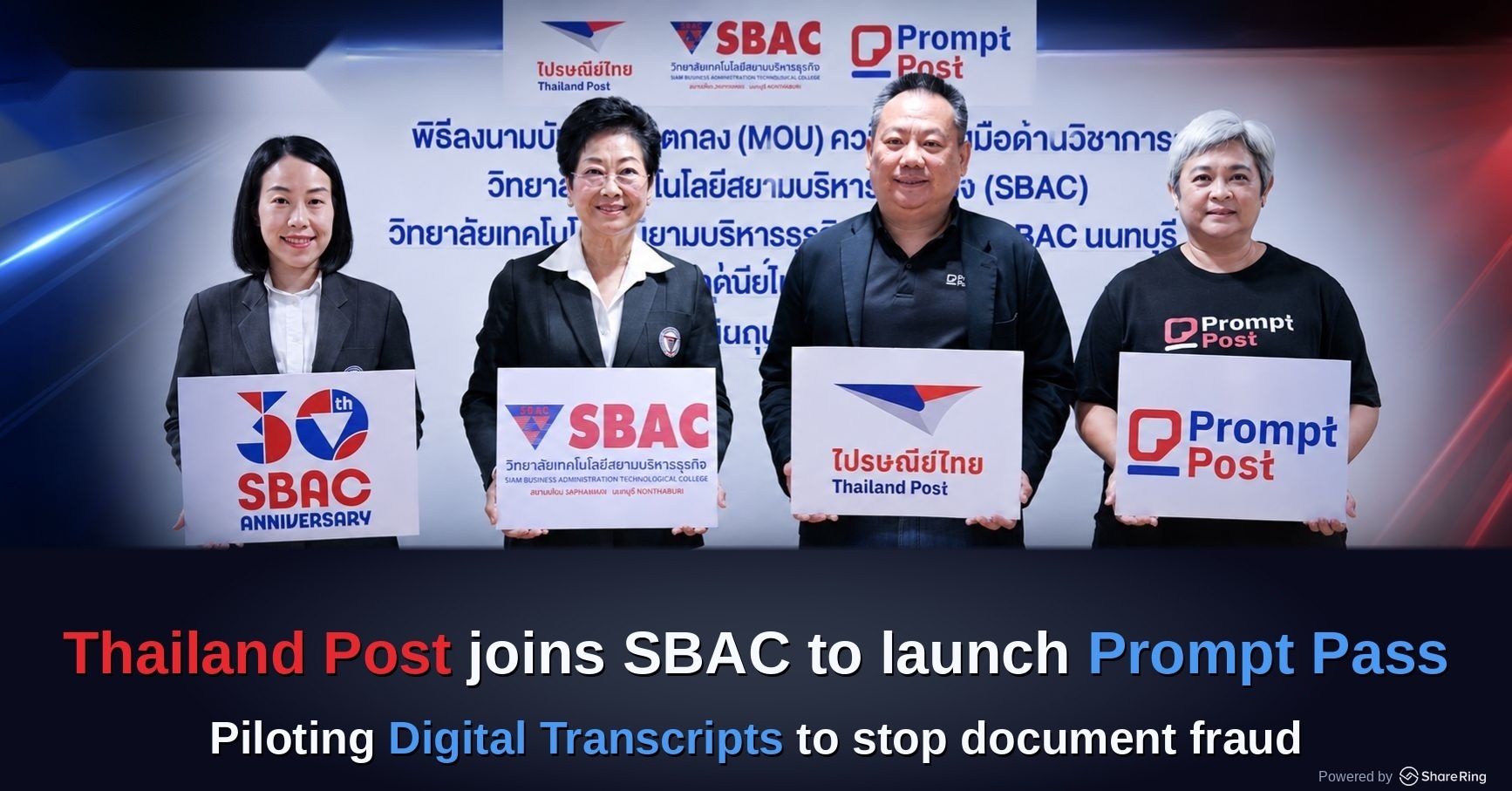
The first deployment is now live. On 18 June 2026, Thailand Post, the country's state-owned national postal service, began issuing verifiable credentials to the public through its Prompt Pass VC Wallet, starting with digital transcripts issued together with Siam Business Administration College (SBAC). This is not a pilot or a roadmap slide. It is a live national service, with credentials in citizens' hands, and it marks the Phase 1 go-live moving from announcement to production. For the full detail on what national adoption looks like, see ShareRing's launch write-up: https://sharering.network/2026/06/18/thailand-post-verifiable-credentials/
The policy frame: ETDA's Phase 2 Digital ID Framework. Most countries are still debating what a digital ID should look like. Thailand has moved past that. ETDA's Phase 2 Digital ID Framework, running 2025 to 2027, is published, funded and underway. Phase 1 established the identity layer. Phase 2 is about issuing every other document a citizen needs as a verifiable credential. ETDA has named three hero use cases for 2026: digital transcripts issued by universities, digital national ID cards, and digital driver's licences. Each is a paper document today. Each becomes a cryptographically signed credential by 2027.
Open standards, not a national silo. The detail most coverage misses is that ETDA has tied Phase 2 to the open international standards the rest of the world is converging on: the W3C Verifiable Credentials Data Model 2.0 as the wire format, OID4VC as the interoperability layer, Self-Sovereign Identity as the approach, and Privacy by Design as the legal posture. The verifiable credentials data structure is already published in ETDA standard ขมธอ. 24-2563. A Thai credential issued under this framework is designed to be readable by an international verifier from day one. This is precisely the standards stack ShareRing has aligned to for years.
The ecosystem is real and dated. ETDA ran a Knowledge Sharing event on 15 May 2026 bringing issuers, verifiers and wallet providers into one room, and the ETDA Bootcamp 2026 has its final 15 teams announced, building digital-trust prototypes intended to graduate into live services. This is government-led, publicly funded, openly judged infrastructure planning, not a closed pilot.
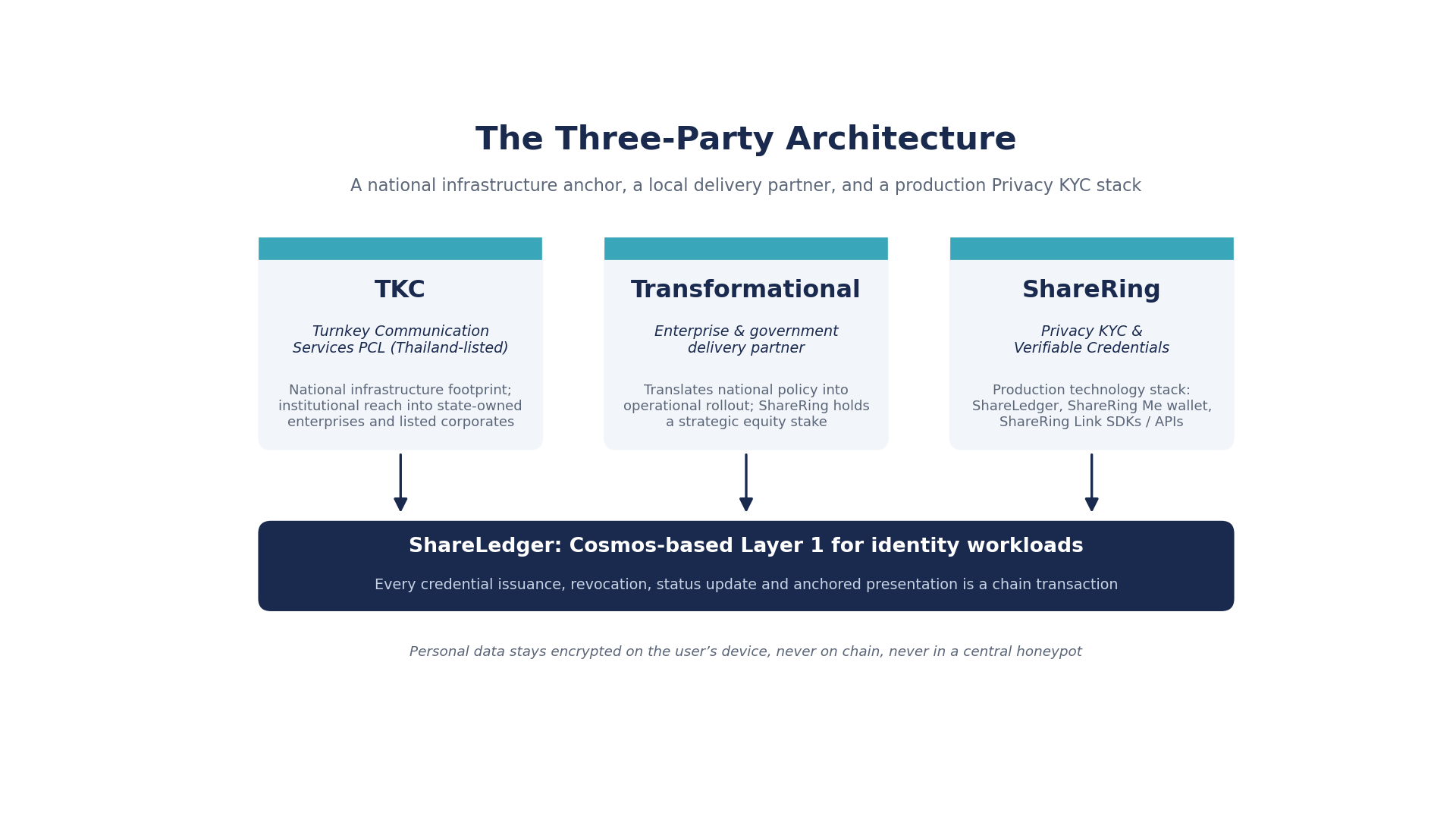
The three-party architecture. TKC provides the national infrastructure footprint and institutional reach into Thai state-owned enterprises and listed corporates. Transformational leads enterprise and government delivery, translating national policy into operational rollout, and ShareRing holds a strategic equity stake in Transformational, aligning incentives beyond a standard vendor relationship. ShareRing provides the production Privacy KYC technology stack: ShareLedger, the wallet and the SDKs.
Implementation roadmap. Phase 1, June 2026: first state-owned enterprise deployment, now live with Thailand Post and SBAC. Phase 2, August 2026: a network of Thai universities issuing digital credentials. Phase 3, in active discussion: financial services, hospitality and public administration.
Why this matters for ShareLedger. Until now, ShareLedger activity has tracked token transfers, staking and bridge flow. The Thailand rollout introduces a new class of activity. Every credential issuance, revocation, status update and anchored presentation is a chain transaction. A single university intake cycle can generate hundreds of thousands of credential events. The network shifts from speculation-led activity to demand-driven, recurring institutional usage, and validator economics strengthen as fee revenue from real-world credential events grows. ShareRing's own framing for 2026 is the move from "building the rails" to "running the trains."
A blueprint for the region. Thailand is the first ASEAN country to commit to W3C VC 2.0 plus OID4VC at the national framework level. If it ships the Phase 2 hero use cases in 2026 and 2027, the architecture becomes a reference other national programmes will design against. Regional conversations are already active.
Digital identity infrastructure is a long-cycle market. Adoption is tied to regulatory rollout, institutional procurement timelines and integration with legacy systems. Early production deployments do not guarantee future deployments, and ramp-up speed varies materially by jurisdiction and sector.
Token holders should be aware of the standard risks associated with crypto assets, including price volatility, regulatory changes in any of ShareRing's operating markets, technical risk in chain operations, and execution risk in commercial rollouts.
This article is informational. It is not financial advice, an investment recommendation, or a solicitation to buy or sell any digital asset. Any participation in crypto markets should be assessed against your own circumstances and, where appropriate, with independent professional advice.
KuCoin supports the SHR/USDT trading pair, allowing users to access SHR through the KuCoin platform. Users can review market depth and the fee schedule directly on KuCoin and trade SHR in line with their own assessment of risk and suitability.
ShareRing's Thailand programme has moved from announcement to operational rollout in under two months, and it is moving inside a published national framework rather than ahead of one. Backed by a publicly listed Thai infrastructure operator, anchored on production technology, built on open standards, and timed to ETDA's Phase 2 Digital ID Framework, the platform is positioned to underpin verifiable credentials across government, education and finance.
The next data points are already arriving. The first state-owned enterprise deployment went live in June 2026 with Thailand Post issuing verifiable credentials via Prompt Pass, and the university network follows in August 2026. Network-level metrics, issuance volumes and expansion across sectors will show how quickly institutional usage compounds. The opportunity for users, institutions and observers is to watch real adoption numbers replace projections.
FURTHER READING
Thailand Post Just Launched Verifiable Credentials. This Is What National Adoption Looks Like:
https://sharering.network/2026/06/18/thailand-post-verifiable-credentials/
-
What is ShareRing?
ShareRing is a Privacy KYC and Verifiable Credential platform building self-sovereign identity technology since 2018. It is W3C Verifiable Credentials compliant, DIATF certified and ISO 27001:2022 accredited, and operates ShareLedger, a Cosmos-based Layer 1 calibrated for identity workloads.
-
What is Thailand's Phase 2 Digital ID Framework?
It is the second phase of Thailand's national Digital ID rollout, run by ETDA from 2025 to 2027. Phase 1 established the identity layer. Phase 2 issues every other document a citizen needs (transcripts, national ID cards, driver's licences and more) as cryptographically verifiable credentials, built on open international standards.
-
Where does ShareRing fit in the framework?
Through the alliance with TKC and Transformational, ShareRing provides the production Privacy KYC stack, ShareLedger, wallet and SDKs. The rollout went live in June 2026 with Thailand Post (state-owned) issuing verifiable credentials via Prompt Pass alongside SBAC, with universities to follow in August 2026.
-
What are the risks?
Crypto assets are volatile and subject to regulatory change. Institutional rollouts can ramp slower than expected. Technical, execution and macro risks all apply. Nothing in this article should be read as a guarantee of future returns.
-
How do recent developments impact users?
The Thailand alliance turns ShareLedger into a settlement layer for real institutional credential activity. For users, that means an expanding network of issuers, including state-owned enterprises, universities and regulators, issuing credentials directly into the ShareRing wallet.
-
How can users get started?
ShareRing Me is available on iOS and Android. KuCoin supports the SHR/USDT trading pair for users wishing to access the token. For institutional integration, ShareRing Link provides SDKs and APIs at sharering.network.
Disclaimer
This article is for informational purposes only and does not constitute financial advice. Cryptocurrency trading involves significant risk. Always conduct your own research and consult with a qualified financial advisor before making investment decisions.