

MegaETH Layoffs: Why MEGA Is Cutting 20% of Staff and Expanding Into AI
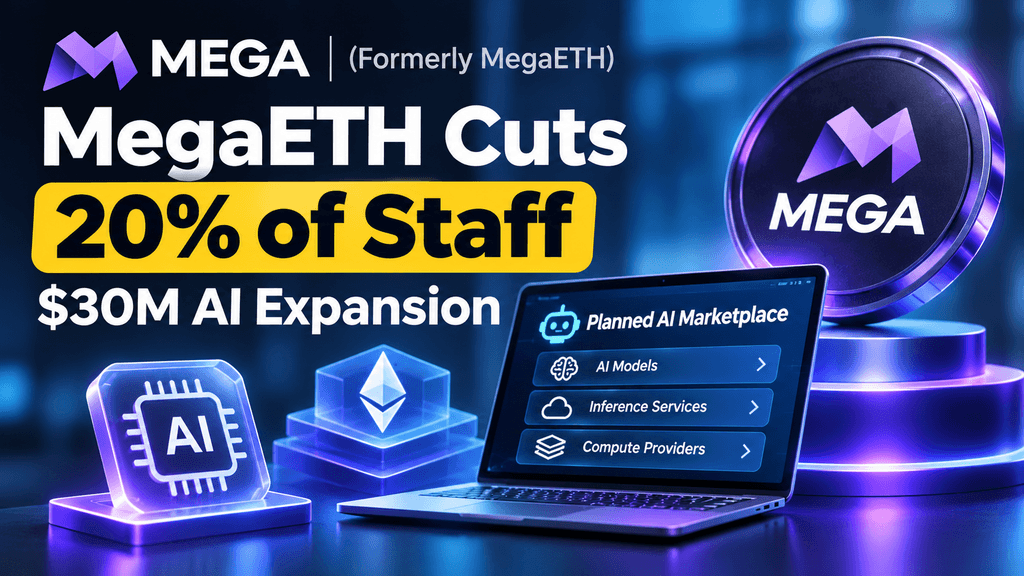
MEGA, the organization behind Ethereum Layer 2 network MegaETH, announced a 20% workforce reduction on November 13, 2026, following months of internal restructuring. The MegaETH layoffs came three days after the organization committed $30 million from its existing treasury to developing new products, beginning with an artificial intelligence inference marketplace. Co-founder Shuyao Kong confirmed that employees across several operational areas were affected but did not directly attribute the job cuts to AI investment. The restructuring raises questions about MEGA's business strategy, the future of its blockchain infrastructure, and the potential implications for MEGA token prices and network activity.
Key Takeaways
-
MEGA, the organization behind MegaETH, announced a 20% workforce reduction on November 13, 2026, following several months of internal restructuring.
-
MEGA committed $30 million from its existing treasury to new products, including AI inference services, without confirming that AI expansion caused the layoffs.
-
The AI marketplace, targeted for December 2026, aims to improve model authenticity, data privacy, and competition among computing providers.
-
MEGA token prices and MegaETH's DeFi activity have declined from earlier levels, although no direct causal relationship with the layoffs has been established.
-
MegaETH continues developing its blockchain infrastructure, with decentralization upgrades targeted for completion by the end of March 2027.
-
Future progress depends on AI marketplace adoption, reliable technical implementation, sustained network activity, and clearer token economics amid execution risks.
Why Did MegaETH Lay Off 20% of Its Staff?
MEGA announced a 20% workforce reduction on November 13, 2026, following several months of internal restructuring and changes to its business priorities. Co-founder Shuyao Kong explained that the organization had reorganized its teams and introduced new capabilities to support a broader product-development strategy. The announcement followed the MegaETH Foundation's rebranding as MEGA, reflecting an ambition to operate beyond blockchain infrastructure alone. However, Kong did not directly attribute the layoffs to AI investment, financial difficulties, or declining cryptocurrency activity. The exact number of employees affected, the timing of their departures, and the anticipated cost savings were not disclosed. Consequently, the restructuring should be described as an organizational change rather than evidence of a specific financial problem.
Which MegaETH Employees Were Affected by the Restructuring?
According to Kong, the layoffs affected employees involved in blockchain development, wallet infrastructure, ecosystem support, and communications. Some departing staff had contributed to MegaETH since its earliest stages, helping establish the network and support applications built on its infrastructure. Despite these departures, MEGA's founders, early employees, and core engineering team remain involved in the organization. The company has not published a department-by-department breakdown or confirmed whether additional staffing adjustments are planned. These uncertainties make it difficult to determine how the smaller workforce will affect development capacity, particularly as MEGA prepares to introduce additional products alongside its existing blockchain operations.
The restructuring follows an earlier shift in how MegaETH supports ecosystem growth. On July 16, 2026, the project announced the closure of its Mega Mafia accelerator, which had supported approximately 20 teams that collectively raised about $80 million. Kong explained that many successful applications developed through the program were no longer being built on MegaETH, prompting a greater emphasis on internally developed products. This change provides historical context for the November restructuring, although management has not confirmed whether individual positions were eliminated specifically because of the accelerator closure. MegaETH remains an active Ethereum Layer 2 scaling network, and organizational changes do not automatically indicate that its underlying blockchain development has stopped.
Why Is MEGA Investing $30 Million in AI?
MEGA announced a $30 million treasury commitment to new products on November 10, 2026, marking an expansion of its business strategy beyond Ethereum Layer 2 infrastructure. The organization plans to begin with an artificial intelligence inference marketplace designed to connect AI developers and businesses with competing model providers. The initiative addresses concerns about model authenticity, data privacy, service reliability, and transparency in AI computing. Rather than replacing MegaETH's blockchain operations, the commitment reflects MEGA's plan to develop products that use the network while serving a wider customer base. The funding comes from the organization's existing treasury rather than a newly announced financing round. MEGA has not disclosed how the commitment will be distributed among individual projects, and it should not be interpreted as money already spent or guaranteed future revenue.
How Will MEGA's AI Inference Marketplace Work?
MEGA's proposed marketplace, described in its November 2026 whitepaper Purified Intelligence: The New Economics of Inference, would allow customers to access AI inference services from multiple providers while introducing mechanisms intended to verify model authenticity and improve data protection. AI inference involves running a trained model to generate predictions, responses, or other outputs. The proposed platform aims to make these services more transparent by helping customers assess whether providers deliver the models and computing capabilities they advertise. Its design also explores competitive pricing, provider selection, and advance commitments for computing capacity. MEGA targets December 2026 for the public marketplace launch, although supported models, participating providers, commercial terms, and initial technical features remain unconfirmed. The whitepaper presents a proposed market architecture rather than evidence that every described capability has already been implemented. Its commercial prospects will depend on whether the platform can demonstrate reliable service delivery, effective verification methods, and sustained customer demand.
MegaETH Layoffs and Their Impact on MEGA Token Price and Network Activity
MegaETH's workforce reduction has raised questions about the future of its native MEGA token and the Ethereum Layer 2 network's ability to sustain activity. The November 13, 2026, announcement came during a period of weaker decentralized finance deposits and substantially lower token prices than those seen soon after the April launch. However, there is no verified evidence that the layoffs directly caused a specific market movement. The restructuring highlights uncertainties around development resources, network adoption, token distribution, and the economic relationship between MEGA's expanded product strategy and its cryptocurrency. Available data describes the network's condition but does not establish why token holders or DeFi users made particular decisions.
What Happened to MEGA Token Price and Market Capitalization?
According to CoinGecko historical market data, MEGA traded around $0.049 on November 16, 2026, when its circulating market capitalization was approximately $56.4 million. The cryptocurrency remained well below its earlier 2026 highs, although its short-term prices did not move consistently in one direction around the restructuring announcement. Token prices can fluctuate with wider market conditions, changes in liquidity, circulating supply, and trading activity. The dated figures establish the scale of MEGA's market valuation at that point, not a direct financial effect of the staffing decision. A causal explanation for a particular price movement would require stronger evidence than the timing of the announcement alone.
MEGA's tokenomics provide further context for interpreting the capitalization figures. According to the official token allocation documentation, the cryptocurrency has a maximum supply of 10 billion tokens, with approximately 53% allocated to performance-based rewards linked to network milestones. This differs from a conventional schedule that releases the entire allocation at predetermined dates. Because only part of the maximum supply was circulating in November, market capitalization and fully diluted valuation describe different measurements. Market capitalization uses circulating supply, while fully diluted valuation multiplies the token price by maximum supply. The timing of future distributions, network usage, and the role of the token in new MEGA products remain relevant uncertainties, not grounds for predicting a price outcome.
How Has MegaETH Network Activity Changed and What Comes Next?
MegaETH's decentralized finance activity has weakened considerably from earlier levels. According to DeFiLlama, the network recorded approximately $8.81 million in DeFi total value locked on November 16, 2026, compared with a previously reported level exceeding $245 million. This represents a decline of at least approximately 96.4% relative to the $245 million reference. However, total value locked in DeFi measures assets held in tracked decentralized finance protocols rather than the entire value of assets across the network. The same dated dashboard recorded approximately $88.32 million in bridged value, $23.03 million in stablecoin capitalization, and $831,602 in decentralized exchange volume over 24 hours. These are separate measures of activity and must not be combined into a single liquidity figure.
The decline in DeFi deposits raises questions about sustained application use and liquidity retention, but it does not prove that the workforce reduction caused funds to leave the network. MEGA's proposed AI marketplace may create additional reasons for businesses and developers to use MegaETH infrastructure if it launches successfully and attracts customers. Such activity would need to be measured through actual applications, transaction patterns, and disclosed product economics. More network usage would not automatically establish greater demand for the MEGA token, particularly while its role in the AI marketplace remains undefined. The most informative subsequent evidence will be consistent onchain metrics and specific details about how the new products interact with the blockchain.
MegaETH AI Marketplace Launch, Future Roadmap and Key Risks
MEGA's next development phase will test whether its expanded product strategy can generate sustainable demand while maintaining the performance and reliability of the MegaETH blockchain. Following its November 2026 restructuring, the organization faces two important milestones: introducing its first AI marketplace and delivering infrastructure improvements intended to support a more decentralized network. Both initiatives could broaden MegaETH's commercial applications, but their outcomes will depend on implementation, measurable adoption, and the ability to compete with established service providers. Pursuing additional products also puts greater emphasis on effective resource allocation after the staff reduction, especially because the organization has not disclosed the full budget or staffing structure of its new operations.
When Will MEGA Launch Its AI Inference Marketplace?
MEGA has targeted December 2026 for the public launch of its AI inference marketplace, although an exact release date has not been announced. The initial rollout will test whether independent computing providers can offer competitive AI services with sufficient verification, reliability, and transparency. Co-founder Shuyao Kong previously indicated that details concerning participating providers, supported models, and marketplace operations would be disclosed closer to launch. The project's whitepaper also explores standardized agreements for reserving future inference capacity, potentially allowing customers to secure computing services under predetermined terms. However, these proposed mechanisms should not be assumed to be available in the first release. Early adoption, transaction activity, service quality, and disclosed commercial arrangements will provide more meaningful evidence of progress than the launch announcement alone. The marketplace's ability to attract both customers and providers will be an important indicator of whether the proposed model works in practice.
What Blockchain Upgrades Are Planned for MegaETH?
Alongside its AI expansion, MEGA has outlined infrastructure priorities intended to improve network performance and decentralization. These include faster transaction finality, sequencer rotation, proximity markets, and stronger censorship resistance. Faster finality aims to provide quicker confirmation of transaction outcomes, while sequencer rotation would allow multiple operators to participate in transaction ordering instead of relying on a single permanent operator. Proximity markets are intended to introduce competition around low-latency network access, while censorship-resistance improvements aim to support more dependable transaction inclusion. MEGA has targeted the end of March 2027 for its broader decentralization effort, although individual upgrades do not all have confirmed release dates. Successful delivery could change how the network operates, but performance and security benefits would need to be demonstrated after deployment rather than inferred from the announced roadmap.
What Are the Biggest Risks to MEGA's AI Growth Strategy?
The principal challenges involve technical execution, customer adoption, competition, and the economics of delivering AI services. MEGA must demonstrate that its marketplace can provide credible evidence of model authenticity, protect sensitive information, and maintain dependable service across independent providers. Its official whitepaper acknowledges that blockchain records alone cannot establish whether an AI service was delivered according to agreed standards, making external verification and dispute resolution important design challenges. Established AI infrastructure providers already have customer relationships, computing capacity, and service agreements. MEGA will therefore need to demonstrate practical differences in service quality, reliability, and access rather than relying solely on its proposed marketplace architecture.
Financial sustainability presents another uncertainty. Although the organization has committed treasury resources to product development, it has not published marketplace revenue projections, customer commitments, operating margins, or a detailed spending schedule. Additional engineering requirements and network decentralization work could create competing demands on staff and funding. There is also no publicly established formula linking AI marketplace activity to MEGA token-holder earnings. Future assessments can focus on completed launches, provider participation, customer usage, operational reliability, and transparent financial disclosures without assuming that expanding into AI will improve organizational finances or cryptocurrency valuations.
Conclusion
The MegaETH layoffs mark a significant organizational change as MEGA moves beyond its original focus on Ethereum Layer 2 infrastructure toward developing its own technology products. The 20% workforce reduction and $30 million commitment to new initiatives reflect changing priorities, but the organization has not confirmed that AI investment directly caused the staffing cuts. Its proposed inference marketplace could introduce additional applications for MegaETH, while planned blockchain upgrades aim to improve network performance and decentralization. Declining DeFi deposits, unclear token economics, competitive pressure, and technical implementation challenges remain unresolved. The clearest evidence of progress will be delivered products, sustained customer activity, and measurable blockchain performance rather than assumptions about future market prices.
FAQs
Is MEGA the Same Organization as MegaETH?
MEGA is the broader organization formerly known as the MegaETH Foundation, while MegaETH refers to its Ethereum Layer 2 blockchain network. The November 2026 rebranding reflects an expanded business strategy covering blockchain infrastructure and additional technology products.
Did MEGA Raise an Additional $30 Million to Fund Its AI Expansion?
No new $30 million fundraising round was announced. MEGA committed that amount from its existing treasury toward developing new products, beginning with AI inference services. The organization has not disclosed its remaining treasury balance or a detailed spending schedule.
How Many MegaETH Employees Lost Their Jobs?
MEGA confirmed a 20% workforce reduction on November 13, 2026, but did not disclose the exact number of affected employees or its total headcount immediately before the restructuring. Consequently, the number of individual job losses cannot be reliably calculated.
Will MEGA Run Artificial Intelligence Models Directly on the Blockchain?
MEGA has not announced that its marketplace will execute entire AI models directly onchain. Its proposed architecture explores blockchain-based records, payments, and contractual commitments, while AI computations are performed by external providers. Verifying that those services meet their obligations remains an important technical challenge.
How Could MEGA Verify That AI Providers Use the Correct Models?
MEGA's November 2026 whitepaper discusses model fingerprinting, trusted execution environments, and cryptographic proofs as possible verification methods. Each offers different levels of assurance and involves technical limitations. The organization has not confirmed which mechanisms will be operational at the marketplace's initial launch.
Disclaimer: This general market information, possibly from third-party, commercial, or sponsored sources, is provided for reference and educational purposes only and does not constitute financial or investment advice, an offer, solicitation, or guarantee. We disclaim liability for its accuracy, completeness, reliability, and any resulting losses. Investments/trading are risky; past performance doesn’t guarantee future results. Users should research, judge prudently, and take full responsibility. For further details, please consult KuCoin’s Terms of Use and Risk Disclosure.