

LayerZero ZRO Staking Explained: Rewards, Lock-Up and Zero Mainnet Launch
LayerZero has opened ZRO staking ahead of its Zero mainnet launch on November 30, 2026, giving token holders an opportunity to participate in securing the network before it goes live. The launch also comes with a significant commitment from the LayerZero Foundation, which plans to stake 100 million ZRO under the same conditions as other participants.
The timing introduces a new dimension to ZRO's utility as the token takes on a role in Zero's delegated proof-of-stake system. However, the opportunity comes with a fixed lock-up period, rewards that depend on staking participation, and a withdrawal date several months after mainnet goes live.
Understanding these conditions is important for holders evaluating the staking opportunity and what it could mean for ZRO as LayerZero expands its ecosystem.
Key Takeaways
-
Zero is LayerZero's new Layer 1 blockchain, designed to support high-performance applications and expand the ecosystem beyond cross-chain communication.
-
ZRO staking helps secure Zero's genesis validators, and holders can stake through the official portal without manually bridging tokens.
-
The LayerZero Foundation has committed 100 million ZRO to support initial network security, representing 10% of the token's maximum supply.
-
Staking rewards depend on the amount and duration of tokens staked, while withdrawals remain locked until March 31, 2027.
-
ZRO also supports transaction fees, governance and buyback mechanisms, but adoption, market volatility and staking restrictions will shape its long-term value.
What Is LayerZero's Zero Network and Why Is Its Mainnet Launch Important?
LayerZero is a cross-chain interoperability protocol that enables applications and blockchains to communicate and transfer information across different networks. Its ecosystem is expanding with Zero, a Layer 1 blockchain designed to support high-performance applications and financial infrastructure.
Understanding how Zero works helps explain why ZRO staking is becoming an important part of LayerZero's ecosystem.
How Does Zero Differ From Existing Layer 1 Blockchains?
Zero takes a different approach to processing transactions by allowing applications to operate independently rather than requiring every validator to repeat the same computational work. This is designed to increase network capacity while maintaining shared security across the blockchain.
It achieves this through Atomicity Zones, which allow different applications to process transactions in parallel. For example, activity on a trading application can take place without necessarily slowing down a separate payments application. Despite operating independently, these applications remain secured by Zero's shared network.
This architecture also separates transaction processing from verification. Specialized producers process transactions and generate proofs that validators can check without repeating the entire process. This reduces the computational demands on validators and provides the foundation for Zero's approach to network security.
What Role Will Zero Play in LayerZero's Ecosystem?
Zero expands LayerZero's ecosystem beyond cross-chain communication by providing a blockchain where applications can process transactions and settle activity. While LayerZero's existing infrastructure connects different blockchains, Zero introduces an environment designed to support financial applications, payments and institutional transactions.
The network is designed to support applications such as payment services, institutional settlement and financial markets that operate continuously. One example is ATLAS, a trading infrastructure built on Zero that brings order matching, clearing, settlement and risk management together within one system.
This expansion also gives ZRO a more direct role in the ecosystem. Beyond its governance function, the token serves as Zero's staking and native gas asset, allowing holders to participate in network security while supporting transaction activity. Its role in Zero therefore connects ZRO's utility to the growth and use of the new blockchain.
How Does LayerZero ZRO Staking Work Ahead of Mainnet?
LayerZero's pre-genesis staking allows ZRO holders to commit their tokens to Zero before its mainnet launch on November 30, 2026. The staked tokens will help validators produce the network's first blocks, while holders earn rewards based on how much they stake and how long they participate. The process also introduces a different staking arrangement because Zero is not yet live.
How Does ZRO Staking Help Secure the Zero Network?
ZRO staking supports Zero's security by giving validators voting power based on the amount of tokens staked behind them. Validators use this voting power to agree on new blocks and maintain the network. The pre-genesis stake will provide the initial backing needed to produce Zero's first blocks when mainnet launches.
During this initial period, staked tokens are distributed equally across Zero's genesis validators. Holders cannot select individual validators, meaning their stake supports the initial validator group rather than a validator of their choice. This arrangement remains in place until March 31, 2027, when the initial staking lock-up ends.
How to Stake ZRO Before the Zero Mainnet Launch
Users can stake ZRO directly from supported networks where they hold the token without manually bridging it to Zero first. To begin, they need to visit the official LayerZero staking portal, connect a compatible wallet and follow these steps:
-
Connect a wallet: Use a compatible standard wallet, including a hardware wallet that supports EIP-712 message signing.
-
Accept the staking terms: Review the conditions and acknowledge that staked ZRO cannot be withdrawn before March 31, 2027.
-
Sign a verification message: Sign a gasless message confirming that the connected wallet can authorize withdrawals.
-
Enter the staking amount: Specify how much ZRO to stake and confirm the transaction through the portal.
-
Track your stake: Monitor your staking position through the official interface.
The pre-genesis process also differs from conventional staking. When users stake ZRO, the tokens are burned on their original network, with corresponding tokens minted on Zero and recorded on LayerZero Scan.
This allows holders to participate from different supported networks without manually transferring their tokens to the new blockchain. Users should only interact through the official portal and must not send ZRO directly to staking contracts, as those transfers could result in permanent loss.
What Does the LayerZero Foundation's 100 Million ZRO Stake Mean for the Network?
The LayerZero Foundation's decision to stake 100 million ZRO is one of the biggest commitments ahead of Zero's mainnet launch. The tokens will support the network's initial validators and remain locked under the same conditions as other participants until March 31, 2027. The commitment also raises questions about ZRO's available supply, network security and potential market impact.
Why Did the LayerZero Foundation Stake 100 Million ZRO?
The LayerZero Foundation committed 100 million ZRO to help secure Zero ahead of its mainnet launch. It completed the stake on November 23, 2026, through two transactions of 50 million ZRO each. The Foundation is subject to the same staking conditions as other participants, including the March 31, 2027 unlock date.
The commitment provides substantial initial backing for Zero's genesis validators, whose voting power depends on the ZRO staked behind them. This means the Foundation's contribution supports the network's ability to reach agreement on blocks from launch. It also signals the Foundation's participation in securing the blockchain rather than relying entirely on external token holders.
Could the 100 Million ZRO Stake Affect Token Supply and Price?
The Foundation's 100 million ZRO stake represents 10% of the token's maximum supply of 1 billion. However, staking does not permanently remove these tokens from the supply. Instead, they become locked and unavailable for withdrawal until March 31, 2027.
This lock-up could reduce the amount of ZRO available for immediate trading if the tokens would otherwise have been transferable. However, it does not automatically mean circulating supply has fallen by 100 million, since the Foundation's existing allocation and the tokens' previous circulation status also matter.
The commitment could strengthen confidence in Zero's initial security, but it does not guarantee an increase in ZRO's market price. Broader staking participation, network adoption and actual demand for ZRO will be more important in determining its long-term market impact.
How Much Can ZRO Stakers Earn and When Can They Withdraw?
ZRO staking offers holders rewards for helping secure Zero, but the amount they earn depends on how much they stake, how long they keep their tokens locked and the total network participation. LayerZero has set a fixed unlock date for the initial staking period, meaning participants must consider both the potential rewards and how long they will be unable to access their tokens.
How Are ZRO Staking Rewards Calculated?
Zero has a target annual inflation rate of 1%, meaning the network aims to issue 10 million new ZRO annually from its 1 billion token supply. Of this amount, 10% goes to validators as commission during the initial staking period, leaving approximately 9 million ZRO annually for stakers.
Rewards are distributed according to the amount of ZRO staked and the length of time it remains locked. They are added to users' staking balances after each reward period, allowing subsequent rewards to accumulate on previous earnings. However, the actual annualized yield depends on how much ZRO is staked across the network. More participation means the available rewards are shared among more tokens. The official calculator provides estimates rather than guaranteed returns, and actual rewards could be zero.
When Can Users Withdraw Staked ZRO?
LayerZero has established three important dates for the initial staking period:
-
November 23, 2026: Pre-genesis staking opens.
-
November 30, 2026: Zero mainnet launches and staking rewards begin accruing at 00:00 UTC.
-
March 31, 2027: Staked ZRO and accumulated rewards become eligible for withdrawal.
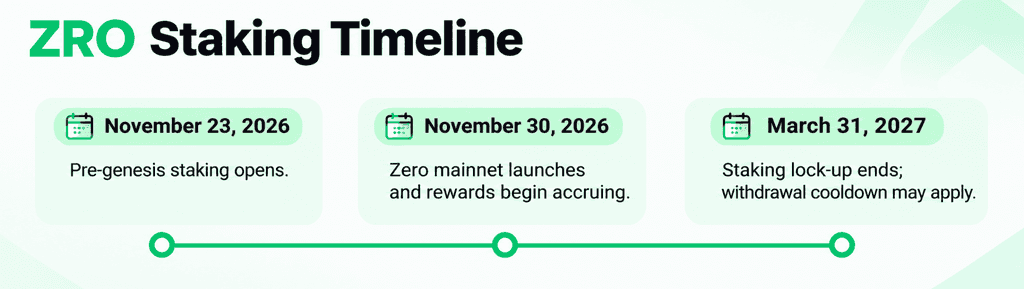
Users cannot withdraw their tokens early or claim rewards before the unlock date. After March 31, withdrawals are subject to a cooldown period of up to seven days. This means holders should be prepared to keep their ZRO locked throughout the initial staking period.
How Could ZRO Staking Affect Token Utility and Long-Term Demand?
ZRO staking introduces another reason for holders to use and retain the token as LayerZero expands its ecosystem with Zero. Beyond staking, ZRO serves as the network's gas and governance token, connecting its utility to transaction activity, network security and protocol decisions. Whether these additional uses translate into stronger long-term demand will depend on how widely Zero and its applications are adopted.
What Are the Main Utilities of the ZRO Token?
ZRO has three main functions on Zero, giving holders a role in network security, transaction payments and governance:
-
Network staking: Holders can stake ZRO to support validators responsible for securing Zero and agreeing on new blocks.
-
Transaction fees: ZRO serves as the network's native gas token, allowing users to pay for transactions across its Atomicity Zones.
-
Protocol governance: ZRO holders can participate in decisions about protocol upgrades and the addition of new Atomicity Zones.
LayerZero also connects protocol revenue to ZRO through buybacks. Revenue generated by Stargate is used to purchase ZRO on the open market, creating a link between activity on the cross-chain protocol and demand for the token.
The protocol also has a fee switch that could direct LayerZero messaging fees towards additional ZRO buybacks and burns if activated through governance. However, the Foundation's buyback dashboard currently shows Stargate-funded buybacks as active, while the protocol fee switch remains inactive.
Could Zero Mainnet Increase Demand for ZRO?
Zero could create additional demand for ZRO as more applications use the network. Staking requires holders to commit tokens to network security, while transaction fees create another use for ZRO as activity increases. Applications such as ATLAS could also contribute to demand: LayerZero's documentation states that 75% of post-venue trading fees on ATLAS are used to buy and burn ZRO.
However, increased network activity does not automatically translate into higher ZRO prices. The impact will depend on actual usage, the amount of ZRO committed to staking, new token issuance and the volume of tokens purchased through buyback programmes. The extent to which these mechanisms create sustained demand will become clearer as Zero attracts more applications and users.
What Risks Should ZRO Holders Consider Before Staking?
ZRO staking offers rewards for supporting Zero's network security, but holders should understand the restrictions and risks before committing their tokens. The most important considerations include:
-
Lock-up and liquidity risk: Staked ZRO cannot be withdrawn before March 31, 2027. Holders cannot sell or access their tokens during this period, even if they need the funds or market conditions change. Withdrawals may also take up to seven additional days after the unlock date.
-
Market volatility: ZRO's market price could decline during the lock-up period, leaving holders unable to sell their staked position and potentially exposing them to losses.
-
Uncertain staking rewards: Returns depend on network participation and validator commissions. The estimated yield is not guaranteed, and actual rewards could be zero.
-
Wallet and transaction risks: Staking requires a compatible wallet that supports EIP-712 message signing. Users must also interact through the official staking portal, as sending ZRO directly to staking contracts could result in permanent loss.
LayerZero also does not provide a liquid staking token for users to trade or use elsewhere while their ZRO remains locked. Holders should therefore consider whether they can commit their tokens for the full staking period before participating.
Conclusion
ZRO staking gives holders a way to participate in securing Zero ahead of its November 30, 2026 mainnet launch while earning rewards from the network's staking programme. The LayerZero Foundation's 100 million ZRO commitment provides significant initial backing, while staking, transaction fees, governance and buyback mechanisms expand the token's role across the ecosystem.
However, the opportunity comes with a fixed lock-up until March 31, 2027, uncertain rewards and limited access to staked tokens during the period. Ultimately, ZRO staking's long-term value will depend on Zero's adoption, network activity and sustained demand for the token. Holders should weigh these factors against the lock-up conditions before deciding to participate.
FAQs
What is ZRO staking?
ZRO staking allows holders to commit their tokens to support Zero's validators and network security while earning rewards based on their stake and participation period.
How can I stake ZRO before Zero mainnet launches?
Visit the official LayerZero staking portal, connect a compatible wallet, accept the staking terms, sign the verification message and enter the amount of ZRO to stake.
How much can you earn from staking ZRO?
Rewards depend on the amount and duration of ZRO staked, as well as total network participation. Estimated yields are not guaranteed, and actual rewards could be zero.
When can I withdraw my staked ZRO?
Staked ZRO and accumulated rewards become eligible for withdrawal on March 31, 2027. Withdrawals may then take up to seven additional days due to the cooldown period.
What is the LayerZero Foundation's 100 million ZRO stake?
The LayerZero Foundation staked 100 million ZRO to support Zero's initial validators. This represents 10% of ZRO's maximum supply, with the tokens locked until March 31, 2027.
Disclaimer
This general market information, possibly from third-party, commercial, or sponsored sources, is provided for reference and educational purposes only and does not constitute financial or investment advice, an offer, solicitation, or guarantee. We disclaim liability for its accuracy, completeness, reliability, and any resulting losses. Investments/trading are risky; past performance doesn’t guarantee future results. Users should research, judge prudently, and take full responsibility. For further details, please consult KuCoin’s Terms of Use and Risk Disclosure.