

Islamic Finance Explained: Muslim Banks, Web3 & Global Impact
2026/05/19 17:57:00
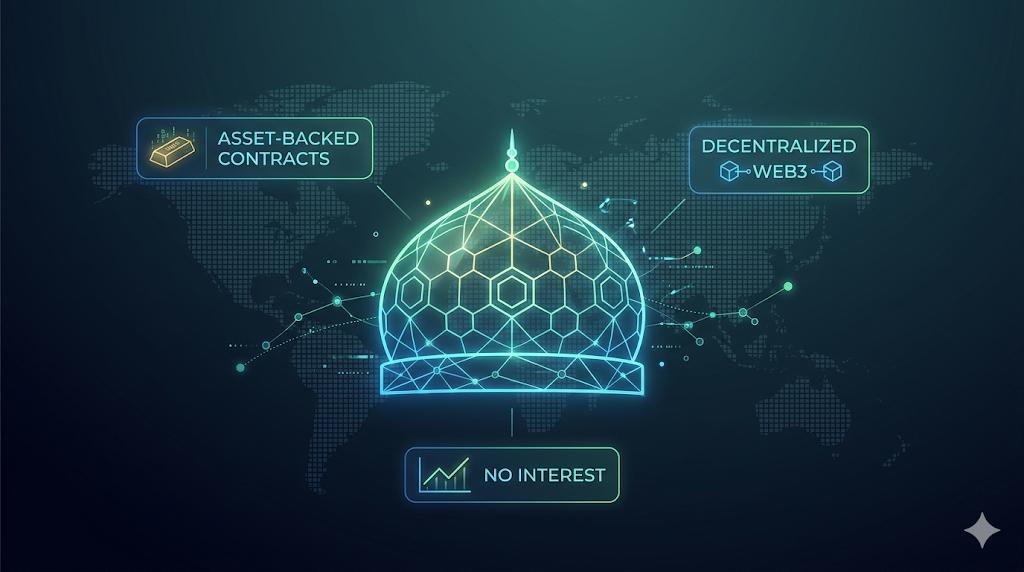
Islamic finance represents an asset-backed, risk-sharing framework governed by Shariah law, strictly prohibiting the collection of interest. Muslim banks utilize equity-sharing and lease-based contracts instead of conventional loans to drive real-world economic productivity. This systemic rejection of speculative debt significantly stabilizes global markets while increasingly integrating with decentralized crypto space.
Key Takeaways
-
Islamic finance eliminates debt-driven interest, replacing conventional lending with asset-backed, ethical contracts focused on real-world economic productivity and risk-sharing.
-
Muslim banks function as merchants or equity partners rather than traditional lenders, utilizing specialized structures like Murabaha and Musharaka to generate legitimate revenue.
-
Shariah-compliant Web3 innovation is growing rapidly by restructuring DeFi into interest-free smart contracts, tokenized asset-backed Sukuk, and verified Halal cryptocurrencies.
-
By tethering capital expansion strictly to physical assets, the $6 trillion Islamic financial landscape inherently insulates global markets from speculative debt bubbles.
The Core Principles of Islamic Finance in the Modern Era
Islamic finance reorganizes capital allocation around ethical risk-sharing and the total elimination of interest. This system ensures money serves merely as a medium of exchange rather than a self-multiplying commodity. Investors must actively participate in commercial trade to earn returns. This foundational shift eliminates traditional debtor-creditor relationships, forcing financial institutions to operate as direct equity partners or physical asset traders.
The framework demands that financial expansion strictly mirrors actual economic productivity. Every financial transaction must be directly tethered to a physical asset or a legitimate commercial service. This stringent requirement mathematically prevents the creation of uncollateralized derivative instruments. It structurally insulates markets from the speculative debt spirals that routinely destabilize conventional centralized banking systems.
The Strict Prohibition of Riba (Interest)
Riba, commonly translated as usury or interest, is entirely forbidden across all Islamic financial transactions. Collecting any predetermined, fixed premium above the principal amount of a loan is considered inherently exploitative and economically destructive. The framework argues that guaranteeing returns for lenders while transferring all operational risks to borrowers creates severe systemic inequality.
Depositors within a Muslim bank do not receive fixed interest rates on their savings balances. They instead become investment partners, entrusting their capital to the bank's commercial portfolios. Returns fluctuate directly based on the actual profitability of these real-world investments. This dynamic guarantees that wealth creation derives exclusively from successful commercial enterprise rather than debt mechanics.
Ethical Screening and Haram Exclusions
Muslim banks are legally prohibited from financing businesses engaged in activities classified as Haram by Islamic law. Institutions routinely deny capital to corporations involved in alcohol production, gambling, adult entertainment, weapons manufacturing, and pork processing. Screening protocols systematically exclude companies burdened by excessive conventional debt or those holding massive interest-bearing cash reserves.
This rigorous ethical filtering operates identically to modern environmental, social, and governance (ESG) screening parameters. By starving harmful industries of institutional capital, Islamic finance actively directs wealth toward socially constructive infrastructure. This ethical mandate makes Shariah-compliant funds highly attractive to secular institutional investors seeking responsible and transparent capital deployment alternatives.
Operational Frameworks of Muslim Banks
Muslim banks utilize specialized, asset-centric contract structures to provide market liquidity without ever charging interest. Because they cannot simply loan money for a fixed percentage, these institutions actively purchase, lease, or co-invest in physical assets. This operational reality forces banks to assume tangible commercial risk alongside their clients, completely altering traditional financial intermediation.
These contract mechanisms ensure that all generated profit stems directly from legitimate commercial trade or physical asset utilization. Whether facilitating retail mortgages or funding massive corporate infrastructure, the bank acts as a merchant or joint venture partner. The resulting profit margins are contractually justified by the actual risk the institution assumes during ownership.
Murabaha: Cost-Plus Financing Models
Murabaha serves as a transparent, cost-plus financing arrangement primarily utilized for asset acquisition and international trade finance. The bank purchases a specific asset directly from a vendor and immediately sells it to the client at an agreed-upon markup. The client then repays the bank through structured installments, avoiding conventional interest mechanics entirely.
The bank must take definitive legal ownership of the asset, however brief, before transferring it to the customer. This momentary ownership exposes the institution to actual commercial risk, legally justifying the earned profit margin on the resale. Murabaha remains the most dominant and widely deployed contract utilized by Islamic banks globally.
Musharaka: Equity Ventures in Decentralized Markets
Musharaka functions as an equitable joint venture where multiple parties contribute both investment capital and managerial effort to a single enterprise. Profits generated by the commercial venture are shared based on a mutually agreed ratio reflecting each partner's technical or financial contribution. This flexible structure effectively syndicates large-scale corporate developments.
Monetary losses must be distributed in exact proportion to each partner's initial capital contribution in the event of a commercial failure. This unalterable mandate ensures absolute fairness and prevents larger institutions from offloading disproportionate risk onto smaller partners. Diminishing Musharaka variants allow one partner to gradually purchase the other's equity shares.
Ijarah: Asset Leasing and Physical Utility
Ijarah operates as a standard leasing agreement where the bank purchases a physical asset and transfers the right of use to the client. The client makes regular rental payments, providing the bank with a predictable, non-interest revenue stream. The bank retains absolute legal ownership of the property or equipment throughout the lease duration.
The bank bears total responsibility for structural maintenance and major insurance coverage, as it remains the definitive legal owner. The client is only financially responsible for routine operational expenses resulting from daily asset usage. Certain Ijarah variations conclude the agreement by transferring full legal ownership to the client upon the final rental payment.
The Evolution of the Global Sukuk Market
Sukuk certificates function as the Islamic alternative to conventional corporate and sovereign bonds, representing fractional ownership in tangible, revenue-generating assets. Investors receive periodic payouts derived directly from the actual profits or rental yields of the underlying asset pool. Because they are strictly asset-backed, Sukuk provide a highly secure mechanism for raising massive institutional capital.
The global Sukuk market remains highly robust, with outstanding global issuance projected to exceed $1 trillion based on recent early 2026 market reports. This immense market depth attracts significant conventional institutional capital seeking diversified, low-volatility fixed-income alternatives. The structural transparency of Sukuk actively prevents corporate issuers from raising capital without possessing equivalent, productive physical infrastructure.
| Contract Type | Primary Mechanism | Risk Allocation Focus | Typical Applications |
| Murabaha | Cost-plus asset sale | Bank assumes temporary ownership risk | Trade finance, retail mortgages |
| Mudaraba | Trust capital partnership | Capital provider bears total monetary loss | Investment funds, savings accounts |
| Musharaka | Joint equity venture | Losses strictly mirror capital ratios | Corporate syndication, real estate |
| Ijarah | Operational asset lease | Bank retains structural liability | Equipment leasing, infrastructure |
Islamic Finance Meeting the Crypto and Web3 Space
The intersection of Islamic finance and cryptocurrency is one of the fastest-growing areas in today's global financial ecosystem. Shariah-compliant digital assets utilize blockchain transparency to mathematically enforce ethical financial rules without relying on centralized intermediaries. Based on Q1 2026 data, the global Islamic fintech market reached record transaction volumes, aggressively merging traditional compliance with decentralized Web3 innovations.
Blockchain networks provide the perfect technological infrastructure to execute highly transparent, trustless Islamic financial contracts. Smart contracts natively eliminate excessive uncertainty by ensuring absolute programmatic transparency regarding pricing, delivery, and automated execution parameters. This profound technological synergy allows Muslim banks to deploy capital securely and efficiently across decentralized global liquidity networks.
Shariah Compliance in Decentralized Finance (DeFi)
Decentralized Finance (DeFi) protocols are being actively restructured to meet strict Shariah compliance standards by entirely removing interest-bearing lending pools. Traditional DeFi platforms rely heavily on conventional algorithmic interest rates, which are fundamentally forbidden. Compliant digital alternatives replace guaranteed yields with dynamic profit-sharing models directly mirroring traditional Musharaka equity principles.
These ethical DeFi platforms distribute protocol revenues proportionally among liquidity providers, ensuring returns stem from actual network utility rather than arbitrary algorithmic debt. Rigorous audits by certified Shariah boards verify that no underlying smart contract code interacts with prohibited financial mechanics. This validation unlocks massive institutional capital previously sidelined by strict religious compliance concerns.
Asset-Backed Tokens and Halal Cryptocurrencies
Halal cryptocurrencies must represent tangible network utility or direct physical asset backing to comply with Islamic wealth generation principles. Tokens designed purely for speculative gambling or offering zero intrinsic network value blatantly violate religious prohibitions. Legitimate Islamic crypto projects frequently tokenize real-world commercial assets like physical gold or sustainable real estate.
Tokenized Sukuk represent a profound technological leap for global capital markets, allowing massive asset-backed bonds to be fractionalized into accessible digital tokens. This blockchain innovation democratizes access, enabling retail investors globally to purchase micro-shares of Islamic bonds directly via crypto exchanges. These asset-backed digital instruments provide unprecedented secondary market liquidity and trading velocity.
Blockchain Transparency Enhancing Islamic Contracts
Blockchain architecture natively resolves the strict Islamic requirement for absolute contractual transparency and mutual consent among transacting parties. Distributed ledgers provide an immutable, publicly verifiable record of every single transaction, completely eliminating hidden fees or ambiguous contractual terms. This cryptographic technological guarantee perfectly satisfies the foundational Shariah mandate against uncertainty.
Smart contracts automatically execute complex multi-party agreements like joint ventures, drastically reducing processing friction and traditional operational overhead. The underlying code executes revenue distributions instantly and accurately according to pre-agreed mathematical ratios. This digital efficiency ensures the ancient principles of Islamic finance remain highly scalable within modern global crypto markets.
Systemic Impact on the Contemporary Financial Landscape
Islamic finance acts as a crucial stabilizing force within the broader contemporary financial system by forcefully decoupling capital growth from speculative uncollateralized debt. The industry serves as a massive macroprudential buffer, actively managing nearly $6 trillion in ethical assets globally according to recent 2026 analytics. Islamic banks routinely remain solvent during severe global credit crunches because they fundamentally cannot utilize toxic uncollateralized derivatives.
The systemic insistence on mandatory risk-sharing fundamentally alters corporate behavior across major international financial hubs. Corporations utilizing Islamic funding cannot simply default on a loan and walk away; they operate as true equity partners with their financial backers. This symbiotic relationship aggressively promotes sustainable, long-term business planning over reckless short-term expansion.
Insulating Capital from Speculative Debt Bubbles
Islamic banking architecture inherently prevents the rapid formation of localized credit bubbles by strictly linking all financing directly to physical assets. Conventional banks can artificially expand the fiat money supply through fractional reserve lending and unbacked speculative credit lines. Muslim banks must absolutely possess or acquire real physical assets to execute a legally valid financial transaction.
This strict asset-centric requirement restricts the hyper-financialization that regularly fractures conventional centralized economies. When financial growth is forcibly tethered to actual physical infrastructure and tangible commercial trade, systemic market volatility dramatically decreases. Global central banks increasingly study this resilient Islamic model to develop significantly stronger macroprudential stability frameworks for traditional markets.
Driving Global Financial Inclusion in Emerging Markets
Islamic finance aggressively accelerates financial inclusion across massive, previously underbanked populations within emerging frontier markets. Millions of individuals historically refused to participate in conventional centralized banking systems due to deep religious convictions prohibiting standard interest payments. The widespread availability of certified Shariah-compliant digital products successfully integrates these massive demographics into the formal global economy.
Providing ethical digital microfinance and asset-backed mobile savings accounts pulls immense capital out of shadow economies and directly into productive national infrastructure. Digital crypto wallets offering Halal decentralized financial services bypass traditional banking barriers entirely in regions severely lacking physical branches. This rapid technological inclusion systematically reduces extreme poverty and accelerates economic development across Africa.
Conclusion
Islamic finance has permanently transformed from a localized faith-based system into a massive $6 trillion systemic pillar of the contemporary global financial architecture. By entirely replacing compounding debt mechanics with tangible, risk-sharing equity partnerships and asset-backed lease frameworks, Muslim banks provide a deeply resilient alternative to conventional financial intermediation. The industry's sustained expansion is driven by its unique ability to insulate capital from speculative volatility.
This framework demands that all financial growth directly supports real-world economic productivity rather than relying on uncollateralized derivative trading. The systemic impact of this asset-backed system extends far beyond its religious origins, offering critical templates for global macroprudential stability and ethical asset management. Its seamless integration with international ESG standards and capacity to drive unprecedented financial inclusion in emerging markets highlight its profound global utility.
As decentralized Web3 networks increasingly adopt Shariah-compliant smart contracts and tokenized asset structures, the intersection of Islamic finance and cryptocurrency will completely redefine modern digital investing. The strict, asset-driven discipline of Islamic finance stands as a proven, highly scalable blueprint for sustainable, equitable economic expansion in the modern era.
FAQs
Are non-Muslims legally allowed to use Islamic banking and crypto services?
Yes, Islamic banks and Halal decentralized finance protocols operate as fully inclusive commercial institutions open to all globally. Millions of secular clients specifically choose Shariah-compliant services to access transparent profit-sharing accounts, avoid compounding late-payment penalties, and ensure their capital is deployed exclusively into ethically screened, socially responsible investments.
How do Muslim banks and Halal DeFi platforms generate revenue without interest?
These platforms earn legitimate commercial profits by operating as active traders, equity partners, or physical asset lessors. They generate revenue by purchasing physical or digital assets and reselling them at a predetermined markup, collecting rental income on leased infrastructure, or receiving a contractual share of yields produced by joint-venture investments.
What happens if a borrower defaults on an Islamic finance contract?
If a client defaults due to verified financial hardship, Islamic institutions are strictly forbidden from applying compounding penalty interest. The bank must restructure the payment timeline or charge a flat, non-compounding late fee, which the institution is legally mandated to donate entirely to verified charitable organizations.
Can Islamic financial institutions invest in standard corporate stocks or tokens?
Islamic funds can invest in public equities or crypto tokens only if the target assets pass rigorous Shariah screening audits. The core operations must not involve prohibited sectors like gambling, and the entity's total conventional debt-to-assets ratio must remain strictly below predefined mathematical limits, typically capped at 33 percent.
What is the specific role of a Shariah Board in a financial institution?
A Shariah Board is an independent committee composed of specialized legal scholars and financial experts who continuously audit the institution's operations. The board strictly reviews every proposed financial product, smart contract structure, and investment allocation, possessing the ultimate authority to veto any activity that violates Islamic jurisprudence.
Disclaimer:This content is for informational purposes only and does not constitute investment advice. Cryptocurrency investments carry risk. Please do your own research (DYOR).