

Instinct AI Considers $1 Billion Raise After Viral Demand Strains Compute Capacity
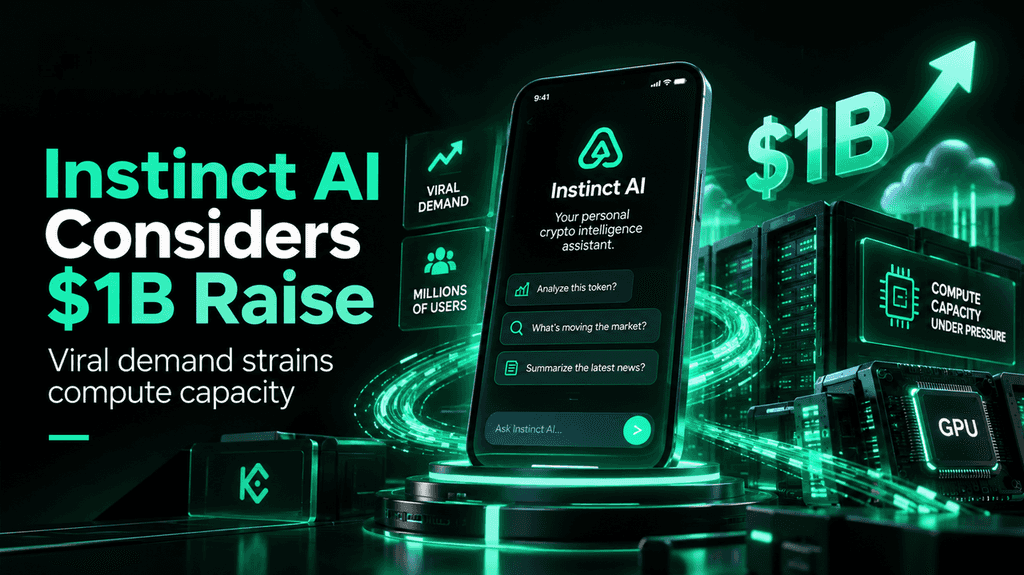
Instinct AI is reportedly considering a $1 billion funding round after rapid adoption of its personal AI assistant placed growing pressure on the computing infrastructure needed to run the service. The potential financing comes only weeks after Instinct completed a $250 million Series B that brought its total reported funding to about $350 million and valued the company at approximately $2.5 billion. The discussions remain preliminary, however, and Instinct has not announced or completed a new $1 billion round.
The development highlights a wider challenge emerging across the AI industry. Personal AI agents are moving beyond simple conversations toward completing bookings, communicating with businesses, managing accounts and carrying out multi-step digital tasks. This transition is part of the broader evolution of how AI agents work, where software can observe information, make decisions and take actions with less direct human involvement. Those capabilities can require substantial inference capacity, making compute availability and infrastructure costs increasingly important as user numbers grow. At the same time, competition is intensifying following Meta's launch of Muse and the wider push by major technology companies into autonomous AI assistants.
Why Instinct AI Is Considering a $1 Billion Raise as Compute Demand Surges
Instinct AI is reportedly exploring a major new financing as demand puts increasing pressure on the infrastructure behind its personal AI assistant. Founder and CEO Noah Shinn has discussed raising as much as $1 billion with prospective investors, according to reporting from The Information. The talks are still at an early stage, so the proposed financing should not be treated as a completed funding round. Even so, considering such a large amount shortly after its previous raise shows how quickly infrastructure requirements can increase when an AI product attracts significant consumer attention.
Why Viral Instinct AI Demand Is Creating a Compute Capacity Crunch
Instinct has reportedly warned some users that the service was operating at full capacity and that responses could take longer while additional resources were brought online. The company's own website has also indicated that access remains limited while Instinct works on scaling its compute capacity. That makes infrastructure one of the company's most immediate challenges as it tries to accommodate more users without reducing response speed or reliability.
The pressure is particularly significant because Instinct is designed to perform actions rather than simply answer prompts. Its AI assistant can interact with online services, communicate with businesses and work through multi-step activities such as bookings, purchases and account-related tasks. These workflows may involve multiple model interactions before a task is completed, increasing inference demand compared with a straightforward chatbot response. As adoption rises, Instinct therefore has to scale both the software experience and the underlying computing resources supporting it.
How a $1 Billion Raise Could Help Instinct Scale Its AI Infrastructure
A potential $1 billion Instinct AI funding round could provide significantly more capital for infrastructure expansion while supporting continued product development. Instinct currently depends heavily on external computing resources, and Shinn has reportedly considered longer-term alternatives that could give the company greater control over its technology stack. Expanding infrastructure could also become important if Instinct moves from limited access toward serving a much larger consumer audience.
Additional capital could support several areas beyond the company's existing funding:
-
More GPU and cloud capacity to accommodate higher usage and more complex AI workflows.
-
Dedicated AI infrastructure that could reduce dependence on rented computing resources over time.
-
Reliability and latency improvements as the number of simultaneous users increases.
-
New agent capabilities and integrations that expand what Instinct can accomplish across digital services.
-
Engineering and infrastructure talent needed to operate increasingly sophisticated AI systems at scale.
The potential financing also illustrates a broader issue across agentic AI. Viral adoption can quickly become an infrastructure problem when every new user generates additional inference workloads. For companies building autonomous assistants, access to affordable computing capacity may therefore become as important as product features or user growth.
How Instinct Reached $350 Million in Funding and a $2.5 Billion Valuation
Instinct's rise from an early-stage AI startup to a company with $350 million in total reported funding and a $2.5 billion valuation happened within a remarkably short period. Investors were drawn to a product designed around practical task completion rather than conventional chatbot interaction, while early users demonstrated potential applications ranging from communication and shopping to reservations and account management. By August 2026, that interest had translated into several financing rounds and placed Instinct among the most closely watched startups in the emerging consumer AI-agent market.
How Instinct's Funding Grew From Early VC Rounds to $350 Million
Instinct's fundraising accelerated over a matter of months rather than years. Forbes reported that Conviction led an early investment that valued the company at roughly $50 million, with Greenoaks also among its early backers. In early August 2026, Kleiner Perkins led a $75 million Series A that valued Instinct at more than $500 million. That rapid increase came while the product was still available to a limited audience, suggesting investors were placing considerable weight on its technology, early engagement and potential position in personal AI.
Later in August, Instinct announced a $250 million Series B co-led by Benchmark and Index Ventures. The financing brought its total reported funding to approximately $350 million and pushed its valuation to about $2.5 billion. The round provided substantially more resources for product development and infrastructure expansion while marking another sharp increase in how private investors valued the company. The $2.5 billion figure remains important because it comes from a completed financing round, unlike higher valuations that could potentially accompany a future $1 billion raise.
Why Investors Gave Instinct AI a $2.5 Billion Valuation
The valuation appears to reflect expectations about the potential size of the personal AI agent market, rather than the characteristics of a mature technology company with an established public revenue base. Instinct is designed to move from understanding a request to carrying out actions across external services. Early users have tested it on tasks involving restaurant reservations, travel planning, online purchases, emails and subscription management. That action-oriented model places Instinct within a broader industry shift toward AI systems capable of completing tasks with less direct human involvement.
Investors may also be looking at the possibility that personal agents could become a new interface for interacting with online services. Interest in artificial intelligence has expanded beyond private AI companies into areas such as the AI and Big Data crypto market, reflecting how the wider AI investment theme now spans multiple parts of the technology and digital-asset sectors. If consumers increasingly delegate routine digital work to AI, successful agent platforms could occupy an important position between users and the applications they rely on every day.
However, a high private valuation does not guarantee commercial success. Instinct still needs to demonstrate sustainable user retention, monetization, security and manageable infrastructure economics as it moves beyond early adoption. Investors therefore need to distinguish between enthusiasm surrounding a fast-growing technology category and evidence that a company can ultimately build a durable business.
What Instinct's Rapid Valuation Growth Says About the AI Agent Market
Instinct's rapid funding history illustrates how aggressively venture capital has moved toward consumer AI assistants and autonomous agents. Its reported valuation increased from more than $500 million after its Series A to around $2.5 billion following its Series B within the same month. That pace reflects strong competition among venture firms seeking early exposure to companies that could benefit if autonomous AI becomes an important consumer technology category. Crypto investors following the same technology theme can also track activity across AI token spot markets, although token-market performance and private AI startup valuations represent separate investment markets with different risks.
Several additional developments make the funding trajectory notable:
-
Prominent venture investors have participated: Backers reported across different rounds include Benchmark, Index Ventures, Kleiner Perkins, Conviction and Greenoaks.
-
Instinct reached a multibillion-dollar valuation before a broad public launch: Investors were therefore relying heavily on early product signals and expectations about future adoption.
-
Operating an AI agent may require substantial ongoing capital: Computing capacity, inference optimization and infrastructure can remain significant expenses even after the initial product has been developed.
-
The eventual business model remains important: Subscriptions and other paid services are possible paths, but long-term economics will depend on revenue per user relative to the cost of running the agent.
-
Competition is expanding rapidly: Large technology companies and well-funded startups are pursuing similar opportunities, raising the importance of product differentiation and execution.
For investors and industry observers, the bigger question is therefore not simply how quickly Instinct achieved its $2.5 billion valuation. The next test is whether strong early enthusiasm can translate into durable usage and a business capable of supporting the significant computing costs associated with increasingly capable AI agents.
Can Instinct Scale Its AI Assistant as Meta Muse Intensifies the Agent Race?
Instinct's next challenge is turning early demand into a reliable and scalable AI assistant while competition in consumer AI agents increases. Meta's September 2026 launch of Muse raises the pressure because Meta enters the market with extensive infrastructure, established consumer platforms and large-scale distribution. Instinct, by contrast, is trying to differentiate itself through an assistant built around completing everyday tasks, communicating with outside services and acting with greater independence than a conventional chatbot. Its future position will depend on whether it can expand capacity without sacrificing performance while keeping infrastructure costs under control.
What Could Determine the Instinct vs Meta Muse AI Agent Race?
The competition is likely to be shaped by which assistant attracts attention first. AI agent adoption will depend on how consistently each platform completes real-world tasks, how easily it connects with services users already rely on, and whether people feel comfortable granting it access to sensitive accounts and information. Instinct may benefit from moving quickly and focusing closely on autonomous task execution, while Meta can draw on a much larger technology ecosystem. Over time, reliability, integration depth, infrastructure efficiency and user trust could become more important competitive advantages than early download numbers or viral interest.
Several factors could shape the Instinct vs Meta Muse competition:
-
Distribution: Meta can expose Muse to users across its existing ecosystem, giving it an immediate advantage in reach.
-
Product differentiation: Instinct can compete by making its agent particularly effective at completing practical, multi-step tasks.
-
Trust and security: Giving an AI access to email, accounts, payments or other personal services increases the importance of strong user controls. The wider security risks of AI assistants become more important as autonomous software receives permission to access sensitive systems and information.
-
Infrastructure efficiency: Instinct needs to support higher usage without allowing inference costs to grow faster than its business can sustain.
-
Wider competition: Meta and Instinct are only part of a larger AI-agent race involving other major technology companies and startups.
For Instinct, success will depend increasingly on execution, reliability and scalability rather than viral attention alone. Meta Muse's arrival demonstrates that major technology companies see significant potential in personal AI agents, but it also raises the standard Instinct must meet as the category develops.
Conclusion
Instinct's reported consideration of a $1 billion funding round shows how quickly the economics of consumer AI can change when a product experiences rapid demand. The company has already raised approximately $350 million and reached a $2.5 billion valuation, yet its compute constraints suggest that building an appealing AI agent is only one part of the challenge. Serving a growing audience with an assistant capable of completing complex real-world tasks requires substantial and potentially expensive infrastructure.
The next phase will reveal whether Instinct can convert its early momentum into a sustainable position in the personal AI agent market. Expanding compute capacity, maintaining reliability, developing a viable business model and earning user trust will all matter as competitors such as Meta Muse increase pressure. The proposed $1 billion raise remains uncertain, but the discussion itself offers a clear signal of how capital-intensive the race to build widely used autonomous AI assistants is becoming.
🔥 Beyond the Headlines: What KuCoin 5.0 Means for You
Market news moves fast — but where you act on it matters just as much. This October, KuCoin launches KuCoin 5.0, transforming KuCoin into a rebuilt platform. Here's what actually changes for you:
-
One account for everything. Older platforms split your money across separate "spot," "margin," and "futures" accounts and expected you to understand why. KuCoin 5.0's unified account removes that entirely — deposit once, and everything is simply there.
-
Stocks, indices, and commodities. KuCoin 5.0 expands beyond crypto into global markets. When crypto chops sideways and equities rally (or the reverse), you rotate in minutes instead of opening a brokerage account and waiting days for fiat rails.
-
Real-world assets (RWA). Tokenized exposure to traditional assets like commodities, right inside your crypto account. One of the fastest-growing segments in global finance is no longer reserved for institutions — you access it from the same balance you trade with.
-
Earn while you learn. Not ready to trade? KCUSD lets your stablecoins earn daily, auto-compounding interest. The lowest-stress way to put your idle deposit to work for 4% yield.
-
An AI assistant in plain language. Ask questions, get market context, understand what you're looking at — built into the platform, no jargon required.
-
An app that doesn't overwhelm. Faster, cleaner, and consistent — intuitive from the first tap, not after a tutorial.
-
Safety you can check, not just trust. A MiCAR-licensed EU entity, Proof of Reserves you can verify yourself, and internationally certified security (SOC 2 Type II, ISO 27001:2022).
Create your account in minutes — and start on the platform built for where crypto is going, not where it's been.
FAQs
What is Instinct AI?
Instinct AI is a personal AI assistant designed to complete digital tasks rather than simply answer questions. It can interact with online services, communicate with businesses and work through multi-step requests on a user's behalf, placing it within the growing category of agentic AI.
Why do AI agents require so much computing power?
A single agent task may involve understanding instructions, planning several actions, accessing external tools, processing new information and checking whether the objective has been completed. Each stage can require additional model inference, making complex agent workflows more computationally demanding than simple text responses.
Is Meta Muse Instinct's only major competitor?
No. Meta Muse is a prominent new entrant, but the AI-agent market is much broader. Major AI companies and technology platforms are developing systems capable of browsing, using tools and completing increasingly complex workflows, meaning Instinct will need to compete across a rapidly expanding field.
What should investors and AI industry watchers monitor next?
Key developments include whether Instinct completes another funding round, expands general availability, improves infrastructure capacity and introduces a clearer monetization strategy. User retention, new integrations, security practices and the cost of serving each user will also provide important signals about whether its early growth can become sustainable.
Disclaimer
The information provided on this page may originate from third-party sources and does not necessarily represent the views or opinions of KuCoin. This content is intended solely for general informational purposes and should not be considered financial, investment, or professional advice. KuCoin does not guarantee the accuracy, completeness, or reliability of the information, and is not responsible for any errors, omissions, or outcomes resulting from its use. Investing in digital assets carries inherent risks. Please carefully evaluate your risk tolerance and financial situation before making any investment decisions. For further details, please consult KuCoin’s Terms of Use and Risk Disclosure.