

How Could New U.S. Tariffs on 16 Economies Affect Bitcoin's Price?
Introduction
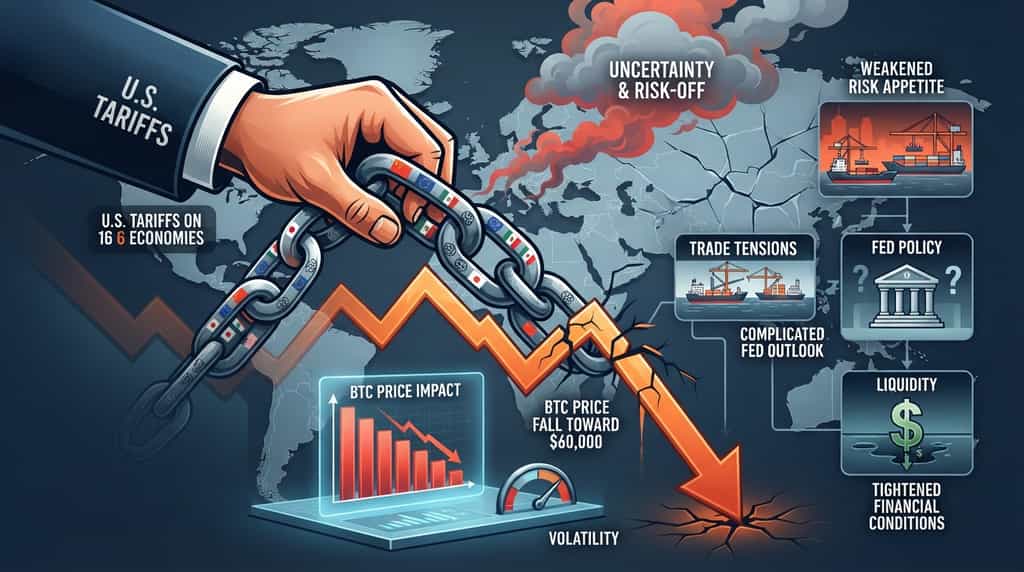
Bitcoin's brief rebound following Jensen Huang's return as Nvidia CEO quickly lost momentum, with BTC price giving back its gains and falling back toward $60,000 on November 24, 2026. The episode highlighted Bitcoin's continued sensitivity to broader financial market sentiment: even a strong recovery in technology stocks did not provide enough support to sustain its rally.
Another macroeconomic risk is now emerging. The Trump administration is preparing to announce potential higher tariffs on China, the European Union, and 14 other economies following a U.S. Trade Representative (USTR) investigation into manufacturing overcapacity and industrial subsidies. Although the investigation has not yet produced a finalized tariff schedule, the prospect of renewed trade tensions could influence Bitcoin through risk appetite, global liquidity, inflation expectations, and institutional capital flows.
Historical market reactions suggest that tariff announcements can trigger sharp BTC sell-offs, but their longer-term effects depend on policy implementation and broader economic conditions.
Quick Answer: Could Higher U.S. Tariffs Push Bitcoin Lower?
Higher U.S. tariffs could create short-term downward pressure on Bitcoin by increasing macroeconomic uncertainty, weakening risk appetite, and encouraging investors to reduce exposure to volatile assets. However, the impact would depend on the actual tariff measures and the market's interpretation of their economic consequences.
-
Risk-off sentiment: Escalating trade tensions could encourage investors to reduce exposure to Bitcoin and other volatile assets.
-
Inflation expectations: Higher import costs could complicate the Federal Reserve's monetary policy outlook and influence interest rate expectations.
-
Liquidity conditions: A stronger U.S. dollar or tighter financial conditions could reduce demand for speculative assets.
-
Historical precedent: Bitcoin experienced significant selling pressure during the October 2025 U.S.-China tariff escalation, although individual policy announcements do not determine longer-term price trends.
-
Policy uncertainty: The latest investigation involves 16 economies, but tariff rates, affected products, and implementation dates have not been finalized as of November 25, 2026.
The central question is therefore not simply whether tariffs are bearish for Bitcoin, but whether the resulting economic and financial conditions create sustained pressure on global risk assets.
What Is Behind the U.S. Plan to Raise Tariffs on 16 Economies?
The latest tariff initiative stems from a U.S. investigation into structural excess manufacturing capacity and production in 16 trading partners. The investigation examines whether industrial policies, subsidies, and other government practices create unfair competitive conditions for U.S. manufacturers.
According to the USTR's March 11, 2026 announcement, the investigation was initiated under Section 301(b) of the Trade Act of 1974. The 16 economies under examination are China, the European Union, Singapore, Switzerland, Norway, Indonesia, Malaysia, Cambodia, Thailand, South Korea, Vietnam, Taiwan, Bangladesh, Mexico, Japan, and India.
The administration's stated objective is to address manufacturing overcapacity and practices that it considers harmful to U.S. commercial interests. The investigation covers manufacturing industries including automobiles, batteries, semiconductors, steel, solar modules, electronics, machinery, and transportation equipment.
Why Could Trade Tensions Affect Bitcoin's Price?
Trade tensions can affect Bitcoin through their influence on global risk appetite, inflation, monetary policy expectations, and financial liquidity. Although Bitcoin operates independently of traditional financial institutions at the protocol level, its market price remains sensitive to the broader financial environment.
The relationship is particularly relevant during periods when institutional investors manage exposure across equities, bonds, commodities, and digital assets.
Why Could Tariffs Trigger a Risk-Off Sell-Off?
Higher tariffs can increase uncertainty about corporate earnings, international trade, and economic growth. When investors become concerned about these factors, they may reduce exposure to assets perceived as relatively volatile.
Bitcoin can be affected by this adjustment because institutional and speculative investors often treat BTC as a risk-sensitive asset rather than a consistent safe haven.
The transmission mechanism is relatively straightforward:
-
Tariff announcements increase uncertainty about international trade.
-
Businesses face potential increases in production costs and supply-chain disruption.
-
Investors reassess earnings expectations and broader economic growth.
-
Risk appetite weakens, potentially triggering selling across equities and cryptocurrencies.
-
Bitcoin experiences additional pressure as leveraged positions are reduced and market liquidity deteriorates.
This does not mean Bitcoin always declines whenever trade tensions increase. If investors interpret the policy as manageable or expect negotiations to produce a resolution, the initial selling pressure may be limited.
The important variable is whether the announcement changes expectations about economic growth and financial conditions.
Could Higher Tariffs Increase Inflation and Delay Federal Reserve Rate Cuts?
Higher import costs could contribute to inflationary pressure, potentially making monetary easing more difficult if the increase becomes broad and persistent.
Tariffs are taxes on imported goods, generally collected from importers. Businesses may absorb some of the additional costs, pass them on to consumers, or adjust their sourcing strategies. The final effect on consumer prices depends on the products affected, the availability of alternative suppliers, exchange rates, and competitive conditions.
For Bitcoin, the main concern is the potential monetary policy response.
If tariff-related price increases make inflation more persistent, the Federal Reserve may have less room to reduce interest rates. Higher expected interest rates can increase the relative attractiveness of yield-bearing assets and raise the opportunity cost of holding non-yielding assets such as Bitcoin.
Conversely, if trade tensions significantly weaken economic growth and employment, expectations of monetary easing could increase. That scenario may eventually support liquidity-sensitive assets, although an initial economic shock could still produce substantial selling pressure.
Therefore, tariffs do not have a mechanically bearish effect on Bitcoin through inflation alone. The balance between inflation and growth is what matters.
How Did Previous U.S. Tariff Announcements Affect Bitcoin?
Previous tariff announcements demonstrate that Bitcoin can experience substantial volatility when trade tensions escalate, but the direction and duration of the reaction depend on the wider macroeconomic environment. Two episodes from 2025 illustrate why tariff-related market reactions should be evaluated over multiple time frames.
What Happened to Bitcoin During the April 2025 Reciprocal Tariff Announcement?
The April 2, 2025 reciprocal tariff announcement triggered an immediate deterioration in global risk sentiment, and Bitcoin initially declined alongside other risk-sensitive assets.
According to historical BTC price data compiled by Clometrix, Bitcoin traded around $86,900 when the announcement began. Its price declined approximately 5.63% over the following 24 hours and reached a maximum drawdown of approximately 14.26% from the event reference price during the first five days.
However, the subsequent recovery was equally important. Bitcoin returned to its pre-announcement reference price on April 20 and finished the 30-day observation period approximately 11.54% higher.
This episode demonstrates two important characteristics of Bitcoin's response to trade policy:
-
Initial reaction: Unexpected tariff announcements can trigger rapid selling as investors reassess macroeconomic risks.
-
Subsequent recovery: The initial decline does not necessarily develop into a prolonged bearish trend if market conditions improve or policy expectations change.
The April episode also illustrates why evaluating Bitcoin's performance using only the first 24 hours after an announcement can produce an incomplete picture.
Why Was the October 2025 Tariff Escalation More Severe?
The October 10, 2025 U.S.-China trade escalation produced a particularly sharp reaction because it involved more than a general discussion of import duties.
President Donald Trump threatened a substantial increase in tariffs on Chinese imports in response to China's restrictions on rare-earth mineral exports. The announcement intensified concerns about a broader trade conflict and its potential implications for global supply chains.
Bitcoin experienced substantial selling pressure during the episode. According to contemporaneous market data reported on October 10, BTC fell below $110,000 during the sell-off, while other major cryptocurrencies experienced even larger declines.
The market reaction was not limited to spot selling. Falling prices also triggered forced liquidations among leveraged traders, amplifying the initial move.
This episode highlighted three interconnected sources of downside risk:
-
Macroeconomic uncertainty: Investors reassessed the potential consequences of an escalating trade conflict.
-
Cross-market selling: Weakness in traditional financial markets coincided with declines in digital assets.
-
Leverage amplification: Forced liquidations increased selling pressure beyond the initial response to the announcement.
The October episode is particularly relevant to the November 2026 tariff developments because it demonstrates that policy threats alone can influence Bitcoin before all the details of a trade measure are finalized.
However, the October sell-off should not be treated as a direct forecast for the current situation. The affected economies, market positioning, monetary policy expectations, and initial economic conditions are different.
What Do These Historical Episodes Tell Us?
The two episodes suggest that tariff-related Bitcoin reactions depend on the interaction between policy uncertainty and broader market conditions.
| Historical event | Initial Bitcoin reaction | Subsequent market behavior |
| April 2, 2025 reciprocal tariffs | Approximately 5.63% decline in the first 24 hours | Recovered to the event reference price by April 20; approximately 11.54% higher after 30 days |
| October 10, 2025 U.S.-China tariff escalation | Sharp sell-off, with BTC falling below $110,000 | Immediate deleveraging and broader crypto-market weakness |
The comparison suggests that a tariff announcement does not determine Bitcoin's longer-term direction by itself. The severity of the policy, the likelihood of retaliation, the market's existing positioning, and the response of monetary policymakers all matter.
For the November 2026 situation, the October 2025 episode may provide a useful reference for short-term volatility, while the April 2025 episode demonstrates why investors should distinguish between an initial shock and a sustained change in market direction.
What Does Glassnode's On-Chain Analysis Reveal About Bitcoin's Current Market Conditions?
Glassnode's on-chain framework provides a complementary way to assess whether macroeconomic uncertainty is translating into actual Bitcoin distribution, investor losses, and weakening demand.
Price declines alone cannot establish whether investors are entering a prolonged distribution phase or whether the market is experiencing a temporary liquidity shock. On-chain metrics help identify how different groups of Bitcoin holders respond as prices change.
The Glassnode on-chain analysis referenced for this topic provides additional market context. Its implications should be evaluated alongside observable price and liquidity data rather than interpreted as a standalone prediction.
Which On-Chain Indicators Matter During a Tariff-Driven Sell-Off?
Four indicators are particularly useful for evaluating Bitcoin's response to macroeconomic uncertainty.
-
Exchange Netflows
Exchange netflows measure the difference between Bitcoin transferred into and out of centralized exchange addresses. Sustained positive netflows can indicate that more BTC is becoming available on exchanges, potentially increasing immediately available selling supply. Negative netflows may indicate withdrawals into self-custody or other destinations.
However, exchange inflows do not necessarily mean that investors are selling. Transfers between custodians, internal exchange wallet movements, and collateral management can also affect the metric.
-
Short-Term Holder Supply in Profit and Loss
Short-term holders (STHs) are generally defined by Glassnode as holders whose coins have been held for less than 155 days. When BTC prices decline below the acquisition costs of recent buyers, a larger share of STH supply may move into unrealized losses. If those investors begin realizing losses, selling pressure can intensify.
A sustained increase in realized losses may therefore indicate that macroeconomic uncertainty is translating into actual investor capitulation rather than simply reducing market sentiment.
-
Realized Profit and Loss
Realized profit and loss measure the difference between the value of coins when they are spent and their estimated acquisition value. During a tariff-related market shock, a sudden increase in realized losses can indicate that investors are exiting positions at unfavorable prices. If this coincides with falling BTC prices and declining liquidity, it may suggest that selling pressure is broadening.
Conversely, declining realized losses after a sharp sell-off can indicate that the most urgent selling activity is easing, although it does not guarantee that a market bottom has formed.
-
Bitcoin Exchange-Traded Fund Flows
Spot Bitcoin ETF netflows provide a separate perspective on institutional investment demand. Persistent net outflows during a period of trade uncertainty may suggest that institutional investors are reducing exposure. Sustained inflows, by contrast, may indicate that demand is recovering despite macroeconomic concerns.
The relationship between ETF flows and Bitcoin prices is not always immediate. Investors can also obtain BTC exposure through other channels that ETF statistics do not capture.
Conclusion
The prospect of higher U.S. tariffs on 16 economies introduces another source of uncertainty for Bitcoin at a time when its recent recovery has already struggled to maintain momentum. The brief rally following Jensen Huang's return to Nvidia demonstrated that positive developments in technology stocks do not necessarily translate into sustained Bitcoin demand.
Historical episodes from April and October 2025 show that tariff announcements can trigger significant BTC volatility, particularly when they coincide with broader financial market weakness and leveraged position liquidations. However, the subsequent recovery following the April announcement also demonstrates that an initial sell-off does not necessarily establish a prolonged bearish trend.
The potential impact of the latest investigation will depend on its final policy outcome, the possibility of retaliatory measures, and the resulting effects on inflation, interest rate expectations, and global liquidity.
For Bitcoin market analysis, the most important distinction is whether trade tensions create a temporary risk repricing or sustained weakness in institutional demand and market liquidity. Monitoring ETF flows, realized losses, exchange activity, stablecoin supply, and Federal Reserve expectations can provide a more comprehensive assessment than reacting to tariff headlines alone.
FAQs
-
Why do U.S. tariff announcements sometimes cause Bitcoin prices to fall?
Tariff announcements can increase economic uncertainty and reduce investor risk appetite. When investors reduce exposure to volatile assets, Bitcoin may experience selling pressure alongside technology stocks and other risk-sensitive investments.
-
Is Bitcoin a safe-haven asset during trade wars?
Bitcoin has not consistently behaved as a safe-haven asset during trade conflicts. Although its decentralized structure makes it independent of any single government's monetary system, its market price has frequently responded to changes in global liquidity and risk appetite.
-
Do tariffs directly affect Bitcoin mining costs?
Yes, potentially. Tariffs on imported mining equipment, semiconductor components, electrical infrastructure, and related hardware can increase costs for mining businesses. The actual impact depends on the products covered, their countries of origin, and available alternative suppliers.
-
Could a stronger U.S. dollar cause Bitcoin to decline?
A stronger U.S. dollar can create downward pressure on Bitcoin by tightening global financial conditions and reducing demand for speculative assets. However, the relationship is not consistent across all market environments, and other factors can outweigh dollar movements.
-
How long can Bitcoin remain volatile after a tariff announcement?
There is no fixed timeframe. Initial volatility may subside within hours or days if investors receive reassuring policy details, but uncertainty can persist for weeks if negotiations, implementation decisions, and retaliatory measures remain unresolved.
Disclaimer
This general market information, possibly from third-party, commercial, or sponsored sources, is provided for reference and educational purposes only and does not constitute financial or investment advice, an offer, solicitation, or guarantee. We disclaim liability for its accuracy, completeness, reliability, and any resulting losses. Investments/trading are risky; past performance doesn’t guarantee future results. Users should research, judge prudently, and take full responsibility. For further details, please consult KuCoin’s Terms of Use and Risk Disclosure.