

Hang Seng Holds 25,000 After a 320-Point Sell-Off: What Drove Hong Kong Stocks?
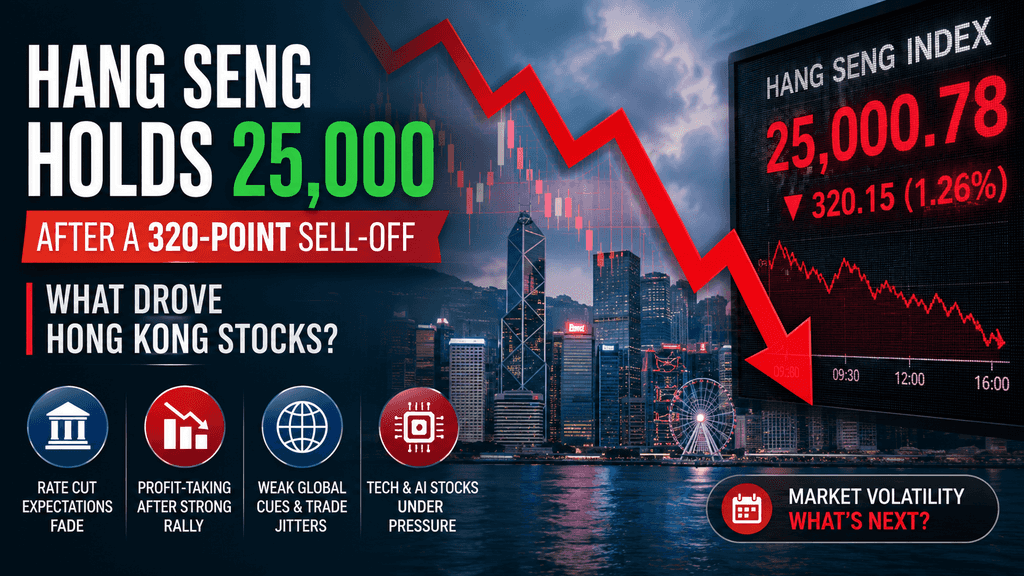
Hong Kong stocks experienced a far more volatile session on September 2, 2026, than the closing numbers initially suggested. The Hang Seng Index fell as low as 25,008 during the session, more than 320 points below the previous close, before recovering almost all of those losses. It eventually finished at 25,311, down just 18 points, or less than 0.1%. The Hang Seng TECH Index was weaker, falling about 0.7% to 4,517, while Main Board turnover declined to roughly HK$216.7 billion.
The dramatic rebound raises a more important question than the modest closing loss: why did Hong Kong stocks sell off so sharply in the first place, and why did buyers return as the Hang Seng approached 25,000? The answer involves more than local market sentiment. Rising global bond yields, renewed U.S.-Iran tensions, higher oil prices, changing Federal Reserve expectations, weakness in technology and electric-vehicle stocks, sector rotation and continued Southbound buying all played a role. Together, they reveal a Hong Kong market facing significant macro pressure but still attracting capital at lower levels.
What Happened to the Hang Seng Index?
The Hang Seng Index opened 48 points lower at 25,280 on September 2 and quickly came under heavier selling pressure. At its intraday low of 25,008, the benchmark was down approximately 320 points and was only a few points above the psychologically important 25,000 threshold. Buyers then returned during the later part of the session, allowing the index to recover to 25,311 by the close. Main Board turnover fell 9.2% from the previous session to approximately HK$216.69 billion.
The relatively flat close concealed significant weakness beneath the surface. The Hang Seng TECH Index lost about 0.7%, while several electric-vehicle, battery and technology-related stocks recorded considerably larger declines. NIO and BYD fell more than 3%, while battery maker CATL lost nearly 5%. In contrast, selected heavyweight financial and property stocks held up much better, helping cushion the broader benchmark.
This distinction is important. A headline saying that the Hang Seng fell only 18 points might suggest an uneventful session. In reality, the market experienced a sharp intraday risk-off move followed by substantial dip buying. Understanding that reversal requires looking beyond Hong Kong itself.
Why Did Hong Kong Stocks Fall So Sharply?
The early sell-off was part of a broader deterioration in global risk appetite. Investors were confronting renewed military exchanges between the United States and Iran, higher oil prices and a sharp rise in sovereign bond yields. Brent crude settled at $95.63 per barrel on September 2 as markets assessed the risk that escalating conflict could disrupt energy supplies through the Middle East.
At the same time, global bond markets were under pressure. The U.S. 10-year Treasury yield reached about 4.8122%, its highest level in roughly three years, while long-term yields in several other developed markets also climbed sharply. Investors were increasingly worried that higher energy costs could keep inflation elevated and force central banks to maintain restrictive monetary policy for longer.
That created a difficult combination for Hong Kong equities. Higher geopolitical risk encouraged defensive positioning, rising oil prices increased inflation concerns, and higher bond yields reduced the relative appeal of stocks. The result was not a Hong Kong-specific crisis, but rather a local expression of a broader global repricing of risk.
Why Rising Bond Yields Matter for the Hang Seng
Bond yields matter to equities because they influence both valuation and investor opportunity costs. When government bond yields rise, investors can earn higher returns from assets that are generally considered less risky than equities. Stocks therefore have to offer more attractive expected returns to justify their higher uncertainty. That adjustment can put downward pressure on valuations, particularly for companies whose expected profits are concentrated far into the future.
Growth and technology stocks are especially sensitive to this effect. Their market values often depend heavily on future earnings expectations, which become less valuable in present-value terms when discount rates rise. Reuters noted that U.S. 10-year Treasury yields approaching 5% had become an increasing threat to stock valuations, particularly in financing-sensitive and high-growth areas such as AI-related investment.
Hong Kong is not isolated from that dynamic. Many of the Hang Seng TECH Index's largest constituents trade on expectations for future growth in internet services, artificial intelligence, cloud computing, electric vehicles and other expansion-oriented sectors. When global yields rise sharply, investors may reduce exposure to these areas even if the companies' underlying businesses have not suddenly deteriorated.
Is the Fed Becoming a Bigger Risk for Hong Kong Stocks?
Federal Reserve expectations are another important part of the current market environment. By September 3, markets were pricing roughly a 62% probability of a 25-basis-point U.S. rate increase in September, up from about 37% one week earlier. Higher oil prices and persistent inflation concerns have helped drive that shift in expectations.
The Federal Reserve matters particularly to Hong Kong because of the Linked Exchange Rate System. The Hong Kong Monetary Authority explains that Hong Kong dollar interbank interest rates generally follow movements in U.S. dollar interest rates under the system, although local liquidity conditions can also create temporary differences. Consequently, changes in U.S. rate expectations can influence Hong Kong funding costs, property financing, corporate borrowing and equity valuations even before the Fed actually changes its policy rate.
This does not mean a Fed rate increase automatically causes the Hang Seng to fall. Chinese growth expectations, company earnings, mainland capital flows and valuations can offset the effect. But when rising Fed expectations occur alongside higher Treasury yields and weaker global risk sentiment, they can create a particularly challenging environment for Hong Kong growth stocks.
Why Did Hang Seng Tech Fall More Than the HSI?
One of the clearest signals from the September 2 session was the gap between the broader Hang Seng Index and the Hang Seng TECH Index. The HSI finished almost unchanged, while the technology benchmark lost about 0.7%. That difference suggests the pressure was concentrated more heavily in growth-oriented and high-beta areas than in the entire market.
Performance within technology was also mixed rather than uniformly bearish. Meituan gained nearly 3% and Xiaomi advanced close to 2%, while Tencent fell about 1%. Southbound data showed that mainland investors were still net buyers of Tencent even as the stock declined, while Alibaba recorded one of the day's largest Southbound net selling totals.
The session therefore looked more like a rotation than a wholesale rejection of Hong Kong technology. Investors were distinguishing between companies rather than simply selling every large internet stock. That pattern becomes important when evaluating whether weakness in the Hang Seng TECH Index is developing into a broader trend or merely reflecting short-term positioning.
Banks, Property and EV Stocks Tell a Different Story
Sector performance explains why the Hang Seng was able to recover despite weakness in growth stocks. Financial shares provided important support. HSBC gained more than 1%, while AIA was little changed and attracted approximately HK$966 million of net Southbound buying, the largest individual net purchase recorded in the day's Stock Connect data.
Property stocks were highly divided. Longfor Group dropped more than 4%, while China Overseas Land gained more than 4%. That divergence suggests investors were not treating the entire property sector as one trade. Instead, they were differentiating among balance sheets, business models and company-specific expectations. A similar pattern has often appeared during periods when investors become more selective rather than abandoning a sector completely.
Electric-vehicle and battery names were much weaker. NIO and BYD shares both fell more than 3%, while CATL declined close to 5%. These companies tend to be sensitive to growth expectations, capital costs and investor appetite for higher-beta themes. Their weakness alongside technology stocks reinforced the impression that September 2 was partly a rotation away from higher-risk growth exposure and toward more defensive or value-oriented areas.
Why Did Buyers Return Near 25,000?
The sharp rebound from 25,008 makes the 25,000 area particularly important. Round-number levels frequently become psychological reference points because large numbers of investors watch them simultaneously. Traders may place orders near them, portfolio managers may use them as risk markers, and market commentary can reinforce their significance.
But psychology alone probably does not explain the recovery. The index's internal structure also mattered. Major financial stocks were comparatively resilient, some property and consumer names remained strong, and mainland capital continued entering Hong Kong equities through Stock Connect. The decline in overall turnover may also suggest that the sell-off did not develop into a full-scale rush for the exits. Main Board turnover was down about 9.2% from the previous day despite the dramatic intraday move.
Still, one rebound does not establish a permanent market floor. The more useful interpretation is that meaningful demand appeared when the Hang Seng approached 25,000. Whether those buyers remain willing to defend the level during another period of macro pressure will provide more information than the first successful test alone.
Are Southbound Investors Buying the Dip?
Southbound capital was one of the strongest counterarguments to the bearish intraday price action. Mainland investors recorded approximately HK$4.09 billion in net purchases of Hong Kong shares on September 2. That was lower than the previous session's HK$7.76 billion, but it still showed that capital was flowing into the market even as the Hang Seng briefly lost more than 300 points. Stock Connect trading accounted for roughly 38.2% of total Main Board turnover.
The buying was selective. AIA recorded around HK$966 million of net Southbound buying, followed by Zhongji Innolight, Tencent, MiniMax and Z.ai. Alibaba, Hua Hong Semiconductor and SMIC were among the largest net sells. This pattern is more informative than the aggregate number alone because it suggests mainland investors were not simply buying the index indiscriminately.
Persistent Southbound inflows can help provide structural support to Hong Kong equities, but they should not be interpreted as a guarantee of higher prices. If global macro conditions deteriorate substantially, foreign selling or broader risk reduction can outweigh mainland demand. For now, however, positive Southbound flows indicate that the September sell-off did not trigger a broad retreat by mainland investors.
Is 25,000 Now the Key Hang Seng Support?
The September 2 low has turned 25,000 into an obvious market reference point. The index approached the level almost exactly before recovering more than 300 points from its intraday losses. That makes 25,000 relevant both psychologically and technically, particularly if future declines again attract buyers around the same region.
What happens around the level matters more than whether the index trades a few points above or below it during a single session. A constructive market structure would involve the Hang Seng holding broadly around the area, technology shares beginning to stabilize, Southbound flows remaining supportive and selling volume failing to accelerate. Repeated failures around 25,000 accompanied by stronger turnover and weaker market breadth would carry a more bearish message.
In other words, 25,000 is best treated as a test rather than a guaranteed floor. Its importance comes from the behavior of buyers and sellers around the level, not from the round number itself.
What Could Help Hong Kong Stocks Recover?
A more sustainable Hong Kong stock recovery would likely require some combination of improving global financial conditions and continued domestic or mainland support. A retreat in U.S. Treasury yields would reduce pressure on growth-stock valuations, while lower expectations for additional Fed tightening could improve risk appetite. Stabilizing oil prices and reduced Middle East tensions could also ease fears that energy costs will keep global inflation elevated.
Hong Kong's internal market drivers are equally important. Continued Southbound inflows could help absorb periods of foreign selling, while stronger technology shares would improve the performance of growth-heavy indices. Better Chinese economic expectations, stronger corporate earnings or supportive policy measures could provide another source of demand independent of U.S. monetary conditions.
The strongest recovery scenario would therefore involve several factors moving together rather than one isolated catalyst. Hong Kong equities sit at the intersection of Chinese fundamentals and global capital markets, so improvements on both sides would create a more durable foundation than a rebound driven only by short-term bargain hunting.
What Could Push the Hang Seng Below 25,000?
The downside scenario becomes more serious if the pressures that triggered the September 2 sell-off intensify. U.S. Treasury yields moving closer to or above 5%, a more hawkish Federal Reserve outlook, another surge in oil prices or further escalation in the U.S.-Iran conflict could all encourage investors to reduce exposure to risk assets. Higher global yields would be particularly challenging if technology stocks remained weak.
Domestic and flow indicators could reinforce the downside. A sustained reversal from Southbound inflows to outflows would remove one source of support. Weak Chinese economic data or deteriorating earnings expectations could also make Hong Kong shares more vulnerable to global selling. If the Hang Seng TECH Index continued underperforming while financial stocks stopped offsetting those losses, the broader benchmark could face greater pressure.
The most important signal would be confluence. A brief move below 25,000 alone would be less meaningful than a break accompanied by rising turnover, weaker technology stocks, negative capital flows and higher global yields. Several bearish indicators moving together would provide stronger evidence that the September rebound had failed.
What Should Investors Watch Next?
The September 2 session showed why investors should not analyze Hong Kong equities through the Hang Seng's closing level alone. A better approach is to monitor several indicators that capture macro conditions, market leadership and capital flows.
| Indicator | What to Watch | Why It Matters |
| Hang Seng Index | Behavior around 25,000 | Shows whether buyers continue defending the key area |
| Hang Seng TECH | Relative performance | Measures sentiment toward growth stocks |
| U.S. 10-year yield | Rising or falling yields | Influences equity valuation and risk appetite |
| Fed expectations | Probability of further tightening | Affects Hong Kong financial conditions |
| Brent crude | Direction of oil prices | Influences global inflation expectations |
| Southbound flows | Net buying or selling | Measures mainland demand for Hong Kong shares |
| Market turnover | Volume during rallies or declines | Helps gauge conviction behind price moves |
| China macro data | Growth and policy direction | Influences earnings and domestic sentiment |
No single indicator can determine the Hang Seng's direction. Positive Southbound flows may support the market while rising Treasury yields pressure valuations. Technology shares may fall while banks rise. The strongest market signals appear when several indicators begin pointing in the same direction.
Was the 320-Point Drop a Warning or a Buying Opportunity?
The September 2 rebound contained encouraging signals. The Hang Seng defended the 25,000 area, Southbound capital remained positive, selected heavyweight financial stocks held up and buyers erased almost all of the day's 320-point decline. Those features suggest that investors were still willing to add exposure when prices fell sharply.
However, the factors that caused the decline did not disappear by the closing bell. Treasury yields remained elevated, oil stayed above $95, technology shares underperformed and markets were still pricing a much higher probability of a September Fed rate increase than they had a week earlier. The rebound therefore showed resilience rather than eliminating risk.
The more balanced interpretation is that September 2 was both a warning and a test of demand. It demonstrated how quickly external macro shocks can hit Hong Kong equities, but it also showed that significant buying interest remains around lower levels. Whether it ultimately looks like a buying opportunity will depend on whether that demand can persist if global conditions become difficult again.
Conclusion: 25,000 Held, but the Bigger Test Is Still Ahead
The most important story from September 2 was not that the Hang Seng Index closed 18 points lower. It was that the benchmark fell more than 320 points, came within eight points of 25,000 and then recovered almost its entire loss before the close.
Global bond-market pressure, higher oil prices, geopolitical tension and changing Fed expectations drove the initial risk-off move. At the same time, resilient financial stocks, selective sector strength and continued Southbound buying helped stabilize the market.
The rebound confirms that buyers are still active, but it does not guarantee that 25,000 will hold indefinitely. The next major test will depend on global yields, technology-stock performance, Chinese fundamentals and capital flows. Those forces will determine whether the September sell-off becomes a temporary shakeout or the start of a more difficult phase for Hong Kong stocks.
FAQs
What is the difference between the Hang Seng Index and Hang Seng TECH Index?
The Hang Seng Index represents a broader group of major Hong Kong-listed companies across industries, while the Hang Seng TECH Index focuses on large technology and innovation-related businesses. This makes the tech index generally more sensitive to growth expectations and changes in market risk appetite.
What time does the Hong Kong stock market open and close?
The Hong Kong Stock Exchange normally has a morning trading session beginning at 9:30 a.m. and an afternoon session that ends at 4:00 p.m. Hong Kong time, with a lunch break between the two main sessions.
Can mainland investors buy Hong Kong stocks?
Eligible mainland investors can access selected Hong Kong-listed stocks through Southbound Trading under the Stock Connect programs linking mainland exchanges with Hong Kong. These flows have become an important source of demand in the Hong Kong market.
Why can Hong Kong stocks move differently from mainland Chinese stocks?
Hong Kong and mainland markets differ in company composition, investor structure, currency and liquidity conditions. Hong Kong also has greater exposure to international institutional capital, meaning global interest rates and overseas risk sentiment can have a stronger immediate influence.
Does a stronger U.S. dollar usually hurt Hong Kong stocks?
A stronger dollar can coincide with tighter global financial conditions and weaker appetite for risk assets, which may pressure Hong Kong equities. However, the relationship is not fixed, and Chinese economic conditions, company earnings and capital flows can sometimes outweigh the dollar's impact.
🔥 KuCoin Offers A More Stable Option in A Volatile Market
If you worry about the frequent ups and downs in the market, and pursue a more stable option to earn money passively, KuCoin is the right place to come:
Simple Earn: Deposit and withdraw tokens anytime, earning stable returns.
Kucoin Earn: Earn stable profits with professional asset management.
Hold to Earn: Earn rewards by holding assets in Funding, Trading, Margin, Futures, Mining, and Unified Accounts.
Staking: Unlock the earning potential of on-chain assets.
Advanced Investments: Advanced Investments offer a variety of structured products to help your money grow in any market.
Shark Fin: Principal Protection and Guaranteed Gains
Dual Investment: Buy low and sell high with transparent return calculations.
Snowball: High yields, with price protection.
Discount Buy: Buy crypto at discount prices.
KCS Loyalty: Level up to enjoy exclusive perks by staking ≥ 1 KCS.
KuCoin Wealth: Discover future value and begin your smart investing journey.
KCS Benefits: Hold and stake KCS to access benefits across the platform.
KCS Staking 2.0: Participate in KCS on-chain governance to earn yield.
Disclaimer: This content is for informational purposes only and does not constitute investment advice. Cryptocurrency investments carry risk. Please do your own research (DYOR).