

Difference Between Coin-Margined and U-Margined Contracts Explained
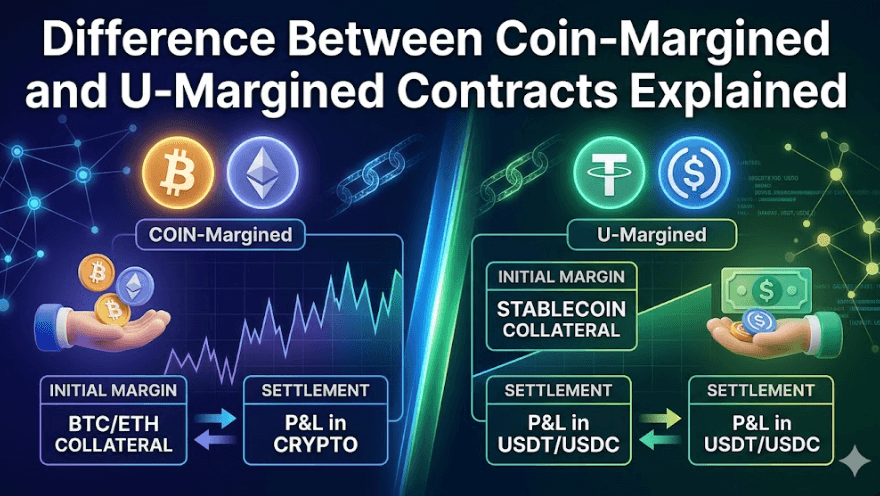
In the landscape of cryptocurrency derivatives, trading futures contracts offers unparalleled opportunities to amplify your profits and hedge your portfolio. However, before you analyze a chart, pick a trading pair, or set your leverage, you must make one foundational decision: How will you fund your margin?
If you open a futures trading terminal on a major exchange, you will immediately be presented with two distinct options: U-Margined Contracts (often labeled as USDT-Margined) and Coin-Margined Contracts.
While both instruments allow you to long (buy) or short (sell) the market with leverage, the underlying mechanics of how your collateral is valued and how your profits are paid out are fundamentally different. Choosing the wrong contract type for the current market conditions can not only limit your potential returns but also expose your portfolio to unnecessary double-liquidation risks.
In this comprehensive guide, we will break down the exact differences between Coin-margined and U-margined contracts, explain their profit and loss (PnL) mechanics, and help you determine which strategy best fits your trading goals.
Key Takeaways
-
The primary distinction lies in the settlement currency. U-margined contracts are quoted and settled in stablecoins (like USDT or USDC), whereas Coin-margined contracts are settled in the underlying cryptocurrency (like BTC or ETH).
-
U-margined futures protect your margin from sudden crypto market crashes because the value of your stablecoin collateral remains pegged to the US Dollar. In contrast, the value of collateral in a Coin-margined account fluctuates with the market price of the coin.
-
Coin-margined contracts are ideal for bull markets, allowing you to multiply your crypto holdings while the coin's fiat value increases. U-margined contracts are preferred in bear markets to lock in fiat value and hedge against downside risk.
-
A U-margined account allows you to trade dozens of different crypto asset pairs using just one single stablecoin balance, making it highly efficient for active day traders.
What Are U-Margined (USDT/USDC) Contracts?
U-margined contracts (frequently labeled as USDT-margined or USDC-margined futures) are derivative instruments where a fiat-pegged stablecoin is used as the base currency for both your margin and your settlement.
To put it simply: you use stablecoins to open the trade, and your profits or losses are paid out in stablecoins. You do not need to actually own the underlying cryptocurrency to trade its price movements.
According to the fundamental trading mechanics outlined by major exchanges, U-margined contracts have become the most popular choice for everyday traders due to two massive advantages:
Intuitive Fiat Valuation
Because stablecoins are pegged 1:1 to the US Dollar, calculating your PnL (Profit and Loss) is incredibly straightforward. If you open a BTC/USDT long position and make a $500 profit, exactly 500 USDT is added to your account. You don't have to do complex mental math to convert crypto fractions back into fiat value.
Margin Stability
This is the most crucial protective feature. When you hold USDT as your collateral, the value of your margin account does not wildly fluctuate with the crypto market. If Bitcoin suddenly crashes by 20%, your underlying USDT collateral remains completely stable, protecting you from unexpected liquidations caused by your margin losing its fiat value.
Cross-Pair Versatility
A U-margined account acts as a universal master key. You can use a single pool of USDT to simultaneously open a long position on Ethereum, a short position on Solana, and a long position on Dogecoin. This eliminates the tedious process of constantly swapping between different coins to trade different charts.
What Are Coin-Margined Contracts?
Coin-margined contracts (frequently referred to as Coin-M or inverse contracts) flip the U-margined logic entirely on its head. Instead of relying on stablecoins, you use the actual underlying cryptocurrency, such as Bitcoin, Ethereum, or Ripple, as both your margin collateral and your settlement currency.
If you want to trade a BTC/USD Coin-margined contract, you cannot use USDT. You must physically hold and deposit Bitcoin into your futures account. When you close a profitable position, your profits are paid out directly in Bitcoin.
According to market dynamics outlined by major exchanges like Bitget and KuCoin, Coin-margined contracts operate with a unique set of mechanics that cater to a very specific type of trader:
The HODLer's Multiplier
Because your profits are paid in the native token, a successful long position creates a compounding effect. Not only do you increase the total amount of Bitcoin you own, but the fiat value of that Bitcoin is simultaneously rising.
Asset-Specific Silos
Unlike the "master key" nature of U-margined accounts, Coin-margined accounts are siloed. If you hold Bitcoin, you can only trade BTC contracts. If you spot a great trading opportunity on Ethereum, you cannot use your Bitcoin collateral to open the trade, you must first acquire and transfer Ethereum into your account.
Volatility Risk
While highly rewarding in a bull run, Coin-margined contracts carry massive risk during a bear market. If the market crashes, you face a double penalty: your open position loses value, and the underlying fiat value of your collateral plunges at the exact same time. This accelerates your margin depletion and dramatically increases the risk of liquidation.
Core Differences: Coin-Margined vs. U-Margined Contracts
To fully grasp which contract type suits your trading style, you must compare them side-by-side. The distinction between these two instruments boils down to three core dimensions: Settlement Currency, Value Fluctuation, and Trading Flexibility.
Here is a quick reference comparison, followed by a detailed breakdown:
| Feature | U-Margined (USDT/USDC) Contracts | Coin-Margined (Coin-M) Contracts |
| Margin & Settlement | Stablecoins (USDT, USDC) | Native Cryptocurrency (BTC, ETH, etc.) |
| Fiat Value of Collateral | Stable (Pegged to USD) | Volatile (Moves with market price) |
| Trading Flexibility | High (Trade any pair with USDT) | Low (Only trade the coin you hold) |
| Best Market Environment | Bear Markets & Sideways Markets | Strong Bull Markets |
-
Settlement Currency
The most fundamental difference is what you are actually holding in your wallet when you open and close a trade.
-
U-Margined: You deposit USDT. If your trade is profitable, your payout is in USDT. You never actually touch Bitcoin or Ethereum.
-
Coin-Margined: You deposit the specific cryptocurrency you want to trade. If you long BTC and win, the exchange pays your profits in Bitcoin.
-
Value Fluctuation
This is where the financial mechanics dramatically diverge. You must account for the fiat value of your collateral while the trade is open.
-
U-Margined: Because your margin is a stablecoin, its fiat value is locked. If you have $1,000 in USDT collateral, it remains $1,000 regardless of whether Bitcoin drops to $10,000 or rockets to $100,000. Your liquidation price is calculated purely based on your trade entry and leverage.
-
Coin-Margined: Your collateral's fiat value is constantly moving. If you use 1 BTC (valued at $50,000) as margin for a long position, and the market crashes to $40,000, your trade is losing money and your margin has simultaneously lost $10,000 in fiat purchasing power. This non-linear risk profile makes Coin-margined contracts inherently more dangerous during downtrends.
-
Trading Flexibility (Ease of Use)
Day traders and long-term investors value their time and portfolio management differently.
-
U-Margined: Offers unmatched efficiency. With a single pool of USDT, you can trade 100 different altcoin pairs. You do not need to convert your assets or manage multiple wallets.
-
Coin-Margined: Requires asset-specific management. If you hold Ethereum but see a sudden breakout opportunity in Solana, you cannot immediately enter a Coin-margined SOL trade. You would first need to sell some ETH for SOL, transfer it to your Coin-M futures account, and then open the trade—a process that costs valuable time and exchange fees.
How PnL is Calculated in Both Modes
U-margined contracts use a linear calculation, while Coin-margined contracts use a non-linear (inverse) calculation. Here is exactly how the math works for a Long (Buy) position in both modes.
The Linear Math: U-Margined Contracts
U-margined PnL is straightforward and intuitive. Because the contract is settled in a stablecoin, your profit scales linearly with the price movement of the underlying asset.
The Formula (For a Long Position):PnL = Position Size × (Exit Price - Entry Price)
Example: Imagine you open a Long position for 1 BTC using USDT as margin.
-
Entry Price: $50,000
-
Exit Price: $60,000
-
Calculation: 1 BTC × ($60,000 - $50,000)
-
Your Profit: 10,000 USDT
For every $1 the price of Bitcoin goes up, you make exactly $1 in USDT.
The Inverse Math: Coin-Margined Contracts
Coin-margined PnL is much more complex because of its inverse (non-linear) nature. In this mode, contracts are usually sized in fixed USD amounts (for example, 1 contract = $1 USD). Because you are putting up Bitcoin to buy USD contracts, your profit is paid out in Bitcoin.
The Formula (For a Long Position):PnL (in BTC) = Total Contract Value in USD × (1 / Entry Price - 1 / Exit Price)
Example: Imagine you use your Bitcoin to buy $50,000 worth of Coin-margined Long contracts.
-
Entry Price: $50,000
-
Exit Price: $100,000 (The price of BTC doubles)
-
Calculation: $50,000 × (1 / 50,000 - 1 / 100,000)
-
Calculation Broken Down: $50,000 × (0.00002 - 0.00001)
-
Your Profit: 0.5 BTC
The Compounding Reality: You earned 0.5 BTC in profit. Because the price of Bitcoin is now $100,000, that 0.5 BTC profit is worth $50,000 in fiat value. Not only did your trade win, but the currency you were paid in also doubled in value.
However, this inverse math also means that as the price of Bitcoin goes infinitely higher, the amount of BTC you earn per dollar of price movement actually gets smaller (even though its fiat value is massive). This curving, non-linear payout structure is exactly why Coin-margined contracts are considered advanced trading instruments.
Pros and Cons
Professional traders do not stick to just one. Instead, they dynamically switch between U-margined and Coin-margined contracts based on the broader macroeconomic trend.
The Bull Market
When the market is in a confirmed, aggressive uptrend, Coin-margined contracts are generally the superior choice.
The Pros:
-
The Compounding Effect: If you believe Bitcoin is going to $100,000, holding your margin in USDT means you miss out on Bitcoin's natural price appreciation. By trading Coin-M contracts, your underlying collateral grows in fiat value while you simultaneously earn more Bitcoin from your successful long positions.
-
Passive Spot Holding: It allows long-term believers (HODLers) to keep their assets in crypto rather than converting them to fiat, ensuring they never miss a spot market pump.
The Cons:
-
Double Exposure Risk: If the bull market suddenly reverses, your long position starts losing money, and the fiat value of your collateral drops simultaneously. This can trigger a liquidation much faster than a U-margined trade.
The Bear Market
When the market is crashing, or chopping sideways in a period of high uncertainty, U-margined contracts become the ultimate defensive weapon.
The Pros:
-
Fiat Protection: During a brutal bear market, holding Bitcoin or altcoins as collateral is highly dangerous. By moving your margin to USDT, you lock in your fiat value. You can then comfortably open Short positions to profit from the crash, knowing your collateral will not shrink in value overnight.
-
Hedging Portfolio Risk: If you hold a large spot portfolio of Ethereum but fear a short-term drop, you can use a small amount of USDT to open a U-margined Short position. If the market drops, your Short trade profits will offset the losses in your spot portfolio.
-
Ultimate Agility: In volatile markets, narratives rotate quickly. A U-margined account allows you to jump from shorting an AI token to going long on a Meme coin in seconds, using the exact same USDT balance.
The Cons:
-
Opportunity Cost: If the market unexpectedly enters a massive bull run, the purchasing power of your USDT margin decreases relative to crypto. You will make profit on your trades, but you missed out on holding the underlying appreciating asset.
Getting Started with Futures Contracts on KuCoin
Before you can trade, you need to allocate your margin. KuCoin makes this incredibly simple. Using the internal transfer feature, you can instantly move assets from your Main or Trading Account to your Futures Account with zero fees.
-
For U-Margined Trading: Transfer your stablecoins (such as USDT) to your Futures account. You can explore the official guide on KuCoin USDT-Margined Contracts to learn more.
-
For Coin-Margined Trading: Transfer your native cryptocurrency (like BTC or ETH). To understand the specific operational mechanics, check out the guide on KuCoin Coin-Margined Contracts.
Conclusion
Choosing between Coin-margined and U-margined contracts is not about finding the perfect instrument, but rather selecting the right tool for the current market environment. U-margined contracts offer intuitive calculations, margin stability, and unmatched flexibility, making them the defensive choice for bear markets and active day trading. Conversely, Coin-margined contracts act as a powerful multiplier during bull runs, allowing long-term investors to grow their crypto bags while the underlying asset appreciates. By understanding these distinct risk profiles and utilizing a secure platform like KuCoin, you can strategically navigate market volatility and optimize your futures trading journey.
FAQs
Can I use USDT to trade a Coin-margined contract?
No, you cannot. Coin-margined contracts are siloed. If you want to trade a Bitcoin Coin-margined contract, you must physically hold Bitcoin in your futures account and use it as your margin. If you only hold USDT, you can only trade U-margined contracts.
Can I get liquidated in both types of contracts?
Yes. Leverage trading carries liquidation risk regardless of the margin type. However, Coin-margined contracts carry a higher risk during a market crash. Because your collateral (e.g., Bitcoin) loses fiat value at the exact same time your Long position is losing money, your margin depletes much faster, bringing your liquidation price closer.
Why does my Coin-margined PnL calculation look weird?
This is because Coin-margined contracts use inverse (non-linear) math. They are quoted in USD but settled in cryptocurrency. As the price of the coin goes higher, the actual amount of cryptocurrency you earn per dollar of price movement gets smaller, even though the fiat value of that crypto is increasing. U-margined contracts do not have this issue as they scale linearly.
Do both contract types charge Funding Fees?
Yes. Both Coin-margined and U-margined perpetual futures utilize a funding fee mechanism to ensure the contract price stays anchored to the spot market price. The only difference is the currency in which the fee is paid. In U-margined contracts, you pay or receive funding fees in USDT. In Coin-margined contracts, the fee is paid or received in the underlying cryptocurrency (like BTC or ETH).
Disclaimer This content is for informational purposes only and does not constitute investment advice. Cryptocurrency investments carry risk. Please do your own research (DYOR).