

CME FedWatch: 86% Chance of a 25 bp Fed Rate Hike at the September 2026 FOMC
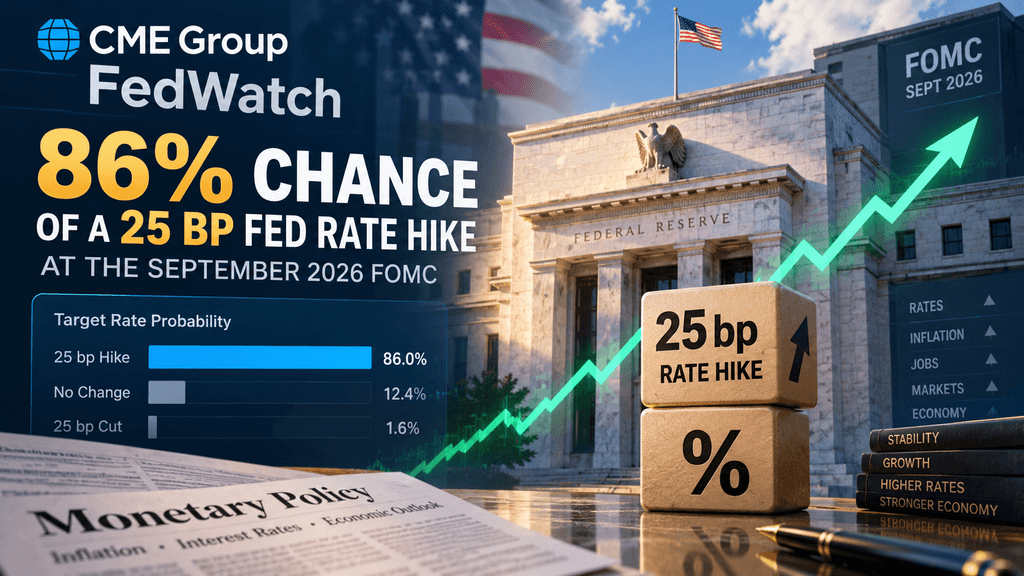
The probability of a Federal Reserve rate hike in September 2026 has risen sharply, with markets pricing about an 86% chance of a 25 basis point increase at the September 15–16 FOMC meeting, according to CME FedWatch. Strong employment data, persistent inflation and higher energy costs have strengthened expectations for tighter policy. A quarter-point hike would raise the federal funds target range to 3.75% -- 4.00%, while investors are also watching the Fed’s projections and guidance for clues about what comes next for stocks, bonds and Bitcoin price movement.
Why Fed Rate Hike Odds Are Rising Ahead of the September 2026 FOMC
Expectations for a Federal Reserve rate hike in September 2026 have risen sharply as fresh inflation and labour-market data strengthen the case for tighter monetary policy. CME FedWatch probabilities moved from roughly 58% after the August jobs report to the mid-80% range following the latest CPI data, with markets recently pricing about an 85%–87% chance of a 25 basis point rate hike at the September 15–16 FOMC meeting. The shift shows how quickly investors have reassessed the interest-rate outlook as new economic data points to persistent inflation alongside continued economic resilience. With the September decision approaching, traders are paying close attention not only to the probability of a hike but also to what the Fed may signal about the path of interest rates through the remainder of 2026.
Inflation Is Keeping Pressure on the Fed
The biggest reason behind the jump in Fed rate hike odds is persistent inflation. U.S. consumer prices rose 0.4% in August, while headline inflation remained at 3.4% year over year. Core CPI, which excludes food and energy, increased 0.3% during the month and 2.4% from a year earlier. Those figures reinforced concerns that inflation is still running above the Federal Reserve's long-term 2% target. Persistent price growth can make policymakers more cautious about keeping borrowing costs unchanged for too long, particularly if consumer demand and economic activity remain relatively strong.
Wholesale inflation has also remained elevated. The Producer Price Index rose 0.4% in August and 5.4% from a year earlier, with higher energy and goods costs contributing to the increase. After the PPI release, markets were already assigning around a 70% probability to a September hike, before stronger CPI data pushed those expectations considerably higher. Producer prices are closely watched because rising costs for businesses can eventually feed into consumer prices if companies pass those expenses on to customers. Together, the CPI and PPI reports have strengthened the view that inflation risks remain significant enough for the Fed to consider another increase in interest rates.
A Strong Labour Market Gives the Fed More Room to Raise Rates
The labour market is another factor supporting expectations for a 25 bp Fed rate hike. The U.S. economy added 162,000 jobs in August, while the unemployment rate remained at 4.1%. The stronger-than-expected report prompted several major banks to revise their forecasts and increased market expectations for a September rate increase. A resilient labour market suggests that the economy may be able to absorb somewhat higher borrowing costs without immediately falling into a sharp slowdown, giving policymakers more flexibility to concentrate on bringing inflation under control.
Taken together, resilient employment and stubborn inflation leave the Fed with more room to focus on controlling prices. Markets now see a September rate hike as the most likely outcome, but the final decision will depend on how policymakers balance inflation risks against the possibility that further tightening could slow economic growth. Investors will therefore be watching not just the rate decision itself, but also the Fed's language on employment, consumer demand and economic momentum. Any sign that policymakers expect growth to remain strong could reinforce expectations that interest rates will stay higher for longer.
Energy Prices Are Adding Another Inflation Risk
Higher energy costs have complicated the inflation outlook ahead of the September 2026 FOMC meeting. Rising gasoline, diesel and oil prices have fed into both consumer and producer inflation, increasing concern that energy-related price pressures could spread into transportation, manufacturing and other parts of the economy. Higher fuel costs can also affect food distribution, logistics and business operating expenses, which means the inflation impact can extend well beyond the energy sector itself. This has made energy prices an increasingly important part of the debate over whether the Fed needs to tighten monetary policy again.
The latest CPI data pushed the probability of a quarter-point September hike from roughly 72% to around 86%, highlighting how rapidly expectations have changed. A 25 basis point increase would lift the federal funds target range from 3.50%–3.75% to 3.75%–4.00%. With a hike increasingly reflected in market prices, investors may now focus just as closely on the Fed's economic projections, the updated rate outlook and comments from policymakers about whether additional increases could follow later in 2026. Those signals could ultimately have a larger impact on financial markets than the widely expected quarter-point move itself.
What a 25 Basis Point Fed Rate Hike Would Mean for Markets
A 25 basis point Fed rate hike would lift the federal funds target range from 3.50%–3.75% to 3.75%–4.00%, increasing borrowing costs across the financial system. Higher policy rates can influence Treasury yields, mortgage rates, corporate financing and the value of the U.S. dollar, while also affecting investor demand for risk assets. Because markets are already assigning a high probability to a September increase, the immediate reaction may depend less on the quarter-point move itself and more on whether the Federal Reserve signals that additional tightening could follow. Investors will therefore be watching the September 2026 FOMC decision, updated economic projections and Chair Kevin Warsh’s comments for clues about how long interest rates could remain elevated.
Stocks, Bonds and Risk Assets Could React Differently
A higher federal funds rate generally makes borrowing more expensive and can put pressure on companies that depend heavily on financing, particularly growth stocks whose valuations are sensitive to future interest rates. Bond markets may also see changes in Treasury yields as traders adjust expectations for the next phase of Fed policy, while a stronger U.S. dollar can create additional pressure on commodities and internationally exposed assets. At the same time, the market response is unlikely to be uniform because a widely expected 25 bp Fed rate hike may already be partly reflected in asset prices. A more hawkish outlook for future rate increases could produce a stronger reaction than the September hike itself, while signals that the Fed is nearing the end of its tightening cycle could ease pressure across stocks, bonds and other risk-sensitive markets.
How a September Fed Rate Hike Could Affect Bitcoin and Crypto
A September Fed rate hike could influence Bitcoin and the wider crypto market through tighter crypto liquidity, changing investor risk appetite and expectations for future monetary policy. Crypto assets are especially sensitive to changes in interest-rate expectations because higher rates can make cash, bonds and other yield-bearing assets more attractive compared with volatile assets such as Bitcoin and altcoins. However, with markets already pricing a high probability of a 25 basis point Fed hike, the eventual reaction may depend more on the Fed's outlook for future rates than on the September increase itself. Traders are therefore watching not only the policy decision but also how the Federal Reserve describes inflation risks, economic growth and the likely path of interest rates through the rest of 2026.
Bitcoin Could Face Short-Term Pressure From Tighter Liquidity
Higher interest rates can reduce the amount of capital investors are willing to allocate to speculative or high-volatility assets. When borrowing costs rise and financial conditions tighten, traders may become more selective about risk, which can create short-term pressure on Bitcoin and crypto prices. Bitcoin often reacts quickly to changes in Fed expectations because the crypto market trades around the clock, allowing investors to respond immediately to policy announcements, movements in Treasury yields and changes in the U.S. dollar.
A Fed rate hike does not automatically mean Bitcoin will fall. If a quarter-point increase is already widely expected, much of the impact may already be reflected in market prices before the announcement. A more significant move could come if the Fed indicates that several additional hikes are likely or that rates may stay elevated for longer than investors previously expected. In that case, tighter liquidity conditions could continue to influence demand for Bitcoin well beyond the September FOMC meeting.
Altcoins May Be More Sensitive Than Bitcoin
The impact of a Fed rate hike on crypto may not be evenly distributed across the market. Smaller altcoins usually carry higher volatility, lower liquidity and greater speculative risk than Bitcoin, which can make them more vulnerable when investors reduce exposure to riskier assets. During periods of tighter monetary policy, traders may cut positions in lower-cap tokens first while keeping more capital in larger and more liquid cryptocurrencies.
This can lead to a shift in market structure rather than a simple decline across every digital asset. Bitcoin could hold up better than parts of the altcoin market if investors become more defensive, while weaker tokens may experience sharper price swings and thinner trading activity. Traders may therefore monitor Bitcoin dominance, stablecoin mechanics, market liquidity and trading volumes for signs that capital is rotating toward larger assets rather than leaving the crypto market completely.
The Fed’s Forward Guidance Could Matter More Than the Hike
For crypto investors, the biggest catalyst may come after the rate decision itself. The September 2026 FOMC meeting will also provide updated economic projections and fresh guidance on how policymakers expect interest rates to develop. If the Fed signals that inflation remains a serious concern and further tightening is likely, Bitcoin, Ethereum and other risk-sensitive assets could face additional pressure as markets adjust to the possibility of higher rates for longer.
A less aggressive message could produce a very different reaction. If policymakers indicate that the September hike may be enough for now or that future decisions will depend heavily on incoming data, traders could begin pricing a slower pace of monetary tightening. That could improve sentiment across the crypto market even if rates are raised by 25 basis points. For this reason, the Fed's forward guidance, rate projections and press conference may ultimately matter more for crypto prices than the headline decision.
Bitcoin’s Reaction Will Depend on What Markets Have Already Priced In
One of the most important questions ahead of the FOMC decision is whether Bitcoin has already priced in a September Fed rate hike. Crypto markets often move before major policy events as traders react to CME FedWatch probabilities, inflation reports, economic data and changes in bond yields. When an outcome becomes heavily anticipated, the actual announcement may have a smaller effect unless the Fed delivers something materially different from market expectations.
The larger volatility risk may therefore come from a surprise. A bigger-than-expected hike, a more hawkish rate outlook or stronger warnings about persistent inflation could pressure Bitcoin and other cryptocurrencies. On the other hand, a softer policy path or signs that the tightening cycle is nearing its peak could support a recovery in risk appetite. For crypto traders, the focus is increasingly shifting from whether the Fed raises rates in September to what the decision reveals about U.S. monetary policy for the rest of 2026 and beyond.
What Investors Should Watch at the September FOMC Meeting
The September 2026 FOMC meeting could be one of the most closely watched Federal Reserve decisions of the year, especially after markets sharply increased their expectations for a quarter-point rate increase. While the headline interest-rate decision will attract immediate attention, investors will also be looking for clues about how policymakers see inflation, economic growth and the path of monetary policy over the coming months. With much of a potential 25 basis point Fed rate hike already reflected in market expectations, the details surrounding the decision could have a greater influence on stocks, bonds, Bitcoin and the broader crypto market. The Federal Reserve has confirmed that the two-day meeting runs on September 15–16, with the policy announcement scheduled for September 16.
The Fed’s Updated Rate Projections Could Shape the Next Market Move
One of the most important releases will be the Fed’s updated Summary of Economic Projections, including policymakers’ expectations for interest rates, inflation, unemployment and economic growth. Investors will examine the new rate projections closely to see whether officials expect further tightening after September or believe the current policy stance will be sufficient. A higher projected path for interest rates could reinforce expectations that borrowing costs will remain elevated for longer, while a more moderate outlook may suggest that the Fed is becoming more comfortable with the inflation trajectory.
Markets will also compare the new projections with previous forecasts to identify changes in the Fed’s economic outlook. Any upward revision to inflation expectations or stronger growth forecasts could support a more hawkish interpretation of the September FOMC decision. By contrast, signs of weaker growth or softer future inflation could reduce expectations for additional hikes. These projections matter because investors are increasingly looking beyond the September meeting and trying to determine where U.S. interest rates could be heading through late 2026 and into 2027.
The Policy Statement and Press Conference May Matter More Than the Headline Decision
Investors should pay close attention to changes in the wording of the FOMC policy statement, particularly language describing inflation, economic activity and future policy decisions. Even small changes can influence market expectations because they may indicate whether officials are becoming more concerned about persistent price pressures or more cautious about tightening financial conditions further. Traders will also watch the vote itself for signs of disagreement within the committee, since a wider split among policymakers could reveal uncertainty about the appropriate path for interest rates.
The post-meeting press conference will provide another opportunity for markets to assess the Fed’s direction. Questions about the possibility of additional rate increases, the conditions needed for the Fed to pause and the outlook for inflation could quickly move Treasury yields, the U.S. dollar and risk assets. For Bitcoin and crypto investors, the key issue will be whether the Fed presents September as a one-off adjustment or the beginning of a longer tightening phase. That distinction could shape market sentiment well beyond the immediate reaction to the September 2026 Federal Reserve rate decision.
Conclusion
The September 2026 FOMC meeting has become a major test for financial markets as CME FedWatch data point to roughly an 86% probability of a 25 basis point Fed rate hike. The rapid change in expectations reflects a combination of resilient employment, persistent consumer inflation, rising producer prices and renewed energy-related price pressures. A quarter-point increase would take the federal funds target range to 3.75%–4.00%, but the rate decision alone may not determine how markets respond.
For investors, the larger question is what comes after September. Updated Fed projections, the policy statement and Chairman Kevin Warsh's press conference could reveal whether policymakers see another hike as necessary later in 2026 or whether they are prepared to pause and assess incoming data. For Bitcoin and crypto markets, that future policy path could be particularly important because expectations around liquidity, interest rates and investor risk appetite can shift rapidly. With a September hike increasingly priced in, any surprise in the Fed's guidance could become the more powerful catalyst for the next major market move.
🔥 Beyond the Headlines: What KuCoin 5.0 Means for You
Market news moves fast — but where you act on it matters just as much. This October, KuCoin launches KuCoin 5.0, transforming KuCoin into a rebuilt platform. Here's what actually changes for you:
-
One account for everything. Older platforms split your money across separate "spot," "margin," and "futures" accounts and expected you to understand why. KuCoin 5.0's unified account removes that entirely — deposit once, and everything is simply there.
-
Stocks, indices, and commodities. KuCoin 5.0 expands beyond crypto into global markets. When crypto chops sideways and equities rally (or the reverse), you rotate in minutes instead of opening a brokerage account and waiting days for fiat rails.
-
Real-world assets (RWA). Tokenized exposure to traditional assets like commodities, right inside your crypto account. One of the fastest-growing segments in global finance is no longer reserved for institutions — you access it from the same balance you trade with.
-
Earn while you learn. Not ready to trade? KCUSD lets your stablecoins earn daily, auto-compounding interest. The lowest-stress way to put your idle deposit to work for 4% yield.
-
An AI assistant in plain language. Ask questions, get market context, understand what you're looking at — built into the platform, no jargon required.
-
An app that doesn't overwhelm. Faster, cleaner, and consistent — intuitive from the first tap, not after a tutorial.
-
Safety you can check, not just trust. A MiCAR-licensed EU entity, Proof of Reserves you can verify yourself, and internationally certified security (SOC 2 Type II, ISO 27001:2022).
Create your account in minutes — and start on the platform built for where crypto is going, not where it's been.
FAQs
Does CME FedWatch guarantee the Fed will raise rates in September 2026?
No. CME FedWatch measures market-implied probabilities based on pricing in 30-Day Fed Funds futures; it does not predict the Federal Reserve’s decision with certainty. The probability can change rapidly as traders respond to economic data, Fed comments and changes in market expectations before the FOMC meeting.
How often do CME FedWatch probabilities change?
FedWatch probabilities can change throughout the trading day because they are derived from futures-market prices. A new inflation report, employment release or unexpected Federal Reserve comment can cause the September Fed rate hike probability to move significantly within hours.
What does a 25 basis point rate hike actually mean?
A 25 basis point hike equals a 0.25 percentage-point increase in the Federal Reserve’s target interest-rate range. For example, moving the federal funds target from 3.50%–3.75% to 3.75%–4.00% would represent a 25 bp increase.
Could the Fed raise rates by more than 25 basis points in September?
A larger increase is possible in principle, but markets generally distinguish between 25 bp, 50 bp and other potential outcomes when pricing Fed expectations. A 50 basis point hike would represent a much more aggressive policy move and would likely require the Fed to see substantially greater inflation risks than markets currently expect.
What is the Fed dot plot and why does it matter?
The Fed dot plot shows where individual FOMC participants expect the federal funds rate to be at the end of future years. Investors use it to judge whether policymakers expect more rate hikes, a long period of unchanged rates or eventual cuts, making it particularly important when the current rate decision is already widely anticipated.
Can the Federal Reserve directly control Bitcoin prices?
No. The Federal Reserve does not set or directly control the price of Bitcoin or other cryptocurrencies. Its policies can influence financial conditions, liquidity, bond yields and the U.S. dollar, which may indirectly affect Bitcoin and crypto market sentiment.
Disclaimer: This article is for informational purposes only and does not constitute investment advice. Crypto assets can be highly volatile, and market conditions, token liquidity and project developments may change rapidly. Readers should conduct their own research and assess their risk tolerance before making financial decisions.