

Bitcoin Hashrate Bear Market 2026: Why Large-Scale Miners Hold the Edge
Introduction
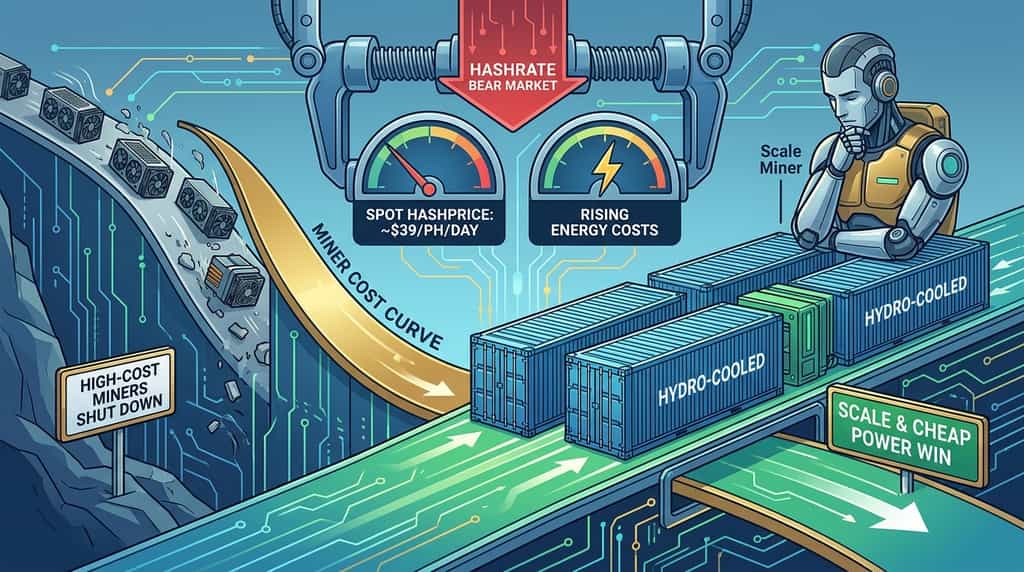
Bitcoin’s computing power has spent more than 300 days below its late-2025 peak — the longest stretch of that kind in about a decade. That is the core of the first true hashrate bear market: network hash rate rolled off near 1.06 ZH/s at year-end 2025 and has since traded closer to 900–950 EH/s, according to difficulty-implied figures compiled from mempool.space by D-Central and live readings from Luxor’s Hashrate Index. Large-scale miners hold the edge because cheap power, newer ASICs, balance-sheet depth, and optional AI or HPC load keep them on the right side of the cost curve while high-cost operators shut down.
This article explains what a hashrate bear market is, why 2026 looks different from earlier miner squeezes, how hashprice and difficulty interact, and why scale now decides who stays online.
What Is Bitcoin’s First Hashrate Bear Market?
A hashrate bear market is a prolonged period when total network computing power stays below a prior peak and fails to make new highs, even if Bitcoin’s price later recovers. That is different from a short weather outage or a two-week difficulty dip.
D-Central’s difficulty history, sourced from mempool.space, shows implied hashrate near 1,061 EH/s at the 25 December 2025 retarget, then a grind lower through 2026, with implied hash around 912 EH/s after the 5 September 2026 adjustment to 127.45 T. Luxor’s Hashrate Index listed a 7-day network hashrate near 946 EH/s and spot hashprice near $38.96 per PH/s per day as of 9 September 2026. Ziven’s public-miner dashboard put network hash at 921.3 EH/s on the same week, with difficulty at 127.45 T.
The label “first” matters because earlier shocks were brief. The 2021 China ban produced a sharp drop and a fast relocation rebound. Winter storms and curtailments in early 2026 also knocked hash offline, including a February retarget of about -11% and a June retarget of about -10%, according to D-Central’s retarget table. Those were events. 2026 is a regime: months below the prior peak, thinner hashprice versus history, and a clear split between low-cost fleets and everyone else.
Rapha Zagury, CEO of Twenty One Capital and founder of Elektron Energy, framed the same point at Bitcoin Asia 2026: mining is not simply a good or bad business. It is a position on the cost curve. Energy-cheap, efficient operators keep margin. High-cost, older fleets power down.
Why Has Bitcoin Hashrate Stalled in 2026?
Hashrate stalled because revenue per unit of compute did not keep pace with power prices, hardware refresh costs, and competition for megawatts from AI and HPC. When hashprice sits in the high $30s per PH/s per day after months in the low $30s, older machines at 20–30 J/TH fall below cash breakeven in many grids.
Luxor’s Hashrate Index showed hashprice near $32.42 about 30 days before early September, then a rebound toward $39–$40 as Bitcoin price firmed — still modest versus prior-cycle peaks. Fees remain a thin slice of miner income. Luxor recorded fees in blocks near 0.65% of rewards in early September 2026, which means almost all revenue still comes from the 3.125 BTC subsidy.
Difficulty does not rescue weak operators immediately. It only resets every 2,016 blocks. D-Central lists the 5 September 2026 retarget at +1.31% to 127.45 T after a -1.31% move on 23 August. Surviving hash can earn a slightly larger share after a down-retarget, but only operators who stayed online capture that.
Power is the other constraint. Cambridge’s Bitcoin Electricity Consumption Index remains the standard official-style estimate of network draw. Mid-2026 commentary tied to CBECI put annualized use on the order of roughly 138 TWh in one widely cited mid-year read, with wide bands because the exact ASIC mix cannot be observed. Whatever the exact TWh print, miners now bid against data centers for the same interconnects. That bid is structural, not seasonal.
How Do Hashprice and Mining Difficulty Decide Who Survives?
Hashprice is the daily dollar value of one unit of hashrate. Difficulty is the protocol’s two-week thermostat. Together they set the cash flow of every rig on the network.
As of 9 September 2026, Luxor listed spot hashprice at $38.96 per PH/s per day, difficulty at 127.45 T, a 7-day hashrate near 946 EH/s, and a next-halving estimate of 12 April 2028. D-Central’s H1 2026 mining report, dated 19 June 2026, put mid-year hashprice near $31.72 per PH/day (fee-inclusive) when prices were weaker. That swing shows why 2026 is a margin year, not a volume year.
Efficiency maps directly onto breakeven power. D-Central’s ASIC dataset and H1 2026 report put the frontier near 9.5 J/TH for hydro-cooled S23-class machines, versus about 17.5 J/TH for a stock S21 and about 29.5 J/TH for a 2022-era S19 Pro. At the same hashprice, a 9.5 J/TH fleet can tolerate roughly double the electricity price of a 19 J/TH fleet before going cash-negative.
Difficulty then reallocates share. When hash leaves, the next epoch gets easier and remaining miners collect a larger slice of the same 3.125 BTC subsidy plus fees. When hash returns, the opposite happens. Large operators with contracted power can choose when to curtail. Small operators with retail power often have only one choice: off.
Why Do Large-Scale Bitcoin Miners Have the Edge?
Large-scale miners win because they stack four advantages that small farms cannot copy quickly: cheaper energy, newer hardware, cheaper capital, and optional second use for the same megawatts.
Public operating hash is already concentrated. Ziven’s September 2026 ranking showed tracked public miners at about 411.2 EH/s, roughly 45% of the network, led by Bitdeer at 76.70 EH/s, Marathon at 70.30 EH/s, CleanSpark at 38.30 EH/s, Riot at 37.20 EH/s, and IREN at 36.00 EH/s. Scale is not a talking point. It is already the market structure.
Energy contracts matter more than headline hash. A one-cent difference in all-in power cost swamps most other line items once machines are installed. Industrial offtake, behind-the-meter generation, and interruptible load deals are negotiated in tens or hundreds of megawatts. Home or container miners buy whatever the local utility posts.
Hardware refresh is a balance-sheet event. S23-class hydro units at about 9.5 J/TH cut joules per terahash by a wide margin versus S19-class stock. Only operators who can finance containers, transformers, and cooling at once can rotate the fleet before hashprice forces a write-down.
Capital markets close that loop. Public miners can issue equity or debt against a disclosed hash and power stack. Private small miners rarely can. When hashprice sits near $39 per PH/s per day, the firm that already owns the substation keeps hashing. The firm that still needs to order PDUs does not.
Option value is the 2026 twist Zagury highlighted: the same interconnect can host Bitcoin ASICs today and HPC or AI load later. That option is real only if the site already has power, land, and cooling. A garage full of last-generation boxes does not have it.
What Happens When High-Cost Miners Shut Down?
High-cost miners shutting down lowers network hash, eases the next difficulty epoch, and transfers block-reward share to whoever remains. That is how a hashrate bear market becomes a share-gain cycle for efficient fleets.
D-Central’s 2026 retarget log is the evidence trail. Large down-moves included about -11.16% on 7 February 2026 and about -10.09% on 14 June 2026. Those prints followed curtailment and margin pressure, then partial rebounds when machines came back. The September 2026 tape still shows hash oscillating in the 850–1,050 EH/s daily range on StatMuse and WhatToMine prints, with implied epoch hash closer to 900–920 EH/s.
Pool concentration magnifies the effect. ChainBulletin’s 8 September 2026 pool table showed Foundry USA near 244.60 EH/s (about 27%), AntPool near 156 EH/s, and F2Pool near 127 EH/s. D-Central’s H1 2026 report put the Nakamoto coefficient at 3 — three pools above half of blocks. When a large public fleet stays on and a long tail of inefficient hash leaves, pool and country shares move, but protocol security does not “break.” Difficulty simply retargets.
Miner treasuries also tell a survival story. CoinCarp, citing on-chain miner balance data as of 5 September 2026, put miner holdings near 1.1919 million BTC, up 261 BTC on the week — the first weekly rise of that size since 26 August. Holding through a hash bear market is easier when power is prepaid and machines are efficient.
How Does AI and HPC Demand Change Bitcoin Mining Economics?
AI and HPC change mining by raising the opportunity cost of every spare megawatt. Miners who own flexible load can sell curtailment or convert halls. Miners who only know SHA-256 cannot.
The physics is simple. A Bitcoin farm is a building, a transformer, and a heat problem. Those are the same scarce inputs an inference cluster needs. When data-center demand bids up industrial power, hashprice must rise or inefficient hash must leave. 2026 has shown both: hash off the peak, hashprice still historically modest even after the September bounce on Luxor’s index.
Flexibility is Bitcoin’s counter. ASICs can drop load in minutes. That makes mining a grid tool in hydro, wind, and gas markets that need a buyer of last resort. Large operators with SCADA, offtake agreements, and multiple sites can monetize that flexibility. Single-site miners usually cannot.
The strategic outcome is a barbell. One end is low-cost Bitcoin-native hash that stays on through thin hashprice. The other end is hybrid energy platforms that treat BTC production as one of several products. The middle — high-cost, single-purpose, last-generation hash — is what a hashrate bear market removes.
Beyond the Headlines: What KuCoin 5.0 Means for You
Market news moves fast — but where you act on it matters just as much. This October, KuCoin launches KuCoin 5.0, transforming KuCoin into a rebuilt platform. Here's what actually changes for you:
-
One account for everything. Older platforms split your money across separate "spot," "margin," and "futures" accounts and expected you to understand why. KuCoin 5.0's unified account removes that entirely — deposit once, and everything is simply there.
-
Stocks, indices, and commodities. KuCoin 5.0 expands beyond crypto into global markets. When crypto chops sideways and equities rally (or the reverse), you rotate in minutes instead of opening a brokerage account and waiting days for fiat rails.
-
Real-world assets (RWA). Tokenized exposure to traditional assets like commodities, right inside your crypto account. One of the fastest-growing segments in global finance is no longer reserved for institutions — you access it from the same balance you trade with.
-
Earn while you learn. Not ready to trade? KCUSD lets your stablecoins earn daily, auto-compounding interest. The lowest-stress way to put your idle deposit to work for 4% yield.
-
An AI assistant in plain language. Ask questions, get market context, understand what you're looking at — built into the platform, no jargon required.
-
An app that doesn't overwhelm. Faster, cleaner, and consistent — intuitive from the first tap, not after a tutorial.
-
Safety you can check, not just trust. A MiCAR-licensed EU entity, Proof of Reserves you can verify yourself, and internationally certified security (SOC 2 Type II, ISO 27001:2022).
Create your account in minutes — and start on the platform built for where crypto is going, not where it's been.
Conclusion
Bitcoin is in its first extended hashrate bear market because computing power has stayed below the late-2025 peak for the longest run in years, while hashprice remains modest versus history. D-Central’s mempool-based difficulty series, Luxor’s Hashrate Index, and public-miner operating totals from Ziven all describe the same tape: roughly 900–950 EH/s of work, difficulty near 127.45 T, hashprice near $39 per PH/s per day in early September 2026, and public fleets already close to half of network hash.
Large-scale miners hold the edge because they buy power in bulk, run machines near 9.5 J/TH instead of 20–30 J/TH, finance refresh cycles, and can point the same megawatts at HPC when economics demand it. High-cost operators exit. Difficulty then hands a larger share of the 3.125 BTC subsidy to whoever stayed on.
For most readers, the practical takeaway is not to build a farm. It is to read hashprice, difficulty, and listed-miner hash as cycle tools — and to express a Bitcoin view on a liquid venue. KuCoin provides spot and derivatives access to BTC without the capex of a substation. The network will keep retargeting every 2,016 blocks. The cost curve will keep choosing winners. Price and hash will not always move together, and that gap is the story of 2026.
FAQs
Is a falling Bitcoin hashrate a sign that the network is unsafe?
No. Security tracks how expensive it is to rewrite recent blocks, and difficulty retargets so that remaining hash still finds blocks about every 10 minutes.
What hashprice level forces older ASICs offline?
It depends on power price and efficiency. At hashprice near $39 per PH/s per day on Luxor’s 9 September 2026 print, high-joule machines on expensive grids go cash-negative first.
Do public miners control the Bitcoin network?
They control a large operating share — Ziven put tracked public hash near 45% in September 2026 — but block production still runs through pools and the protocol’s difficulty rules.
When is the next Bitcoin halving?
Luxor’s Hashrate Index estimated 12 April 2028 as of 9 September 2026, with tens of thousands of blocks still to go and the subsidy still at 3.125 BTC.
Should a retail user mine Bitcoin at home in 2026?
Usually no. Home power rates and last-generation hardware sit on the wrong side of the same cost curve that is already sidelining industrial high-cost hash.
Disclaimer: This article is for informational purposes only and does not constitute financial, legal, or investment advice. Always conduct your own research before interacting with digital assets.