

What Is AI Optical Networking? Why Goldman Sachs Sees a $154 Billion Market by 2028
For much of the AI boom, investors have focused on one question: how many GPUs can technology companies deploy? But as AI clusters become larger and more powerful, another bottleneck is moving to the center of the infrastructure race—how quickly those processors can communicate with one another.
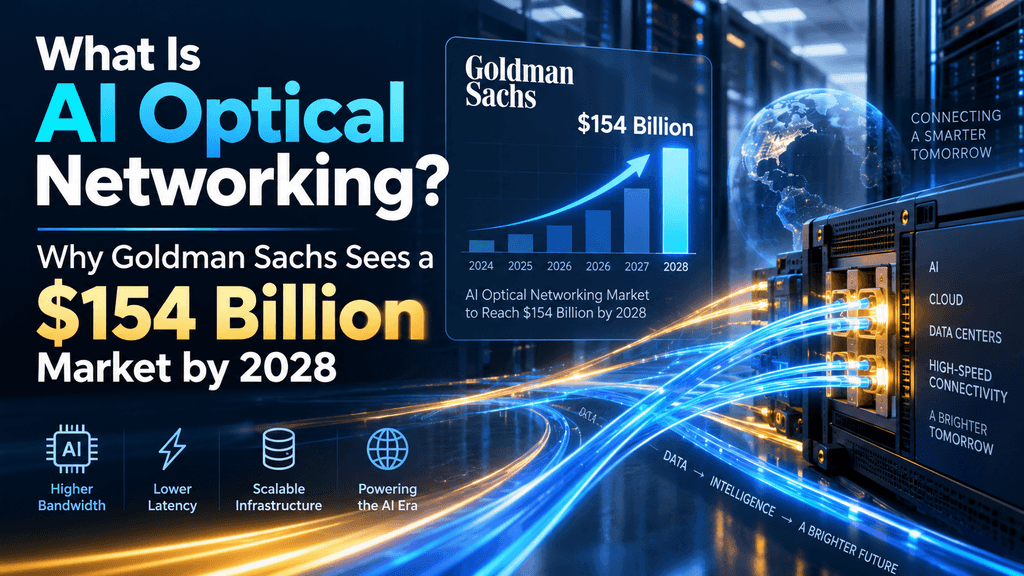
That shift is putting optical networking in the spotlight. Goldman Sachs Research described optical networking as the “next mega trend” in AI infrastructure and estimated that rising computing power per rack and broader AI infrastructure deployment could unlock roughly nine times more total addressable market, taking the opportunity to about $154 billion.
The thesis reflects a broader change in AI infrastructure. Faster accelerators generate more data, larger clusters require more processor-to-processor communication, and traditional electrical connections become increasingly difficult to scale efficiently. Fiber optics, silicon photonics and co-packaged optics could therefore become as important to the next phase of AI infrastructure as GPUs, memory and power systems were to the first.
What Is AI Optical Networking?
AI optical networking refers to the use of light-based communication technologies to transfer data between processors, servers, switches, racks and data-center clusters. Instead of relying entirely on electrical signals moving through copper, optical systems convert data into light and transmit it over fiber.
The easiest way to understand its role is to think of an AI data center as a factory. GPUs and other accelerators are the machines performing the work, while networking is the transportation system connecting them. A factory filled with extremely powerful machines will still perform poorly if materials cannot move between those machines quickly enough. The same principle applies to AI: processors must continuously exchange model parameters, activations, gradients and other data while training or serving large models.
This makes networking part of the effective computing system rather than a peripheral component. Goldman Sachs argues that networking unlocks the computing capability of individual AI chips by allowing many processors to operate together with low latency. As AI clusters grow, the amount spent on moving data can therefore rise alongside the amount spent on generating compute.
Why AI Needs Faster Networks
Traditional enterprise computing often involves workloads that can operate relatively independently across servers. Large AI models are different. Training frequently requires thousands of accelerators to coordinate calculations, exchange large amounts of information and remain synchronized. If communication is delayed, expensive processors can spend part of their time waiting instead of calculating.
That challenge becomes more severe as AI systems scale. A cluster containing hundreds of GPUs requires one level of network capacity; a system containing tens of thousands—or eventually hundreds of thousands—creates a fundamentally different connectivity problem. NVIDIA now describes networking as a critical multiplier of computing power in gigascale AI factories, with its latest Spectrum architecture designed to connect extremely large GPU deployments.
The result is a shift from a chip-centric view of AI to a system-level view. Faster GPUs still matter, but their economic value increasingly depends on memory, power, cooling and networking being capable of keeping them productive. As compute density rises, the cost of an inadequate network also rises because increasingly expensive processors are being underutilized.
Copper vs Fiber: Why Optics Is Gaining Ground
Copper has long been essential inside data centers. It is inexpensive, well understood and highly effective across short distances. For many connections, copper will continue to make economic sense. The problem is that moving electrical signals at ever-higher speeds becomes increasingly challenging as bandwidth and distance increase.
At higher data rates, electrical links face signal loss, power and thermal constraints. Engineers can compensate with retimers, digital signal processing and improved cable designs, but those solutions also consume energy. Optical communication can transmit very high bandwidth over longer distances with lower signal degradation, making it increasingly attractive as AI networks become larger and faster. Goldman Sachs Asset Management noted in July that data centers are expected to shift more transmission links from copper toward fiber optics as requirements for speed and interconnectivity increase.
This does not mean fiber will eliminate copper throughout an AI data center. The more likely transition is gradual: copper remains competitive for many short-reach connections, while optics moves closer to switches and processors as bandwidth requirements make electrical transmission increasingly difficult. The key variable is therefore not whether copper disappears, but how much of each new generation of AI infrastructure requires optical content.
Scale-Up vs Scale-Out: The Two AI Networking Markets
Understanding the optical opportunity also requires distinguishing between scale-up and scale-out networking. Scale-up connects accelerators closely enough that they can behave more like a single computing system. These links prioritize extremely high bandwidth and very low latency because GPUs may need to exchange information continuously during a workload.
Scale-out networking connects larger groups of servers, racks or computing domains so that the overall AI cluster can expand. Optical communication has historically been more established across these longer links. The major change is that optics is beginning to move inward toward scale-up environments as processor density and bandwidth requirements rise.
This distinction helps explain why the potential market can expand much faster than the number of data centers alone. Goldman Sachs' analysis examines both scale-up and scale-out opportunities, as well as the changing mix of copper cables, pluggable optical modules, co-packaged optics and other interconnect components. In other words, AI is not simply building more networks—it is increasing the amount and sophistication of networking required inside each computing system.
What Is Co-Packaged Optics?
Co-packaged optics, usually shortened to CPO, is one of the most important technologies behind the current AI networking discussion. In a conventional architecture, a switching chip communicates electrically across a circuit board before the signal reaches a pluggable optical transceiver, where it is converted into light and transmitted through fiber.
CPO moves the optical engines much closer to the switching silicon, integrating optics with the chip package rather than placing all optical conversion at the edge of the system. The shorter electrical path can reduce signal loss and power consumption while allowing higher bandwidth density. That becomes particularly valuable as network speeds rise and the energy cost of moving data becomes increasingly important.
CPO is already moving beyond the laboratory. Broadcom said in March that its AI infrastructure portfolio included a 102.4-terabit-per-second Ethernet switch with co-packaged optics, alongside 400G-per-lane optical DSP technology and other high-speed connectivity products. NVIDIA is also bringing CPO into its Spectrum-X Ethernet Photonics platform, making the technology part of a commercial AI architecture rather than simply a long-term research concept.
Why Goldman Sachs Sees a $154 Billion Market
The headline number in Goldman Sachs' optical-networking thesis is a potential $154 billion total addressable market. The bank estimates that AI infrastructure growth and rising computing power per rack could create roughly a ninefold expansion in the opportunity across different network configurations. Its analysis includes scale-up and scale-out systems as well as copper cables, pluggable optical modules, CPO and PCB midplanes.
The important point is that the forecast is driven by two forces at the same time. First, the AI industry is deploying more computing infrastructure. Second, each new generation of infrastructure may require more networking content per unit of compute. Adding more GPUs creates additional links, while increasing the bandwidth of each link raises the value of the networking equipment required to connect them.
That creates a potential multiplier effect. AI networking revenue does not have to grow only because more data centers are constructed; it can also grow because every rack, supernode or cluster contains more expensive connectivity. The $154 billion figure should therefore be understood as an estimate based on future system architectures and adoption assumptions—not guaranteed revenue—but it illustrates how dramatically AI infrastructure spending could broaden beyond accelerators themselves.
Why NVIDIA Vera Rubin Matters
NVIDIA's Vera Rubin platform provides one of the clearest signs that optical networking is becoming strategically important. In May 2026, NVIDIA said Vera Rubin was ramping into full production and introduced Spectrum-X Ethernet Photonics, a CPO-based networking system designed to help support future million-GPU AI factories.
According to NVIDIA, Spectrum-X Ethernet Photonics can deliver five times better power efficiency than networks using traditional transceivers, alongside improvements in application uptime and deployment speed. Those figures are NVIDIA's own product comparisons, but they illustrate why networking power has become a major design concern. Every watt consumed moving data is a watt unavailable to the processors performing AI calculations.
The significance is broader than one product generation. When a dominant AI accelerator supplier integrates photonic networking into its platform roadmap, optics becomes part of the system architecture surrounding future compute. That strengthens the argument that connectivity could become a larger share of AI infrastructure spending even if individual networking technologies continue to evolve.
Will CPO Replace Pluggable Optical Modules?
CPO has compelling advantages, but that does not mean traditional pluggable optical modules will disappear. Pluggable transceivers have a major operational advantage: they are modular. Data-center operators can replace, upgrade or service them independently from the switch, and a mature global supply chain already supports the architecture.
CPO trades some of that modularity for tighter integration. Moving optics closer to switching silicon can improve power efficiency and bandwidth density, but packaging, thermal management, manufacturing yield and serviceability become more complicated. These trade-offs mean the optimal solution can vary depending on distance, bandwidth requirements, system architecture and the cost of downtime.
The likely future is therefore more nuanced than a simple CPO-versus-pluggable battle. A rapidly expanding AI networking market could support both technologies in different parts of the network. Even if CPO captures increasing share in the highest-bandwidth environments, overall demand for pluggable optics could continue rising if the total number of optical links grows fast enough.
Which Companies Could Benefit From the AI Optics Boom?
The potential opportunity extends well beyond GPU makers because optical networking is a multi-layer supply chain. Compute systems create demand, networking chips route the traffic, optical components convert electrical signals into light, fiber carries those signals, and networking equipment brings the pieces together.
| Segment | Role in AI networking | Examples |
| AI compute systems | Create demand for high-speed connectivity | NVIDIA |
| Switching and network silicon | Route traffic across AI clusters | Broadcom, NVIDIA |
| Optical components | Lasers, transceivers and related components | Coherent, Lumentum |
| Fiber infrastructure | Carries optical signals | Corning |
| Networking systems | Builds high-speed optical networks | Ciena |
The broader investment thesis is therefore that AI capital spending may diffuse outward. The first wave disproportionately rewarded companies selling compute. Later waves have increased attention on memory, power and cooling, and networking could represent another layer of that expansion. Broadcom's current product portfolio is a useful example: it now spans XPUs, Ethernet switches, optics, SerDes, DSPs and PCIe technologies for large AI clusters.
Still, industry exposure does not automatically make every optical company a winner. Product mix, customer concentration, manufacturing capacity, pricing and technological transitions can create very different outcomes across the supply chain.
What Could Stop the $154 Billion Boom?
The largest risk is straightforward: AI capital expenditure could grow more slowly than expected. Optical-networking forecasts ultimately depend on how quickly hyperscalers, AI labs and enterprises continue building computing infrastructure. A reduction in accelerator deployments would also reduce the need for the connections surrounding those accelerators.
Technology could change the forecast as well. Improved active electrical cables, retimers and other copper technologies may extend electrical connectivity farther than current projections assume. CPO could face manufacturing, packaging or serviceability challenges that slow adoption. Future AI architectures may also organize compute differently, changing how many optical links are required per rack or cluster.
Finally, efficiency is a genuine uncertainty. Better models, software and inference techniques could allow AI providers to perform more work with the same hardware. Goldman Sachs' $154 billion figure is therefore best treated as a scenario for how large the opportunity could become under certain infrastructure assumptions. The more durable thesis is not the exact number—it is that data movement is becoming a larger and more valuable part of AI compute.
Is Optical Networking the Next Big AI Infrastructure Trend?
The technical case is increasingly strong. GPU clusters are becoming larger, bandwidth requirements are rising, and more attention is being paid to the amount of energy consumed simply moving data. Both NVIDIA and Broadcom now have commercial product roadmaps that place advanced optical technologies inside large-scale AI networking systems.
The important question, however, is not whether the market lands precisely at $154 billion by a particular date. Forecasts will change as AI architectures evolve. A more useful metric is the amount of networking and optical content required for each unit of AI compute. If that ratio continues climbing while overall AI compute deployment also expands, optical networking can grow rapidly even if individual technologies or market-share assumptions change.
That makes connectivity one of the most important areas to watch in the next phase of the AI buildout. GPUs may generate intelligence, but increasingly sophisticated networks are required to combine those processors into computing systems large enough to train and operate the next generation of models.
Conclusion: AI Is Becoming a Connectivity Story
The first stage of the generative AI infrastructure boom was dominated by compute. GPUs became the scarce resource, and companies raced to secure accelerators, memory, power and data-center capacity. As those systems scale, the challenge is increasingly shifting toward connecting all that compute efficiently.
Optical networking addresses that challenge by delivering the bandwidth, reach and power efficiency required to move enormous amounts of data between processors and clusters. CPO and silicon photonics could move optics even closer to AI silicon, while next-generation systems such as NVIDIA Vera Rubin show that the transition is already entering commercial infrastructure.
Goldman Sachs' $154 billion forecast may or may not prove exact. The larger trend is more important: the next phase of the AI infrastructure race may increasingly depend not just on how quickly processors can calculate, but on how quickly information can move between them.
FAQs
Is silicon photonics the same as fiber optics?
No. Fiber optics refers primarily to transmitting light through optical fiber, while silicon photonics uses semiconductor manufacturing techniques to integrate optical functions such as modulators and photodetectors onto silicon-based devices. The two technologies can work together: silicon photonic components generate, manipulate or receive optical signals that then travel through fiber.
What is an optical transceiver in an AI data center?
An optical transceiver converts electrical data from servers or networking chips into optical signals for transmission over fiber and converts incoming light back into electrical signals. These modules are critical connection points in modern data-center networks, especially as link speeds rise and fiber reaches deeper into AI infrastructure.
What do 800G and 1.6T mean in optical networking?
They describe the approximate data capacity of a networking connection. An 800G link can carry up to roughly 800 gigabits per second, while 1.6T refers to about 1.6 terabits per second. These numbers describe networking bandwidth rather than the computational performance of a GPU.
Does AI inference need optical networking as much as AI training?
The networking pattern can differ. Training large models often requires intensive synchronization across many accelerators, making extremely fast interconnects essential. Inference can sometimes be distributed more independently, but large-scale reasoning models, agentic AI and high-volume services can also require substantial communication between processors and systems.
Why does networking power consumption matter for AI data centers?
AI data centers operate within finite electrical and cooling budgets. Energy consumed by switches, transceivers and signal-processing equipment reduces the amount available for GPUs and other compute hardware. As AI clusters grow, lowering the energy required to move each bit of data can therefore improve both system efficiency and the economics of the entire data center.
🔥 KuCoin Offers A More Stable Option in A Volatile Market
If you worry about the frequent ups and downs in the market, and pursue a more stable option to earn money passively, KuCoin is the right place to come:

Simple Earn: Deposit and withdraw tokens anytime, earning stable returns.
Kucoin Earn: Earn stable profits with professional asset management.
Hold to Earn: Earn rewards by holding assets in Funding, Trading, Margin, Futures, Mining, and Unified Accounts.
Staking: Unlock the earning potential of on-chain assets.
Advanced Investments: Advanced Investments offer a variety of structured products to help your money grow in any market.
Shark Fin: Principal Protection and Guaranteed Gains
Dual Investment: Buy low and sell high with transparent return calculations.
Snowball: High yields, with price protection.
Discount Buy: Buy crypto at discount prices.
KCS Loyalty: Level up to enjoy exclusive perks by staking ≥ 1 KCS.
KuCoin Wealth: Discover future value and begin your smart investing journey.
KCS Benefits: Hold and stake KCS to access benefits across the platform.
KCS Staking 2.0: Participate in KCS on-chain governance to earn yield.
Disclaimer: This content is for informational purposes only and does not constitute investment advice. Cryptocurrency investments carry risk. Please do your own research (DYOR).