

30-Year Treasury Yield Hits 5.33%, Highest Since 2007: What It Means for Stocks, Bitcoin, and Gold
Treasury Yields Hit 19-Year High as Rising Debt Costs Pressure Stocks and Bitcoin
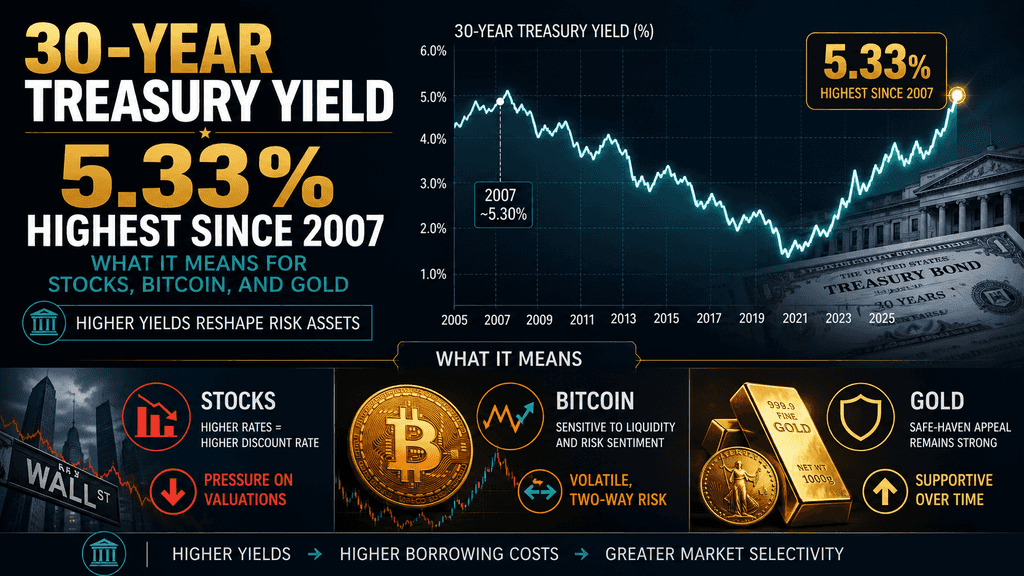
The U.S. 30-year Treasury yield experienced a significant increase, climbing to an impressive 5.33% on August 18, 2026. This notable rise marks its highest level since June 2007, according to the latest available data. This surge in yield shows a growing demand from investors for greater compensation, driven by persistent inflation that remains stubbornly high, substantial government debt issuance, and increased competition from corporate borrowing, particularly linked to the burgeoning infrastructure needs of artificial intelligence. Geopolitical risks stemming from the ongoing conflict between the U.S. and Iran have contributed to this situation, as these tensions have kept oil prices elevated, consistently above $90 a barrel. This movement in yields has extended a broader global bond sell-off, with yields in other major economies, including Japan, Germany, and France, also reaching multi-year highs, indicating a widespread trend in the bond markets.
Recent economic data from the U.S. has been softer than expected, which has tempered near-term expectations regarding potential rate hikes by the Federal Reserve. However, despite this softer data, longer-term yields have continued to rise. This trend suggests that market participants are increasingly focusing on structural fiscal concerns and term premiums, which are influencing their expectations for future interest rates. Elevated long-term yields have significant implications for the economy. They raise the opportunity cost associated with holding non-yielding assets, such as cash or certain commodities, while simultaneously increasing borrowing costs across various sectors of the economy. This dynamic creates near-term pressure on equity valuations and Bitcoin, as investors reassess their risk appetite in light of rising yields. At the same time, the effects on gold are mixed, as investors weigh the benefits of inflation hedges against the backdrop of higher real interest rates, which can diminish the appeal of holding gold as a safe haven asset.
Geopolitical Tensions and Oil Prices Fuel the Latest Yield Spike
Stalled negotiations to end the U.S.-Iran conflict and the expiration of a temporary ceasefire agreement sent oil prices higher, with Brent crude trading above $91 a barrel. Markets interpreted the lack of progress and statements from Iranian officials about shifting to a more offensive posture as heightening the risk of further supply disruptions through the Strait of Hormuz. Higher energy costs feed directly into headline inflation and raise the possibility of broader second-round price pressures if firms pass on elevated input costs. Bond investors responded by demanding higher yields on long-duration Treasuries to protect real returns over a multi-decade horizon. Reuters reported that the 30-year yield touched 5.327% and later reached levels near 5.33%, while the 10-year yield moved above 4.73%. This dynamic occurred even as traders scaled back odds of an immediate Federal Reserve rate increase following softer employment, inflation, and retail sales figures.
The combination of geopolitical risk and energy-driven inflation expectations has therefore become a primary near-term driver of the long end of the curve. Fiscal dynamics amplified the move. Persistent large federal deficits near $2 trillion annually and the need to finance ongoing military-related spending have increased the supply of long-dated debt at a time when traditional foreign buyers have reduced holdings. Data showed major holders, including the United Kingdom, China, and Japan, cutting Treasury positions in recent months. The result is a higher term premium as investors require extra compensation for duration risk, inflation uncertainty, and political factors. Soft economic data that might normally push yields lower has been overshadowed by these structural pressures, producing a steepening of the yield curve where longer maturities have risen more than shorter ones.
Heavy Government Debt Issuance and Rising Term Premiums
The U.S. national debt approaching $40 trillion and interest costs exceeding $1 trillion annually have forced the Treasury to issue substantial volumes of long-term bonds. A recent 30-year auction cleared at yields above 5.2%, the highest for such sales in many years, according to market reports. Investors have absorbed the supply but only at higher yields, reflecting reduced appetite relative to the volume of paper on offer. Barclays strategists have shown the budget deficit outlook as one of three key factors supporting higher long-end yields, alongside corporate issuance and shifts in the buyer base. The Federal Reserve is no longer a large net buyer under quantitative tightening, further increasing the burden on private investors. As a result, the term premium, the extra yield demanded for holding longer-maturity bonds instead of rolling shorter ones, has climbed.
This environment differs from earlier periods of rising short-term rates driven purely by Federal Reserve policy. Soft activity data has limited upward pressure on the front end of the curve, while the long end continues to reprice higher. The divergence produces a steeper curve that signals market concern about the sustainability of fiscal trajectories rather than immediate growth strength. Analysts note that without a meaningful reduction in deficits, slower corporate issuance, or a shift in Treasury issuance strategy toward shorter maturities, the pressure on long yields is likely to persist. Higher government borrowing costs also raise the long-run interest expense burden, creating a feedback loop that can further elevate the required term premium.
AI-Driven Corporate Bond Issuance Competes for Capital
Technology companies building artificial intelligence infrastructure have issued large volumes of long-dated corporate debt, competing directly with Treasuries for investor capital. Goldman Sachs has projected hyperscaler issuance reaching hundreds of billions of dollars in the coming years to fund data center and related capital expenditure. These bonds often offer yields above Treasuries, drawing funds that might otherwise have supported government paper. The simultaneous surge in both sovereign and high-quality corporate supply has forced yields higher across the long end of the curve. Reports indicate that investment-grade issuance overall is on track for record levels, intensifying the competition.
The effect is particularly visible in the 20- and 30-year sectors where both governments and corporations prefer to lock in longer-term funding. Investors can now obtain attractive cash yields from highly rated tech issuers, reducing the relative appeal of lower-yielding Treasuries. This dynamic has contributed to the sustained move in the 30-year yield above 5% for longer stretches than seen since before the global financial crisis. Market participants describe the combination of fiscal supply and AI-related corporate supply as a structural feature rather than a temporary one, suggesting that elevated long-term rates may remain a feature of the investment landscape even if near-term growth softens.
Stocks Face Valuation Pressure from Higher Discount Rates
Rising long-term yields increase the discount rates applied to future corporate cash flows, placing downward pressure on equity valuations, particularly for growth-oriented and technology stocks with distant earnings. On the days surrounding the 5.33% peak, major U.S. indexes declined, with the S&P 500 falling around 0.5% in one session and technology shares showing greater sensitivity. Higher risk-free rates make the guaranteed return on Treasuries more competitive with equity risk premiums, prompting some portfolio reallocation. Analysts have noted that while stocks have previously tolerated 5% yields when earnings growth is strong, a quick further move higher could test valuations more severely.
The impact is not uniform across sectors. Companies with high debt levels face rising refinancing costs, while those with strong balance sheets and pricing power may weather the environment better. Soft economic data has so far limited recession fears, allowing equities to avoid deeper drawdowns. However, strategists warn that equity markets may not be fully prepared for a swift further rise in the 30-year yield toward 6%. The recent sessions have seen futures and cash indexes under pressure as bond yields remained elevated and oil prices added to inflation concerns. Overall market breadth and volatility measures have reflected the increased uncertainty surrounding the cost of capital.
Technology stocks, which often trade on long-duration cash-flow expectations, have displayed particular sensitivity to the rise in long-term yields. The Nasdaq Composite experienced sharper percentage declines than broader indexes in sessions coinciding with the yield spike. Higher discount rates reduce the present value of projected future earnings that are concentrated further in the future, a characteristic of many AI-related and software companies. At the same time, the very same companies are issuing debt to fund expansion, creating a dual effect of higher funding costs and competing supply in the bond market.
Despite the pressure, earnings momentum in parts of the technology sector has provided a partial offset. Some strategists argue that strong profit growth can support valuations even when yields are elevated, provided the growth rate exceeds the increase in the discount rate. Portfolio managers have pointed to large cash holdings in money-market funds as a potential source of support if risk appetite returns. Nevertheless, the immediate market reaction has been one of caution, with technology shares leading declines when long yields moved higher. The interplay between AI investment demand, corporate debt issuance, and equity valuations remains a central theme for investors assessing the sector’s outlook under the new yield regime.
Bitcoin Confronts an Opportunity Cost It Has Rarely Faced
Bitcoin, which generates no yield, faces a heightened opportunity cost when long-term Treasury yields exceed 5%. Over the trailing twelve months, Bitcoin has declined substantially while gold has advanced, highlighting the divergence in performance between the two non-yielding assets. With the 30-year yield at multi-decade highs, investors can obtain a real return from government bonds after accounting for inflation, reducing the relative attractiveness of pure price-appreciation assets. CoinDesk and other market reports have noted that higher sovereign yields threaten to draw capital away from risk assets, including cryptocurrencies.
Bitcoin price movement has shown periods of resilience, holding near the $64,000 level even as stocks declined and yields peaked. Spot ETF flows have provided intermittent support. Yet the broader backdrop of elevated risk-free rates and competing fixed-income opportunities continue to weigh on sentiment. Analysts observe that Bitcoin’s history largely coincides with a lower-yield environment; the current level of long-term rates is outside the range experienced for most of its existence. This structural shift tests the asset’s ability to attract capital when safer alternatives offer meaningful positive real yields. The result has been underperformance relative to gold and more muted upside participation during risk-on episodes.
Gold Displays Mixed but Still Constructive Behavior
Gold has faced the classic headwind of higher opportunity costs from rising real yields yet has retained relative strength over longer horizons. Spot prices pulled back on the day of the latest yield spike, trading near $4,390–$4,400 as the higher rates and firmer dollar weighed on non-interest-bearing bullion. At the same time, gold has posted solid monthly gains and remains well above levels from a year earlier. Market participants interpret the resilience as evidence that investors are also hedging against concerns over sovereign fiscal credibility and persistent inflation risks.
The divergence between gold’s longer-term performance and Bitcoin’s more pronounced weakness underscores differing investor perceptions. Gold continues to benefit from central-bank buying and its traditional role as a store of value during periods of elevated uncertainty. Higher oil prices and geopolitical tensions provide additional support even as yields rise. Analysts note that the relationship is not one-directional; periods of yield spikes can produce short-term pullbacks, yet structural demand and loss-of-confidence hedges have limited downside. The current environment therefore presents gold with competing forces, opportunity cost versus safe-haven and inflation-hedge demand, resulting in more measured price action than pure risk assets.
Global Bond Markets Amplify the U.S. Move
The rise in U.S. long-term yields has occurred alongside similar moves in other major markets. Japanese 10-year yields reached 30-year highs, German bund yields approached levels last seen in 2011, and French yields hit multi-year peaks. This synchronized sell-off indicates that concerns about fiscal trajectories, inflation, and debt supply are not limited to the United States. When yields rise globally, the relative attractiveness of any single market’s bonds can diminish, contributing to higher required returns across the board. Reports from Bloomberg and the Financial Times have described the episode as a broad-based fixed-income rout.
The global dimension adds complexity for portfolio construction. Investors seeking duration exposure must now contend with elevated yields in multiple currencies and jurisdictions. Currency effects and relative value considerations become more important. At the same time, the synchronized nature of the move reduces the diversification benefit that foreign bonds might previously have provided during a pure U.S. rate shock. The result is a more challenging environment for fixed-income allocations that rely on long-duration exposure for income or hedging purposes.
Mortgage Rates and Consumer Borrowing Costs Rise in Parallel
Long-term Treasury yields serve as a primary benchmark for mortgage rates and other consumer and corporate borrowing costs. The climb in the 30-year yield has therefore translated into higher home-loan rates, increasing monthly payments for new borrowers and refinancers. Auto loans, credit card rates, and business borrowing also tend to move higher when long-term yields rise, although the transmission is not always one-for-one. Higher financing costs can dampen housing activity, big-ticket consumer spending, and capital investment, creating a gradual tightening of financial conditions even without Federal Reserve rate hikes.
The effect is particularly relevant given the volume of debt that needs refinancing in coming years. Companies and households that locked in lower rates earlier face a higher cost of capital when rolling over obligations. This dynamic can slow economic activity at the margin and contribute to the soft data already visible in some indicators. Policymakers and market participants watch the feedback loop carefully: higher yields raise borrowing costs, which can slow growth, which in turn may eventually ease inflation and support lower yields, yet the timing and magnitude of that adjustment remain uncertain.
Context Shows High Yields Alone Rarely Trigger Equity Collapse
Historically, periods when the 30-year Treasury yield exceeded 5% have not automatically produced equity market declines of crisis proportions. In several earlier cycles, stocks delivered positive forward returns even with elevated long-term rates, provided the broader economy avoided recession or severe credit stress. The current episode shares some similarities with those periods in that soft data has so far limited recession probability. Yet the combination of high fiscal deficits, AI-related corporate issuance, and geopolitical energy shocks is distinct from pure cyclical rate increases of the past.
Market strategists emphasize that valuation compression from higher discount rates is real and observable in recent sessions. However, earnings growth, cash levels in the system, and the absence of widespread credit deterioration have prevented deeper equity drawdowns to date. The historical record therefore suggests that the level of yields matters less than the accompanying macroeconomic and credit conditions. Investors continue to monitor whether the current yield rise remains orderly or accelerates into a more disorderly sell-off that could challenge that historical pattern.
Portfolio Implications for Multi-Asset Allocations
Elevated long-term yields alter the relative attractiveness of major asset classes. Fixed-income investors can lock in higher income but face price risk if yields continue rising. Equity investors confront higher discount rates that can compress multiples. Non-yielding assets such as Bitcoin and, to a lesser degree, gold must justify their place through price appreciation or hedge characteristics that outweigh the opportunity cost. Cash and short-duration instruments currently offer competitive yields with lower volatility, explaining the large balances held in money-market funds.
Practical portfolio responses include shortening duration in fixed income, emphasizing quality and cash-flow generation in equities, and carefully sizing exposure to pure risk assets. Diversification across assets that respond differently to fiscal and inflation shocks remains relevant. Gold’s relative resilience compared with Bitcoin illustrates that not all non-yielding assets behave identically under the same yield regime. Investors are therefore recalibrating allocations to reflect a higher structural cost of capital rather than assuming a rapid return to the low-yield environment of the prior decade.
What Could Reverse or Extend the Yield Move
Several factors could influence the path of the 30-year yield from current levels. A sustained decline in oil prices following diplomatic progress, clearer evidence of cooling inflation, or a meaningful shift toward fiscal consolidation would support lower yields. Conversely, further escalation of geopolitical tensions, continued large deficits, or additional waves of corporate issuance could push the long end higher still. Soft economic data that prompts more aggressive Federal Reserve easing expectations might lower the front end while leaving the long end elevated if term-premium concerns persist.
Market participants also watch auction outcomes and foreign official buying closely. Weak demand at Treasury auctions or further reductions in foreign holdings would reinforce the upward pressure. Conversely, stronger-than-expected demand or a reduction in issuance volume could stabilize yields. The interplay of these forces will determine whether 5.33% marks a temporary peak or the beginning of a more prolonged period of higher long-term rates.
FAQs
How does a 5.33% 30-year Treasury yield compare with historical averages?
The current level sits well above the long-term average near 3.4% and represents the highest reading since 2007. It remains far below the peaks of the early 1980s when yields exceeded 15%, yet it marks a clear break from the post-2008 low-rate regime that lasted more than a decade. Investors now confront a cost of long-term capital that has not been experienced for most of the current economic cycle.
Why are long-term yields rising even as near-term rate-hike expectations ease?
Soft economic data has reduced the probability of immediate Federal Reserve tightening, allowing shorter-maturity yields to stabilize or decline modestly. Longer yields, however, are more sensitive to inflation expectations, fiscal supply, term premiums, and structural factors such as corporate issuance. The result is a steepening curve driven primarily by the long end rather than a uniform parallel shift higher.
What is the main transmission channel from higher Treasury yields to stock prices?
Higher long-term yields raise the discount rates applied to future corporate earnings, lowering the present value of those cash flows. Growth stocks with earnings expected further in the future typically experience greater sensitivity. In addition, higher risk-free rates increase the opportunity cost of holding equities relative to bonds, prompting some reallocation of capital.
Why has Bitcoin underperformed gold during the recent yield rise?
Both assets generate no yield and therefore face an opportunity-cost headwind when real rates climb. Gold has benefited from central-bank demand, its established role as a monetary hedge, and perceptions of fiscal risk. Bitcoin’s more speculative character and shorter track record have left it more vulnerable to capital rotation toward yield-bearing or more traditional safe-haven assets.
Can higher yields support gold through a loss-of-confidence channel?
Yes. When rising yields reflect concerns about fiscal sustainability or persistent inflation rather than pure growth strength, investors may increase allocations to gold as a hedge against sovereign risk. Recent monthly gains in gold despite the yield spike illustrate this dual influence of opportunity cost versus safe-haven demand.
How do higher 30-year yields affect mortgage rates?
Mortgage rates are closely linked to long-term Treasury yields. A sustained rise in the 30-year yield typically translates into higher home-loan rates, increasing monthly payments for new borrowers and reducing affordability. The effect can slow housing activity and related consumer spending over time.
🔥 KuCoin Offers A More Stable Option in A Volatile Market
If you worry about the frequent ups and downs in the market, and pursue a more stable option to earn money passively, KuCoin is the right place to come:

Simple Earn: Deposit and withdraw tokens anytime, earning stable returns.
Kucoin Earn: Earn stable profits with professional asset management.
Hold to Earn: Earn rewards by holding assets in Funding, Trading, Margin, Futures, Mining, and Unified Accounts.
Staking: Unlock the earning potential of on-chain assets.
Advanced Investments: Advanced Investments offer a variety of structured products to help your money grow in any market.
Shark Fin: Principal Protection and Guaranteed Gains
Dual Investment: Buy low and sell high with transparent return calculations.
Snowball: High yields, with price protection.
Discount Buy: Buy crypto at discount prices.
KCS Loyalty: Level up to enjoy exclusive perks by staking ≥ 1 KCS.
KuCoin Wealth: Discover future value and begin your smart investing journey.
KCS Benefits: Hold and stake KCS to access benefits across the platform.
KCS Staking 2.0: Participate in KCS on-chain governance to earn yield.
Disclaimer: This content is for informational purposes only and does not constitute investment advice. Cryptocurrency investments carry risk. Please do your own research (DYOR).