

Why Could Crypto Hacks Cost $8.5 Billion in 2026? ARK Analyst Highlights Growing Security Risks
Introduction
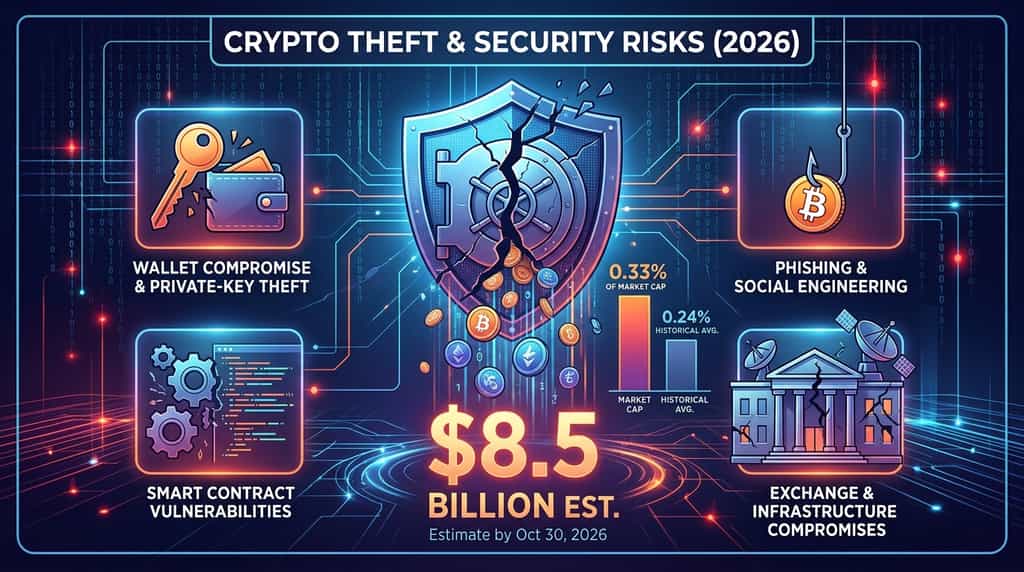
Crypto theft has become a major security concern in 2026. Lorenzo Valente, a digital assets research leader at ARK Invest, estimated that approximately $8.5 billion in cryptocurrency had been stolen by October 30, 2026. The figure represents around 0.33% of the year's average crypto market capitalization, highlighting the financial scale of security failures across the digital asset industry.
The estimate also raises an important question: why are crypto thefts generating such substantial losses, and what do recent incidents reveal about the vulnerabilities of exchanges, wallets, and blockchain protocols?
Key Takeways
The $8.5 billion figure is an analyst estimate of cryptocurrency stolen through October 30, 2026—not a standardized industry-wide total. It nevertheless highlights the scale of security risks facing the crypto sector.
-
A significant share of market value: The estimated losses equaled approximately 0.33% of average crypto market capitalization in 2026.
-
Above the historical average: Valente said annual losses had averaged around 0.24% of crypto market capitalization since 2018.
-
Wallet compromise is particularly costly: CertiK recorded approximately $444.5 million in losses from wallet compromises in H1 2026.
-
Multiple attack methods remain relevant: Phishing, private-key theft, smart contract vulnerabilities, and infrastructure compromises continue to expose digital assets.
-
Security is an ecosystem-wide responsibility: Exchanges, protocol developers, custodians, and individual users all need effective safeguards.
How Much Cryptocurrency Has Been Stolen in 2026?
According to Lorenzo Valente's November 2026 post, approximately $8.5 billion in crypto assets had been stolen through October 30, 2026. Valente compared this with the average market capitalization of the crypto market, estimating that thefts represented 0.33% of that value. He also cited a historical annual average of approximately 0.24% since 2018.
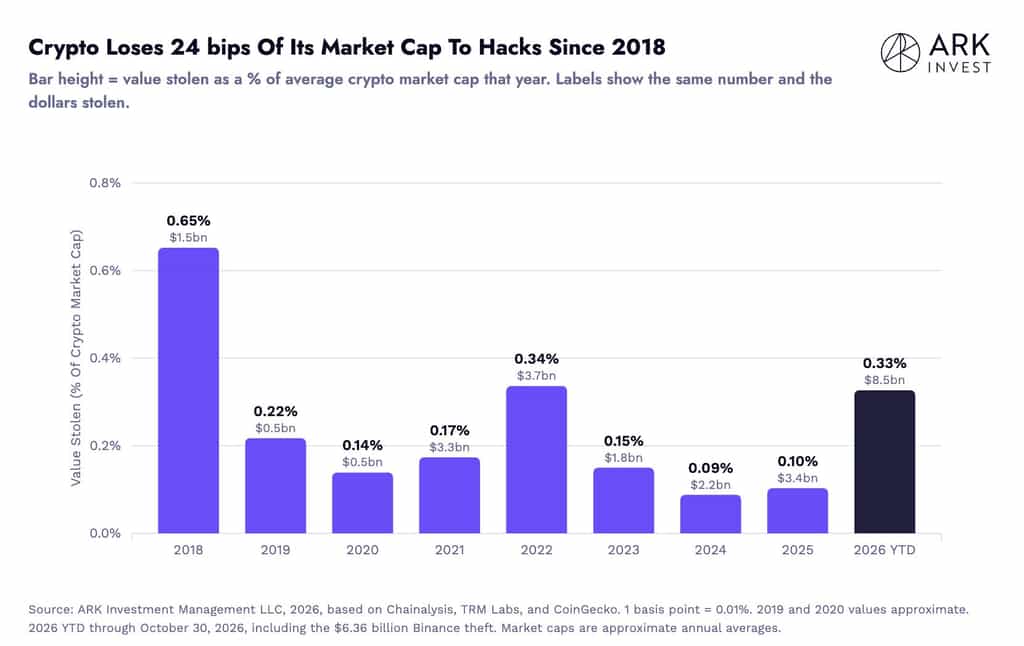
The comparison suggests that crypto theft has become a substantial source of financial risk relative to the market's overall size. However, the $8.5 billion figure should be treated as an attributed analyst estimate rather than an independently audited industry consensus. Different security researchers track different categories of incidents, and their totals are not necessarily directly comparable.
For context, CertiK's Hack3D H1 2026 report, published on July 6, 2026, recorded approximately $1.316 billion in losses across 344 Web3 security incidents during the first half of the year. After accounting for frozen or returned funds, adjusted losses were approximately $1.2 billion.
The report also identified wallet compromise as the most financially damaging category during the period. These figures provide additional evidence of the scale of security incidents, although CertiK's Web3 incident dataset should not be treated as a direct breakdown of Valente's full-year estimate.
What Are the Main Causes of Crypto Theft in 2026?
Crypto theft is not driven by a single vulnerability. Recent security research points to several recurring attack vectors, including compromised wallets, phishing, software vulnerabilities, and weaknesses in operational infrastructure.
1. Wallet Compromise and Private-Key Theft
Wallet compromise was the largest loss category in CertiK's H1 2026 report, accounting for approximately $444.5 million across 33 incidents.
A private key is the cryptographic credential that allows someone to authorize transactions from a blockchain address. If attackers obtain control of a private key or compromise the systems responsible for signing transactions, they may be able to transfer assets without the owner's authorization.
The risk affects both individual holders and large organizations. Exchanges and custodians manage substantial digital asset holdings, making their key storage, signing procedures, and access permissions critical security controls.
2. Phishing and Social Engineering
Phishing attacks exploit human behavior to obtain account credentials, recovery phrases, or transaction approvals. Attackers may impersonate exchanges, wallet providers, project teams, or other trusted entities to persuade users to disclose sensitive information.
CertiK recorded approximately $366.3 million in phishing-related losses across 63 incidents during H1 2026. The number of incidents declined by 52.3% year over year, while reported losses fell by only 10.8%. This indicates that a smaller number of attacks can still produce substantial losses, particularly when high-value accounts are targeted.
Users should be cautious of unexpected login requests, suspicious links, unsolicited software downloads, and messages creating artificial urgency. A legitimate-looking website or communication does not necessarily establish that a request is authentic.
3. Smart Contract Vulnerabilities
Smart contracts automate transactions and other functions on blockchain networks, but flaws in their code can expose funds to exploitation.
CertiK recorded approximately $151.6 million in losses associated with code vulnerabilities across 204 incidents in H1 2026. This category had the highest incident count among the attack types listed in its report.
Common weaknesses include incorrect access permissions, flawed transaction logic, and vulnerabilities in interactions between different contracts. Independent audits, formal verification, and bug bounty programs can help identify these issues, but no audit can guarantee that a deployed contract is completely secure.
4. Exchange and Infrastructure Compromises
Crypto platforms also face risks beyond blockchain code and individual wallet security. Their infrastructure includes employee devices, administrative accounts, internal applications, APIs, withdrawal systems, and wallet-signing processes.
A compromise of one part of this infrastructure may provide attackers with access to systems that control or authorize asset transfers. This makes operational security, privileged-access management, employee awareness, and continuous monitoring essential parts of exchange protection.
The broader implication is that securing digital assets requires more than storing funds in cold wallets. The systems and people involved in authorizing transactions must also be protected.
How Does KuCoin Approach Platform and Asset Security?
KuCoin outlines a multi-layered security framework covering user accounts, wallets, data, applications, and platform operations. Its Security Center describes several measures designed to protect users and platform infrastructure.
These include multi-factor authentication, identity verification, anti-phishing protections, device security, withdrawal safeguards, wallet security, data encryption, API protection, firewalls, DDoS protection, asset exposure scanning, and 24/7 security operations. The platform also describes security education initiatives, including training, exercises, and user alerts.
KuCoin additionally publishes Proof of Reserves information, which allows users to review reported reserve ratios and the platform's reserve verification process. Proof of Reserves can help users assess whether disclosed on-chain assets cover reported user balances at a particular snapshot. It does not, however, guarantee protection against cyberattacks, operational failures, or every other form of platform risk.
These measures illustrate several important components of exchange security, but no single control can eliminate all threats. Account protection, wallet management, infrastructure security, reserve transparency, and incident response must work together.
Conclusion
Lorenzo Valente's estimate that approximately $8.5 billion in cryptocurrency had been stolen by October 30, 2026, highlights the continuing security challenges facing the digital asset industry. Although the figure is not a standardized industry-wide total, independent research from security firms also documents substantial losses from wallet compromise, phishing, and code vulnerabilities.
The underlying issue is broader than individual hacking incidents. Cryptocurrency platforms and protocols depend on interconnected systems involving private keys, smart contracts, user accounts, and operational infrastructure. A weakness in any of these areas can expose significant amounts of digital assets.
For exchanges, robust security requires layered controls, continuous monitoring, restricted access, and transparent asset reporting. For individual users, protecting credentials and verifying transactions remain essential. KuCoin's published security framework and Proof of Reserves disclosures provide information about some of the measures it applies, while also illustrating why platform security should be assessed through multiple dimensions rather than a single metric.
FAQs
1. How much cryptocurrency was stolen in 2026?
Lorenzo Valente of ARK Invest estimated that approximately $8.5 billion in cryptocurrency had been stolen through October 30, 2026. The estimate represented around 0.33% of average crypto market capitalization for the year.
2. What percentage of crypto market capitalization did the losses represent?
Valente estimated that the $8.5 billion in losses equaled approximately 0.33% of average 2026 crypto market capitalization. He also cited a historical annual average of approximately 0.24% since 2018.
3. What are the most common types of cryptocurrency attacks?
Major attack categories include wallet compromise, private-key theft, phishing, social engineering, smart contract vulnerabilities, and exchange infrastructure compromises. Their frequency and financial impact vary across reporting periods and research methodologies.
Disclaimer
This general market information, possibly from third-party, commercial, or sponsored sources, is provided for reference and educational purposes only and does not constitute financial or investment advice, an offer, solicitation, or guarantee. We disclaim liability for its accuracy, completeness, reliability, and any resulting losses. Investments/trading are risky; past performance doesn’t guarantee future results. Users should research, judge prudently, and take full responsibility. For further details, please consult KuCoin’s Terms of Use and Risk Disclosure.