

Tesla Q2 2026 Earnings: Revenue Hits Record $28.24 Billion While EPS Misses and Free Cash Flow Turns Negative $1.1 Billion
Introduction
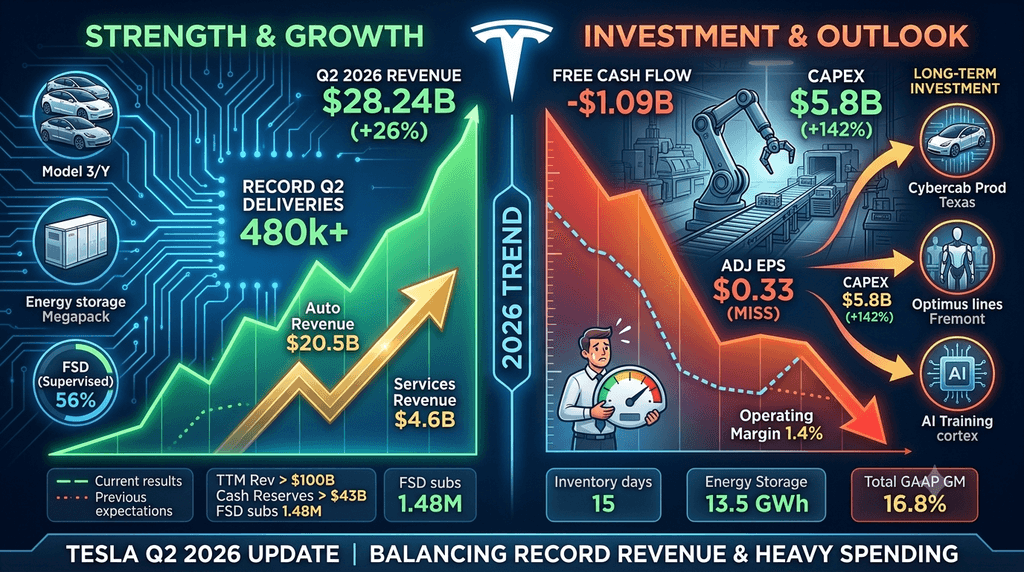
Tesla delivered its strongest second-quarter revenue ever in 2026, yet profitability and cash flow told a different story. According to Tesla’s official Q2 2026 Update released on July 22, 2026, total revenue reached $28.24 billion, a 26% year-over-year increase that beat analyst estimates ranging from $25.71 billion to about $26.4 billion. Adjusted non-GAAP earnings per share came in at $0.33, missing expectations of $0.51 to $0.55. Free cash flow swung to a negative $1.09 billion after capital expenditures surged 142% to $5.79 billion. GAAP net income fell 5% to $1.11 billion. The results highlight strong vehicle deliveries and services growth alongside heavy spending on AI, robotics, and manufacturing capacity.
What Were the Key Financial Results in Tesla’s Q2 2026 Earnings?
Tesla’s Q2 2026 revenue of $28.24 billion marked the first time trailing twelve-month revenue exceeded $100 billion, driven by record second-quarter vehicle deliveries and growth across segments. Automotive revenue rose 23% to $20.52 billion. Energy generation and storage revenue increased 13% to $3.14 billion. Services and other revenue jumped 50% to $4.58 billion, achieving record profitability and margin.
Gross profit totaled $4.75 billion, with total GAAP gross margin at 16.8%, down from 17.2% a year earlier and below the roughly 19.4% to 19.5% consensus. Operating expenses climbed 47% to $4.35 billion, pushing operating income down 57% to $398 million and operating margin to 1.4% from 4.1%. Adjusted EBITDA stood at $3.27 billion with an 11.6% margin.
GAAP diluted EPS was $0.32, while non-GAAP diluted EPS was $0.33. The non-GAAP figure excluded a large unrealized gain related to Tesla’s SpaceX equity investment. Net income attributable to common stockholders was $1.11 billion on a GAAP basis and $1.15 billion on a non-GAAP basis. Operating cash flow rose 85% to $4.70 billion, yet the sharp rise in capital spending produced the free cash flow deficit.
These figures come directly from Tesla’s Q2 2026 Update and confirm that volume growth outpaced near-term profitability as the company accelerated long-term investments.
How Did Vehicle Deliveries and Production Perform in Q2 2026?
Tesla achieved record second-quarter vehicle deliveries of 480,126 units, up 25% year-over-year, according to both the production and deliveries release and the full financial update. Production reached 451,758 vehicles, a 10% increase. Model 3 and Model Y accounted for the vast majority of both production and deliveries.
Inventory days of supply fell to 15 from higher levels earlier in the year, indicating improved demand-supply balance. Cumulative vehicle deliveries surpassed 9.7 million. Active FSD (Supervised) subscriptions grew 56% year-over-year to 1.48 million, with more than 55% of new North American deliveries including an FSD subscription at the time of purchase.
Energy storage deployments hit 13.5 GWh, up 41% year-over-year and the second-highest quarterly figure on record. Trailing twelve-month energy storage deployments also set a new high. Supercharger stations rose to 8,704 and connectors to 82,357.
The delivery beat supported the revenue surprise, while FSD subscription growth and energy deployments provided additional top-line contributions and longer-term growth signals.
Why Did Tesla’s Free Cash Flow Turn Negative in Q2 2026?
Free cash flow turned negative $1.09 billion primarily because capital expenditures more than doubled year-over-year to $5.79 billion and rose sharply from the prior quarter. Operating cash flow remained healthy at $4.70 billion, but it could not cover the elevated investment level.
Tesla stated it is in its largest period of investment, focused on AI compute, battery and semiconductor manufacturing, Cybercab production, Optimus robotics lines, and supporting infrastructure. Cash, cash equivalents, and short-term investments ended the quarter at $43.52 billion, down modestly from the prior quarter but still up 18% year-over-year.
Management guided full-year 2026 capital expenditures to more than $25 billion and indicated spending would continue rising over the next two to three years. The company noted that free cash flow could remain negative through at least the end of 2026 as these investments scale. This marks the first negative free cash flow quarter in more than two years and reflects a deliberate shift toward future capacity rather than near-term cash generation.
How Is Tesla Progressing on AI, Robotaxi, and Optimus Initiatives?
Tesla advanced several key programs that underpin its long-term strategy. Cybercab production began at Gigafactory Texas. Robotaxi operations expanded and are now live in seven major metro areas, with unsupervised rides ramping in multiple cities. Construction of Optimus production lines started at the Fremont Factory after Model S and Model X lines were decommissioned, with initial units planned for training data collection later in 2026.
AI training compute capacity expanded with Cortex systems in Texas. Battery cell, cathode, and lithium refining capacity continued to ramp. Site work progressed for solar and semiconductor manufacturing. FSD adoption accelerated, and cumulative miles driven with FSD (Supervised) continued to grow.
These initiatives explain the elevated capital spending and operating expenses. Management emphasized that scaling will be non-linear and that the focus remains on long-term value creation through real-world AI applied to transportation, energy, and productivity.
How Did the Stock and Market React to the Q2 2026 Results?
Tesla shares declined in after-hours trading following the release, with drops reported in the 3% to 4% range on the day of the announcement. The stock had already been under pressure earlier in 2026. Investors weighed the strong revenue and delivery beats against the earnings miss, margin contraction, and negative free cash flow driven by higher spending guidance.
Analyst commentary highlighted the tension between near-term profitability and the company’s aggressive investment cycle in AI and robotics. Some viewed the results as confirmation that vehicle sales are currently funding the broader technology bets. The market reaction reflected ongoing debate over the timeline for returns on those investments.
Should You Trade Tesla-Related Assets on KuCoin?
Tesla’s Q2 2026 results underscore both the resilience of its core business and the scale of its AI and robotics ambitions. For traders interested in exposure to Tesla or related market movements, KuCoin offers a range of crypto assets, tokenized stock products where available, and trading pairs that can reflect broader equity market sentiment. Users can access deep liquidity, competitive fees, and tools for both spot and derivatives trading.
To get started, create an account on KuCoin, complete verification, and explore available markets linked to major technology and EV themes. Always conduct independent research, consider risk management, and remember that cryptocurrency and tokenized assets carry volatility. Past performance of related equities does not guarantee future results in digital markets. KuCoin provides the platform; trading decisions remain the user’s responsibility.
Join KuCoin 9th Anniversary Trading Campaign
KuCoin is celebrating its 9th anniversary with a special platform campaign filled with exclusive rewards, trading activities, and limited-time offers. Don’t miss the chance to participate and enjoy the benefits as the exchange marks nine years of growth and innovation. Visit the official campaign page now:

Conclusion
Tesla’s Q2 2026 earnings delivered record revenue of $28.24 billion and record second-quarter deliveries of 480,126 vehicles, confirming demand strength and growth in energy storage and services. Adjusted EPS of $0.33 missed expectations, operating margin compressed to 1.4%, and free cash flow turned negative $1.09 billion as capital expenditures rose 142% to $5.79 billion. FSD subscriptions reached 1.48 million and energy deployments hit 13.5 GWh.
The results illustrate a company prioritizing long-term capacity in AI compute, Cybercab, Optimus, and supporting infrastructure while its core automotive, energy, and services businesses continue to expand. Full-year capital spending is guided above $25 billion, with further increases expected in coming years. Cash reserves remain substantial at more than $43 billion.
Investors and market participants will continue to monitor delivery trends, margin recovery, FSD monetization, Robotaxi scaling, and the pace of robotics progress. The quarter reinforces Tesla’s dual identity as both a high-volume vehicle manufacturer and a heavy investor in next-generation technologies.
FAQs
What was Tesla’s exact free cash flow in Q2 2026?
Tesla reported free cash flow of negative $1.09 billion in Q2 2026, calculated as operating cash flow of $4.70 billion minus capital expenditures of $5.79 billion.
How many vehicles did Tesla deliver in Q2 2026?
Tesla delivered 480,126 vehicles in the second quarter of 2026, a 25% increase from the same period a year earlier and a record for the second quarter.
What was the year-over-year change in Tesla’s operating expenses?
Operating expenses increased 47% year-over-year to $4.35 billion, driven primarily by higher spending on AI, research and development, and robotics.