

Samsung and SK Hynix Leveraged ETFs Head for First Monthly Outflow Since Launch as Nearly $1 Billion Exits
2026/08/26 15:04:00
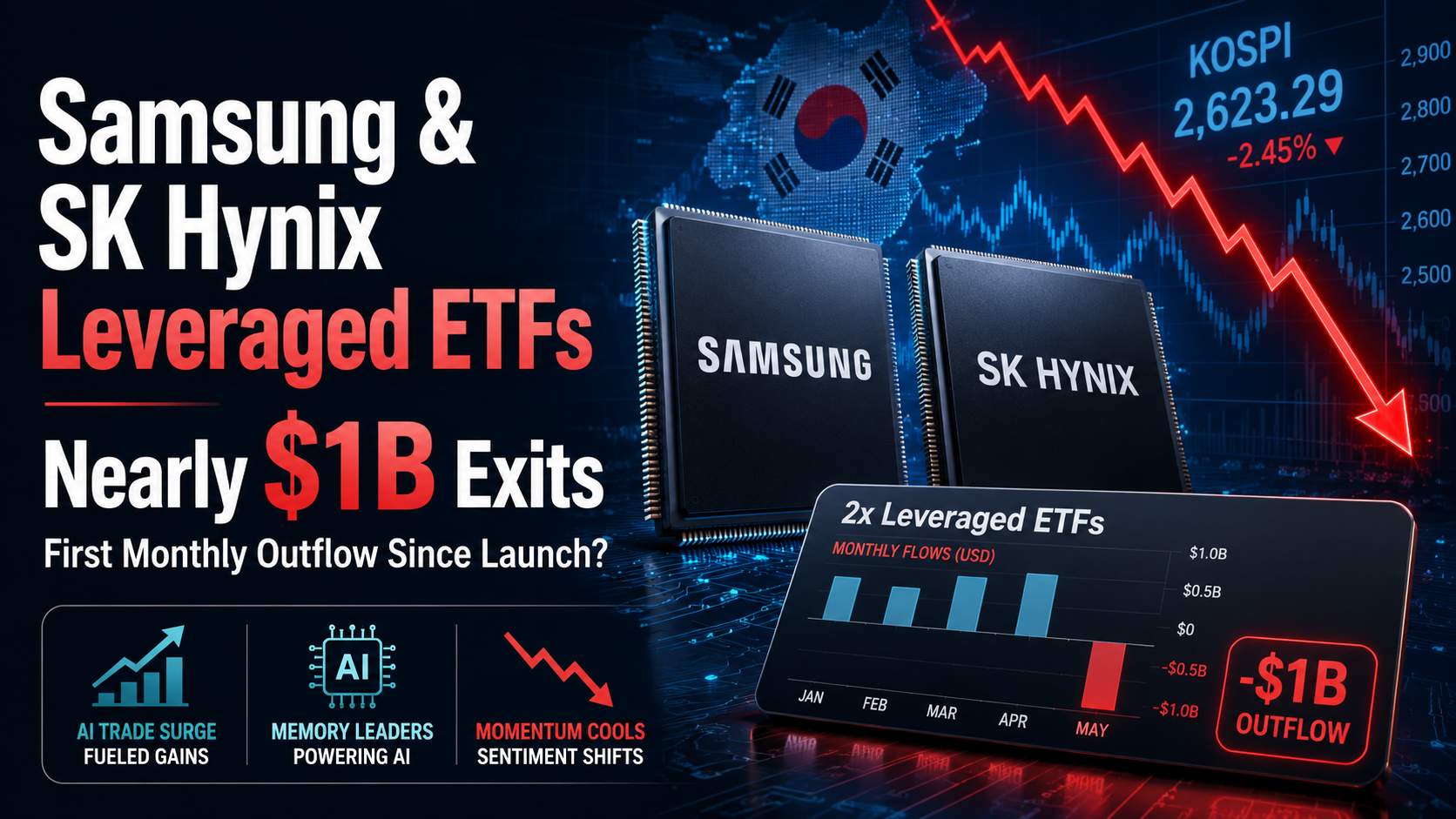
South Korea’s experiment with single-stock leveraged ETFs is facing its first major test. Leveraged products tied to Samsung Electronics and SK Hynix have suffered nearly $1 billion in August outflows, putting them on course for their first monthly net withdrawal since launching in late May. Funds tracking SK Hynix have lost roughly $601 million this month, while Samsung-linked products have seen about $381 million exit.
The reversal is striking because these products were introduced at the height of South Korea’s AI and semiconductor investment boom. Retail traders rushed into funds designed to deliver twice the daily moves of the country’s two biggest chipmakers, only to encounter a sharp market correction, amplified losses and a rapid regulatory crackdown. The central question is therefore bigger than whether investors have turned bearish on Samsung or SK Hynix: Is the AI trade losing its appeal, or are investors simply retreating from one of the most aggressive ways to bet on it?
What Happened to Samsung and SK Hynix Leveraged ETFs?
South Korea introduced its first domestic single-stock leveraged and inverse products on May 27, 2026, with Samsung Electronics and SK Hynix serving as the initial underlying stocks. The products were designed to track approximately twice the daily percentage move of a single stock in either the positive or inverse direction. South Korea’s Financial Services Commission had warned before launch that the combination of leverage and single-stock concentration could produce significantly larger losses than conventional ETFs.
Demand initially surged, particularly for bullish 2x products tied to SK Hynix and Samsung. But August has brought a sharp reversal. Bloomberg Intelligence data cited in recent reports show that about $601 million has left SK Hynix-linked leveraged ETFs and $381 million has left Samsung-linked funds, bringing combined August withdrawals to approximately $982 million. If that position remains negative through the end of August, it would represent the first monthly outflow since the products entered the market.
| Key Metric | Latest Figure |
| Single-stock products launched | May 27, 2026 |
| SK Hynix-linked August outflows | ~$601 million |
| Samsung-linked August outflows | ~$381 million |
| Combined August outflows | ~$982 million |
| Potential milestone | First monthly outflow since launch |
The speed of the reversal is as important as the size. Products that were designed to capture enthusiasm around Korea’s strongest AI stocks have rapidly become a symbol of the risks associated with concentrated retail leverage.
Why Did These Leveraged ETFs Become So Popular?
The products arrived during an extraordinary period for South Korean semiconductor stocks. Artificial intelligence infrastructure spending had driven intense demand for advanced memory, especially high-bandwidth memory used alongside AI accelerators. SK Hynix emerged as a major HBM supplier and a key beneficiary of the AI data-center cycle, while Samsung remained one of the world’s largest memory-chip manufacturers. Their soaring share prices helped turn the Korean market into one of the most aggressive expressions of the global AI investment theme. Reuters reported that billions of dollars of leveraged bets on the two companies contributed to unusually high volatility in the local market.
For retail investors, single-stock leveraged ETFs offered an accessible way to amplify those gains without directly trading futures or other complex derivatives. Instead of buying Samsung or SK Hynix shares and receiving the normal daily return, an investor could buy a product targeting roughly twice the daily move. During a sustained rally, the appeal was obvious: a 5% daily gain in the underlying stock could translate into approximately 10% for a 2x bullish product before fees and tracking differences.
That attraction also created the seeds of the later reversal. The strategy worked particularly well while AI stocks were rising quickly and consistently. Once those same shares became volatile and began falling sharply, the leverage that had attracted traders started working in the opposite direction.
How Do 2x Single-Stock ETFs Actually Work?
A 2x single-stock leveraged ETF is designed to deliver roughly twice the stock’s daily return, not twice its return over weeks or months. That distinction is essential. The portfolio is reset every trading day to maintain its target leverage, meaning performance depends not only on where the stock starts and finishes, but also on the path it takes between those points. South Korean regulators explicitly warned investors before launch that these products could lose value even when the underlying stock moves sideways over time.
Consider a simplified example. Suppose a stock starts at 100, falls 10% to 90 and then rises 11.1% the following day, returning approximately to 100. A 2x leveraged product could fall around 20% on day one, from 100 to 80. A roughly 22.2% gain on day two would then raise it only to about 97.8. The stock has recovered, but the leveraged investment remains below its starting value.
This is known as the negative compounding effect or volatility drag. It becomes particularly damaging when an underlying stock experiences large moves in both directions. The Financial Services Commission has highlighted this characteristic as one of the main risks investors need to understand, and its later mandatory simulated-trading program was specifically designed to expose new investors to the effect before they put real money into these products.
Why Did Nearly $1 Billion Leave in August?
The first major trigger was the sharp correction in South Korean equities. July was exceptionally painful: the KOSPI fell about 22%, while Samsung Electronics dropped approximately 21.5% and SK Hynix declined around 35.5%. Investors using 2x products faced substantially larger short-term losses than shareholders who simply owned the underlying companies. The combination of high volatility and daily rebalancing also made negative compounding increasingly relevant.
The correction altered investor behavior. During the rally, leveraged ETFs offered a way to maximize upside from the AI semiconductor boom. After the market reversed, preserving capital and reducing exposure became more important. That helps explain why the August withdrawals should not automatically be interpreted as a prediction that Samsung or SK Hynix will continue falling. A significant portion of the move appears to be deleveraging—investors reducing the amount of amplified risk they are willing to carry.
The third force was regulation. South Korean authorities responded to extreme market volatility by tightening access to single-stock leveraged products. The timing matters because the regulatory changes did not merely affect sentiment; they made it significantly more difficult for new retail investors to enter the products, while existing holders were already reassessing positions after the July losses.
Why Did Korean Regulators Step In?
South Korea’s regulators had warned about the dangers of single-stock leverage before the products were launched, but the subsequent surge in speculative activity and market volatility prompted stronger action. On July 16, authorities announced additional investor-protection measures, citing concerns over volatility in major memory-semiconductor stocks. Regulators later accelerated the increase in the minimum deposit required for new investors, raising it from KRW 10 million to KRW 30 million in cash.
From August 19, the rules became stricter again. New retail investors seeking access to domestic or overseas single-stock leveraged products must hold the KRW 30 million cash deposit, complete three hours of prior education and finish a Korea Exchange simulated-trading program. The simulation requires at least one hour of trading on each of a minimum of five trading days, specifically so investors can experience characteristics such as negative compounding before using real capital.
The impact has been dramatic. According to the Financial Services Commission, daily trading value in single-stock leveraged products fell from roughly KRW 12.4 trillion on July 30 to KRW 0.7 trillion on August 11, just 5.6% of the earlier level. About KRW 1.4 trillion of net redemptions were recorded between August 4 and August 10 alone. That collapse shows why regulation needs to be considered alongside market sentiment when explaining the nearly $1 billion in August ETF outflows.
Why Outflows Continued Even as Chip Stocks Rebounded
An especially revealing feature of the August data is that the underlying stocks have not simply continued falling. Through the period covered by the flow data, Samsung had gained about 3.6% in August and SK Hynix around 2.2%, even as money continued leaving their leveraged products. Samsung later suffered another sharp one-day drop after its shareholder-return announcement disappointed some investors, but the broader pattern still shows that ETF redemptions have not moved perfectly with the underlying shares.
That divergence supports a more nuanced interpretation. If investors were abandoning Samsung and SK Hynix because they believed the AI semiconductor story had fundamentally collapsed, a rebound in the stocks might have been expected to attract aggressive leveraged buyers again. Instead, tighter eligibility rules, previous losses and a reassessment of risk appear to have kept many traders away.
The message is therefore less “investors no longer want AI stocks” and more “investors are becoming less willing or less able to express that view through extreme leverage.” That difference matters when assessing whether these ETF outflows signal a broader turning point for the global AI trade.
Does This Mean the AI Trade Is Over?
The nearly $1 billion withdrawal gives bears a compelling headline. South Korea’s semiconductor rally had been one of the strongest manifestations of global AI enthusiasm, and the rapid collapse in leveraged trading demonstrates that speculative excess can unwind quickly. Reuters has described how leveraged bets helped transform a market historically viewed as a global economic bellwether into one characterized by unusually intense AI-driven volatility.
Yet the fundamental semiconductor story has not disappeared. SK Hynix remains deeply exposed to high-bandwidth memory used in AI infrastructure and is a major supplier into the AI hardware ecosystem. In August, the company announced plans to repurchase and cancel 40 trillion won, or roughly $28.6 billion, of treasury shares, while also committing to return more than half of cumulative free cash flow over 2025–2027. Samsung has likewise announced unusually large shareholder-return plans after strong semiconductor earnings, even though investors were disappointed by the structure and lack of clarity around future buybacks.
The more defensible conclusion is therefore that the leveraged AI trade is cooling faster than the underlying AI semiconductor investment thesis. Demand for HBM, memory pricing, hyperscaler capital expenditure and the pace of AI infrastructure deployment remain more important for the companies’ long-term fundamentals than one month of leveraged ETF redemptions.
Where Is Korean Retail Money Going Now?
The decline in leveraged ETF demand does not necessarily mean South Korean retail investors have suddenly become conservative. Instead, some capital appears to be shifting toward different products. Equity-linked securities, or ELS, have become particularly popular. About KRW 3.5 trillion, roughly $2.5 billion, of ELS products were sold in July, the highest monthly total since April 2023, with structures linked to Samsung and SK Hynix among the most popular. Some were marketed with annualized coupons in the 40%–50% range.
ELS products differ substantially from leveraged ETFs. Their returns typically depend on predetermined conditions linked to the performance of an underlying asset, while downside protection may disappear if the asset crosses specified barriers. That can make their risk less immediately visible than the daily price swings of a 2x ETF. Korea also has a history of retail losses from structured products during episodes such as the 2020 oil crash and subsequent weakness in Chinese equities.
This rotation therefore suggests that risk appetite may be changing form rather than disappearing. Some investors are leaving leveraged single-stock ETFs but continuing to seek high returns through structured securities, overseas equities or more diversified funds. The development is important because it means regulators may have reduced one source of speculation without eliminating the underlying demand for high-risk investments.
What the Outflows Mean for Samsung and SK Hynix Stocks
Large leveraged ETFs can interact with their underlying shares because fund operators need to adjust exposure as assets enter or leave the products and as markets move. During periods of rapid inflows, that rebalancing can contribute to incremental demand. During redemptions or sharp declines, the process can work in the opposite direction. Reuters has reported concerns that the scale of leveraged positioning in Samsung and SK Hynix contributed to market volatility during the earlier boom and correction.
However, it would be too simplistic to say that ETF outflows caused Samsung or SK Hynix shares to fall. Their stocks are influenced by earnings expectations, DRAM and NAND prices, HBM market share, competition, foreign institutional flows, currency movements, global AI spending and company-specific capital allocation decisions. In August alone, Samsung’s shareholder-return announcement caused a sharp share-price reaction independent of ETF flow dynamics.
Leveraged ETF flows are therefore best treated as a measure of short-term positioning and speculative appetite, not a substitute for fundamental analysis. If ETF volumes remain depressed while semiconductor earnings continue to strengthen, the two stories could diverge substantially.
Why This Matters Beyond South Korea
Samsung Electronics and SK Hynix sit at the center of the global semiconductor supply chain, so shifts in investor positioning around them attract attention far beyond Seoul. AI accelerators rely on sophisticated memory technologies, particularly HBM, and SK Hynix has become one of the leading suppliers to the sector. Samsung’s enormous manufacturing footprint similarly makes its performance relevant to memory prices, smartphones, data centers and the broader technology cycle.
South Korea’s leveraged ETF boom can therefore be viewed as a particularly aggressive indicator of global enthusiasm for AI-related assets. When investors were confident that semiconductor shares would continue climbing, they embraced products designed to double their daily movements. When those shares corrected, the same market quickly exposed the fragility of highly leveraged positioning. Similar enthusiasm has appeared elsewhere in leveraged semiconductor funds and other high-beta AI investments.
The August outflows consequently provide a useful signal about risk tolerance, but not necessarily about the end of AI spending. A retreat from leveraged Samsung and SK Hynix ETFs tells investors that enthusiasm has become more cautious. It does not by itself establish that Nvidia customers are cutting AI budgets, HBM demand is collapsing or the global data-center investment cycle has reversed.
What to Watch Next
The first thing to watch is the final August fund-flow figure. With the month not yet complete, the approximately $982 million withdrawal remains a month-to-date number. Confirmation of a first full monthly net outflow would strengthen the argument that the market has entered a different phase from the launch-period frenzy. Trading volume will be equally important: if turnover remains near post-regulation lows, it would suggest that the new eligibility requirements have produced a lasting structural change rather than a temporary decline in activity.
The second area is the performance and fundamentals of Samsung and SK Hynix themselves. HBM demand, memory pricing, semiconductor earnings and corporate capital-return policies will help determine whether investors distinguish between weakness in leveraged trading and weakness in the underlying AI business. The response to SK Hynix’s massive buyback and Samsung’s shareholder-return strategy will also provide clues about how shareholders value cash returns after the recent correction.
Finally, the destination of retail money matters. Continued growth in ELS, overseas equity purchases or diversified index ETFs would suggest that investors are reallocating rather than leaving markets altogether. The key question is no longer simply whether Korean traders still believe in AI, but how much leverage they are willing—or permitted—to use to express that belief.
Conclusion
Nearly $1 billion leaving Samsung and SK Hynix leveraged ETFs marks the sharpest reversal yet for South Korea’s newly launched single-stock leveraged products. After attracting investors during an extraordinary AI-driven rally, the funds have collided with a powerful combination of falling chip stocks, negative compounding, heightened volatility and tougher regulation.
The outflows should not automatically be interpreted as evidence that investors have abandoned the AI semiconductor story. Samsung and SK Hynix remain strategically important to global memory and AI infrastructure, while their underlying shares have shown periods of recovery even as leveraged ETF redemptions continued. The stronger conclusion is that the market is undergoing deleveraging rather than wholesale rejection of AI. Whether that transition becomes permanent will depend on final August flows, regulatory policy, semiconductor fundamentals and where Korean retail investors choose to take risk next.
FAQs
Can Foreign Investors Buy Korean Single-Stock Leveraged ETFs?
Potentially, yes, but access depends on brokerage support, local regulations and the investor’s jurisdiction. Not all overseas brokers provide direct access to Korean-listed leveraged products.
What Is the Difference Between a Leveraged ETF and an Inverse ETF?
A leveraged ETF aims to multiply the underlying stock’s daily return, while an inverse ETF is designed to move in the opposite direction. Both typically reset daily.
Are Samsung and SK Hynix Leveraged ETFs Suitable for Long-Term Investing?
They are generally designed for short-term trading rather than traditional long-term investing because daily rebalancing and volatility can significantly affect returns over time.
Can a Leveraged ETF Lose Money Even If the Stock Ends Higher?
Yes. Because leveraged ETFs reset daily, the path of price movements matters. High volatility can cause the ETF to lose value even if the underlying stock eventually recovers.
What Is HBM and Why Is It Important to SK Hynix?
HBM, or high-bandwidth memory, is a type of advanced memory widely used in AI accelerators. Strong HBM demand has made SK Hynix one of the key beneficiaries of global AI infrastructure spending.
Are Single-Stock Leveraged ETFs Available Outside South Korea?
Yes. Similar products are available in markets such as the United States, although leverage limits, regulation and product structures vary by country.
🔥 KuCoin Offers A More Stable Option in A Volatile Market
If you worry about the frequent ups and downs in the market, and pursue a more stable option to earn money passively, KuCoin is the right place to come:

Simple Earn: Deposit and withdraw tokens anytime, earning stable returns.
Kucoin Earn: Earn stable profits with professional asset management.
Hold to Earn: Earn rewards by holding assets in Funding, Trading, Margin, Futures, Mining, and Unified Accounts.
Staking: Unlock the earning potential of on-chain assets.
Advanced Investments: Advanced Investments offer a variety of structured products to help your money grow in any market.
Shark Fin: Principal Protection and Guaranteed Gains
Dual Investment: Buy low and sell high with transparent return calculations.
Snowball: High yields, with price protection.
Discount Buy: Buy crypto at discount prices.
KCS Loyalty: Level up to enjoy exclusive perks by staking ≥ 1 KCS.
KuCoin Wealth: Discover future value and begin your smart investing journey.
KCS Benefits: Hold and stake KCS to access benefits across the platform.
KCS Staking 2.0: Participate in KCS on-chain governance to earn yield.
Disclaimer: This content is for informational purposes only and does not constitute investment advice. Cryptocurrency investments carry risk. Please do your own research (DYOR).