

Robinhood Chain Fees Hit Record $3.75 Million, Surpassing Ethereum and Base
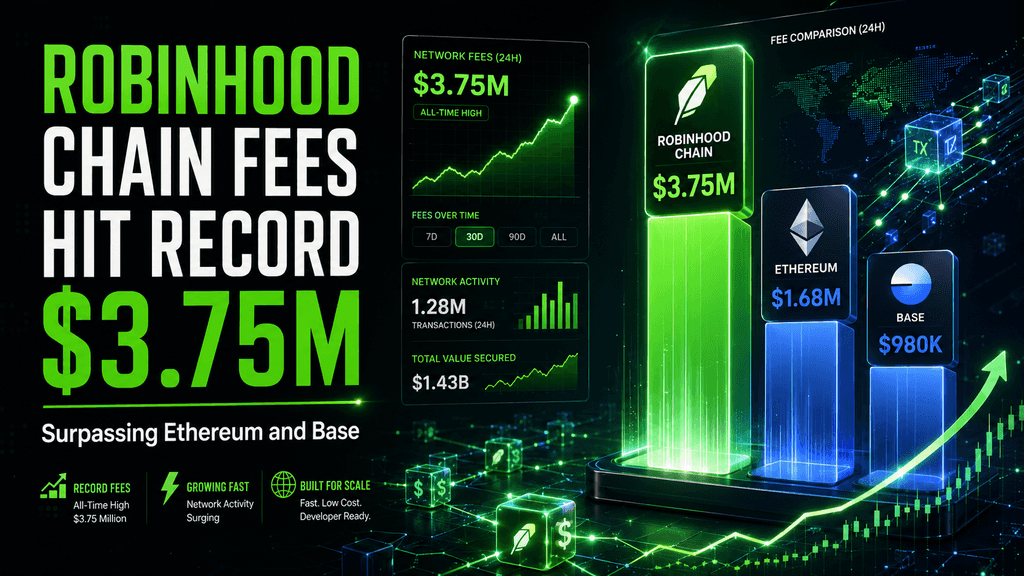
Robinhood Chain Sets New Fee Record as Network Activity Surges
Robinhood Chain, the Ethereum Layer 2 network operated by the brokerage firm and built on Arbitrum’s Orbit stack, generated a record $3.75 million in user-paid transaction fees on September 1, 2026. According to data compiled by DeFiLlama and reported across multiple outlets, this figure marked a new all-time high for the network and placed it ahead of both Ethereum mainnet and Coinbase’s Base for that single day. The chain, which launched its public mainnet only on July 1, 2026, has already accumulated more than $13 million in cumulative fees within its first two months of operation. Decentralized exchange volume on the network exceeded $1.5 billion on the same day, while total value locked cleared $750 million.
These metrics show an unusually quick ramp-up for a consumer-branded rollup that initially emphasized tokenized stocks and real-world assets yet has seen the bulk of early activity driven by speculative trading and launchpad activity. The core development is that a two-month-old Layer 2 controlled by a major brokerage has out-earned long-established networks on daily fees while routing a fixed share of net protocol revenue back to the Arbitrum ecosystem, illustrating both the speed of branded onboarding and the economics of Orbit-based chains under the Expansion Program.
Record Daily Fees Place Robinhood Chain Ahead of Established Networks
On September 1, 2026, users on Robinhood Chain paid $3.75 million in transaction fees, an all-time high that surpassed the combined daily fee generation of Ethereum mainnet and Base, according to contemporaneous DeFiLlama data. The figure represented the fourth consecutive day of new records, indicating sustained rather than one-off activity. Independent reporting confirmed the network ended the day as the highest fee-generating blockchain tracked that period. Cumulative fees since the July 1 mainnet launch already exceeded $13 million, with some trackers placing the total near $14.7 million over a 30-day window by early September. The majority of these fees arise from Layer 2 execution costs plus the Layer 1 data availability component required to post compressed transaction data back to Ethereum. Because the sequencer is operated by Robinhood, the firm retains the bulk of net revenue after settlement costs and the contractual share owed under the Arbitrum Expansion Program. This rapid fee accrual stands in contrast to the multi-year timelines typically required for other Layer 2 networks to reach comparable daily revenue levels.
The economic structure amplifies the significance of the $3.75 million print. Roughly 10 percent of net protocol revenue flows to the Arbitrum ecosystem, with 8 percent directed to the Arbitrum DAO treasury and 2 percent to the Developer Guild. At the record daily rate, that share equated to approximately $377,000 transferred in a single day. Earlier in July, the chain’s licensing fees alone contributed $360,000, accounting for 35 percent of the Arbitrum DAO’s income that month. Gross margins on protocol revenue across the Arbitrum ecosystem have remained above 97 percent in recent reporting periods. These flows demonstrate how an Orbit chain can generate meaningful external revenue for the parent ecosystem while the operator retains the large majority of fees. Data from DefiLlama continued to show elevated fee generation in subsequent days, with one snapshot recording $4.45 million in 24-hour chain fees shortly after the September 1 peak.
DEX Volume Exceeds $1.5 Billion as Trading Activity Accelerates
Decentralized exchange volume on Robinhood Chain surpassed $1.5 billion on September 1, 2026, setting a record for the network and ranking it among the top chains by daily throughput. Earlier peaks had already reached $989 million and $1.07 million in fees on preceding days, with cumulative DEX volume exceeding $47 billion since launch according to multiple trackers. Uniswap deployments, particularly v4 and v3, accounted for the largest share of activity, together handling a substantial portion of the chain’s total volume. Launchpads such as Pons contributed additional fee-generating swaps and token issuance volume. The combination of high-frequency trading and new token launches produced transaction counts measured in the millions per day, far outpacing the early activity levels of most peer Layer 2 networks. Bridged assets into the network exceeded $2.5 billion in some snapshots, providing the liquidity base that supported the elevated turnover.
The composition of that volume has evolved. Initial weeks after the July 1 launch featured heavy memecoin activity, including pairs involving tokens such as Cash Cat. Subsequent periods showed a rising contribution from utility-oriented and infrastructure tokens as well as trading in tokenized stock pairs. Real-world asset-related volume, including tokenized equities, reached approximately $390 million on September 1, according to Dune Analytics data cited in secondary reporting. This mix of speculative and asset-linked trading has produced high turnover ratios relative to total value locked, a characteristic of chains experiencing quick but still early-stage capital deployment. The presence of integrated tools and bots further concentrated activity on the most liquid venues, sustaining the fee and volume prints even as individual token narratives rotated.
Total Value Locked Crosses $750 Million Within Two Months
Total value locked on Robinhood Chain surpassed $750 million by September 1, 2026, representing growth from roughly $4 million in the pre-mainnet period to multi-hundred-million-dollar levels in under 60 days. Later snapshots placed TVL near $819 million with continued daily increases. Stablecoin market capitalization on the chain rose in parallel, reaching approximately $797 million to $868 million depending on the measurement window, with USDG holding a dominant share. Bridged value, which includes assets transferred onto the network whether or not they sit in DeFi protocols, exceeded $2.5 billion in contemporaneous data. Lending protocols, decentralized exchanges, and specialized venues for tokenized assets absorbed the majority of the locked capital. The speed of this accumulation outpaced the early direction of several established Layer 2 networks that required longer periods to reach similar absolute levels.
The locked capital supports both speculative and more persistent use cases. Morpho and related lending markets captured hundreds of millions in deposits, while Uniswap pools provided the primary trading venues. The presence of tokenized stock liquidity, even if still secondary to pure crypto activity, creates a hybrid environment rarely seen at this scale so early in a chain’s life. Turnover ratios remain elevated because the same capital cycles through multiple trades within short periods, a pattern typical of launchpad-driven ecosystems. As the 90-day gas subsidy window for Robinhood Wallet users approaches its late-September close, the sustainability of these TVL levels will depend on whether organic demand continues once users bear full transaction costs. Current figures nevertheless establish a substantial base of on-chain capital for a network that did not exist on public mainnet form three months earlier.
Under the Arbitrum Expansion Program, any Orbit-based chain that settles outside Arbitrum One or Nova routes 10 percent of its net protocol revenue to the broader ecosystem. Of that amount, 8 percent flows to the Arbitrum DAO treasury controlled by ARB token holders, and 2 percent supports the Developer Guild. Robinhood Chain’s record $3.75 million fee day therefore generated roughly $377,000 for the Arbitrum side in a single 24-hour period. July’s licensing contribution of $360,000 already represented 35 percent of the DAO’s income for that month. Cumulative transfers since launch have reached several million dollars, providing a measurable new revenue stream that sits alongside Arbitrum One’s own fees, Timeboost auctions, and treasury returns. The Arbitrum Foundation’s H1 2026 update showed overall ecosystem income of $6.19 million with gross margins above 97 percent; subsequent months incorporating Robinhood Chain activity are tracking higher.
This arrangement functions as a form of technology licensing that converts infrastructure adoption into recurring protocol revenue. The fee base is defined as net protocol revenue rather than gross user fees, so costs of Layer 1 data posting and other operational expenses are subtracted before the split. Robinhood, as a sequencer operator, retains approximately 89 to 90 percent after the share and settlement costs. The structure creates aligned incentives: higher activity on partner chains directly increases treasury inflows for ARB holders without requiring those holders to operate the additional networks. Early data indicate that Robinhood Chain has already become one of the more material contributors under the Expansion Program, illustrating how branded consumer platforms can accelerate ecosystem revenue beyond what pure crypto-native deployments have historically achieved.
Fee Structure Combines Layer 2 Execution and Ethereum Data Costs
Transaction fees on Robinhood Chain are denominated in ETH and comprise two primary components. The Layer 2 execution fee covers the cost of processing the transaction on the Orbit stack itself and remains relatively low under normal load. The Layer 1 data fee covers the cost of posting compressed transaction data to Ethereum for data availability and final settlement; this portion fluctuates with Ethereum congestion and scales with calldata size. Both components are bundled into the single gas payment users experience. Documentation confirms that standard estimation tools automatically account for the combined cost. Because the chain produces blocks at approximately 100-millisecond intervals, execution capacity is abundant, and base gas prices stay low except during extreme congestion. Complex swaps and multi-step interactions that generate larger calldata incur higher total fees than simple transfers.
Additional protocol-level fees arise at the application layer. Launchpads typically charge 1 percent on swaps of newly issued tokens, with some creator taxes scaling higher. Graduated tokens trading on Uniswap v4 may incur further charges. These application fees are distinct from the chain-level gas costs yet contribute to overall user expenditure and to the revenue captured by protocols operating on the network. During the initial 90-day period, Robinhood has covered network fees for eligible transactions executed inside the Robinhood Wallet app, effectively subsidizing activity for its own user base until late September 2026. Third-party wallets and certain transaction types remain subject to full costs. The subsidy has accelerated early adoption metrics while the underlying fee schedule remains fully operational for non-subsidized flow.
Memecoin and Launchpad Activity Drive Early Fee Generation
The majority of fee-generating volume in the first two months has originated from memecoin trading and token launchpad activity rather than the tokenized equity use case originally emphasized. Platforms such as Pons and related venues have produced continuous issuance and secondary trading, generating both swap fees and launch-related charges. Uniswap deployments capture a large fraction of the resulting volume, with v4 accounting for a substantial share of total DEX activity across all networks in some measurement windows. Daily transaction counts have reached several million, reflecting the high-frequency nature of speculative trading. This activity pattern produces elevated fee revenue relative to total value locked because capital turns over quickly. Secondary reporting notes that individual gas prices have risen during peak periods, reaching levels equivalent to tens of dollars for complex interactions when denominated in USD.
The original design centered on 24/7 trading of tokenized stocks and real-world assets. While RWA-related volume has grown, including pairs involving tokenized equities, it has not yet displaced speculative flow as the primary driver of fees. The regulatory pathway for fully compliant on-chain equity trading remains more complex than the issuance of pure crypto tokens, so the market has filled available capacity with higher-velocity activity. For the chain operator and for the Arbitrum revenue share, the source of fees is secondary to their existence; both parties capture value regardless of whether the underlying trades involve memecoins or blue-chip stock tokens. Sustained fee generation after the gas subsidy ends will provide a clearer test of whether the current activity mix can persist or whether it must transition toward the originally intended asset classes.
Comparison With Ethereum Mainnet and Base Fee Generation
On the September 1 peak day, Robinhood Chain’s $3.75 million in fees exceeded the daily figures recorded for Ethereum mainnet and for Base. Earlier snapshots showed similar inversions, with the new chain out-earning both on 24-hour metrics while longer-term 30-day totals still favored the more established networks. Arbitrum One itself generated under $15,000 in fees on the same day that Robinhood Chain produced $3.75 million, showing the divergence between the flagship rollup and a high-activity Orbit chain built on the same technology stack. These comparisons are sensitive to the exact measurement window and to whether chain fees or application-layer revenue are being tracked. Nevertheless, the ability of a two-month-old network to lead daily fee rankings illustrates the impact of a large existing user base and active onboarding incentives.
Longer windows still show Ethereum, Tron, Solana, and certain other chains ahead on cumulative 30-day fees. Base continues to process high absolute transaction counts in some datasets. The short-term leadership by Robinhood Chain therefore shows concentrated activity rather than a permanent reordering of the fee hierarchy. As the subsidy period concludes and if speculative volume moderates, the relative ranking may normalize. The data still demonstrate that consumer distribution channels can compress the time required for a new Layer 2 to reach material fee generation, a dynamic that older networks built primarily through organic crypto-native growth did not experience at the same pace.
After the 10 percent Arbitrum Expansion Program cut and the relatively small Layer 1 data costs paid to Ethereum, Robinhood retains the large majority of net protocol revenue. Estimates place the retained share near 89 percent under typical conditions. On a $3.75 million fee day, this translates into several million dollars of gross contribution before internal costs. The sequencer is operated centrally by Robinhood, allowing the firm to capture the execution margin directly. Earlier periods showed similar retention ratios, with cumulative retained revenue already measured in the tens of millions of dollars annualized at peak rates. This structure differs from pure public-goods Layer 2 models in which a larger fraction of fees might be directed to token holders or burned; here the operator is a publicly traded brokerage with an existing P&L.
The high retention ratio improves the economics of running a branded chain. Transaction fees become a direct revenue line that can offset the costs of subsidies, infrastructure, and ongoing development. Because gas is paid in ETH, the firm also maintains exposure to the native asset used for settlement. The model has already produced measurable income in the first two months, providing a proof point for other consumer platforms considering similar deployments. Whether the retained margin remains attractive once full user-paid fees apply and once activity potentially shifts away from high-turnover launchpad trading will determine the longer-term contribution of the chain to Robinhood’s overall results. Current data indicate that the fee capture mechanism is functioning as designed.
Gas Subsidy Period Supports Early User Onboarding
Robinhood has covered network fees for eligible transactions executed inside the Robinhood Wallet on Robinhood Chain until September 29, 2026. The promotion applies to crypto and stock-token swaps above a minimum value and to certain one-time approval fees but excludes wallet-to-wallet transfers, bridges, and activity originating from third-party wallets or the in-app dapp browser. This subsidy has lowered the effective cost of experimentation for the firm’s existing user base and contributed to the rapid rise in transaction counts and volume. Users outside the Wallet or performing non-covered actions have always paid full fees. The temporary nature of the program means that observed metrics during the first 90 days incorporate a cost externalization that will end in late September.
Once the subsidy expires, the true demand curve for the chain will become clearer. High-frequency traders and launchpad participants who have operated under reduced costs may reduce activity if absolute fees rise, while users focused on tokenized assets or longer-horizon positions may prove less price-sensitive. The chain’s low base execution costs under normal load should keep ordinary transactions inexpensive even without the subsidy, but complex multi-hop swaps and peak-period congestion can still produce higher bills. Monitoring fee generation, volume, and TVL in October and beyond will therefore provide a more durable signal of organic usage than the subsidized window currently allows.
Tokenized Assets and Real-World Asset Volume Begin to Scale
Although memecoin activity has dominated early fee generation, trading in tokenized stocks and related real-world assets has reached meaningful absolute levels. Daily RWA volume hit approximately $390 million on September 1, with tokenized equity pairs contributing a substantial fraction. Specific pairs involving major equity names have appeared among the higher-volume markets. The chain was explicitly designed to support 24/7 trading of these assets, and infrastructure partners including Chainlink, BitGo, and others provide supporting services for price feeds, custody, and bridging. Cumulative volume in tokenized stocks through Uniswap has already exceeded $1 billion in earlier reporting windows. This activity creates a hybrid market structure in which pure crypto tokens and equity-linked instruments trade on the same venues.
The regulatory and operational complexity of fully permissioned equity tokens is higher than that of standard ERC-20 issuance, which helps explain the relative lag. As more issuers and liquidity providers enter, the share of volume attributable to RWAs may increase. For fee generation, the absolute contribution already matters: hundreds of millions in daily RWA notional produce corresponding swap fees and support deeper liquidity that benefits all market participants. The presence of both speculative and asset-backed flow on a single chain operated by a regulated brokerage constitutes a distinctive positioning relative to purely crypto-native Layer 2 networks. Continued growth in this segment would diversify the revenue base beyond launchpad-driven cycles.
Broader Market Effects for Layer 2 Economics
The quick fee accrual on Robinhood Chain illustrates how distribution advantages can compress the timeline for a new Layer 2 to reach material revenue. A consumer brokerage with tens of millions of funded accounts can onboard users and capital far faster than most crypto-native projects. The Orbit stack and Expansion Program provide a ready technical and economic framework that allows the operator to launch quickly while still contributing to the parent ecosystem. Daily fee leadership, even if temporary, demonstrates that branded chains can capture a significant share of on-chain activity in a short order. For Ethereum itself, the data availability fees received remain a small fraction of the total fees generated on the L2, a pattern consistent with the broader shift of execution value toward rollups.
The episode also shows the importance of net protocol revenue definitions and sequencer control. Operators that retain sequencing capture the majority of the margin; ecosystems that license the technology capture a fixed share. Both parties have an incentive to maximize activity. Whether similar models proliferate among other large consumer platforms will depend on regulatory clarity, user demand for on-chain assets, and the durability of fee generation after promotional periods end. Current metrics from Robinhood Chain provide one of the clearest early data points on the economics of this approach.
Sustainability Questions After the Initial Growth Phase
High turnover ratios and launchpad concentration raise questions about the durability of current fee levels. Chains that generate hundreds of millions or billions in daily volume against a few hundred million in TVL typically rely on repeated trading of the same capital rather than sticky deposits. Once the gas subsidy ends and if memecoin narratives cool, both volume and fees could moderate. The presence of growing RWA activity and the integration of lending markets offer partial offsets. Monitoring metrics after late September will be essential. Cumulative fees already in the low teens of millions of dollars within two months establish a non-trivial baseline even if daily peaks prove temporary.
The chain’s architecture remains fully operational and EVM-compatible, so developers and liquidity providers can continue building regardless of short-term volume fluctuations. Robinhood’s continued operation of the sequencer and its existing distribution channels provide ongoing support. The combination of retained fee economics, ecosystem revenue share, and hybrid asset support creates a structural foundation that can accommodate both speculative and more persistent use cases. The next several months will clarify the relative weight of each.
FAQs
How did Robinhood Chain generate $3.75 million in fees so quickly after launch?
The network benefited from an existing user base through Robinhood Wallet, a temporary gas subsidy that lowered barriers to entry, high-frequency memecoin and launchpad trading, and rapid integration of major DEXes such as Uniswap. These factors combined to produce millions of daily transactions and over $1.5 billion in DEX volume on the peak day, translating directly into elevated fee revenue within two months of the July 1, 2026, mainnet launch.
What portion of fees does Arbitrum receive from Robinhood Chain?
Under the Arbitrum Expansion Program, 10 percent of net protocol revenue is shared with the ecosystem. Of that 10 percent, 8 percent goes to the Arbitrum DAO treasury and 2 percent to the Developer Guild. On the $3.75 million fee day, this equated to roughly $377,000 transferred to the Arbitrum side.
Is the current fee level sustainable once the gas subsidy ends?
The subsidy for eligible Robinhood Wallet transactions expires on September 29, 2026. Post-subsidy metrics will provide a clearer view of organic demand. Base execution costs remain low under normal conditions, but complex transactions and peak congestion can still produce higher absolute fees. The durability of volume after the promotional period will determine whether daily fee generation remains near recent peaks.
How does Robinhood Chain’s TVL compare with its trading volume?
TVL has grown to more than $750 million, while single-day DEX volume has exceeded $1.5 billion. The resulting high turnover ratio is characteristic of launchpad-driven activity in which capital cycles rapidly. Bridged assets exceed $2.5 billion in some measurements, providing additional liquidity beyond strict DeFi TVL.
What role do tokenized stocks play in current activity?
Tokenized equity and related RWA volume reached approximately $390 million on the September 1 peak day. While still secondary to pure crypto trading in fee generation, these markets are growing and create a hybrid environment that aligns with the chain’s original design goals.
How are transaction fees calculated on the chain?
Fees consist of an L2 execution component for processing on the Orbit stack and an L1 data component for posting data to Ethereum. Both are paid in ETH and bundled into a single gas cost. Application-layer fees from launchpads and certain DEX interactions sit on top of the chain-level gas.
🔥 KuCoin Offers A More Stable Option in A Volatile Market
If you worry about the frequent ups and downs in the market, and pursue a more stable option to earn money passively, KuCoin is the right place to come:

Simple Earn: Deposit and withdraw tokens anytime, earning stable returns.
Kucoin Earn: Earn stable profits with professional asset management.
Hold to Earn: Earn rewards by holding assets in Funding, Trading, Margin, Futures, Mining, and Unified Accounts.
Staking: Unlock the earning potential of on-chain assets.
Advanced Investments: Advanced Investments offer a variety of structured products to help your money grow in any market.
Shark Fin: Principal Protection and Guaranteed Gains
Dual Investment: Buy low and sell high with transparent return calculations.
Snowball: High yields, with price protection.
Discount Buy: Buy crypto at discount prices.
KCS Loyalty: Level up to enjoy exclusive perks by staking ≥ 1 KCS.
KuCoin Wealth: Discover future value and begin your smart investing journey.
KCS Benefits: Hold and stake KCS to access benefits across the platform.
KCS Staking 2.0: Participate in KCS on-chain governance to earn yield.
Disclaimer: This content is for informational purposes only and does not constitute investment advice. Cryptocurrency investments carry risk. Please do your own research (DYOR).