

How Does Robinhood Chain Make Money? Why Millions in L2 Fees Cost Almost Nothing to Settle on Ethereum
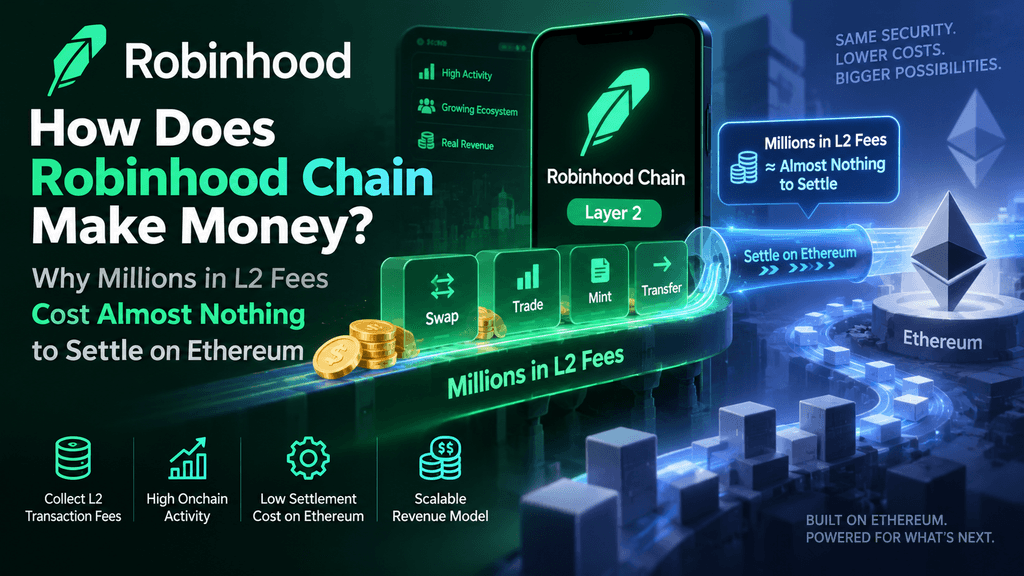
Robinhood Chain has emerged as one of the clearest examples of how profitable an application-focused Ethereum Layer 2 can potentially become. In early September 2026, the network was generating millions of dollars in daily user fees while spending only a tiny fraction of that amount to post data and settle activity on Ethereum. On September 3, for example, Bitquery estimated that Robinhood Chain collected about $4.5 million in user fees while its Ethereum-related data and proof costs were only around $400.
The numbers look almost contradictory. If Ethereum ultimately secures the network, why does so little of the money reach Ethereum?
The answer lies in the economics of modern Layer 2 networks. Robinhood Chain sells execution and specialized blockspace to users, Arbitrum monetizes the technology stack through revenue sharing, and Ethereum charges only for the settlement and data resources actually consumed. That structure explains both Robinhood Chain’s unusually high margins and one of the biggest debates surrounding Ethereum today: who captures the economic value created by Layer 2 growth?
What Is Robinhood Chain and Why Did Robinhood Build It?
Robinhood Chain is a dedicated Ethereum Layer 2 built using Arbitrum technology. Its public mainnet launched in July 2026, with ETH used for gas and Ethereum serving as the underlying settlement layer. Unlike Arbitrum One, which hosts applications from many developers, Robinhood Chain is designed specifically around Robinhood’s own financial ecosystem, including trading, tokenized assets and future on-chain financial products.
Building a dedicated chain gives Robinhood significantly more control over the user experience and economics. Instead of placing every product on a shared blockchain, Robinhood can manage its own blockspace, transaction sequencing, fees and product integrations. It can also connect blockchain infrastructure more closely with its existing brokerage distribution, potentially bringing traditional financial users into on-chain markets without requiring them to interact with a generic crypto network.
This distinction matters because Robinhood Chain is not simply paying Ethereum to process each user transaction. It operates its own execution environment and only relies on Ethereum for specific infrastructure services. That separation creates the large gap between what Robinhood can charge its users and what it ultimately pays Ethereum.
How Does Robinhood Chain Actually Make Money?
The most direct revenue source is gas. Whenever users transfer assets, trade tokens, interact with decentralized applications or execute other transactions, they pay fees for using Robinhood Chain blockspace. Those fees are collected within the Layer 2 rather than automatically flowing to Ethereum. Robinhood Chain also controls the sequencing process, which determines how transactions are ordered and included before information is eventually submitted to Ethereum.
The basic economics can be simplified as user fees minus Ethereum settlement costs and other operating expenses equals protocol net revenue. This is why gross transaction fees are not the same as profit, but it also explains why margins can become extremely large when the cost of the underlying infrastructure is low. Robinhood is effectively selling a specialized execution environment whose economic value can be much higher than the cost of the base-layer resources required to secure it.
That model becomes particularly powerful when combined with distribution. Robinhood already owns a large financial user base, recognizable brand and trading ecosystem. If those users increasingly interact with tokenized stocks, crypto assets or other on-chain products, Robinhood can capture transaction economics at the application layer rather than simply sending customers to third-party blockchains and exchanges.
Why Does Ethereum Settlement Cost Almost Nothing?
The key is batching. Robinhood Chain does not send every user transaction individually to Ethereum. Instead, Layer 2 networks execute transactions away from Ethereum’s main execution layer, compress the resulting information and submit batches of data or commitments back to Ethereum. Thousands or even millions of Layer 2 actions can therefore create far fewer Ethereum transactions than the headline activity numbers might suggest.
This means users and Ethereum are effectively being charged for different products. A Robinhood Chain user pays for fast execution, sequencing and access to the network’s applications. Ethereum is paid only for the comparatively small amount of data availability and settlement capacity the Layer 2 consumes. One million Robinhood Chain operations do not translate into one million Ethereum mainnet transactions.
This is why it is misleading to describe the difference as Robinhood “keeping Ethereum’s money.” Ethereum does not charge a percentage of Robinhood Chain revenue. It prices blockspace and data according to resource demand. If those resources remain abundant and efficient, the amount paid to Ethereum can remain tiny even when the economic activity occurring above it becomes enormous.
How Blobs Made the L2 Business Model More Profitable
Ethereum deliberately designed its scaling roadmap to make this type of settlement cheaper. The introduction of blobs gave rollups a specialized market for publishing temporary transaction data without forcing them to compete entirely for expensive traditional Ethereum blockspace. Later upgrades, including Fusaka and PeerDAS, expanded the amount of data Ethereum could make available to Layer 2 networks while reducing the burden placed on individual nodes.
The economics are straightforward. More blob capacity creates more available data space; greater supply can lower the marginal cost of publishing rollup data; lower settlement costs allow Layer 2 networks to process more activity cheaply. From Ethereum’s technical perspective, this is a success. The network is supporting far more total activity without requiring every user to transact directly on Layer 1.
Robinhood Chain demonstrates the consequence of that strategy in unusually dramatic form. If a Layer 2 can collect millions of dollars from users while buying only hundreds or thousands of dollars of Ethereum resources, then the economic margin naturally remains higher up the stack. This is precisely where the technology discussion turns into a value-capture debate.
Where Does the Money Go?
Robinhood Chain sits inside a three-layer economic structure in which each participant monetizes a different service.
| Layer | Main Role | Revenue Model |
| Robinhood Chain | Execution, sequencing and user-facing blockspace | User transaction fees and protocol revenue |
| Arbitrum | Provides the Layer 2 technology stack | Share of protocol net revenue |
| Ethereum | Provides data availability and final settlement | Blob and Layer 1 resource fees |
Robinhood retains most of the execution economics because it owns the user-facing network. Arbitrum monetizes the software layer differently. Under the Arbitrum Expansion Program, qualifying chains settling outside Arbitrum One or Nova contribute 10% of protocol net revenue to the Arbitrum ecosystem, with 8% going to the DAO treasury and 2% to the Developer Guild.
Ethereum, by contrast, does not receive a percentage of Robinhood’s revenue. It simply charges for the settlement and data resources consumed. This is why Arbitrum revenue can rise more directly alongside Robinhood Chain’s profitability while Ethereum’s fee income may increase much more slowly.
Why Arbitrum May Capture More Direct Revenue Than Ethereum
The difference comes down to business models. Ethereum uses resource-based pricing: consume more blockspace or blob capacity and pay more. Arbitrum uses a revenue-share model: if an Arbitrum-based chain earns more protocol net revenue, the absolute amount flowing back to the Arbitrum ecosystem can also increase. Robinhood sits at the top of the stack and charges according to user demand.
Imagine Robinhood Chain’s net protocol revenue rising tenfold. Ethereum settlement costs would not necessarily increase tenfold because transactions can still be compressed into efficient batches. Arbitrum’s revenue share, however, is structurally linked to net revenue, meaning its income potentially scales more directly with the success of the chain.
That does not mean Arbitrum provides something more important than Ethereum. Ethereum supplies the underlying settlement and security foundation, while Arbitrum provides software infrastructure. But Robinhood Chain highlights an unusual feature of modular blockchain economics: the layer providing the deepest infrastructure may not be the layer capturing the most direct revenue.
Is Ethereum Capturing Too Little Value From Layer 2 Growth?
This is the most important debate created by Robinhood Chain’s fee numbers. Ethereum’s long-term scaling strategy assumes that large amounts of user activity can move onto Layer 2 networks while Ethereum remains the secure settlement foundation. The problem for ETH investors is that ecosystem growth does not automatically translate into proportional Layer 1 fee growth.
The bearish argument is simple. If Robinhood Chain can collect millions of dollars from users while paying Ethereum only a negligible amount, economic value is accumulating at the application and Layer 2 levels rather than the base layer. If the same pattern occurs across Base, Arbitrum-based chains, Optimism-based networks and hundreds of future L2s, Ethereum could secure a massive ecosystem while capturing relatively little direct transaction revenue.
The opposing view is that cheap settlement is exactly what Ethereum is trying to achieve. Charging Layer 2s significantly more would increase user costs and make Ethereum-based networks less competitive. ETH may also capture value through collateral demand, settlement, DeFi liquidity, gas usage and broader network effects rather than relying solely on direct L1 transaction fees. Robinhood Chain therefore does not prove Ethereum’s scaling model is failing; it exposes the tension between scaling the ecosystem and monetizing the base layer.
Are Robinhood Chain’s Million-Dollar Fees Sustainable?
The current revenue figures should not be treated as a stable annual run rate. Robinhood Chain is still a young network, and much of its recent fee growth has arrived during a short burst of extremely intense trading activity. Multiplying several $3 million or $4 million days by 365 may create a billion-dollar annualized figure, but that does not mean the network will actually produce that revenue over a full year.
A significant portion of recent activity appears connected to speculative trading, meme tokens, decentralized exchanges, bots and highly active automated accounts. These activities can create enormous transaction counts and gas demand without representing long-term adoption by millions of individual Robinhood customers. Crypto history contains many examples of chains producing spectacular short-term fee figures during speculative waves before activity falls sharply.
For that reason, the most useful metrics are not simply daily fees. Investors should pay attention to the composition of those fees, recurring active users, the share generated by bots, tokenized-asset trading, user retention and protocol net revenue after expenses. Sustainable economics will depend on whether short-term speculative activity develops into recurring financial usage.
Why Tokenized Assets Matter More Than Meme Coins
Robinhood Chain’s long-term opportunity is much larger than hosting speculative crypto trading. Robinhood has increasingly positioned blockchain infrastructure as a way to expand access to tokenized financial assets and markets that operate beyond traditional exchange hours. A dedicated chain could eventually support tokenized stocks, transfers, trading, lending and settlement within a single integrated financial environment.
That is strategically different from launching another general-purpose crypto chain. Robinhood already owns the customer relationship. If an existing brokerage user trades tokenized assets or uses on-chain financial products without leaving the Robinhood ecosystem, the company can potentially capture both traditional financial economics and blockchain transaction revenue. This distribution advantage could be far more valuable than any temporary period of elevated meme-coin activity.
The most important question is therefore not whether Robinhood Chain can continue generating several million dollars in daily fees from speculation. It is whether Robinhood can convert traditional financial activity into persistent on-chain demand. If that happens, current fee growth may represent the beginning of a much larger business model rather than a temporary anomaly.
What Robinhood Chain Reveals About the Future of L2 Economics
Robinhood Chain points toward a future in which different blockchain layers specialize economically. Ethereum can become a low-cost settlement and data layer. Arbitrum and similar infrastructure providers can monetize software, interoperability and chain deployment. Companies such as Robinhood can build branded execution environments and capture the customer-facing economics.
In that world, the most important competitive advantage may not be raw transactions per second. Many Layer 2 networks will eventually offer cheap and fast execution. The harder advantage to replicate is distribution. A network connected to millions of existing customers, deep liquidity and familiar financial products can potentially create demand that a technically impressive but unknown blockchain cannot.
That also changes how Layer 2s should be evaluated. The central question becomes less “Which chain is cheapest?” and more “Who owns the users, applications and liquidity?” Robinhood Chain suggests that the economic center of gravity in modular blockchains may increasingly move toward the platforms controlling those relationships.
What Could Challenge Robinhood Chain’s Model?
Robinhood’s current margins are not guaranteed. Competition between Layer 2 networks could push transaction fees lower, while a decline in speculative activity could sharply reduce demand for blockspace. Ethereum settlement costs could also increase if blob demand eventually grows faster than available capacity, narrowing the gap between L2 revenue and base-layer expenses.
Regulation is another important variable. Robinhood’s long-term blockchain thesis is closely connected to tokenized financial products, and securities rules may determine how broadly those products can be offered. Changes to sequencer architecture, interoperability standards or Arbitrum revenue-sharing terms could also alter the amount of economics Robinhood ultimately retains.
These risks make one point especially important: the current spread between millions in user fees and tiny Ethereum costs should not be viewed as a permanent margin. Robinhood Chain’s real long-term moat is unlikely to be cheap settlement alone, because every Ethereum L2 can benefit from inexpensive data availability. Its defensible advantage will depend on distribution, liquidity and financial products.
Is Robinhood Chain’s Business Model Sustainable?
The early evidence shows that application-specific Layer 2 networks can generate substantial revenue while consuming remarkably little base-layer infrastructure. Robinhood Chain has demonstrated that user-facing blockspace can carry much higher economic value than the underlying settlement resources required to support it.
Whether that becomes a durable business depends on what happens after the speculative phase. If Robinhood can turn its brokerage users into recurring participants in tokenized markets, integrate blockchain settlement into mainstream products and build sustained liquidity, its chain could develop into a meaningful financial infrastructure business. If activity remains concentrated among bots and short-lived tokens, recent fee records will look much less significant in retrospect.
The key competitive advantage is therefore not settlement cost. It is ownership of the user relationship. Ethereum and Arbitrum provide infrastructure that many companies can access. Robinhood’s opportunity is to combine that infrastructure with something harder to copy: its existing financial distribution network.
Conclusion: The Real Value May Sit Above the Settlement Layer
Robinhood Chain provides a striking example of how modular blockchain economics can work. Millions of dollars in Layer 2 user fees can coexist with tiny Ethereum settlement costs because Robinhood, Arbitrum and Ethereum are selling different services.
Robinhood monetizes users and execution. Arbitrum monetizes software infrastructure. Ethereum monetizes settlement and data availability. The model raises legitimate questions about how much value Ethereum ultimately captures from Layer 2 growth, but cheap settlement is also evidence that Ethereum’s scaling roadmap is working as intended.
The bigger lesson may extend beyond Robinhood. As blockchain infrastructure becomes cheaper and more modular, the largest economic margins may increasingly belong to the platforms that own customers, liquidity and financial products—not necessarily the networks sitting at the bottom of the stack.
FAQs
Does Robinhood Chain use ETH for gas?
Yes. ETH is used to pay transaction gas on Robinhood Chain, although the fees users pay on the L2 are separate from the much smaller amount later spent on Ethereum settlement.
Is Robinhood Chain the same as Arbitrum One?
No. Robinhood Chain uses Arbitrum technology but operates as a dedicated network with its own applications, economics and execution environment.
Can assets move between Robinhood Chain and Ethereum?
Assets can potentially move between Layer 2 networks and Ethereum through supported bridges or interoperability infrastructure. Users should verify official routes because bridging introduces additional smart-contract and liquidity risks.
Who controls transaction ordering on Robinhood Chain?
Transaction ordering is handled by the chain’s sequencer infrastructure. Like many Layer 2 networks, sequencer design can evolve over time as projects explore different approaches to decentralization.
Are Robinhood Stock Tokens identical to traditional shares?
Not necessarily. Tokenized products may provide economic exposure to underlying securities without granting exactly the same legal rights as directly registered shares. The rights depend on the specific product structure and jurisdiction.
🔥 KuCoin Offers A More Stable Option in A Volatile Market
If you worry about the frequent ups and downs in the market, and pursue a more stable option to earn money passively, KuCoin is the right place to come:

Simple Earn: Deposit and withdraw tokens anytime, earning stable returns.
Kucoin Earn: Earn stable profits with professional asset management.
Hold to Earn: Earn rewards by holding assets in Funding, Trading, Margin, Futures, Mining, and Unified Accounts.
Staking: Unlock the earning potential of on-chain assets.
Advanced Investments: Advanced Investments offer a variety of structured products to help your money grow in any market.
Shark Fin: Principal Protection and Guaranteed Gains
Dual Investment: Buy low and sell high with transparent return calculations.
Snowball: High yields, with price protection.
Discount Buy: Buy crypto at discount prices.
KCS Loyalty: Level up to enjoy exclusive perks by staking ≥ 1 KCS.
KuCoin Wealth: Discover future value and begin your smart investing journey.
KCS Benefits: Hold and stake KCS to access benefits across the platform.
KCS Staking 2.0: Participate in KCS on-chain governance to earn yield.
Disclaimer: This content is for informational purposes only and does not constitute investment advice. Cryptocurrency investments carry risk. Please do your own research (DYOR).