

OpenAI Cash Burn Forecast: $278 Billion Through 2030 as Compute Costs Hit $856 Billion
Introduction
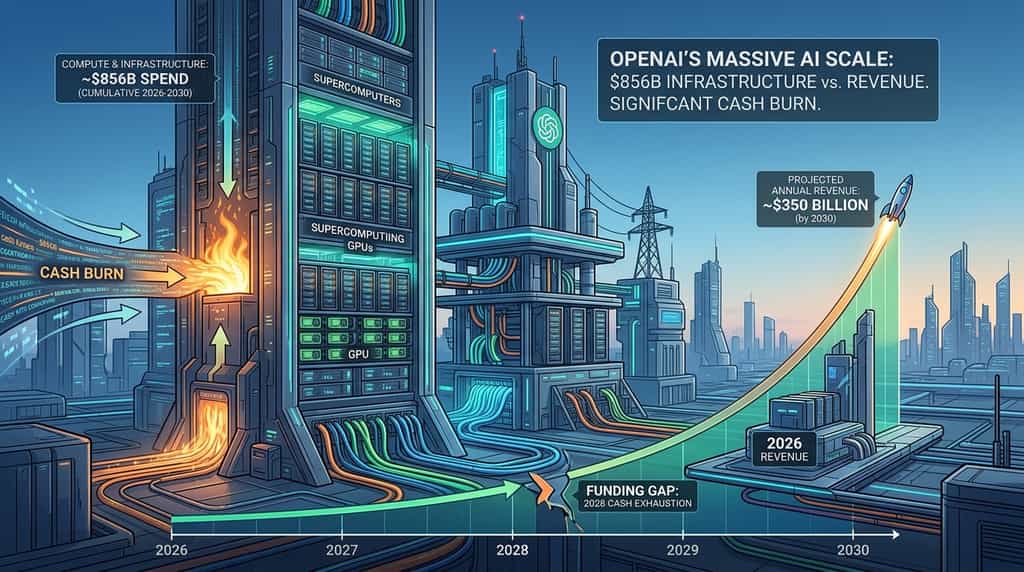
Can a company project $350 billion in 2030 revenue and still plan to consume $278 billion in cash over the same window? OpenAI’s internal forecast says yes. According to an OpenAI presentation summarized by Reuters on September 18, 2026, the company expects negative free cash flow of $278 billion from 2026 through 2030, while computing power and infrastructure spending is projected at about $856 billion. Revenue is forecast to rise from $36 billion in 2026 to $350 billion in 2030, with cumulative revenue near $840 billion.
Those figures define the next phase of the AI arms race: scale is no longer only about model quality. It is about who can fund chips, power, and data centers at a multi-hundred-billion-dollar pace.
What Do OpenAI’s 2030 Cash Burn Figures Actually Mean?
OpenAI’s $278 billion cash-burn forecast means planned cash outflows will exceed cash generated by operations by that amount between 2026 and 2030. Negative free cash flow is not the same as an accounting loss. It is the cash left after operating needs and capital investment. In this case, capital investment is the story.
Reuters reported on September 18, 2026 that the forecast comes from a company presentation. The same materials project computing and infrastructure as the largest expense line at roughly $856 billion through 2030. Cumulative revenue over the period is estimated at about $840 billion. Compute spend therefore sits near the same order of magnitude as the entire revenue stack.
The forecast improved from an earlier internal view. In May 2026, the five-year negative free cash flow figure was about $305 billion. The later $278 billion number is still deeply negative, but it is $27 billion narrower. That change matters because it suggests product launches and usage growth are moving the model, not that spending has stopped.
OpenAI raised $122 billion in March 2026 at an $852 billion valuation, according to the same Reuters summary of the presentation. The materials indicate that cash could be exhausted around 2028 if spending follows the planned path. A 2028 cash trough, two years before the 2030 revenue peak of $350 billion, is the core funding problem.
Why Are OpenAI Compute Costs Projected at $856 Billion?
Compute costs dominate because training and serving frontier models require continuous access to high-end accelerators, power, cooling, and data-center capacity. The $856 billion figure is OpenAI’s own projected spend on computing power and infrastructure through 2030, according to the September 18, 2026 Reuters report on the internal presentation.
That number is larger than earlier 2026 planning ranges discussed around mid-year cloud and infrastructure targets. The direction of travel is consistent: each model generation raises both training cost and inference cost. Inference scales with users. Training scales with model size, data, and experiment volume. Both run on scarce chips and scarce megawatts.
OpenAI has separately stated a long-range compute capacity goal of 30 gigawatts by 2030, according to an official OpenAI Newsroom update. Capacity measured in gigawatts is a power constraint as much as a chip constraint. Data centers cannot absorb $856 billion of compute without multi-year power contracts, substations, land, and cooling systems.
The spend is not only cloud rental. It includes owned and partner-built facilities, reserved chip supply, and the networking fabric that moves training jobs and user queries. Once those commitments are signed, cash outflows become relatively sticky. That is why a revenue path to $350 billion in 2030 can coexist with multi-year negative free cash flow.
How Does OpenAI Plan to Grow Revenue to $350 Billion by 2030?
OpenAI’s revenue plan is a roughly tenfold increase from $36 billion in 2026 to $350 billion in 2030, according to the September 18, 2026 Reuters account of the company presentation. Cumulative revenue across those years is projected near $840 billion.
That path depends on consumer subscriptions, enterprise licenses, API usage, and new product surfaces built on successive model releases. Reports tied to the same forecast cycle noted that a July model release lifted annualized revenue by about 20 percent. Usage growth is the mechanism that is supposed to convert $856 billion of infrastructure into $840 billion of cumulative sales.
The gap between those two totals is the cash problem. Revenue can compound quickly and still lag infrastructure payments if chips and sites must be secured years before the corresponding usage arrives. Price competition also matters. Lower prices can expand volume while delaying the moment when incremental revenue covers incremental inference cost.
The $350 billion 2030 revenue target is a projection, not an audited result. It assumes OpenAI keeps distribution, model quality, and enterprise adoption on a steep curve while rivals such as other frontier labs and lower-cost open-weight systems press on price. The cash-burn number already embeds that race.
What Does the Funding Gap Mean for AI Infrastructure Markets?
The funding gap means OpenAI must keep raising external capital well after its March 2026 $122 billion round. Reuters reported that the presentation shows that capital on track to run out around 2028. Separate market coverage of the same week described early talks that could value a new round above $1.2 trillion, a premium to the March $852 billion mark.
For suppliers, that gap is demand. Chipmakers, cloud providers, data-center developers, power producers, and cooling specialists sit upstream of an $856 billion compute budget. The cash OpenAI does not yet generate must still be spent if the capacity plan holds. That is why infrastructure equities and related digital-asset narratives often move on AI capex headlines even when the model vendor itself remains private.
The risk is the other side of the same ledger. If fundraising slows, if power interconnects slip, or if revenue undershoots the $36 billion-to-$350 billion path, committed capex becomes stranded. Markets then reprice not only one lab but the entire chain of GPU, power, and data-center expectations.
OpenAI’s confidential IPO filing and later comments that a 2026 listing would be ill-advised on safety grounds add another constraint. Private capital must bridge the 2028 cash trough if public markets are not the near-term outlet. That keeps valuation talks and compute contracts tightly linked.
Beyond the Headlines: What KuCoin 5.0 Means for You
Market news moves fast — but where you act on it matters just as much. This October, KuCoin launches KuCoin 5.0, transforming KuCoin into a rebuilt platform. Here's what actually changes for you:
-
One account for everything. Older platforms split your money across separate "spot," "margin," and "futures" accounts and expected you to understand why. KuCoin 5.0's unified account removes that entirely — deposit once, and everything is simply there.
-
Stocks, indices, and commodities. KuCoin 5.0 expands beyond crypto into global markets. When crypto chops sideways and equities rally (or the reverse), you rotate in minutes instead of opening a brokerage account and waiting days for fiat rails.
-
Real-world assets (RWA). Tokenized exposure to traditional assets like commodities, right inside your crypto account. One of the fastest-growing segments in global finance is no longer reserved for institutions — you access it from the same balance you trade with.
-
Earn while you learn. Not ready to trade? KCUSD lets your stablecoins earn daily, auto-compounding interest. The lowest-stress way to put your idle deposit to work for 4% yield.
-
An AI assistant in plain language. Ask questions, get market context, understand what you're looking at — built into the platform, no jargon required.
-
An app that doesn't overwhelm. Faster, cleaner, and consistent — intuitive from the first tap, not after a tutorial.
-
Safety you can check, not just trust. A MiCAR-licensed EU entity, Proof of Reserves you can verify yourself, and internationally certified security (SOC 2 Type II, ISO 27001:2022).
Create your account in minutes — and start on the platform built for where crypto is going, not where it's been.
Conclusion
OpenAI’s September 2026 internal forecast, as summarized by Reuters, puts $278 billion of negative free cash flow against $856 billion of planned compute and infrastructure spend from 2026 through 2030. Revenue is projected to rise from $36 billion to $350 billion, with about $840 billion of cumulative sales. The March 2026 raise of $122 billion at an $852 billion valuation is expected to run short around 2028 if the spend path holds.
Those numbers describe a capital-intensive industry, not a finished business model. Cash burn improved from a May 2026 view near $305 billion, which shows revenue can move the forecast. It does not remove the need for new funding, power, and chips. For markets, the implication is upstream: GPU supply, data centers, and electricity remain the binding constraints.
Crypto traders sit one layer further out. They price narratives around compute, miners with spare megawatts, and AI tokens that move with headlines. The forecast is a planning document, not a guarantee. Position for volatility, verify figures against official updates, and separate infrastructure demand from token speculation.
FAQs
Does OpenAI’s $278 billion figure mean the company will lose $278 billion in accounting profit?
No. The $278 billion figure is projected negative free cash flow from 2026 through 2030, according to the OpenAI presentation summarized by Reuters on September 18, 2026. It measures cash after operations and investment, not a single net-income line.
Is the $856 billion compute number an audited spending commitment?
No. It is OpenAI’s projected spend on computing power and infrastructure through 2030 as described in the same internal presentation. Actual outlays can change with chip prices, power availability, and contract timing.
When could OpenAI run out of the March 2026 capital raise?
The presentation indicates the $122 billion raised in March 2026 at an $852 billion valuation could be exhausted around 2028 if spending follows the planned trajectory, according to Reuters.
Does OpenAI plan to reach $350 billion in annual revenue by 2030?
Yes, that is the internal revenue target cited in the September 18, 2026 Reuters summary, up from $36 billion in 2026, with cumulative revenue near $840 billion through 2030.
Is there an official OpenAI cryptocurrency to buy this thesis?
No. There is no official OpenAI token. Traders who want market exposure typically use AI-themed tokens, large-cap crypto pairs, or other listed instruments on platforms such as KuCoin, which do not confer a claim on OpenAI equity or cash flows.
Disclaimer: This article is for informational purposes only and does not constitute financial, legal, or investment advice. Always conduct your own research before interacting with digital assets.